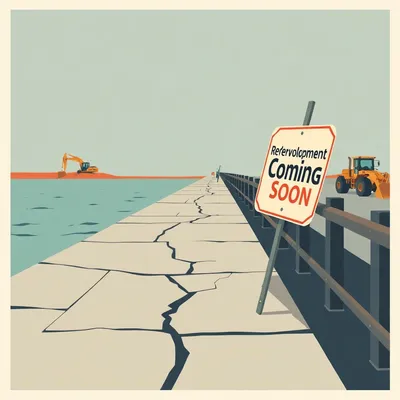
Daniel sent us this one — he's asking about Akko, or Acre, up on Israel's northern coast. He's noticed it's one of those cities that tourists mostly skip, and even Israelis don't seem to go there much. He wants to know what its reputation actually is, how its economy works, what it centers around. And the bigger question — as Tel Aviv and Jerusalem keep pushing past the bounds of affordability, do places like Akko start playing a real role in housing the population, or do they stay these relatively obscure pockets of the country? There's a lot to unpack here.

There really is. And I should say upfront — I've been to Akko probably a dozen times over the years, and every single time I walk away thinking I still haven't quite figured it out. It's one of the most layered places in the country, literally and figuratively.
For one thing, you've got Crusader halls sitting directly underneath Ottoman streets sitting underneath modern apartment blocks. The whole Old City is built on top of itself in a way that makes Jerusalem look straightforward. But beyond the archaeology, the social fabric is just as stratified. You've got a mixed city — Jewish and Arab, roughly sixty-five percent Jewish, thirty percent Arab — with deep historical communities that don't always interact much, an old port that hasn't been a real commercial port in decades, a tourism sector that punches way below its weight, and this kind of stubborn local identity that resists easy categorization.
It's not just overlooked — it's actively complicated.
The reputation question Daniel's asking about? That's almost the most interesting part. If you ask the average Israeli about Akko, you'll get one of maybe three responses. Either "oh, the hummus is incredible" — which, by the way, is absolutely true — or "it's a bit rough around the edges," or honestly, a blank look. It's the kind of city people drive past on their way to somewhere else.
The hummus response is basically Israel's version of damning with faint praise. When a city's entire reputation reduces to a chickpea, you know something's off.
It's not even that the hummus reputation is wrong. Said hummus in the Old City market is genuinely world-class. But a city can't live on hummus tourism alone.
Although several have tried.
But here's what makes Akko different — Akko has the historical substance to be a major destination. I'm talking about a city that's been continuously inhabited for about four thousand years. It's mentioned in Egyptian execration texts from the nineteenth century BCE. It was a Phoenician port, then conquered by Alexander the Great. The Crusaders made it their main port in the Holy Land — it was the last Crusader stronghold to fall, in 1291. Napoleon tried to take it in 1799 and failed. The British used its fortress as a prison and executed Jewish underground fighters there.
Yet the average tourist itinerary is Tel Aviv, Jerusalem, Masada, Dead Sea, maybe a quick stop in Haifa. Akko doesn't even make the list of afterthoughts.
I've been trying to understand why. Part of it is practical — until relatively recently, the train connection wasn't great, though that's changed dramatically. The coastal railway line was upgraded, and now you can get from Tel Aviv to Akko in about an hour and a half. There's a station right in the city. That's a huge infrastructure improvement that should have opened things up. But the tourism numbers still don't reflect what the city actually offers.
Give me numbers.
The Old City of Akko was designated a UNESCO World Heritage Site in 2001. You'd expect that to drive a sustained tourism boom, and it did increase visitation for a while. But we're still talking about numbers that are a fraction of what Jerusalem sees. Jerusalem gets something like three to four million tourists a year. Akko gets maybe a few hundred thousand visitors annually, and many of those are day-trippers who spend a few hours in the Old City market, eat hummus, maybe see the Crusader halls, and leave by mid-afternoon.
Day-trippers don't build an economy. They buy lunch and a fridge magnet and they're gone.
That's exactly the problem. The economic impact of a day-tripper is maybe fifty to a hundred shekels. An overnight visitor spends on accommodation, dinner, breakfast, multiple attractions, shopping — it's a completely different multiplier. And Akko has struggled to convert day visitors into overnight stays. The hotel infrastructure has improved — there are some excellent boutique hotels now, like the Efendi Hotel, which is stunning — but the broader hospitality ecosystem is still thin.
What does the economy actually center around, if not tourism?
This is where the picture gets complicated. Historically, Akko was a major port — one of the most important in the eastern Mediterranean. That declined significantly over the twentieth century as Haifa's port modernized and Ashdod's was built. Today, Akko's port is mostly fishing boats and a marina. The fishing industry is still present but it's small-scale. There's some light industry on the outskirts — steel processing, food production — but it's not a major employment center.
People are commuting out?
A lot of them are. Akko is effectively becoming a satellite of Haifa's metropolitan area. Haifa is maybe twenty, twenty-five minutes away by car or train. The Haifa bay area has the port, the refineries, the Technion, the Rambam medical center, the high-tech parks. So a significant portion of Akko's working population commutes into the Haifa area for employment. Within Akko itself, the local economy is a mix of small commerce, public sector jobs, tourism-adjacent services, and a fairly substantial informal economy in parts of the Old City.
When you say informal economy, you're being polite about something.
I'm being descriptive. The Old City market has a lot of small vendors, some of whom operate in a gray area — cash businesses, unlicensed stalls, that sort of thing. It's not unique to Akko, but it's part of the economic reality. And there are socioeconomic challenges that are hard to ignore. Parts of Akko, particularly some neighborhoods in the Old City and the eastern sections, have poverty rates significantly above the national average. The municipality has limited resources. Infrastructure in some areas is aging.
You've got a city with UNESCO heritage status, some of the most significant Crusader-era architecture in the world, a stunning coastal location, and it's economically struggling with people commuting out to Haifa for work. That's a disconnect that needs explaining.
I think there are a few things going on. One is the perception issue. Akko has a reputation — and I want to be careful how I phrase this — for being somewhat neglected, somewhat tense, somewhat complicated. The mixed-city dynamic is real. Akko has seen periods of intercommunal tension. There were significant clashes in 2008 during the Yom Kippur period, and again in 2021 during the broader unrest that affected mixed cities across Israel. Those episodes leave a mark on how Israelis think about the place.
Even if the day-to-day reality for most residents is peaceful coexistence.
Which it largely is, by the way. Plenty of Jews and Arabs in Akko live as neighbors, shop in the same markets, send their kids to the same public spaces. The Old City market on a busy Friday is a mixed space — you'll see everyone there. But the headline events shape perceptions disproportionately.
That's the nature of perception. Nobody writes a headline that says "Akko Remains Uneventful for Seventeenth Consecutive Month.
There's another layer to the perception problem, which is that Akko is often framed — consciously or not — as a place that's seen better days. There's this narrative of decline. The glory days of the port are gone, the British Mandate period when it was a regional administrative center is long past, and what's left is a city that feels, in some parts, like it's been waiting for something that hasn't arrived.
That's a brutal framing. The city as a waiting room.
It's not entirely fair, but it's how a lot of people experience it. You walk through certain streets in the Old City and you see these incredible Ottoman-era buildings with gorgeous stonework and arched windows, and half of them are either vacant or in serious disrepair. There's this tension between the visible history and the visible neglect that's hard to reconcile.
The question Daniel's really getting at — the housing question — sits inside all of this. If Akko is underpopulated relative to its potential, and the center of the country is bursting at the seams, why isn't there a natural gravitational pull?
Let's talk about the housing market, because this is where things get interesting. Akko is, by Israeli standards, affordable. We're talking about prices that are maybe a third to half of what you'd pay for comparable space in central Tel Aviv. You can still find apartments in Akko for under a million shekels. In Tel Aviv, a million shekels gets you a parking spot and a handshake.
Or a very nice cardboard box with partial sea views.
The sea views in Akko are actually better, honestly. The coastline there is beautiful — the Old City walls drop right into the Mediterranean. So on paper, you'd think Akko would be absorbing some of the overflow from the central region. And to some extent, it is. The population has been growing — Akko's at about fifty thousand residents now, give or take, and there's been new construction. But it's not experiencing the kind of boom you might expect given the price differential.
What's holding it back?
A few structural factors. If you're a young family looking to leave Tel Aviv because you can't afford it, you need to know you can find work. And the Haifa job market is solid, but it's not Tel Aviv. The high-tech jobs, the startup ecosystem, the professional services — those are concentrated in the center. Haifa has some of that, particularly around the Technion and the science parks, but the scale is different. So you're asking people to trade not just location but career ecosystem.
The commute from Akko to Tel Aviv, even with the improved train, is not something you'd want to do daily.
It's about an hour and a half each way. That's three hours a day. People do it, but it's not a lifestyle anyone chooses voluntarily. It's a survival strategy.
Akko is caught in this loop — it can't attract the employment base without the population, and it can't attract the population without the employment base.
That's the classic regional development trap. And it's not unique to Akko — you see versions of this in peripheral cities all over Israel. But Akko has assets that most peripheral cities don't. The historical core, the coastal location, the proximity to Haifa, the UNESCO designation. The question is whether those assets can be converted into economic momentum.
What would that conversion actually look like?
There are a few models. One is the niche tourism play — go hard on becoming a genuine overnight destination. Not mass tourism, but cultural tourism. Akko has the raw material. The Crusader halls are jaw-dropping — the Knights' Halls complex is one of the most impressive medieval spaces I've ever been in. The Templar Tunnel, the Ottoman bathhouse, the Bahai gardens just outside the city, the old port, the market. If you package that right and build out the hospitality infrastructure, you could see a significant uptick.
Cultural tourism alone doesn't employ fifty thousand people.
No, it doesn't. And that's where the second model comes in — positioning Akko as a residential satellite of Haifa with its own distinct identity. Not just a dormitory suburb, but a place people actively choose because it offers something Haifa doesn't. The Old City lifestyle, the coastal access, the lower cost of living, the historical texture. That requires investment in quality of life — schools, parks, public spaces, cultural institutions — so that it's not just "cheaper than Haifa" but attractive on its own terms.
The third model?
The third model is the one that's politically complicated but probably necessary — some form of targeted economic development, either government incentives to attract employers, or integration into the broader Haifa bay economic zone in a more deliberate way. There have been various government programs over the years aimed at developing the Galilee and the north, and Akko has been included in some of those, but the results have been mixed.
Government programs in Israel have a way of being announced with great fanfare and then quietly underdelivering.
I was trying to find a diplomatic way to say that, but yes. And Akko has the added complication of being a mixed city, which means any development initiative has to navigate communal politics. You can't just drop a tech park on the outskirts and call it a day — you have to think about who benefits, who's included, how the different communities participate.
That's the thing about mixed cities in Israel — they're not just demographically diverse, they're politically intricate in ways that make every decision harder.
Akko is one of the more intricate ones. It's not like Haifa, where the mixed character is well-established and there's a long tradition of coexistence that, while imperfect, is fairly stable. Akko's Jewish and Arab communities are more spatially separated in some respects, and the economic disparities between them are sharper. The Old City is predominantly Arab, while the newer neighborhoods tend to be more Jewish. That spatial division maps onto economic divides in ways that complicate everything from municipal budgeting to school placement to infrastructure investment.
When Daniel asks whether Akko can play a role in housing Israel's growing population, part of the answer is that it can — but the housing question can't be separated from the employment question, the infrastructure question, and the social-cohesion question. It's all one knot.
The knot has historical roots that go deep. After 1948, Akko absorbed a large number of Jewish immigrants, many from North Africa, who were settled in neighborhoods built quickly and sometimes poorly. Some of those neighborhoods still have substandard housing stock and infrastructure that hasn't been adequately upgraded. Meanwhile, the Old City, which was predominantly Arab after 1948, suffered from decades of underinvestment in basic services. So you have multiple communities with legitimate grievances about neglect, and those grievances don't always align in ways that make coalition-building easy.
It's almost like a city needs a functional municipal government with resources and a coherent plan. Radical thought, I know.
Akko's municipality has had its struggles. There have been financial issues, political turnover, challenges with governance. It's not a uniquely Akko problem — plenty of Israeli municipalities are under-resourced and over-politicized — but in a city with Akko's level of complexity, the consequences are more visible.
Let me pull on a thread you mentioned earlier. You said the Old City has these incredible Ottoman buildings that are half-vacant or falling apart. Why hasn't preservation and restoration been a bigger priority?
Restoring a centuries-old stone building to modern standards is enormously expensive. You're dealing with historical preservation requirements, which limit what you can do, plus the engineering challenges of old structures, plus the fact that many of these buildings have unclear ownership or multiple heirs who can't agree on anything. There are properties in the Old City that have been tied up in inheritance disputes for decades.
The Mediterranean version of a classic problem — fractured ownership leading to decay.
The municipality doesn't have the budget to acquire and restore these properties at scale. There have been some successful restoration projects — the Efendi Hotel I mentioned is a beautiful example of what's possible when private capital meets historical preservation — but those are point solutions, not a systematic approach.
You get these islands of restoration in a sea of slow decline.
That's a bit harsh but not entirely wrong. The Crusader and Ottoman heritage sites managed by the state or by the Old Acre Development Company are generally well-maintained. The problem is the residential and commercial fabric around them. You walk from the beautifully lit Knights' Halls into a side street where the buildings are crumbling and there's garbage in the alley, and the contrast is jarring.
Which probably reinforces the day-tripper dynamic. Tourists see the managed sites, then wander a bit, get a sense of neglect, and head back to their hotels in Haifa or Tel Aviv.
That's exactly what happens. And it's a shame, because the Old City at night — when the day-trippers are gone and the streets are quiet and the stone glows under the lamps — is magical. The sea crashes against the walls, the alleyways echo, and you feel the weight of all that history. But most visitors never experience that.
You're getting poetic about urban planning. It's endearing.
I contain multitudes. But seriously, this is the kind of thing that matters for the city's economic future. If Akko could capture even a fraction of the overnight tourism that currently goes to places like Nazareth or Tiberias or even Haifa, it would transform the local economy. We're not talking about becoming the next Barcelona — just capturing a reasonable share of the northern Israel tourism market.
What's the current share?
I don't have an exact figure, but anecdotally, when tour groups do northern Israel itineraries, Akko is often a two-hour stop rather than an overnight. The overnight destinations in the north tend to be the Galilee kibbutz hotels, the Sea of Galilee area, sometimes Haifa or Nazareth. Akko is treated as a waypoint.
Which is wild when you think about what's actually there. Napoleon failed to take the city in 1799 — his first major defeat in the Middle Eastern campaign. The city's walls withstood a siege by one of the greatest military minds in history. That's a story you can sell.
It gets better. The defense was led by Ahmed al-Jazzar, the Ottoman governor — known as "the Butcher" for his, let's say, robust approach to governance — with significant help from the British Royal Navy under Sir Sidney Smith. So you have this bizarre moment where the British and the Ottomans are allied against Napoleonic France, fighting it out on the walls of a city in the Holy Land. It's an incredible story.
"The Butcher" is a branding challenge.
It's not ideal. But the point is, the historical narrative is rich and largely untapped. And that's before you even get to the Crusader period. The Siege of Acre in 1191 during the Third Crusade — Richard the Lionheart versus Saladin — was one of the most significant military engagements of the medieval period. The Templars had their last stand there in 1291, and the fall of Acre effectively ended the Crusader presence in the Holy Land.
Akko is where the Crusades went to die. That's a tagline right there.
And the physical evidence of that history is still there, under the ground, remarkably well-preserved. The Crusader city was buried for centuries under Ottoman construction and only rediscovered in a major way during the British Mandate period, when prisoners were put to work excavating. The Knights' Halls complex is one of the best-preserved Crusader sites anywhere. It's not a reconstruction — it's the actual halls.
Yet, somehow, this doesn't translate into a tourism identity that sticks.
I think part of the problem is that Israel's tourism branding has historically been dominated by Jerusalem and the biblical narrative. The Crusader period doesn't fit neatly into that. It's Christian history, but it's not biblical history. It's medieval European history that happens to be located in the Middle East. So it falls between the cracks of the standard tourism narratives.
The branding is caught between "Holy Land pilgrimage" and "Mediterranean beach vacation," and Akko doesn't fully deliver either.
It's not a beach destination in the way Herzliya or Netanya are — the beaches near Akko are fine but not spectacular. And it's not a pilgrimage destination in the way Jerusalem or Nazareth are. It's a historical destination, and historical tourism is a narrower market.
Unless you do it really well. People go to Rome for the history. They go to Athens for the history.
Those cities have built entire economic ecosystems around historical tourism. But they've also been doing it for centuries. Akko is still figuring out how to package and sell its history in a way that generates sustained economic returns.
Let's shift to the housing question more directly, because that's where Daniel's prompt ends up. If Akko is going to play a role in housing Israel's population as the center becomes unaffordable, what needs to change?
The most immediate thing is transportation. The train to Tel Aviv is good but not great — frequency could be higher, travel time could be shorter. There have been discussions about upgrading the coastal line further to bring Akko within an hour of Tel Aviv, which would be a game-changer. At an hour commute, you start to be a realistic option for people who work in the center but can't afford to live there.
An hour commute is still not pleasant, but it's survivable.
It's already normal for a lot of people in the Tel Aviv metro area who are stuck in traffic. The difference is that on a train, you can work or read or sleep. So improving rail connectivity is probably the single highest-impact infrastructure investment for Akko's future as a residential city.
If you want families to move to a city, you need good schools. Akko's school system has some strong points but also faces challenges — lower-than-average test scores in some sectors, resource constraints, the complexities of running a mixed system with separate Jewish and Arab school streams. Investing in education quality would signal that the city is serious about attracting and retaining families.
Employment within the city itself, not just commuting to Haifa.
That's the harder piece. You can't just will employers into existence. But there are targeted things that could work — expanding the light industrial zones, offering incentives for businesses to relocate, developing co-working spaces that could attract remote workers who want a lower cost of living but still need professional infrastructure. The remote work revolution has been kind to places like Akko in theory, because suddenly you don't need to be in a Herzliya office park to do knowledge work. But you need the broadband, the workspace options, the coffee shops, the professional community.
The ecosystem of professional life doesn't just appear because the rent is cheap.
That's where deliberate municipal strategy comes in. There are cities around the world that have successfully repositioned themselves as attractive alternatives to expensive urban cores — places like Porto in Portugal, or certain cities in the American Midwest that have reinvented themselves around quality of life rather than industrial employment. Akko has the bones for that kind of reinvention. But bones aren't enough.
You need muscle and a nervous system.
That's maybe the scarcest resource of all in this equation. The national government has a role to play — Akko can't do this on a municipal budget alone — but national attention tends to be focused elsewhere. The periphery gets rhetorical support and occasional bursts of funding, but sustained, strategic investment is harder to come by.
Is there a version of this story where Akko remains exactly as it is — a small, somewhat overlooked coastal city with a stunning historical core and a complicated present — and that's actually fine? Not every place needs to be transformed.
That's a fair question. Not every city needs to grow. Not every city needs to be "developed" in the conventional sense. There's an argument that Akko's charm is precisely in its unpolished, uncommercialized character — that if you turned it into a polished tourism destination or a booming commuter suburb, you'd lose something essential.
The preservation-through-neglect argument.
Which has some truth to it. The Old City of Akko feels authentic in a way that heavily restored historical districts often don't. It's lived-in. It's messy. It's real. That's valuable.
The people who live there might reasonably want better housing, better jobs, better services.
That's the tension. The aesthetic appeal of "authenticity" to an outsider is often just "underinvestment" to a resident. Nobody wants to live in a museum, especially if the museum has leaky plumbing and intermittent electricity. The goal shouldn't be to freeze Akko in amber — it should be to improve quality of life for the people who actually live there while preserving what makes the place distinctive.
The question becomes: can you do both? Can you invest in infrastructure, attract economic activity, improve housing stock, and still maintain the character that makes Akko Akko?
I think you can, but it requires a level of care and intentionality that top-down development usually lacks. It means working with the existing fabric rather than imposing a master plan from outside. It means preserving the scale of the Old City rather than building towers that overwhelm it. It means supporting the existing market culture rather than replacing it with generic retail. It means investing in the public realm — the streets, the squares, the waterfront — in ways that benefit residents first and tourists second.
The waterfront is an interesting case. You mentioned the port isn't a real commercial port anymore. What's happening with that space?
The old port area has been partially redeveloped — there's a marina, some restaurants, the usual waterfront amenities. But it hasn't been transformed in the way that, say, the Tel Aviv port was turned into a commercial and entertainment district. It's more low-key. There's a fishing harbor that's still active, which gives it a working-waterfront feel that's actually quite appealing. You can buy fish straight off the boats in the morning.
Which is the kind of thing urbanists get excited about and residents might just think of as, you know, the place where you buy fish.
But these are the kinds of assets that, if you're thinking about Akko's future, give it a distinctive identity. A working fishing harbor next to a Crusader fortress next to an Ottoman market next to modern residential neighborhoods — that's not a combination you find in many places. It's a city that doesn't fit a single category.
Which is probably why it's been hard to market. Marketing likes categories. "The city of X." "The capital of Y." Akko doesn't reduce to a slogan.
"Akko: It's Complicated." There's your tourism campaign.
I'd visit.
Honestly, that might actually work better than whatever the current campaign is. Authenticity sells, and Akko has authenticity in abundance. The problem is that authenticity without basic services and economic opportunity is just poverty with good architecture.
That's a Herman Poppleberry original line right there.
I stand by it. And I think the future Daniel is asking about really hinges on whether Israel can figure out a model for developing its mixed peripheral cities that isn't just about dropping infrastructure and hoping for the best. Akko is a test case for something bigger — how do you take a place with extraordinary historical and cultural assets, a complex demographic reality, and genuine economic challenges, and help it become a viable, thriving city without erasing what makes it interesting?
The clock is ticking, because the housing pressure from the center isn't going away. Tel Aviv and Jerusalem aren't getting cheaper. The population is growing. People are going to look north, whether Akko is ready for them or not.
The question is whether they look north to Akko specifically, or whether they look to places like Nahariya, or the Krayot suburbs of Haifa, or the new developments going up in the Galilee. Akko has competition for the role of "affordable northern alternative." And right now, it's not clear that Akko is winning that competition.
What would tip the balance?
If I were advising the municipality — which I'm not, and they haven't asked — I'd focus on three things. One, make it as easy as possible for developers to build new housing stock while preserving the Old City's character. That means streamlining permitting, investing in infrastructure for new neighborhoods, and being clear about what kind of development is welcome. Two, invest aggressively in the public realm — clean streets, well-maintained parks, good lighting, safe public spaces. Those things matter enormously to families deciding where to live. And three, pick one or two economic niches and go deep on them. Maybe it's cultural tourism plus remote-work infrastructure. Maybe it's food and hospitality plus light manufacturing. But pick something and execute, rather than trying to be everything.
Focus is underrated in municipal strategy.
Cities try to be all things to all people and end up being nothing in particular. Akko's advantage is that it's already something in particular — it's a four-thousand-year-old port city with Crusader halls and Ottoman markets and incredible food and a mixed population and a stunning coastline. That's not nothing. That's a lot. It just needs to be shaped into a coherent proposition.
Someone needs to actually do the shaping.
Which is always the hard part. Plans are cheap. Execution is expensive and politically difficult and takes longer than anyone wants. But the alternative is just drift, and drift is what Akko has been doing for decades.
Drift with really good hummus, though.
The hummus is transcendent. I want to be clear about that.
Alright, let's land this. Daniel asked about Akko's reputation, its economy, and its role in Israel's housing future. The reputation is complicated — historical gem, mixed city with tensions, somewhat neglected, incredible food, overlooked by tourists. The economy is a mix of light industry, fishing, some tourism, and a lot of commuting to Haifa. The housing potential is real but unrealized — it's affordable, it's on the train line, it has coastal access, but it lacks the employment base and the quality-of-life infrastructure to pull people in at scale.
That's a good summary. I'd add that the historical and cultural assets are world-class, and the underinvestment in leveraging them is one of the more puzzling failures of Israeli tourism and regional development policy. This is a city that should be on every serious traveler's itinerary, and it's not. Fixing that alone would transform the local economy.
The bigger question — whether places like Akko remain obscure pockets or become part of the solution to Israel's housing crunch — that's still an open question. The ingredients are there. The recipe hasn't been written yet.
Or it's been written but nobody's cooking. Either way, it's a city worth watching. If you haven't been, go. Walk the walls at sunset. Eat the hummus. See the Crusader halls. It's worth your time.
That's a solid recommendation. And now: Hilbert's daily fun fact.
Now: Hilbert's daily fun fact.

In the 1780s, on the island of Bioko in what is now Equatorial Guinea, European naturalists documented a venomous snake that deliberately misses its first defensive strike, apparently using the miss as a warning before committing to an envenomation — a behavioural anomaly that still puzzles herpetologists.
The snake fires a warning shot.
A venomous snake with a de-escalation policy. There's a lesson in there somewhere.
This has been My Weird Prompts with me, Herman Poppleberry, and my brother Corn. Produced by the inestimable Hilbert Flumingtop. You can find every episode at myweirdprompts dot com, or wherever you get your podcasts. If you enjoyed this, leave us a review — it helps. We'll be back next week.