Daniel sent us this one, and it's a rich one. He's been driving through Ashdod with Hannah, a city of over two hundred thousand people, and he says it feels like a nondescript mash of nothingness. The buildings are tall, the density is there on paper, but the soul isn't. He compares it to Modi'in, same feeling, and then asks what makes small towns like Clonakilty in Ireland feel so much more alive despite having a fraction of the population. His real question is: what creates that mesmerizing, peaceful experience in places like Greek villages or Spanish hill towns, and why does Ashdod fail so completely at it?

This is the exact question I love. Because the numbers do say Ashdod should work. Two hundred twenty-five thousand people, a deepwater port, a coastline, a history stretching back to the Philistines. On a spreadsheet it's a major city. On the ground it's a parking lot with tall buildings in it.
A parking lot with tall buildings is my new band name.
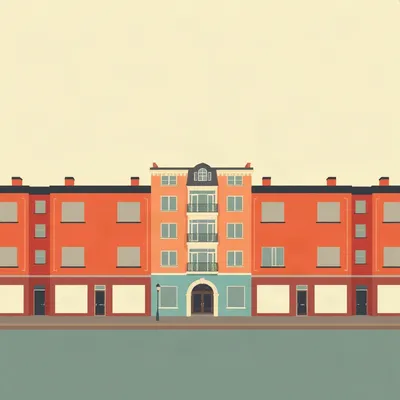
Here's the thing. When Daniel talks about that feeling of emptiness, he's not being poetic. There's a specific planning pathology at work. Ashdod was founded in nineteen fifty-six as one of Israel's development towns, designed from scratch on a sand dune using nineteen-fifties modernist planning principles. Everything was zoned in isolation. Residential here, commercial there, industrial over there. The assumption was that cars would connect everything.
The emptiness was designed in from day one.
It's not just Ashdod. Israel built roughly thirty development towns between the nineteen-fifties and seventies, and most share this DNA. They were built fast to absorb immigrants. The goal was housing units per year, not urban quality. Arieh Sharon, the architect who designed Israel's first national master plan, was a Bauhaus-trained modernist. He applied those principles to an entire country: separate functions, tower blocks in open space, wide roads.
The Bauhaus-to-beige pipeline.
It works terribly in a hot climate. Those wide open spaces between towers create what planners now call the "no-man's-land effect." They're not parks, they're not plazas, they're just leftover space. Too big to feel intimate, too barren to feel welcoming, and in August they're blast furnaces.
When Daniel says you can't import European planning to a hot Middle Eastern environment, he's partly right, but for the wrong reason. The problem isn't that European planning doesn't work in the heat. It's that Israel imported the wrong European planning.
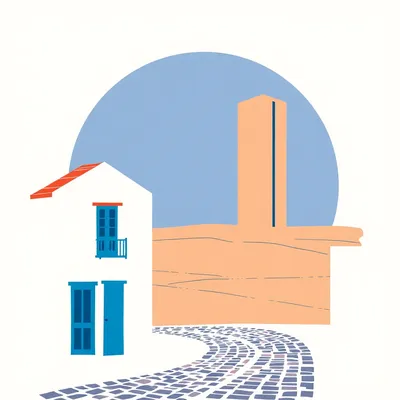
Israel imported northern European modernism. Le Corbusier, the radiant city, towers in parks. But the places Daniel is comparing Ashdod to—Greek villages, Spanish hill towns—those weren't planned by modernists. They grew organically over centuries. Narrow streets that create shade, small plazas that feel like outdoor rooms, buildings that meet the street directly. Those aren't European imports. They're vernacular responses to a Mediterranean climate.
Which Greece and Spain share.
The Greek islands have the same sun, the same heat, the same need for shade and breeze. Their villages solved it with tight street networks, whitewashed walls that reflect heat, courtyards that trap cool air at night. That's not "European planning" as some alien import. That's Mediterranean common sense. Israel had that too—the old neighborhoods of Jaffa, the alleyways of Jerusalem's Old City, the stone villages of the Galilee. All the knowledge was there.
Modernism declared all of that obsolete. Arieh Sharon and his generation saw those narrow streets as backward, unsanitary, unfit for a modern state. They wanted to leapfrog directly into the twentieth century. They just leaped right over everything that made Mediterranean cities livable.
It's like throwing out your air conditioner because the future is heat lamps.
Then being confused about why everyone's uncomfortable. But let me give you a more specific mechanism. There's a researcher named Jan Gehl who's done incredible work on what makes public spaces feel alive. He talks about the "edge effect." People naturally gravitate toward edges—the edge of a square, the edge of a building, the transition zone between public and private. In a traditional Mediterranean town, every building creates edges. Doorways, steps, small balconies, shop fronts that spill onto the street. The street itself is an outdoor room defined by walls on both sides.
Whereas in Ashdod, the building is in the middle of a sea of nothing.
The tower sits in an undefined expanse. There's no street wall, no edge, no transition. You step out of your lobby into... And open ground doesn't invite lingering. It invites walking across it quickly to get to somewhere else.
The entire city is designed as a place you're supposed to leave.
That's the tragedy. Every element of the design says "this is not a destination." Wide arterial roads say "drive through." Setback buildings say "don't get close." Lack of street-level retail says "nothing to see here." The public realm is a corridor, not a place.
That's the difference with Clonakilty. Daniel mentioned it, small town in West Cork, maybe five thousand people. The streets are narrow, buildings are different heights and colors, pushed right up to the pavement. A pub next to a bakery next to a bookshop. Every twenty meters there's something new to look at.
That's measurable. Gehl's team counts what they call "soft edges"—the number of doorways, windows, shopfronts, and transitions per hundred meters of street frontage. A lively street in Copenhagen might have fifteen to twenty soft edges per hundred meters. A typical Ashdod residential block might have one. The lobby door. Everything else is blank wall or parking entrance.
One soft edge per hundred meters. That's not a city, that's a warehouse district.
The human brain processes this constantly. Our walking pace, our eye movements, our sense of safety and interest, all respond to the complexity of the facade. Researchers call it "visual complexity" or "information richness." A traditional street gives you constant small variations—materials, colors, shadows, signs, plants, people. A modernist tower block gives you the same window frame repeated four hundred times.
The brain checks out. It's the architectural equivalent of a screensaver.
That checking out is exactly what Daniel is feeling. It's not that Ashdod is ugly, though parts of it certainly are. It's that it's information-poor. Your senses have nothing to do. You can drive for ten minutes and nothing has changed except the number on the building.
Which brings us to Modi'in. Same problem, but the version they built in the nineties and two thousands.
Modi'in is fascinating because it was supposed to be different. It was planned in the nineteen-nineties as a new city halfway between Jerusalem and Tel Aviv. The master plan was by Moshe Safdie, a genuinely thoughtful architect who designed Habitat sixty-seven in Montreal. He knows about human-scale urbanism. But somewhere between his vision and the execution, it became exactly what Daniel describes. Cookie-cutter suburbs. The same handful of building types repeated endlessly.
First, the planning system. Israel still operates on a very rigid zoning code. Residential zones are residential. You can't have a corner shop in a residential neighborhood even if it would create a natural gathering point. Second, the construction industry is dominated by a handful of large contractors who optimize for speed and cost. They have catalogues of approved building types. You pick from the catalogue. Variations cost money.
Build me a city nobody notices they're living in.
That's the brief, and they nailed it. Third, the financing. Most new apartments in Israel are sold off-plan, before construction starts. The buyer is an investor, not a future resident. They care about square meters and projected value, not whether the street will be pleasant to walk down. The developer optimizes for the buyer, and the buyer isn't there for the street life.
The entire incentive structure is aligned against charm.
And there's a fourth factor specific to Israel: the security dimension. For decades, the planning assumption was that residential buildings should face inward, toward protected interior spaces, not outward toward the street. The street was a security vulnerability. That thinking has shaped everything from window placement to the lack of ground-floor retail.
That's a point I don't hear enough. The architecture of security is inherently anti-urban. Urbanism requires openness, permeability, eyes on the street. Security wants controlled access, defensible perimeters, inward focus.
Those two impulses are in direct tension. Some cities manage it—Jerusalem's newer neighborhoods have found ways to have street life and security. But in the development towns, the balance tipped entirely toward the fortress mentality. The result is buildings that don't engage with the public realm at all.
Let's go back to the Greek comparison. Daniel says you can't dismiss this as just a climate question because Greece and Spain are sunny and they figured it out. What did they figure out that Israel didn't?
The short answer is continuity. Greek island villages weren't master-planned by a central authority. They grew incrementally, over centuries, with each generation adding and adapting. The result is a built environment tested against the climate, against social needs, against economic realities, thousands of times. Every detail that survived earned its place.
Evolution versus intelligent design, and evolution won.
It almost always does in complex systems. But let me get specific. A typical Cycladic village has streets two to three meters wide—just wide enough for a donkey historically, now just wide enough for a small delivery vehicle but not a car. The buildings are two to three stories, whitewashed, with flat roofs. The white reflects heat. The narrow streets create continuous shade for most of the day. The street pattern is slightly irregular, which creates small wind vortices that cool the air.
None of this was in the building code. It was just what worked.
There was no code that said "streets shall be two point five meters wide to optimize shade." People built what worked, copied what their neighbors built, and over time the entire village became a finely tuned climate machine. The Spanish hill towns do something similar with different materials. In Andalusia, you get narrow streets, white walls, but also interior courtyards with fountains. The courtyard creates a microclimate—evaporative cooling from the fountain, shade from the surrounding walls, and at night the heat radiates out into the clear sky.
The courtyard is essentially a natural air conditioner. Zero energy, zero moving parts, working for a thousand years. And this is what drives me crazy about the Israeli planning conversation. The knowledge is sitting right there, across the Mediterranean. The climate is similar. The materials are available. But instead we got tower blocks with air conditioning units bolted to every wall.
The air conditioner is the crutch that enables bad design. If you know every unit will have mechanical cooling, you don't have to think about orientation, cross-ventilation, thermal mass, or shading. The architect can place the building any direction, use any materials, and the engineer will bolt on enough cooling capacity to make it habitable. The result is a building that's unlivable without electricity.
In a country where summer temperatures hit forty degrees and the grid is under constant strain, that's not just an aesthetic problem. It's a resilience problem.
A massive one. During heat waves, the Israeli electric grid hits peak loads almost entirely driven by air conditioning. If buildings were designed for passive cooling, that load would drop dramatically. The traditional Mediterranean courtyard house uses something like eighty percent less energy for cooling than a comparable modern apartment.
The soullessness Daniel is feeling is the visible symptom of a deeper functional failure. The buildings don't work, so they need mechanical life support, and the life support makes the public space hostile. You're not going to linger in a plaza when every air conditioner is dumping waste heat into it.
That's the cascade. Bad urban form creates bad microclimate, which drives people indoors, which empties the public realm, which makes the place feel dead, which makes people care less about it, which leads to neglect, which makes it even deader. It's a doom loop.
The charming places have the opposite loop. Good urban form creates pleasant microclimate, which draws people outside, which activates the public realm, which makes people love the place, which leads to care and investment, which makes it even better.
It starts with the very first design decisions. Street width, building height, facade treatment, material choice. Those aren't aesthetic decisions. They're functional ones that cascade into social outcomes.
Let's talk about scale. Daniel mentions Ashdod has over two hundred thousand people, and at that size a city should have some kind of culture, some kind of identity. That's the size of Bordeaux, of Aberdeen, of Richmond Virginia. Those places have character.
The reason they do is that they weren't built all at once. Bordeaux grew over two thousand years. Every century left a layer. The Roman grid, the medieval walls, the eighteenth-century boulevards, the modern tram system. The city is a palimpsest. When you walk through Bordeaux, you're walking through time. When you walk through Ashdod, you're walking through nineteen sixty-three.
One set of assumptions.
That's the problem with master-planned cities in general. They freeze a single vision at a single point in time. They can't adapt because the plan is totalizing. Every element was designed in relation to every other element, so you can't change one thing without breaking the logic of the whole.
It's the urban planning equivalent of a Jenga tower made of one solid block. You can't pull a piece out.
Real cities are the opposite. They're messy, layered, full of ad-hoc adaptations. A medieval street gets widened in the eighteenth century. A warehouse becomes apartments. A parking lot becomes a park. The city is constantly editing itself. That editing process is what creates visual interest, what creates the nooks and crannies that people love.
How do you get that in a new city?
You can't get the time, but you can design for adaptation. You can lay out a street grid that allows for infill and change. You can mix uses from day one so residential and commercial evolve together. You can use small block sizes so the city can be redeveloped incrementally rather than in giant chunks. And critically, you can avoid oversized infrastructure that locks in car dependency.
The wide arterial roads. Once they're in, they're never coming out.
They determine everything. The width of the road determines the scale of the buildings, the speed of traffic, the comfort of pedestrians, the viability of retail. A six-lane arterial is an urban wall. It cuts the city into pieces and makes crossing it an ordeal. Ashdod is full of these. They're the skeleton of the city, and the skeleton is hostile to human life.
There's a specific detail I want to pull out. The train station is nowhere near the beach. It's surrounded by parking lots. So even the one piece of infrastructure that should connect people to the waterfront fails to do it.
That's such a perfect encapsulation of the problem. The beach is Ashdod's greatest asset—a Mediterranean coastline, kilometers of sand. And the planning decision was to put the train station inland, separated from the beach by a highway and acres of parking. So if you arrive by train, the beach is still a car ride away. The city took its one irreplaceable natural amenity and designed the transportation system to ignore it.
It's like building a ski resort and putting the lifts at the bottom of the mountain but not connecting them to the slopes.
The beachfront itself tells the same story. Daniel mentioned a couple of overpriced stores by the beach. That's the commercial strip. It's not integrated into the urban fabric. It's a destination you drive to, park at, consume, and leave. There's no neighborhood that naturally spills onto the beach. No streets that terminate at the water with a view corridor. The beach is an edge condition, not a heart.
Compare that to Tel Aviv's beachfront. The city grid runs right up to the sand. Streets end at the promenade. Hotels and apartments face the water. The beach is woven into the daily life of the neighborhoods behind it. You can walk from your apartment to the sand in five minutes without crossing a highway.
That's not an accident. Tel Aviv's original Geddes plan from nineteen twenty-five laid out a street grid that connected the city to the sea. The blocks are small, the streets are relatively narrow, and there are view corridors to the water. It was a planning decision that paid dividends for a century.
Tel Aviv works despite being a planned city because the plan was good.
Because it was allowed to evolve. The Geddes plan was a framework, not a straitjacket. It set the street pattern and the block sizes, but it didn't prescribe every building. Different architects, different decades, different styles filled in the blocks. The result is variety within a coherent structure. That's the sweet spot.
Framework, not straitjacket. That's the phrase.
That's what's missing in Ashdod and Modi'in. The plan was the straitjacket. Every building is a variation on the same theme, and the theme wasn't very good to begin with.
Is this fixable? Can you take an Ashdod and retrofit it into something that feels like a place?
It's hard, but not impossible. Barcelona in the nineteen-eighties took its superblocks and injected public space, narrowed streets, planted trees. It didn't demolish the towers, but it transformed the ground plane. The space between buildings became rooms rather than leftovers.
That's the key. You don't need to tear everything down. You need to fix the space between.
The public realm is where urban life happens. If the public realm is hostile, the city feels hostile no matter how nice the apartments are. But if you can reclaim the ground plane, narrow the roads, add street trees, allow ground-floor uses that activate the street, you can start to create the conditions for urban life even with the tower typology.
Street trees alone make an enormous difference. They create a ceiling over the street, a sense of enclosure. They provide shade, which makes walking tolerable. They slow down traffic visually, which makes drivers go slower even without speed bumps.
There's research on this. Streets with a continuous tree canopy see average vehicle speeds drop by eight to ten kilometers per hour, even without any other traffic calming. The trees create what psychologists call "perceptual narrowing." The driver feels the space is smaller, so they naturally slow down.
The pedestrian feels protected. The tree trunk creates a vertical barrier between them and the cars. It's psychological as much as physical.
It's one of the cheapest interventions you can make. A street tree costs a few hundred shekels to plant and maybe a few hundred a year to maintain. It pays back in shade, air quality, stormwater absorption, property values, pedestrian comfort. It's the highest-return urban investment there is, and Israeli cities chronically underinvest in it.
Because you can't sell a tree off-plan.
You can't sell a tree off-plan. That's the whole problem in one sentence.
Alright, let's zoom out. Daniel's prompt is really about a feeling. The feeling of being let down by a place that should be more than it is. And he's asking what creates the opposite feeling—the mesmerizing, relaxing, peaceful experience of a Greek village or a Spanish hill town. Can we name the ingredients?
Let's do it. Number one, enclosure. The street feels like an outdoor room with defined walls on both sides. The buildings meet the street, and the height-to-width ratio is roughly one-to-one or one-to-two. That creates a sense of shelter.
Number two, shade and climate comfort. The street is designed for the climate. Materials, orientation, vegetation, and proportions all work together to create a microclimate that's pleasant to be in. You're not fighting the environment, you're working with it.
Number three, visual complexity at eye level. The first two floors of every building offer something to look at. A doorway, a window with shutters, a potted plant, a shop display, a bench, a cat. Your eyes are constantly engaged without being overwhelmed.
Number four, the absence of cars or at least their subordination. In a Greek village, the car is a guest, not the master. Streets are narrow enough that cars move slowly and carefully. The pedestrian has priority by default.
Number five, mixed use. People live above shops that sell things people need. There's a bakery, a small grocery, a cafe. Daily life doesn't require a car trip. The street is a destination for multiple reasons at multiple times of day.
Number six, incremental variation. No two buildings are identical. Different heights, different colors, different details. The street has been built over time by different hands, and you can feel that. It's the opposite of a single developer's catalogue.
Number seven, social legibility. The village is small enough that you recognize people. The shopkeeper knows your name. There's a web of social relationships embedded in the physical space. The place feels inhabited, not just occupied.
Number eight, connection to nature, but nature shaped by human hands. A courtyard with a lemon tree. A vine-covered trellis. A view of the sea framed at the end of a street. It's not wilderness. It's a garden. Nature made intimate.
That's the list. And you can see instantly why Ashdod fails on every single one.
Every single one. No enclosure, no climate comfort at street level, zero visual complexity, cars dominate, uses are separated, buildings are identical, social legibility is nonexistent, and nature is either absent or reduced to a scorched lawn between parking lots.
None of this is mysterious. Jan Gehl has been writing about this for fifty years. Jane Jacobs wrote about it sixty years ago. The knowledge is there. The problem isn't a lack of knowledge. It's a system optimized for everything except human experience.
Say more about the system.
The Israeli planning system has several structural features that produce these outcomes. First, the land is almost entirely state-owned. The Israel Land Authority controls something like ninety-three percent of the land. Development happens through a tender process where the state releases land to developers according to a master plan. The developer who wins the tender is the one who offers the most money, not the best urban design.
The land is allocated by price, not by quality.
The price is driven by the maximum number of housing units the zoning allows. So the incentive for the developer is to max out the zoning envelope, build the cheapest possible structure that meets code, and sell the units as quickly as possible. Urban quality is an externality. Nobody's paying for it, so nobody's providing it.
The municipality, Ashdod in this case, what's their role?
The municipality approves the plans and collects the betterment taxes. They have an interest in more development because it expands the tax base. But they're not equipped to demand high-quality urban design. The planning departments are understaffed, the design review process is minimal, and the political pressure is to approve, approve, approve.
The developer maximizes units, the city maximizes tax revenue, and the resident gets a living environment that nobody optimized for.
The resident is the only stakeholder who cares about the public realm, and they have the least power in the process. By the time a resident buys an apartment, the street is already determined, the building is already designed, and the public spaces are already set. They're buying into a finished product with no ability to influence it.
In a functioning market, developers would compete on quality. If people hated living in soulless towers, they wouldn't buy them, and developers would build something better. But that doesn't happen here.
Because the housing market in Israel is so supply-constrained that people will buy anything. When there's a structural shortage of hundreds of thousands of units, quality goes out the window. The choice isn't between a charming apartment and a soulless one. The choice is between a soulless apartment and no apartment. The soulless one wins every time.
It's the architectural equivalent of "you'll eat what you're given and be grateful.
That's been the Israeli housing story for at least two decades. The conversation is always about quantity. How many units did we start this year? How many units do we need to meet demand? The quality conversation barely exists in the political sphere. It's treated as a luxury, something for rich neighborhoods.
The Greek villages Daniel is comparing to weren't rich. They were fishing villages. They were poor. The beauty wasn't a luxury add-on. It was inherent in the way they were built.
That's the part that really gets me. The traditional Mediterranean vernacular is not expensive. Small buildings, simple materials, narrow streets. It's cheaper per square meter of livable space than a tower block with underground parking and elevators and HVAC systems. The tower block is actually the expensive option, but the costs are hidden in the financing and the ongoing energy bills.
We're paying more for worse outcomes.
Calling it progress.
There's a deeper question here that Daniel is circling around. When a city has over two hundred thousand people, shouldn't it develop a culture organically? Doesn't density force some kind of urban life to emerge, even if the physical form fights it?
That's the hope, and it's partially true. Ashdod does have culture. It has a Russian-speaking community that brought theaters and literary circles. It has a Moroccan Jewish community with deep traditions. It has a growing population of Ethiopian Israelis. The people aren't the problem. The problem is that the physical city gives those communities no place to express themselves publicly. The culture is happening behind closed doors, in apartments and community centers, not in the streets.
Because the streets don't invite it.
A Moroccan Jewish celebration needs a public square. A Russian literary reading needs a sidewalk cafe. An Ethiopian market needs a street where vendors can set up stalls. If the city doesn't provide those spaces, the culture goes indoors. The city feels dead even though the people are alive.
That's a haunting image. A city full of vibrant communities that you'd never know existed because the architecture hides them.
It connects back to something Hannah has talked about. The idea that architecture is a functional discipline, not just an aesthetic one. A building that doesn't support the life inside it is failing its function, no matter how it looks. A city that doesn't support the public life of its citizens is failing its function, no matter what its population numbers say.
The soullessness Daniel feels is a real functional deficit. It's not a matter of taste. It's not "some people like modern and some people like traditional." It's that the city is failing to do what cities exist to do: bring people together in public space.
A city is a social technology. It's a machine for turning proximity into community. When the machine is broken, you get proximity without community. Two hundred thousand people living near each other but not with each other. That's what Ashdod feels like.
The charming places have community baked into the very shape of them. The plaza isn't an afterthought. It's the reason the village exists in the first place. The buildings are arranged around it. The streets lead to it. Life naturally gathers there.
There's a wonderful term in Spanish urbanism: "el espacio de todos." The space of everyone. It refers to the public spaces that belong to no one and therefore belong to everyone. The plaza, the promenade, the market street. In a well-designed town, these spaces are the heart. Everything else is in service to them. In Ashdod, the space of everyone is the parking lot.
The parking lot is the anti-plaza. It's public space surrendered to private machines. You can't linger in a parking lot. You can't set up a market stall in a parking space. You can't have a conversation in the middle of a parking aisle without being in the way. It's space technically designated as public but functionally made unusable for public life.
That's not an accident. Israeli planning codes mandate minimum parking requirements for every building. A residential tower needs a certain number of parking spaces per unit. The result is that every building is surrounded by parking. The ground plane is dominated by the car. Even if you wanted to create a plaza, the parking requirements would eat it.
The parking minimum is a direct enemy of urban life.
It's one of the most destructive policies in urban planning history, and it's still on the books in most Israeli cities. The assumption is that everyone will drive, so we must provide parking. But providing parking induces driving. It's a self-fulfilling prophecy. Build for cars and you get cars. Build for people and you get people.
There's a fascinating counterexample. Freiburg in Germany. After the war, they rebuilt their destroyed medieval center not as a modernist clean slate but following the original medieval street pattern. Narrow streets, small plazas, mixed use. They added a tram system and restricted cars. The result is one of the most livable cities in Europe.
Freiburg proves you can build new urban fabric that feels old. It's not about literally being ancient. It's about following the patterns that work. Narrow streets, human scale, mixed use, connection to nature. Those patterns can be built new. They just rarely are, because the system is optimized for something else.
What would it take to change the system? If you were appointed urban planning czar of Israel tomorrow, what's your first move?
Abolish parking minimums nationwide. Replace them with parking maximums. If you want to build parking, you can, but you're capped at a certain number of spaces, and you pay a fee per space that goes into a public transit fund.
Reform the zoning code to allow mixed use by right. If you're building a residential building, you can include ground-floor commercial without a special permit. Corner shops, cafes, small offices. Let the street evolve naturally.
Establish a street design manual based on human-scale principles. Maximum street widths for different contexts. Mandatory street trees. Minimum sidewalk widths. Requirements for active frontages on designated main streets. Make it so the default street is pleasant to walk on, and you need a special permit to build something worse.
Day four you get fired because the developers and the parking lobby and the traffic engineers all revolt at once.
Oh, I'd be out by lunch on day one. But the point stands. The changes needed are not technically difficult. They're politically difficult. Every part of the current system has a constituency that benefits from it. Developers who've optimized for the current rules. Planners who've built careers on the current framework. Residents who've organized their lives around car dependency and fear change.
Change means uncertainty, and uncertainty is the enemy of a housing market that's already terrifying for most people.
If you tell someone who just spent their life savings on a car-dependent suburban apartment that the future is walkable urbanism, they don't hear "better quality of life." They hear "my property value will drop" and "my commute will get worse." The transition is hard, and you can't dismiss those fears.
The pragmatic path is incremental. Street trees first. Then a pilot neighborhood where you allow mixed use and narrow the streets. Show people what it looks like. Let them experience it. Build demand for more.
That's the only way it works. You can't impose urbanism from above. You have to demonstrate it. Create one great street, one great plaza, one great neighborhood, and let people see what they're missing. The demand will follow.
In the meantime, people like Daniel and Hannah will keep driving through Ashdod, feeling that vague sense of loss, not quite able to name what's missing but knowing it matters.
It does matter. This isn't a niche aesthetic concern. The design of our cities shapes our health, our social connections, our carbon emissions, our resilience to climate change, our daily happiness. The fact that Ashdod feels empty is not a small thing. It's a sign that something fundamental is broken.
The fact that Clonakilty feels alive is not a small thing either. It's proof that the alternative is real and achievable.
It's been achieved in a thousand places, in a dozen climates, across centuries of trial and error. The knowledge is there. The question is whether we have the will to use it.
That's the open question. And I think it's where we should leave it.
Now: Hilbert's daily fun fact.

In the seventeen-eighties, traders in what is now South Sudan described a deep blue pigment made from grinding a specific iron-rich clay found at the edge of a seasonal ice cave. When mixed with gum arabic, the pigment produced a blue so intense it was reserved for ceremonial body painting and was said to be visible from half a mile away.
Visible from half a mile away. That's less body paint and more emergency signaling.
I have so many questions about an ice cave in South Sudan.
That was a lot to process.
This has been My Weird Prompts. Thanks to our producer Hilbert Flumingtop for keeping the show running and apparently for unearthing deep-cut pigment trivia from the seventeen-eighties. If you enjoyed this episode, the best way to support us is to leave a review wherever you listen. We'll be back soon.