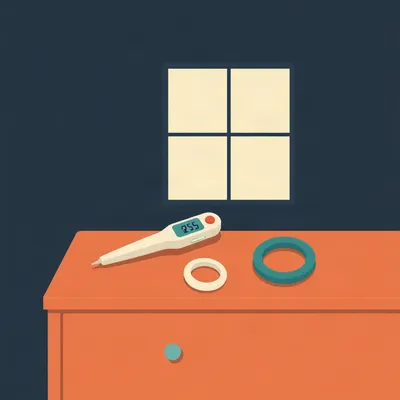
There's a sound that cuts through every other noise in a house — a cry you can't decode. A cry where you've checked the obvious things, you've run through the mental list, and you're still standing there at two in the morning with no answer. That moment is worse than the crying itself. The not-knowing is what makes your heart race.

The absence of a structured response amplifies the panic. When you don't have a system, your brain just loops — is it this, is it that, should we call someone, are we overreacting? The cognitive load in that moment is enormous, and most parents are running on empty to begin with.
That's the prompt we got — and it lands hard. The listener has a ten-month-old, and they're describing something I think every parent recognizes. You're in that pre-verbal phase where teething, minor illnesses, developmental leaps, and just plain fussiness all produce essentially indistinguishable distress signals. And the stakes of misreading them feel absolutely enormous, even when intellectually you know most crying is benign.
Right, and ten months is this particular inflection point. They're mobile, they're putting everything in their mouth, they're getting teeth in bunches, they're going through separation anxiety, and they still can't tell you what hurts. It's a diagnostic puzzle where the patient can't self-report, the behavioral cues overlap across a dozen different causes, and the clinician — that's you, the parent — is operating with a brain flooded with cortisol and sleep deprivation. It's honestly one of the harder diagnostic challenges in everyday life.
Here's what I find striking about how the prompt frames this. They've done a first aid course. They know the emergency stuff — choking, burns, fever thresholds. What they're describing is the gray zone. Not "my baby is turning blue," but "something seems a bit weird and I can't figure out what." That daily triage is where parents actually live, and it's almost completely unaddressed in parenting education.
We license people to drive. We train people for workplace safety. But the moment you become a parent, you're expected to perform this incredibly nuanced clinical assessment with no framework, at three in the morning, on zero sleep. The gap between what first aid courses cover and what parents actually face day to day is enormous. Courses teach you what to do when something is clearly wrong. They don't teach you how to figure out whether something is wrong in the first place.
That's the question. If you're the parent of a pre-verbal child and they're crying in a way that seems off — maybe it's consistent, maybe there's no obvious cause, maybe your spidey sense is tingling — what's the diagnostic algorithm? What do you run through, in what order, and when do you escalate?
I think the core thesis here — and this is where I want to push back against a lot of the parenting advice out there — is that what parents need in that moment isn't more intuition. It's the opposite. It's a structured, repeatable algorithm that externalizes the decision tree so your cognitive load drops when your stress rises. You want to offload the thinking to a system you've already internalized.
Which is exactly the spaced repetition point from the prompt. They mentioned that first aid skills degrade without reinforcement, and they're right. But the algorithm itself — the triage sequence — that's what we need to build first. Then we talk about how to drill it so it's there when you need it.
Let's build it. And I'll say upfront — none of this is medical advice. I'm a retired pediatrician, but I'm not your pediatrician. What I can offer is a framework that's grounded in how clinicians actually think about undifferentiated distress in infants, translated into something a parent can run in under two minutes.
Let's do it. Start with the structure. What's step one?
Step one is where I think most parents actually start, but they do it haphazardly. You need a deliberate environmental scan. And I mean deliberate — not just glancing around the room while you're bouncing a screaming baby. You're looking for recent falls, hazards they could have reached, the temperature of the room, and the state of the nappy. Those four things take maybe twenty seconds and they rule out a surprising number of causes.
The nappy is the one everyone checks first because it's the easiest to fix. But the room temperature — that's sneaky. Overheating is a huge cause of unexplained fussing and parents miss it constantly because they're dressed for the same room and feel fine.
Infants have a terrible thermoregulatory system. A room that feels pleasant to you at twenty-two degrees can be genuinely uncomfortable for a ten-month-old in footie pajamas. So that's part of the scan. But here's what I want to zoom out and address first, because the prompt raised a bigger structural question that's worth sitting with before we dive into the algorithm itself.
Why is this specific scenario — the "something seems off" gray zone — so poorly covered in parenting education? I think the answer has three layers. First, medical liability. Organizations that publish first aid guidance are terrified of being sued if a parent follows their flowchart and misses something. So they stick to the unambiguous emergencies — choking, burns, seizures — where the protocol is clear and the liability is manageable. The gray zone is exactly where liability gets murky, so they stay out.
Which creates this weird inverted reality where the thing parents face every single week is the thing nobody will give them a framework for. The thing that happens once in a childhood — a burn, a choking episode — that's what the app walks you through.
That's the second layer. The "one weird trick" culture of consumer apps doesn't reward thoroughness. A branching diagnostic flowchart with maybe forty end nodes is not a sexy app store listing. It doesn't screenshot well. It looks like work. So the market incentives push toward simple, clean, single-scenario apps — the baby sleep tracker, the feeding timer, the milestone checklist. Nobody wants to build the messy thing, even though it's what parents actually need.
The musical equivalent of beige wallpaper. Functional, essential, deeply unglamorous.
The third layer — and this is relevant to the listener's specific situation — is that non-English markets are catastrophically underserved. Hebrew, Arabic, Hindi, Swahili — the addressable market for each language is small relative to development costs. So even if someone builds a great triage app in English, the parent in Jerusalem who needs it in Hebrew is out of luck. The economics of app development just don't favor linguistic diversity in medical decision support.
You've got liability aversion, market incentives against complexity, and a language fragmentation problem. The result is that millions of parents worldwide are doing diagnostic triage in their heads at two in the morning with no external scaffolding. It's actually kind of astonishing when you lay it out.
And what makes pre-verbal pain assessment fundamentally different from, say, choking first aid is that choking has a single, unambiguous presentation. The algorithm is linear — recognize, act, reassess. Pain in a non-verbal child is a differential diagnosis problem with incomplete data. You have no self-report from the patient. The behavioral cues — crying, fussing, pulling at ears, arching the back — each map to multiple possible causes. And the clinician in this scenario is sleep-deprived, emotionally invested to a degree that would disqualify them from treating any other patient, and probably hasn't eaten a proper meal in eight hours.
The clinician is also the person whose nervous system is hardwired to find the sound of that specific cry physically unbearable. That's not a metaphor. The anterior cingulate cortex lights up like a fire alarm when your own infant cries.
So you're trying to perform differential diagnosis while your brain is being actively hijacked by your own neurobiology. That's why the core thesis matters so much. What parents need isn't better intuition — it's a structured, repeatable algorithm that externalizes the decision tree. You want to offload as much cognition as possible to a system you've already practiced, so that when your brain is screaming, your hands still know what to do.
I think that distinction — intuition versus algorithm — is worth underlining. The parenting advice world loves to tell you to trust your gut. And there's something to that, which we'll get into. But your gut is a lousy first responder. It's a decent final check. It should not be step one.
No, it absolutely should not. Step one is the environmental scan. Step two is the physical inspection. Step three is vitals. Step four is behavioral pattern matching. And only after you've run those four steps do you check in with your instinct and say, does something still feel wrong? The algorithm creates the container. Instinct gets the final word, not the first.
Let's build that container. Walk me through the physical inspection.
Step two is the physical inspection, and this is where I want parents to get methodical in a way most never do. You're looking at four zones. First, clothing — anything too tight, a onesie snap digging in, a zipper catching skin. Second, digits and genitals — and I mean a deliberate check for hair tourniquets. A single strand of hair can wrap around a toe or finger so tightly it cuts off circulation, and the baby can't tell you. It just screams. Third, mouth and nose — is there a foreign object, a bit of food, a small toy piece? At ten months, everything goes in the mouth. Fourth, groin — a quick hernia check. Press gently on either side of the pubic bone. If you feel a bulge that wasn't there before, especially one that's firm or the baby flinches when you touch it, that's an immediate escalation.
The hair tourniquet one is terrifying precisely because it's so mundane. There's a documented case — a nine-month-old crying inconsolably for forty-five minutes. Parents checked temperature, checked nappy, tried feeding, nothing. Finally ran a full physical inspection and found a single strand of hair wrapped around the second toe. It had been there long enough that the toe was starting to discolor. They unwound it with tweezers and the crying stopped within thirty seconds. Without that structured inspection, that could have progressed to ischemia and tissue loss.
It's not even rare. Hair tourniquet syndrome accounts for roughly one in every thousand pediatric ER visits for unexplained crying in infants under twelve months. That's not trivial. The fix takes thirty seconds if you find it. The consequence of missing it is a child losing a digit. The asymmetry there is staggering.
Step one is environmental scan — falls, hazards, room temperature, nappy. Step two is physical inspection — clothing, digits and genitals, mouth and nose, groin. What's step three?
Vital sign snapshot. And I want to be specific about what a parent can actually assess without medical equipment beyond a thermometer. Temperature — rectal is gold standard for infants, axillary is fine for a first pass. Respiratory rate — count breaths for thirty seconds and double it. Normal for a ten-month-old is thirty to forty breaths per minute at rest, but you're not memorizing numbers, you're looking for deviation: is it fast and shallow, or is there grunting at the end of each exhale? Grunting is a red flag, period. Third, skin — color and mottling. Pink and warm is reassuring. Pale, gray, or mottled in a lace-like pattern, especially on the trunk, is not. Fourth, capillary refill — press on the baby's sternum or fingertip until it blanches white, then release. If it takes more than two seconds for color to return, that's delayed perfusion and you're heading to the ER.
The beauty of capillary refill is it requires zero equipment and about three seconds. It's the poor man's perfusion scan.
It's also one of those things that most parents have never been taught to check, but every pediatrician does it reflexively. You can learn it in thirty seconds and it gives you useful information about circulation. So that's step three. Temperature, respiratory pattern, skin, capillary refill. If all four are normal, you've ruled out a significant chunk of the serious causes.
Which brings us to step four — behavioral pattern matching. This is where you stop scanning the body and start reading the cry itself.
Right, and this is the hardest one to teach because it's pattern recognition, not a checklist. But there are specific things to look for. First, is the cry high-pitched and constant, or intermittent and consolable? A high-pitched, shrieking cry that doesn't stop when you pick the baby up is neurologically different from fussing that ebbs and flows. Second, body language — is the baby arching their back? That can indicate reflux or meningeal irritation. Drawing up the legs toward the belly? That's often abdominal pain, could be gas, could be intussusception. Refusing to feed? In a ten-month-old who normally eats well, sudden refusal is a signal. Third, consolability — can you distract them? If a cold teether, a change of scenery, or being held stops the crying even briefly, that's reassuring. The truly concerning cry doesn't respond to any of that.
Let's make this concrete. The prompt mentioned teething as a frequent suspect. Walk me through teething versus, say, an ear infection — because those two get confused constantly.
They do, and the overlap is real. Teething cry tends to be intermittent. The baby drools, chews on their hands, chews on your shoulder, and a cold teether provides noticeable relief. The crying comes in waves and you can usually console them between waves. An ear infection cry is different. It often has a more sudden onset, the baby pulls at one ear specifically, and crucially, it gets worse when they're lying flat because the pressure in the middle ear changes. Fever may not show up for twelve to twenty-four hours — so you can't use the absence of fever to rule out an ear infection in the first several hours. If the baby was fine all day, then woke up screaming two hours after bedtime and won't settle lying down but is slightly calmer upright, that's a classic ear infection presentation.
That's the kind of pattern detail that doesn't make it into the parenting books. "Baby pulls at ear" is the line everyone gets. The flat-versus-upright distinction is what actually helps you discriminate.
That's why the behavioral step matters so much. It's not just "is the baby crying" — it's the quality, the triggers, the relievers, and the associated movements. You're building a small phenomenological profile of this specific episode of distress.
We've got the four steps. Environmental scan, physical inspection, vital sign snapshot, behavioral pattern matching. Now let's talk about what you do with the information. Because the output of this algorithm isn't a diagnosis — it's a triage decision. Either you've found something you can fix, or you haven't, and you need to decide: wait and watch, or escalate.
This is where the red flag taxonomy comes in. I want parents to have a clear, memorizable split between "this is probably fine to monitor" and "this means you're making a call or going to the ER right now.
Give me the wait and watch list first.
Mild fever under thirty-eight degrees Celsius in an infant over three months who's still feeding well and is consolable. A mild rash that blanches when you press on it. Intermittent fussiness with normal vital signs and a normal physical exam. Teething symptoms with no other red flags. A single episode of vomiting with no fever and no abdominal rigidity. These are situations where you set a timer — give it two hours, re-run the algorithm, and if nothing has changed or things have improved, you're probably fine to keep monitoring.
The escalate immediately list?
This one you memorize cold. High-pitched or weak cry — either extreme is concerning. Lethargy — if the baby is difficult to wake or won't sustain alertness. A bulging fontanelle — the soft spot on top of the head should be flat or slightly sunken; if it's bulging and firm, that's a potential sign of increased intracranial pressure. Persistent vomiting, especially if it's green or projectile. Inconsolability lasting more than two hours with no identifiable cause. And any period where the baby stops breathing, even briefly, or any blue tint around the lips or face — that's apnea or cyanosis, and you don't call the doctor, you go straight to the ER.
Two of those deserve extra weight. The bulging fontanelle — most parents don't know to check it, and it's exactly that kind of detail that gets lost at two in the morning. You can have the most elegant algorithm in the world, and it's worth exactly nothing if you can't remember step three. The prompt raised spaced repetition for a reason. Without reinforcement, recall of a four-step protocol drops below fifty percent within seventy-two hours. That's the Ebbinghaus forgetting curve. It's not a suggestion. It's a measured, replicated fact about how human memory works.
This is where I think the first aid app gap is dangerous. We've got parents who took a course six months ago, they remember maybe that they should check something, but the specifics are gone. The mental drill idea is the bridge. Once a week, when the baby is calm, you run the full four-step triage in under two minutes. You're not diagnosing anything — you're building procedural memory. You're teaching your hands to go to the right places so that when the crisis hits, the sequence is automatic.
It's like a fire drill. You don't wait until the smoke alarm goes off to figure out where the extinguisher is.
The drill has a secondary benefit — you learn your baby's baseline. What does their normal capillary refill look like? What's their resting respiratory rate? How flat is their fontanelle normally? Those baselines are what make deviations detectable later.
Which brings us back to the app question. The prompt was blunt about this — why isn't there a good one? And I think you laid out the structural reasons earlier, but let's name the specific barriers. Number one, medical liability. If you publish an algorithmic decision tree that tells a parent "you can wait and watch," and that child turns out to have early sepsis, your organization is getting sued. Most medical bodies would rather publish nothing than publish something that could be wrong in a small percentage of cases.
That's a rational fear, but it creates a worse outcome. The absence of guidance doesn't prevent bad outcomes — it just ensures they happen to parents who lacked information rather than parents who followed a flowchart. The liability is displaced, not eliminated.
Second barrier — the app store economy doesn't reward thoroughness. A branching flowchart with animations for each inspection step takes real development work. It's not a "one weird trick" app. It doesn't have a subscription model. It's hard to monetize. So the incentive structure pushes developers toward sleep trackers and milestone apps, not toward medical decision support.
Third barrier, and this one matters for the specific situation the prompt describes — non-English markets are radically underserved. Hebrew, Arabic, Hindi, Swahili. The addressable market for any single language is small relative to development costs, so nobody builds it. But the need doesn't scale with market size. A parent in Tel Aviv has the same diagnostic puzzle as a parent in Toronto.
The spec for what a good app would actually look like isn't complicated. Clear yes or no paths. Animations that show exactly how to check for a hair tourniquet or test capillary refill. No login required — nobody's creating an account while their baby is screaming. And critically, no medical disclaimer walls that slow you down. A single acknowledgment at install, and then the app gets out of your way. Time to first decision should be under thirty seconds.
I'd add one more feature — a lock screen card. A condensed red flag list that lives on your phone's lock screen, so you don't even need to open an app. High-pitched cry, lethargy, bulging fontanelle, grunting respirations, persistent vomiting with fever. If you see any of them, you're not opening an app — you're getting in the car.
You've run the algorithm, you've either found a fixable cause or you haven't, and now you're staring at the output. Let's get specific about escalation. What does "call the doctor" actually mean in practical terms? Because that phrase does a lot of work in parenting advice, and it's too vague to be useful at three in the morning.
Right, and this is where protocols need to be region-aware. Let me give you the general thresholds, and then we'll talk about how the Israeli system changes the calculus. Fever over thirty-eight Celsius in an infant under three months — you go to the ER directly, no call first. Fever over thirty-nine Celsius in any infant with lethargy — ER. Persistent vomiting with no fever — call your pediatrician within two hours. Inconsolable crying lasting more than two hours with no identifiable cause and no fever — call within one hour. Any breathing abnormality — grunting, retractions, nasal flaring — ER immediately, do not wait for a callback.
Those thresholds are useful because they remove the judgment call. You're not asking yourself "is this bad enough?" — you're checking a number against a number.
Here's a case that shows why the algorithm works. Seven-month-old, thirty-eight point five degree fever, crying. Parent runs the four steps — environmental scan is clean, physical inspection finds nothing, vitals show the fever but normal capillary refill and no respiratory distress, behavioral pattern shows the baby is fussy but consolable and still feeding. No red flags beyond the fever itself. Parent calls the pediatrician, who says monitor and alternate acetaminophen and ibuprofen. Fever resolves in thirty-six hours. Turns out to be roseola — the classic fever-then-rash sequence. The algorithm prevented an unnecessary ER visit while still getting appropriate medical guidance.
The flip side matters too. If that same baby had been lethargic or had delayed capillary refill, the algorithm would have sent them to the ER, and rightly so.
Now, the Israeli context specifically changes the escalation math in one important way. In Israel, every HMO has a twenty-four seven pediatric hotline. You can call and speak to a pediatrician directly within minutes, not hours. In the US or the UK, you might be waiting for a callback from an on-call doctor, or navigating a nurse triage line that defaults to "come in." The Israeli system gives you a middle option — you can get an expert on the phone fast, which means you can sometimes avoid an ER visit that a more conservative protocol would demand.
The escalation protocol has to flex based on what your local system actually offers. In Israel, "call the pediatrician" is actionable within five minutes. In other systems, that same instruction might mean leaving a message and waiting an hour, which changes whether you should just go straight to the ER.
That's why I want parents to write their own escalation list — take the general thresholds, then map them to their actual local resources. What's the number you call? At what hour does that number switch to an after-hours service? Where is the nearest ER that sees infants? These are not things you want to Google while holding a screaming baby.
It's the same principle as the mental drill. You externalize the decision tree ahead of time so that when the cognitive load spikes, you're executing, not deliberating.
From that, let's distill this into three things you can actually do starting tonight. Not "think about," not "consider" — do.
First one is obvious but most people won't do it. Print or memorize the four-step algorithm. Environmental scan, physical inspection, vital signs, behavioral pattern. Run it as a weekly two-minute drill with your partner. Pick a time — Sunday evening, whatever — when the baby is calm and you're both home. One of you runs through the steps out loud while the other watches. Switch roles the next week.
The drill isn't about finding anything. It's about making the sequence so automatic that when you're sleep-deprived and anxious, your brain doesn't have to search for what comes next. You've walked the path enough times that your hands know where to go.
The Ebbinghaus curve is unforgiving on this. Without reinforcement, you lose half the protocol in three days. A two-minute weekly drill resets that clock. It's the cheapest insurance you'll ever buy.
Second actionable — build a red flag lock screen card. High-pitched or weak cry. Lethargy or difficulty waking. Persistent vomiting with fever. That's the list. Put it on your phone's lock screen, your partner's lock screen, and if you want to go old school, tape it inside a kitchen cabinet. You're not opening an app when you see one of these — you're moving.
The lock screen matters because it removes the step of unlocking your phone and finding the right app. You glance down, you see the list, you match a symptom, you act. That's the whole interaction.
Third one is for the app developers listening. The spec is sitting right here, fully formed. A branching flowchart with animations showing each inspection step. No account creation. Offline-first — this has to work when you're in a rental apartment with spotty Wi-Fi at two in the morning. Time to first decision under thirty seconds. Medical disclaimer once at install, then never again. The market is underserved and the need is real.
I want to underline the language piece of this. If you build it in English, great — now build it in Hebrew, Arabic, Hindi, Swahili. The development cost for localization is a fraction of the initial build, and the parents in those markets currently have nothing. You'd be the only option.
One more note on the lock screen card — don't just save it as a photo. Set it as your actual lock screen wallpaper for the first year. You'll see it dozens of times a day without trying. That's passive spaced repetition. By the time your kid is twelve months old, you'll know the red flags cold without ever having sat down to memorize them.
That's the kind of design thinking that actually works. Don't ask exhausted parents to study flashcards. Embed the knowledge in the environment so it finds them.
Here's what keeps me up, and I think it's worth naming out loud. What happens when the algorithm fails?
That's the question that humbles every clinician, and it should humble every parent too. The algorithm is designed to catch the most common presentations of the most dangerous conditions. But some things present with almost nothing. Early sepsis in a young infant can look like mild fussiness and slightly cool extremities. Early meningitis can present with nothing more than irritability and poor feeding — no fever, no stiff neck, no bulging fontanelle. The algorithm says "wait and watch" because there's nothing to trigger a red flag, and that's the right call based on the information available. And it's also terrifying.
The system has to be built with humility baked in. Not "this algorithm is correct" but "this algorithm is the best we can do with the data we have, and it comes with an asterisk." If you've run the steps and the output is "monitor," but your gut is screaming, the algorithm doesn't get the final vote.
That's where the instinct piece circles back. We said earlier — fifty-eight percent positive predictive value, forty-two percent false positive rate. Not good enough to lead with, but absolutely good enough to be the tiebreaker. If the algorithm clears and something still feels wrong, you call. You don't need to justify it with a number. The algorithm is a tool, not a boss.
There's a line from medicine that applies here. "The test is not the patient." The four-step triage is a test. Your child is the patient. When they disagree, you investigate further.
Which brings us to something on the horizon that might change this whole equation. The prompt asked about diagnostic algorithms, and I think it's worth looking at where this is heading. There's been research into whether AI can analyze infant cry acoustics for pathological patterns. The University of Northern Colorado published work in twenty twenty-four showing eighty-seven percent accuracy in distinguishing cries of infants with medical conditions from those without, just from acoustic analysis.
Eighty-seven percent is interesting. It's not deployable yet — you wouldn't hang a clinical decision on it — but it's well above chance.
Right, and the mechanism is fascinating. Pathological cries have subtle acoustic signatures — higher fundamental frequency, different harmonic structure, shorter pauses between cries. Things the human ear can't consciously parse but that a trained model can flag. The researchers used a dataset of over twelve hundred cry samples from infants with confirmed diagnoses. The model picked up patterns that even experienced pediatricians couldn't consistently identify by ear.
You could imagine a future where you open an app, hold your phone near a crying baby for fifteen seconds, and it gives you a probability score. "Eighty-three percent match with non-pathological crying." Or "sixty-two percent match with pain cries — consider ear infection or teething." That changes the whole diagnostic landscape.
We're not there yet, and I want to be clear about what "not there" means. The eighty-seven percent accuracy was in a controlled research setting with clean audio and known diagnoses. In a real home environment with background noise, a baby who's moving around, and a parent who's not holding the phone at the optimal distance, that number would drop. Plus, the model was trained to distinguish "has a medical condition" from "doesn't have a medical condition" — it can't yet tell you which condition. That's a much harder problem.
For now, the human algorithm is still the best tool. But the trajectory is clear. Give it five years, and a smartphone might be able to do what currently takes a pediatrician's physical exam for some of these presentations.
That's why the app spec we laid out matters. Build the branching flowchart now. Add the acoustic analysis layer when the research matures. The core architecture — offline-first, no login, under thirty seconds to first decision — doesn't change. You're just adding a more sophisticated input.
Let's land this. The goal of everything we've described — the four-step algorithm, the weekly drills, the lock screen card, the escalation thresholds — isn't to eliminate uncertainty. You can't eliminate uncertainty in parenting. The goal is to make it manageable. To shrink the gap between "something is wrong" and "here's what I do next" down to seconds instead of minutes of panicked guessing.
A structured algorithm doesn't replace parental instinct. It gives instinct a framework to operate within. Instinct without structure is anxiety. Structure without instinct is rigidity. You need both, and you need to know which one leads.
If you're a developer listening to this — the spec is on the table. Branching flowchart, animations, offline-first, no login, under thirty seconds to first decision. Build it in English, then localize. The parents who need this aren't scrolling the app store at two in the morning looking for a subscription to try. They're holding a crying baby and running out of ideas. Be the thing they find.
That's the pitch. Now let's wrap this up.
Now — Hilbert's daily fun fact.
Hilbert: In the nineteen tens, linguists working on Inuktitut polysynthetic morphology briefly attributed a complex verb-incorporation pattern to influence from Comorian languages, a claim that was quietly retracted a decade later when it became clear the researcher had confused his field notes from two different expeditions.
That's one way to stretch a grant budget.
I have follow-up questions I'm not going to ask.
The question we're left with is whether the algorithm holds up under the worst-case scenario — the one where symptoms are so vague that even a perfect triage sequence can't catch them. That's the edge we have to live on as parents, and the best response isn't to pretend the edge doesn't exist. It's to build the best system we can, drill it until it's automatic, and then trust ourselves to know when the system needs to be overridden.
Thanks to our producer Hilbert Flumingtop for another excellent fun fact and for keeping this show running. This has been My Weird Prompts. I'm Herman Poppleberry.
I'm Corn. Find us at myweirdprompts dot com, and if you build that app, let us know — we know some parents who'd use it tonight.