Hannah sent this one in. She's been on the suburbs beat before, and she thinks the last time we did this, we never got to the other half of the question.

Which half?
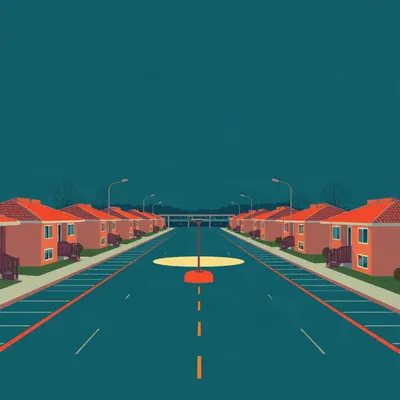
The city half. Her point is that the answer isn't "suburbs are bad, therefore small towns are good." Cities could be the answer themselves, if anyone bothered to design them for the people who leave them. She wants the space, the quiet, the greenery, the safety, the room for kids, the sense of community, brought into a city or a larger town, without giving up the walkability, the culture, the shops, the transit, the density, the access. And she wants to go back through the history of city building to find out how to do it, from Çatalhöyük forward.
That's two episodes.
It's one. She asked.
Then let's do one. Because the framing she's rejecting is the lazy one. The suburbs are bad, so move to a village. Villages have their own problems, and they always have. The interesting question is whether a dense place can be quiet.
Cities are the most efficient habitat humans have ever built. They also make people want to leave. Both of those are true at the same time, and nobody designing anything seems to hold them together.
The efficiency is real. A city delivers water, power, food, medicine and work to a smaller footprint per person than anything else we've invented. That is why eight hundred thousand people lived in Rome in the first century, and it is why they live in cities now.
And the frustration is real too. Noise, cost, stress. The three things a person cannot buy their way out of in a dense place.
So this is two threads. First, the modern design question. What do families actually want when they move out, and why do cities fail to give it to them? Second, the historical question. How did premodern cities get density and livability into the same street, and what is worth stealing?
And we're not doing nostalgia. Ancient cities had slavery, disease, and an infant mortality rate you don't want to think about too hard.
They also solved problems we've forgotten we have. That's the part worth mining.
So here's where I want to start, Herman. Not with the design. With the leaving. What is a family actually buying when it moves out?
Ask them and they'll tell you the same four or five things. Quieter, greener, safer. Somewhere appropriate for bringing up children. Lower density, less noise, a slower pace, less crime. That's a consistent finding across the counterurbanisation literature going back twenty years. It isn't a mystery what people want.
Then the interesting half is why the city can't sell it to them.
Because on the list of things cities are good at, "limited play and green facilities, an overload of people in certain locations, traffic danger" is not a competitive pitch. That's the trade families are making. They give up the walkability and the culture to get the quiet and the yard, and they know exactly what they're giving up. Most of them aren't happy about it.
So what do they actually need to stay? Give me the package.
The Urban Institute put a paper out this summer on exactly this, on what it would take to keep families in core cities. Four things. Family-sized housing that a family can afford, which in practice means three bedrooms and up. Schools that are good. Safe, walkable neighbourhoods with low crime and real green space. And child care that is reliable and affordable. That's it. There's no fifth thing.
Four items, and most cities can't do one.
The paper calls them a package deliberately, because doing three of four doesn't work. A great school and a safe street mean nothing if the only three-bedroom apartment is priced for a couple with two incomes and no children.
What happens if the package never gets assembled?
A loop, and it's a nasty one. Families leave, so enrolment falls, so schools close, so the neighbourhood is less attractive to the next family, so more leave. The tax base thins and the city's costs don't. Poverty concentrates. The paper's line is that without a stable base of families with children, core cities risk population loss, fiscal strain, and rising inequality.
Three things every city is already worried about.
Which is why the paper frames families as infrastructure rather than as a demographic. Families anchor the future labour supply. Nearly sixty percent of young adults live within ten miles of where they grew up. Lose the children and you don't just lose the school. You lose the workforce that would have replaced you.
If families are infrastructure, then a city that loses them is like a city that let its water mains rot. You don't notice for a decade, and then you notice all at once.
That's exactly the framing. And the reason it's useful is that infrastructure gets a capital budget. Demographics get a press release. One of those gets maintained and the other one doesn't.
So the argument to a mayor is not "be nice to families." It's "your replacement workforce lives in a three-bedroom apartment you haven't built yet."
And the mayor who doesn't build it will be out of office before the bill comes due, which is the whole problem with infrastructure arguments generally.
The neighbourhood you're describing, families with kids, low crime, decent shops, good transit. That's just a functioning city, isn't it? That's not a suburb.
That's exactly the thing. The things families want are not suburban things. They're neighbourhood things that the modern suburb happens to supply and the modern city happens not to. Space, quiet, green, safety, other children for yours to play with. None of that requires a lawn.
Say more about that, because I think it's the hinge of the whole episode.
The classic statement of the alternative is the fifteen-minute city. Most of your daily needs within a fifteen-minute walk, bike ride, or short transit hop. Work, shopping, school, healthcare, leisure. The idea came from Carlos Moreno and it rests on four components. Density, proximity, diversity, and ubiquity. Density puts enough people in a place. Proximity puts the destinations close. Diversity means the destinations aren't all the same kind, so you don't have to leave. Ubiquity means it works across the whole city, not just in two nice neighbourhoods.
Is that new? Because that sounds like a description of a normal town from about 1900.
It's not new, and the people pushing it know it isn't. It's Jane Jacobs with a map. Human-scale streets, mixed uses, and a firm refusal of car-dependent sprawl. Her whole argument was that a city is legible at the scale of a person walking around a corner.
Give me the Jacobs version, because I think people hear her name and nod without being able to say what she actually claimed.
Her claim was that the safety of a city street is not maintained mainly by police. It's maintained by an intricate, almost unconscious network of voluntary controls and standards among the people themselves, and enforced by the people themselves. That's close to a direct quote. The eyes on the street. The shopkeeper who knows who belongs and who doesn't. The neighbour who notices a child is somewhere they shouldn't be.
And that only works if there are enough people to do the looking.
And enough variety of use that the street is occupied at different hours. A purely residential street is empty from nine in the morning until five in the afternoon. That's when the eyes go away. A street with a bakery, a school, a laundromat and some offices has somebody on it all day.
So mixed use isn't an aesthetic preference. It's a safety mechanism.
It's a safety mechanism that we replaced with a zoning code and then wondered why the streets felt dead.
Then let me be the skeptic for thirty seconds. Does the fifteen-minute city actually work when you measure it?
That's where it gets honest. There's a study from January that used mobile phone data from Helsinki to ask a simple question. Do the standard livability indicators for a fifteen-minute city actually predict where people go?
And?
Only weakly. And unstably. The fit gets worse at night, when people are doing a completely different set of things than they do at noon. So you can score a neighbourhood beautifully on paper and watch the phones say something else.
So all the maps and the scores and the spreadsheets predict behaviour about as well as a weather forecast in April.
Roughly. Which doesn't mean proximity is irrelevant. It means we've been measuring the wrong thing, or measuring one thing and calling it the whole. People don't only care about how close the bakery is. They care whether the street between them and the bakery feels good to walk down at seven in the evening.
That's the gap I keep coming back to. Somewhere between the design and the phone.
There's a 2026 study that walked Google Street View through the suburbs of Nice, in France, and scored the streetscape quality. Pedestrian-friendly qualities characterize only a fraction of the streets in a modern French suburb. So the suburbs don't reliably deliver the walkability either. Nobody's got this right.
Then the fifteen-minute city has one more problem, and it isn't a design problem.
Go on.
It got politicized. In 2023 there was a stretch where it was presented as a government plot to lock people in their neighbourhoods and take their cars away, which is not a thing the proposals do. There are no travel bans in them.
None. And the reputational damage stuck anyway, because the language was abstract enough to be filled in with whatever a person already feared. That's a caution about how you sell a design idea, not about whether it's a good one.
Anybody designing a city should note that the pitch matters as much as the block layout.
The other thing worth saying is that there's real demand for this and we're not building it. There are scans of housing markets that put the gap between what people want in walkable urban living and what gets built at somewhere between twenty and thirty-five percent.
A quarter of the market asking for something and not getting it.
And you can see it in the geography. A global study from 2024 mapped access to services within fifteen-minute thresholds across thousands of cities, and what it found was inequality. Not just between cities. Within them. Two neighbourhoods in the same city can have completely different access to a pharmacy, and we mostly don't design that. It just happens.
So the diagnosis is that people want a specific set of things, cities want to sell those things, and both the market and the measurement keep missing.
That's the modern half, yes.
Then let's go back. You've been waiting.
I have been waiting. Because the thing that makes me least patient with all of this is the assumption that dense urban life is a recent experiment we're still getting wrong. It's not recent and we aren't the first. Take Çatalhöyük.
Eight thousand years before Rome.
Roughly. Seven thousand four hundred BC to sixty-two hundred. Thirty-seven hectares, eighteen occupation levels, and the same site occupied for over two thousand years. That is longer than any city we've ever built has lasted, in any form.
And what was it like?
No streets.
None?
None. The houses were built back to back, clustered, and you entered through the roof. You moved around the settlement on the roofs. UNESCO calls it a streetless settlement of houses clustered together with roof access, and describes the layout as based on community and egalitarian ideals, with comparably sized dwellings throughout the city.
So dense living for two thousand years, and nobody needed a pavement.
Which is a genuine problem for anyone who equates livability with a street grid. It also raises the question of what a street is for. If you can't walk down at ground level you lose some things and you're spared others.
No traffic danger in Çatalhöyük.
No.
No traffic.
Also no traffic. I'd flag that the population estimates vary and the site did burn more than once, so it wasn't a paradise. But two thousand years of stable dense occupation is the number that matters. Whatever they were doing, it worked for a very long time.
Where did they put the dead? Because I remember something about that.
Under the floors. They buried their dead beneath the platforms inside the houses. So the ancestors stayed in the household. There was no separate cemetery, no separate district for the dead. The dead were part of the domestic architecture.
So even death was integrated into the dwelling rather than zoned out to the edge of town.
Which is a strange thing to say out loud, but it's the same principle we've been circling. Nothing in that settlement was set apart. Not the living, not the dead, not the storage, not the work. It was all in the same structure.
All right. Rome.
Rome is the other end. In the early imperial period the population is somewhere between eight hundred thousand and a million. Most of them lived in insulae. Apartment blocks. The ground floor held tabernae, which are shops, with living space above. So Rome was mixed-use by default, because that's how you build when you don't have a zoning code and no reason to want one.
Shops under apartments. That's just a building.
It's a building, and it's the building most of Rome lived in. The regionary catalogues list somewhere between forty-two and forty-six thousand insulae against about seventeen hundred and ninety private houses. So the apartment block is not the exception. It's the norm, by a factor of twenty-five.
What were they like inside?
Strabo describes them as having running water and sanitation, which is better than a lot of mid-century housing in cities I could name. They weren't all grim.
And they had height limits. That's the part I want, because that's the part we pretend is new.
Augustus capped them at seventy Roman feet, which is about twenty and a half metres. Trajan brought it down to sixty Roman feet, roughly seventeen and three-quarters. So the imperial capital had a height restriction, twice revised downward, because tall buildings were collapsing and there was a fire problem.
So the two-storey height limit debate in my neighbourhood is twenty centuries old.
And here's the detail I'd keep. The elite houses and the poor housing were intermingled. The city didn't have rows of nice districts and then the district where the apartment blocks live. It mixed.
Which is the opposite of what nearly every modern city does.
And it's the thing modern planning is most confident about. We separate uses and we separate incomes, and we call it order, and then we wonder why the neighbourhoods we built for families have no shops in them.
How did the mixing actually work day to day? Because a rich family and a poor family in the same block still live differently.
They used the same streets, the same fountains, the same bakeries, the same baths. The bathhouse is the one I'd point at. It's the most socially level institution in the Roman city. Everybody goes, everybody pays a small fee or gets in free, and the same building serves the senator and the porter at different hours of the same afternoon.
So the mixing wasn't just an address pattern. It was a shared set of facilities.
It was a shared set of facilities, and the facilities were the point. That's the part we've lost. We have mixed-income buildings now, and the people in them never share a room.
Then go to the Americas, because I think that's the part most people have never heard.
Teotihuacan, at its zenith around four hundred and fifty CE. Thirty square kilometres and up to a hundred and fifty thousand people. Some estimates go higher, toward two hundred and fifty thousand. Largest city in the Americas at the time.
And what's the striking thing?
There's no evidence of a king.
None?
The scholarly conclusion is that it's strikingly absent, and that the city looks like collective governance. No royal palace, no single monumental tomb that reads as a ruler. And no discrete zoning districts either. It does not appear to have been organised into separate areas for separate uses.
A hundred and fifty thousand people and no zoning and no king.
They also fed it on chinampas. Raised agricultural beds, with canoe canals for moving the food. So the agricultural belt and the city weren't separate things. They were the same system.
That's the green belt argument, and it's a thousand years old.
Older, honestly, if you count the general principle. The city and its food supply were contiguous, and water did the hauling.
I like that more than I expected to, and I want to know why.
Because it means the green space wasn't a park you visit. It was productive land you pass through, and the reason it survived is that it was doing work.
Teotihuacan's the one that makes every mayor of every mid-sized city feel bad. No king and no zoning.
And Tenochtitlan is the one that makes every infrastructure planner feel bad.
Somewhere over two hundred thousand people before fifteen twenty-one. Four zones, each divided into twenty calpullis, which are districts. Each district crossed by streets. Three main streets ran to the causeways and Bernal Díaz, who saw it, said they were wide enough for ten horses abreast.
Ten horses is about four lanes.
Roughly. And the canals meant all sections of the city could be visited on foot or by canoe. So it wasn't either-or. They had both networks running in parallel.
Water.
Two double aqueducts, each over four kilometres, terracotta, supplying fresh water. And the Nezahualcoyotl levee, about twelve to sixteen kilometres, built around fourteen fifty-three, which kept fresh water and brackish water separate in the lake. That's not a village solving a drainage problem. That's a city running environmental engineering at scale.
And they had a planning department.
They had a calimilocatl. A functionary whose job was approving all construction. The city had great symmetry and every building had to go past him.
An approvals office. In the fifteenth century.
With the same power as anyone at a modern planning desk, and apparently the same effect on symmetry.
The market.
Tlatelolco, the main market. Cortés estimated sixty thousand traders on a market day. Sahagún put it lower, twenty to forty thousand. Take the range and it's still the biggest market in the world at the time.
And each district had its own market.
Each calpulli did, yes. So you had the once-a-week or daily market at the corner and the enormous one at the centre. Two scales operating at once.
That's the piece I'd steal if I only got one.
Because it's the thing modern cities do worst. We build one enormous retail centre and then a ring of neighbourhoods with no shops at all, and we act surprised that everybody drives.
Now the study, because you've been sitting on it.
There's a street-network study from 2021 that mapped street networks across eighty-nine pre-industrial sites in Africa and Eurasia. Orthogonal cities, the gridded ones, show higher and more even street centrality than the organic ones. So the grid does something real.
And the second half?
Larger sites show declining node density and centrality. The bigger the city gets, the less any single point in the network connects to the rest of it. The authors say that's comparable to modern urban systems, where larger districts restrict overall interaction.
So scale itself is the enemy of access.
Scale by itself, yes, if nothing else changes. Tenochtitlan got past it with canals and districts and a market system. Most cities don't, and they just get bigger until the parts stop talking to each other.
So what's the synthesis here? Because I don't think the lesson is "copy the Aztecs."
The lesson is that our model is one option among many. Density and livability are not opposites. They've been combined repeatedly, in wildly different ways, by people who had no zoning code and no king and no cars and no choice.
Rome mixed rich and poor. Teotihuacan had no zoning and no king. Tenochtitlan had aqueducts and planned streets. Çatalhöyük had no streets and two thousand years of stable living.
Çatalhöyük had no streets, Herman. Say that again.
Çatalhöyük had no streets.
Good. Now build me the modern version, because that's the part that's actually hard. What do you actually do? I've heard "build more housing" a hundred times and it's never once changed a street.
Start with the housing type, because that's the smallest unit that matters. Missing middle housing. Duplexes, triplexes, townhomes, courtyard clusters. Daniel Parolek's term. The defining feature is scale. A house-sized building with two or three or four units in it, so it fits in the fabric of a street that's already built.
Why does the size matter so much?
Because a four-storey walk-up with a courtyard doesn't announce itself as dense. It looks like a house that happens to hold three families. That's the entire pitch. It gives a family a bedroom for each child and a bit of outdoor space, on a plot that would hold one house under current rules.
So the suburb's main product, room for the kids, delivered at city density.
Delivered at somewhere between two and four times the density, with no visible change to the street.
And the demand is there.
That's the twenty to thirty-five percent gap again. There's a large market for walkable urban living and the supply of the housing type that delivers it barely exists in most of the developed world.
Why not? If the demand is there.
Because a lot of cities make the duplex illegal. Illegal, on the majority of the residential land in the city. That's the whole story of the housing shortage in one sentence.
So it's not a mystery. It's a rule.
It's a rule, and rules can be rewritten, and when they are, the duplexes get built. That's the least speculative thing in this entire episode.
Give me the concrete version, because "rewrite the rule" is abstract. What does the rule actually say?
Take a typical single-family zone in a typical American city. It says one dwelling unit per lot. It says a minimum lot size, often five thousand square feet. It says a minimum setback from the front, the sides and the back. It says a maximum height, usually two storeys. And it says a minimum number of parking spaces per unit.
And those five numbers together make the duplex impossible.
They make everything except a detached house on its own lot impossible. And none of those numbers is about safety. They're about keeping the street looking a particular way. Which is a legitimate thing to want, and it's also the reason a quarter of the market can't buy what it wants.
So the reform is to change the numbers.
Change the numbers, and the buildings appear. That's the bit that's been tested. Cities that have legalized the missing middle have gotten the missing middle. It's not a theory at this point.
All right. Proximity. What's actually been done?
Paris under Hidalgo from twenty twenty opened school playgrounds to the public outside school hours. So during the summer, and on weekends, the courtyards that already exist inside the blocks become the green space for a dense neighbourhood. No land acquisition. No construction. Just a lock and a schedule.
That's the best idea I've heard all day.
Singapore has committed to twenty-minute towns and a forty-five-minute city by twenty forty. Dubai announced a twenty-minute city in twenty twenty-two with a target of placing fifty-five percent of residents within eight hundred metres of mass transit. China's had fifteen-minute community life circles in the Shanghai master plan since twenty sixteen.
Those are real cities doing it at scale.
At very different scales and very different political systems, which is the useful part. The idea travels.
The playbook for families specifically?
Prioritize two-to-four-bedroom units rather than studios. Build mixed income rather than all-luxury. Fund the schools properly, because the school is the neighbourhood's reputation. Calm the traffic on the routes children actually walk. And build parks with playgrounds and something programmed in them, not just grass.
Traffic calming is the unglamorous one and I think it's the biggest.
It's the one parents mention first if you ask them rather than the planners. A parent will trade a shorter walk for a safer crossing every time.
Now greenery, because that's the one I don't believe a dense city can deliver.
Historically it did, and the mechanism was that the green was productive. Teotihuacan's chinampas fed the city from within the city. Tenochtitlan ran aqueducts and separated fresh from brackish water with a sixteen-kilometre levee. The nature wasn't set aside in a preserve on the edge. It was load-bearing.
So the modern version is green roofs, pocket parks, linear parks, community gardens, planted to do a job.
And the job can be real. Storm water, heat, food, shade. If a green thing in a city is doing work, it survives the budget cycle. If it's decoration, it gets cut the first hard year.
Shade is not decoration.
Shade is infrastructure.
Now safety, because that's the one I think you'll have the most interesting answer to.
Neighbourhoods with young families tend to have lower crime rates, because parents are invested in their children's safety and their neighbours' children's safety, and that investment shows up in the street.
So safety isn't the precondition. It's the output.
Partly the output, yes. Design for families and some of the safety arrives as a byproduct. Some, not all. You can't design your way out of a police problem, and anyone who says you can is selling something. But the direction runs both ways, and most cities only think about one of them.
And community, which is the one nobody can build on purpose.
Historically it was structural, not sentimental. Tenochtitlan's calpulli was a district with a market and an identity, twenty to a zone. The insulae in Rome were the neighbourhood. Çatalhöyük's dwellings were comparable in size and its layout was egalitarian, so there was no grand quarter to look up to and no slum to look down on.
What's the modern equivalent of a calpulli?
Courtyard housing, shared amenities, community land trusts, co-housing. Something between the front door and the whole city. That's the scale we've lost. Most people live in a private unit and are governed by a city hall and there's nothing in between, so there's nowhere for the neighbourhood to be a thing.
That's the sentence I'd keep from this whole episode. Nowhere for the neighbourhood to be a thing.
And it explains the rest. If there's no district, there's no district market, no district school worth defending, no district identity. So people move out and buy one.
What does a community land trust actually do? Because I've heard the term and I couldn't tell you the mechanism.
The trust owns the land and never sells it. You buy the building on the land, or you rent it, and the land stays in the trust forever. So the cost of the land is taken out of the price permanently. That's the whole trick. It's the reason the housing stays affordable through the next three owners instead of just the first one.
So it's a way to make the affordability permanent rather than a one-time discount.
It's a way to take the speculative part of housing out of the equation, and the speculative part is the land, not the building. The building depreciates. The land is what runs away.
And co-housing is the other one.
Co-housing is a cluster of private homes around a shared house. You have your own kitchen and your own front door, and you also have a common kitchen and a common dining room and a common laundry and a common guest room. Typically thirty to forty households. The whole point is that the shared space is where the neighbourhood happens, and it's designed in from the beginning rather than hoped for.
So the porch, but with something on the other side of it.
The porch, but with a building attached that everyone actually uses.
So the mid-sized city is the target.
The mid-sized city is the target, because you can retrofit it. A city of a hundred thousand can add courtyards to a neighbourhood, open a schoolyard, calm three streets, and change its zoning in a single council term. A metropolis of nine million cannot.
So the checklist is the package. Three-bedroom housing, good schools, safe walkable neighbourhoods with green, affordable child care. The package from the Urban Institute, which is the modern version of what Rome, Teotihuacan and Tenochtitlan were each delivering in their own way.
Mixed-use, mixed-income, human scale, and something civic in the middle. That's the whole historical record reduced to four words.
Then I'll take the cynical view and you can talk me out of it. Every one of those things costs money and every one of them gets a public meeting.
Every one. Which is why the historical examples matter. As proof that none of this is speculative. We're not asking whether dense, livable, mixed, family-friendly cities are possible. We're asking why we stopped building them. And the answer to that is mostly that we wrote a rule in the middle of the last century and never revisited it.
I believe everything you said, except the part where Çatalhöyük had no streets.
Çatalhöyük had no streets.
Unbelievable.

You keep saying walkability. I don't think that's the right word for what you mean.
What would you call it?
Being able to get somewhere. Walkability sounds like a hobby.
It does sound like a hobby.
I lived in one of these. Planned community. Architect designed it, mixed-use centre, green belts, pedestrian paths. Looked perfect on paper. Every house had to have a front porch. That was the rule. It was in the covenants.
Why a porch?
To encourage community. That was the reason given. My porch faced a wall. The house across the street was set at an angle, and the way the two lots ran, my porch looked straight at the side of it. Blank brick.
You sat on a porch looking at a brick wall.
For years. Blue-grey brick, English bond, with a bit of green in the mortar. Late afternoon it went the colour of a plum. That was the best hour of the day in that town, and I had it.
Hilbert.
I waved at it. Every morning, before work. Habit.
You waved at a wall.
You say it like it's a bad thing. It was a very good wall. I had a name for it.
What did you call it?
The wall. You don't need a whole name. It was a nice wall and I waved at it and then I found out it was meant to have a mural.
The wall was supposed to have a mural.
That's what it was for. The town commissioned an artist to paint the whole side of it. Seascape, I think. He took the deposit and quit, and they never got anyone else, and the wall just stayed the colour it is when nobody's painted it.
How long did you live there?
I want to say four years. Six. Six years and four months.
Six years and four months sitting opposite a wall that was supposed to be a sea.
The seascape was never going to be as good. You can't paint a sea on a wall that faces the wrong way. The light's wrong.
The wall was better facing nothing.
The wall was better. They were going to ruin it with the sea.
Did you ever find out what happened to the artist?
He moved to the coast. That's what I heard. Which is either funny or it isn't.
It's funny.
It's not funny. He went to look at the actual sea and decided he didn't need to paint one.
So the community design worked and the mural didn't, and what you took from the community design was a wall.
The porch worked. That's the point. Everyone had a porch and everyone sat on it. The issue was the porches mostly faced the people who lived opposite, and mine faced a house whose porch faced mine. Which was the same house. The covenants had us sit outside on opposite sides of it.
So the wall was the neighbourhood.
The wall was the better neighbour. The people inside were perfectly pleasant. The wall didn't need anything from me. That's a different thing from a rule that says sit outside.
Where's the wall now?
Not mine. I don't own it. The man who bought the house after me owns it, and he's never once mentioned it.
Are you still in touch?
No. But if he takes the deposit and paints the sea, that's his business.
I think the porch tells you what's wrong with the whole design model, and I think it's the same thing that's wrong with a lot of modern cities. The design assumed that putting the porch next to the sidewalk creates community. But community isn't about the position of the porch. It's about the person on the porch having somewhere to be going and someone to be going with.
The porch was the wrong variable.
The porch was fine. The wall was the problem. The wall didn't have anywhere to be going either. We were both in the same position.
So the lesson is that the covenants said "sit outside," and the wall says "there's nothing out here to sit for."
I wouldn't put it that way. The light was good.
Let me take it further than Hilbert would. The covenant was an attempt to force a behaviour by shaping the building. Somewhere in front of every planning department in the world is a version of the same instinct. "Build the porch, get the community." But the community has to already want to be there, and in a one-house-per-lot settlement, there's a limit to what a porch can do.
The remedy is the same thing we spent the last hour on, which is having some intermediate structure. A courtyard, a shared courtyard, a district, a market, something that isn't a porch and a wall.
And the porch and the wall aren't even connected to each other. That's what bugs me. There's a person on one side and a wall on the other and nothing between. It's the same as a lot of dense neighbourhoods, where you have the density but you don't have the district.
I wouldn't call it a problem. But I wouldn't call it a neighbourhood either.
Then we're back to the package.
What's the open question? Because I don't want to leave this in the "yes, design is nice" place.
The open question is whether we can retrofit the cities we have, not whether we can design a new one. Every historical example we've talked about was built from scratch, by people who had room to invent. We have a hundred years of buildings that are already there, on land that's already owned, under rules that already forbid what we want to build.
The economics.
The politics. You can zone a duplex into existence on paper in a single vote. You can't create a live neighbourhood in the same meeting. Fifteen minutes by foot doesn't mean much if the block between the two places feels bad to cross, and the phone data is telling us that's exactly the case.
A neighbourhood with the four items, the housing and the school and the safety and the child care, is the only thing that makes the rest work. Without it, the fifteen-minute map is a drawing.
The other thing worth saying is that the direction of the loop matters. If a city gets the package right, families stay, and if families stay, the school stays, and if the school stays, the next family comes. If the city gets it wrong, the loop turns the other way, and it gets harder every year.
The package is the fulcrum.
The package is the fulcrum, and the housing and the school are the two ends of the lever.
That's the thought to leave it on. A city that wants families has to build for families, and the record of cities that did it is longer than any of us can get through in an episode.
Two thousand years is just one of them.
I still don't believe the streets thing.
The streets thing is the one I'm most confident about.
That's why I don't believe it.
That's the show. Thanks to Hilbert Flumingtop, our producer, who has a wall somewhere in a town he no longer lives in, and who has never once gone to look at it since.
I fully expect him to visit.
If you want more of this, try episode five oh four, How to Start Thinking Like an Urbanist; episode thirty-one ninety-two, Jane Jacobs Made Simple; and episode thirty-one ninety-three, Connected Villages. This has been My Weird Prompts, the human-AI collaboration podcast. If you're enjoying what we do, do us a favour and leave us a review, wherever you get your podcasts. It helps other people find the show, and it takes about a minute.
The whole archive, all five thousand seven hundred and seventy-six episodes, lives at my weird prompts dot com. Every topic we have ever covered, and some we will never cover again.
If you have a prompt, send it to us on Telegram at t dot me slash MWP listener bot. Hannah's prompts tend to start arguments between us. We appreciate those.
See you tomorrow.