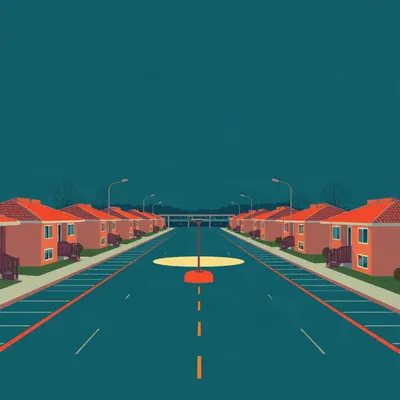
Hannah sent us something this week. She's been reading about suburbs and she wants us to take them seriously. On the personal level she hates the lifestyle, and she's especially frustrated by the idea that once you have kids, you're supposed to move to the suburbs. As if children need a small patch of monoculture grass more than they need walkability, amenities, culture, independence, and not spending hours of their lives in cars.

And then she goes bigger. She's asking whether suburbs are actually a bad model on a societal level. The Strong Towns argument that the infrastructure costs eventually outstrip the tax base. The environmental cost of more land, more roads, more driving, bigger footprints. Whether rural life can be something entirely different from sprawl. And if suburbs aren't the answer, what is the best model for human settlement, and how much of it just comes down to the car?
So let's start with the personal, because that's where the frustration actually lives.
Right, and I think the personal case is the strongest version of this whole argument. There's a public-health literature on children's independent mobility that is damning, and it says something very specific.
Define it first.
Independent mobility is the freedom for children to move about their neighbourhood without adult supervision. That's Frohlich and Collins, twenty twenty-three. And the case they make is that this is not a nice-to-have. It's associated with physical activity, with social development, with motor development. Marzi and Reimers, the twenty eighteen review, put it plainly. There's been a reduced number of children engaging in independent mobility over the last twenty years.
A measured decline.
A measured decline, and they attribute it to increasing motorization, urban sprawl, and traffic safety. Those three things. Not screen time, not stranger danger as a cultural mood. Motorization, sprawl, and the perception of danger on the roads. And the mechanism matters. Automobile-centric community design severely restricts opportunities for children to engage in active transportation and outdoor free play. That's the phrase. It restricts opportunity. It doesn't just fail to provide freedom.
It removes it.
It removes it, because every destination becomes a car trip. That's what the design does. And that's where motornormativity comes in. Frohlich and Collins coined that. It's the normalization of car-centric design, the way chauffeured childhoods come to seem natural and inevitable, when it's actually a choice. And that choice is in direct conflict with children's independent mobility.
So "of course you'd drive them, it's not safe to walk" is itself the design talking.
It's the design talking. The road tells you it's not safe to walk, and then you conclude walking is unsafe, and then you build the next road wider.
How much of a ratchet is this?
That's the part that surprised me. There's a study, Hecker and colleagues, twenty twenty-five. Around sixteen hundred and ninety-nine children, grades four to six, across urban, suburban and rural schools in Vancouver, Ottawa and Trois-Rivières. And the finding is intergenerational. The later a parent was allowed to travel alone as a child, the less independent mobility their own child has.
Parents who were restricted restrict their kids.
Yes. The restriction passes down.
So it compounds across generations.
Each generation grants the next less freedom, and the generation after that inherits both the restriction and the design that produced it. That's not a cycle that corrects itself.
It's a ratchet. Each turn only goes one direction.
That's exactly what I'd call it.
And the lawn?
The lawn is the symbol of the whole trade. The suburban lawn is monoculture grass you mow. It's privately owned, it requires maintenance, and it's often not actually used. And the reason it matters is what it stands in for. The pitch is: children need a patch of grass. What the evidence says children need is access, independence, walkability, friends within walking distance. And the suburb doesn't provide those things. It provides the lawn instead.
They sell the lawn and call it childhood.
And the neighbourhood gives the kid nothing. A kid in a walkable neighbourhood can go to the park, the corner store, a friend's house, on their own. A kid in a subdivision has the lawn, and the driveway, and the street with no sidewalks.
So the child's freedom is the same size as the lawn.
Roughly. That's the actual offer.
Here's the thing that gets left out of the lawn talk. The lawn is private space, and the suburb sells private space. The street, the pavement, the square, the park, the shop, those are shared space. And shared space is what gives a kid independence, because they can reach it without asking permission from a driver.
The lawn is a place a child plays alone, and the public realm is a place a child plays among other people. And you can't buy the second one, because it's not yours.
A patch of grass is owned. A neighbourhood is common.
And that's why the promise is broken in a specific way. Suburbs are sold as the best place to raise children, and on the metric of what children actually need, which is movement and independence and challenge, they're often the worst. The suburb doesn't give the child freedom.
It takes the freedom and replaces it with a car ride.
It replaces it with a chauffeur service that runs.
For how long?
Into adolescence, and past it. And this is the part where the childhood argument turns into the adult one. Because a child who never moved around independently grows into an adult who moves around in a car, and an adult in a car needs a place to park, needs a wider road, needs another lot paved.
So the childhood ratchet becomes the fiscal ratchet.
It's the same ratchet with more zeros.
So that's the personal case. Suburbs may be bad for the very people they're sold to protect. But the bigger picture is whether the whole model holds up, and there's a fiscal argument here that doesn't depend on anyone's preferences at all.
Strong Towns and Chuck Marohn. The core claim is that the financing mechanism of the suburban era, the entire post-war development pattern, operates like a classic Ponzi scheme. Ever-increasing rates of growth necessary to sustain long-term liabilities.
Say the mechanism slowly.
The mechanism is this. A local government takes the near-term cash from new development. New houses, new commercial, new streets. That cash feels like growth, feels like the tax base rising. But the same local government typically assumes the long-term liability for maintaining the new infrastructure. And that liability doesn't arrive with the tax revenue. So we must use new growth today to pay for the most urgent obligations of yesterday's growth.
So this year's development pays for last year's repairs.
And when the current year's new growth doesn't cover it, the town borrows. And it can keep doing that for years, because the cash flows in and the liability stays invisible. It only breaks when growth stops, and the whole thing collapses because the model needs the growth to keep going.
So what's the scale of that pending debt?
Strong Towns puts unfunded municipal infrastructure liabilities in the United States in the trillions.
Trillions of what, roads?
Roads, pipes, bridges, the maintenance backlogs that nobody has ever budgeted for because the model assumes growth will cover it.
And the crucial honesty move here, which I want to credit, is that Strong Towns says this isn't fraud. No one is being nefarious. This is the status quo approach every one of us has inherited. The villain is the design default, not the people.
Which is why it gets traction in places that are allergic to the other arguments.
Because it's not a moral accusation. It's a spreadsheet.
It's a spreadsheet, and it's worse, because you can't vote a spreadsheet out. The pattern is inherited.
Where's the case study?
Nolensville, Tennessee, and this is the one I'd put up first.
Small town near Nashville.
Small town outside Nashville. An infrastructure study of five streets. And all four non-townhome suburban patterns ran long-term deficits.
Even with the higher-value homes paying more tax? Because that's the standard defense.
Even adjusting for higher-value homes paying more tax. They compared the townhome street, with twenty-four foot lots, against the suburban streets, with sixty-nine to one hundred and fourteen foot lots. And the townhome street, with the smallest lots and presumably the cheapest homes, produced a surplus of fifty-one dollars and forty-three cents per lot.
The cheap houses made money.
The cheap houses made money, and the expensive houses on the big lots lost money, because they have a small tax contribution per foot of infrastructure they require. And the numbers get worse the newer the street. The worst deficit was three hundred and twenty-six dollars and twenty-seven cents per home, on a street that was platted between twenty thirteen and twenty sixteen.
The newer the street, the deeper the hole.
Yes. Which tells you the model is becoming more expensive over time, not less.
So what's the fix, if not a ban?
Strong Towns' fix is not banning suburbs. It's ending the subsidy. Their line is: all we have to do is stop subsidizing it. That alone would drastically slow its spread.
So charge it what it costs.
Charge it what it costs. And the framing they use is the sharpest line in the whole argument. Why should the townhome dweller be forced to subsidize the McMansion resident?
Why should the small house pay for the big one.
That's it.
And the case studies aren't outliers, you said.
Lafayette, Louisiana, which would have been bankrupt decades ago on accrual accounting. Kansas City. Spokane, which Strong Towns describes as a soft default, functionally insolvent. Cobb County, Georgia. Collin County, Texas, where officials claim twelve point six billion dollars is needed for new roads over thirty years, and nothing for maintenance.
Twelve point six billion for new roads.
And zero for maintenance as a line item.
So the budget is set up so that maintenance doesn't exist.
It doesn't exist as a category.
And Detroit on the end of that list.
Detroit is the end state of the list.
So the fiscal argument runs on the same arrow as the childhood one. It builds and assumes the future keeps building.
Both are the same engine, and the engine needs growth.
Now the environmental cost. And this is where the numbers surprised me.
The Berkeley work. Christopher Jones and Daniel Kammen, twenty fourteen. Suburbs account for about fifty percent of all United States household greenhouse gas emissions while holding less than half the population.
Half the emissions, less than half the people.
Households in dense urban cores have carbon footprints about fifty percent below average. Households in distant suburbs are up to twice the average.
Twice.
Twice the average, and the drivers are income, vehicle ownership, home size. All three go up in the suburbs.
So it's not just the commuting. It's the house, the cars, the consumption pattern around the house.
And Jones coined the image for it. Metropolitan areas look like carbon footprint hurricanes, with dark green, low-carbon urban cores surrounded by red, high-carbon suburbs.
A hurricane with a green eye.
And the point of the image is that the big metros have the greenest cores and the widest red rings, so their overall average can end up slightly higher than a smaller metro. The suburb eats the core's savings.
Which sounds like the answer is build dense, and then that's it.
That's the trap, and I want to be careful here, because the study explicit says it isn't so simple. A tenfold increase in central-city density corresponds to only about twenty-five percent lower emissions.
Only.
Only. So you can multiply density ten times and get a quarter off. And worse, dense suburbs actually have higher footprints than less dense ones, because the people living there are richer and consume more. So density alone is a red herring dressed up as an answer.
So the suburb-lover says, see, density doesn't even work.
And the honest reply is that density is a component, not the whole design. Kammen's actual prescription for suburbs is solar photovoltaic, electric vehicles, and energy-efficient technologies.
Which is a retrofit, not a redesign.
It's a retrofit. And it's a real prescription for existing suburbs, because you're not demolishing them. But it doesn't address the land use, the car dependency, the infrastructure liability. It changes the cars and the roof, not the geometry of the settlement.
So which suburb is the bad one?
The distant one. The far one. The one that made development possible with the car, and made the car mandatory for residents.
So the problem is the distance the design forces, not the brick.
That's it. It's the geometry.
Hannah's question has a hinge, though, and it's the part almost nobody gets right. Not all non-urban living is the same. A suburb and a countryside village are categorically different things, and lumping them together is how the sprawl argument gets accidentally extended to rural life.
It's the distinction Strong Towns' Daniel Herriges drew explicitly, in a piece with the title Walkable? Check. Urban? Check. Rural? Also Check.
How does a village get a check on all three?
Dingle, Ireland. Population around two thousand. Tightly packed rows of buildings with storefronts below and homes above. Inherently a fifteen-minute community. You can walk from one end to the other in minutes. And crucially, because the village has a compact form with fairly hard edges, you can walk out of town into unspoiled nature within minutes.
So the walkable village and the countryside are the same object. The outside begins at the edge.
The outside begins exactly where the town stops. That's the thing. The hard edge is what gives you both. And he gives a bigger example too, Shrewsbury in England. Seventy thousand people. Within less than two miles of the center, the surroundings quickly become rural.
Two miles from a town of seventy thousand, and you're in farmland.
And then the contrast, which is North America. Towns that bleed gradually into the countryside. Large lots, wide roads, strip retail. The greenery in these places is greenery you can only view from a car, and the nature is pushed far from downtown amenities.
The countryside is present but unreachable.
Present as scenery. You can see the field from the parking lot of the strip mall, and you can't walk to the field, because the road is designed so you can't.
So in a suburb you can see the trees but not reach them.
And in Dingle you can walk out of town into the hill. Herriges' conclusion is a sentence worth keeping. Let urban be urban and rural be rural.
Let the edge be an edge.
The suburb is the settlement that refuses to be either. It spreads the city without the city's compactness and pushes the countryside without the countryside's access.
That's the distinction Daniel was making and it's the one the lawn argument hides, because suburbs are sold as countryside. They're not countryside. They're the in-between that doesn't work as either.
And now we get to the hardest part of the whole episode. Because the accounting has come home.
Ireland.
Ireland.
Where the small town is a housing answer being thrown away.
Valerie Mulvin, an architect writing in the Irish Times in twenty twenty-four. Ireland's rural towns contain an estimated ninety thousand potential homes. Already built. Already serviced, with shops, schools, health centres, parks. Clustered around what she calls some of the finest civic squares in Europe.
Ninety thousand homes already standing.
Already standing. She counted more than one hundred vacant shops on the main street of Youghal, one town in County Cork.
One town. One hundred empty storefronts.
And her first requirement for revival isn't money. It's a mindset change. Many people think they need to have a suburban existence, with a car that can be parked in the front garden.
So the town is empty and the fields at the edge are filling with houses.
That's the pattern. In Dublin's hinterland, once-busy market towns have been reduced to dormitories servicing the capital. And growth happens doughnut-style, in sprawling estates and shopping centres in a ring around the edge.
So they hollowed the town and built the ring around it.
Meanwhile Seán Moncrieff, also writing in the Irish Times this year, points out that Dublin's nineteen sixties suburbs created communities. And today's sprawl is soulless. Established places that used to have a centre are becoming hollowed out.
So the old suburbs worked and the new ones don't.
That's the distinction he's drawing. And Olivia O'Leary, the same year, asks the question I'd frame the whole debate around. In the middle of a housing crisis, why are our town centres so empty?
When did the town stop being the obvious place to live?
That's the bit that surprised me most, because the town was never rejected. It was priced and designed around. The suburban expectation arrived with the front-garden car, and the town centre got treated as past it, and stopped getting investment. And now you have empty buildings and an empty field on the edge of everything.
The buildings have plumbing.
They have plumbing, they have school places, they have a square, and they're standing empty.
What's Daniel's hypothesis at the end of all this, that rural living is ecologically defensible only when it serves agriculture. Is that actually testable?
There's no direct source that tests that claim. The closest thing is the Strong Towns argument that compact rural villages are fiscally and environmentally sound because of their hard edges, and the Irish material about vacant town-centre housing. But the framing that rural living only counts when it serves agriculture, I don't think that holds up.
Why not?
Because the criterion is doing the wrong job. The question isn't what the land produces economically. It's whether the settlement is compact and walkable, with a functioning high street and a hard edge. Dingle doesn't ask you what the fishing earns. It works because you can walk it.
It's the form, not the output.
It's the form. A small town with a functioning high street is defensible even if it's not primarily agricultural, because the form puts daily needs within walking distance, keeps the edge sharp, and doesn't require the entire business to be driven.
Agriculture is a red herring, and Hannah's intuition about small towns is right. The form is what matters.
Hannah is right. But the productivity criterion is the wrong test.
Then let's try the urban answer, because the city is not the villain in any serious version of this. Human beings have lived in dense settlements for thousands of years. What's wrong is the design we chose in the last century, and the car is where the design went wrong.
The research does converge on an answer, even though it's a family of answers rather than one. Compact, mixed-use, walkable settlements with hard edges. That's the common thread.
The answer to the suburb is the small town.
The small town is the answer for a lot of people. But the Berkeley study is the caution here. Density alone isn't sufficient. So the prescription isn't build denser and call it a day. It's about design. Mixed uses. Green space. Traffic calming. The absence of car-dependency as a structural fact of the place.
All the things the suburb is missing.
All of it, at once. That's the reason it's so hard. The suburb isn't bad on one axis. It fails on all of them at the same time, and each failure reinforces the others.
What does the kid in the city actually get, and why does it feel like no one talks about it?
Because the suburb promises the child a lawn, and the city was promised nothing. Nobody in the advertising ever said the city was the place to raise a kid. And the city often isn't, not in its current form, because we built the city around the car too.
The answer to sprawl isn't Manhattan.
The answer isn't Manhattan. The answer is the fifteen-minute town, with a centre, an edge, and daily needs within a walk.
Which takes us to the car as the actual engine of all of it. It's the one physical object that ties the fiscal failure, the environmental failure, and the childhood failure into a single mechanism.
It's the same object in all three analyses. The car enables sprawl, because you can live far from everything. The car requires miles and miles of road, which is what blows the municipal budget. The car isolates children, because the roads it needs are roads a child can't safely cross. And the car makes the suburb possible in the first place.
It's not that the car is the problem and everything else is downstream. It's that the car is the visible part of the design, and the design is the problem. The car is the symptom and the enabler at the same time.
That's why the fix is design, not just engines. The electric car fixes the emissions, but it doesn't fix the distances, the land use, the liability, or the childhood.
It fixes the tailpipe.
The geometry stays exactly the same.
The honest summary is that the suburb optimizes the wrong thing. It optimizes privacy and space, and it pays for them with the public realm, which is the only place a community and a child and a budget actually live.
The payment comes due slowly, which is why nobody noticed.
The town is the model, if we can stop treating it as a relic.
In Ireland the town is sitting there, ninety thousand homes of it, with a high street and a square, waiting.
This isn't really a question of rural against urban.
No, it's a question of compact against sprawl.

I've been watching one of these for years. There's a cul-de-sac behind the pub in Mooncoin and a man named Ned Prendergast, who measured it, and it came to two hundred and twelve feet. Every house on it. He had this theory that the tarmac gets put down in three passes, and the middle pass is the one the developer skips.
What happened to it?
The middle pass came up first. And they did a survey at the edge of it, and the soil was nine inches down to the standing water. Ned went to the meeting from the house and came home with the survey and gave it to me at the gate.
What did the meter say?
I had this plan, years before, to build a house in a bog outside Mooncoin. I'd set out the money for a septic tank and a driveway and I'd asked a man about the price of a road. And I found out the local authority would take over the estate when it was done, so nobody had ever priced the maintenance.
You'd have been the one paying it.
I read the county development plan three times, front to back, in the kitchen, with the pen. And there's a table in it of what they charge per metre of the footpath, and the road, and the scope of the taking-in-charge, and I checked it with the surveyor before I put a bid on the field.
What did the surveyor say?
He said the price was right and the time was wrong. I sent the letter to the council in November and I never got a reply. And the price of the field doubled in the meantime, so it was never going to happen anyway. But the number came out at two thousand and two pounds, and I know the number because I've got the envelope somewhere.
You still keep the envelope.
I know where it is.
The letter never got a reply.
No.
The number was real even if the house wasn't.
The number was real.
The estimate on paper, which is the only maintenance number anyone was holding.
That's the whole trap in one envelope.
The plan was real and the price was real and the thing that stopped it was the money, not the design.
It was a good design.
The cutting-room floor has a number, and it's about how often the model has been tried and refuted before.
It has. There's a thread on Hacker News from twenty eleven titled The American suburbs are a giant Ponzi scheme.
Twenty eleven.
Twenty eleven, with hundreds of comments, and nothing about the argument has changed since. The same debate, the same case studies, the same rebuttals, fifteen years of it, and the pattern has spread further every year.
The argument that broke today has been breaking for fifteen years.
Nobody's changed the default.
Which is what we said at the start about the municipal budget. The maintenance line that doesn't exist until it's due. The estate that gets taken over when the developer is gone. The kid who never got to walk. The town centre with a hundred empty shops. All of it the same model, all of it billed later.
The Irish towns are the thing that could have answered it already, if we'd seen them as an answer instead of a past.
The field outside Mooncoin was never the problem. It was the envelope. We told the developer to skip the middle pass, and then we paid for it.
In Ireland there are ninety thousand homes with plumbing and schools and a square, waiting for the mindset change.
If people move back into the towns, Mulvin says, they'll be vibrant communities again. The bit that has to happen is longer than a street.
That's where we land. It isn't rural against urban. It's compact against sprawl. And it isn't just about the car. It's about the design the car made mandatory. The suburbs weren't the wrong choice in the moral sense. They were the wrong option that got subsidized into being the only option, and now the bill's coming in and the field's already been sold.
If you can walk to the pub from your house, you're part of the answer, no matter how far the nearest field is.
The lot's about whether you can walk to the centre. Compact and walkable or spacious and stranded. That's the fork. The rest is the bill.
Thanks to Hilbert Flumingtop for producing this one. If you enjoyed the episode, please leave a review. It helps other listeners find the show. For more along these lines, there's episode thirty-one ninety-three, Connected Villages; episode five oh four, How to Start Thinking Like an Urbanist; and episode twenty-seven forty-six, How Zoning Built the Suburbs We Hate. This has been My Weird Prompts. Send us your own prompt on Telegram at t dot me slash MWP listener bot.
We'll be back soon.