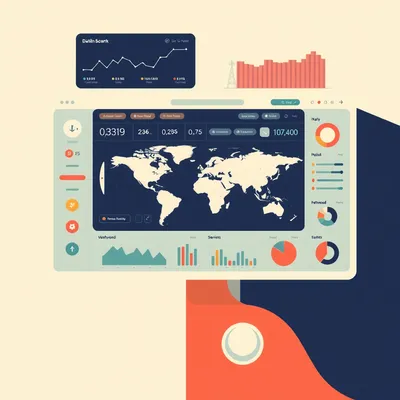
During the Taiwan Strait earthquake back in March, the response teams in Taipei had a live dashboard pulling in data from over two hundred different feeds. Seismic sensors, traffic cameras, social media posts geotagged with damage reports, even power grid status from the utility company. The commanders weren't just looking at a map with pins; they were watching a live stress index for each district, calculated from all that noise, which told them exactly where to send the first helicopters.

That's the perfect example. The dashboard didn't stop the earthquake, but it turned chaos into a prioritized list. The district with the highest composite score—factoring in collapsed structures, trapped-person signals from mobile networks, and blocked roads—got resources in under eighteen minutes. Real-time data didn't just inform the decision; it was the decision framework.
Which brings us to Daniel's prompt. He wrote in after our SITREP episode, curious about how people actually build these dashboards for situational awareness. He notes that open-source tools like Grafana are great for server metrics, but turning the chaos of world news or a crisis into a clean, meaningful metric is the hard part. He's asking about the foundational technology, how they're used in emergency response, and whether there are any existing solutions out there, open-source or commercial, for monitoring things like TV news panels, or if everyone is still building from scratch.
It's a fantastic follow-up. And by the way, today's script is coming to us from deepseek-v-three-point-two.
A friendly assist from our AI neighbor. So, Herman, where do we even start with this? It feels like the gap between a pretty Grafana graph and knowing which city block is about to collapse is… substantial.
It is, but the bridge is built from a stack of technologies that have gotten incredibly powerful and, crucially, more accessible. The core idea isn't new—military command centers have had maps with overlays for decades—but the democratization of the components is what's changed the game. It's why a local fire department can now have a system that would have been a national intelligence asset twenty years ago. And that system, at its core, is what we'd call a situational awareness dashboard.
What exactly is a situational awareness dashboard? It's a visual interface that aggregates, analyzes, and displays real-time data from multiple, often disparate, sources to support rapid decision-making. Its core components are data ingestion, processing, and visualization.
The primary function is to reduce cognitive load. A commander or a news editor can't mentally process two hundred feeds. The dashboard's job is to do that processing for them, highlight anomalies, and surface the signal—like that district stress index. It’s a force multiplier for human attention.
And this is the digital evolution of the SITREP format we talked about. The old-school paper SITREP was a snapshot: enemy location, friendly status, weather. A modern dashboard is that same intent—what’s happening, where, and what does it mean for my mission—but it’s a living, breathing, auto-updating document. The "summary" is now a dynamic visualization.
The functions boil down to… monitoring, alerting, and forecasting?
I’d frame it as awareness, understanding, and projection. First, make me aware of all relevant data points. Second, help me understand their relationships and implications—this fire is near a chemical plant, this protest is blocking an ambulance route. Third, project likely outcomes if current trends continue. That last bit is where the real magic, and the real difficulty, lives.
This isn't just for earthquakes or war rooms. You could use the same stack to monitor a financial market, a social media narrative, or the operational health of a city.
The technology stack is agnostic. The key is defining what "situational awareness" means for your specific context. For a power company, it's grid stability. For a newsroom, it's breaking story development. The dashboard is just the window—though, as you know, the plumbing behind it matters too.
Right, and that plumbing often starts with Elasticsearch and Kibana. It's not a coincidence—it's the default for a reason. When Daniel mentioned the heavy lifting earlier, this is usually where it happens.
That's because the problem, at its core, is a search and indexing problem. You have torrents of unstructured or semi-structured data—news articles, social posts, sensor telemetry, video transcripts. Elasticsearch is built to ingest that firehose, index every word and metadata field, and make it queryable in milliseconds. Kibana then provides the visualization layer on top. It's why, as of this year, estimates suggest over seventy percent of custom situational awareness dashboards use Elastic somewhere in their pipeline.
It’s the industrial-grade filing cabinet. But indexing text is one thing. How do you get from "ten thousand news articles about flooding" to a single, reliable metric showing flood severity in region X?
That's the transformation layer. This is where you move from search to sense-making. You might have a pipeline where raw news text is first categorized by a classifier—is this about infrastructure, casualties, weather? Then, a named entity recognizer pulls out locations, organizations, and event types. Finally, you apply some heuristic or even a simple machine learning model to assign a severity score based on the language used. "Catastrophic flooding" scores higher than "heavy rains." Multiple sources mentioning the same location increase confidence. That final score becomes the metric you graph.
Which sounds straightforward until a headline says "heroic efforts avert catastrophic flooding," and your naive model still spikes the severity meter.
That's the classic challenge in condensing news into metrics: context collapse. You lose nuance, irony, speculation, and future tense. The dashboard might see "invasion" and "border" and spike a military tension metric, when the article is actually historical analysis. This is why the most effective systems use hybrid approaches. They combine quantitative data—like satellite imagery showing actual troop movements—with qualitative news analysis, but they weight the quantitative signals much higher. The news informs the 'why,' but the sensor data defines the 'what.
Let’s ground this. Walk me through how that might have worked in a real case, like a hurricane response.
Okay, take Hurricane Helene's landfall in Florida last year. A county emergency operations center dashboard would ingest data streams. Quantitative: National Weather Service wind speed and pressure data, real-time river gauge levels, power outage maps from utilities showing percentages of customers dark. Qualitative: local news broadcast transcripts, citizen reports via a public-facing app, even 911 call log keywords.
The dashboard isn’t reading the news article about the river; it’s reading the actual river gauge.
The news might say "the river is rising dangerously," which is a useful flag. But the dashboard’s primary metric for "flood risk" is directly fed from the gauge’s data feed—water level in feet, rate of rise per hour. That’s an objective, actionable metric. The qualitative feeds help with triage. A cluster of 911 calls mentioning "roof collapse" in a specific zip code, even before official damage surveys can get there, becomes a hot spot on the map. The system correlates the call location with the quantitative wind gust data for that area to validate the signal. It’s about weaving threads together to create a fabric of understanding, not just a single thread.
This has to happen in real time. How do these systems handle the latency? You can’t have a fifteen-minute processing delay when a levee is failing.
This is where the architecture choices matter. The classic ELK stack—Elasticsearch, Logstash, Kibana—can be tuned for low latency, but it’s fundamentally batch-oriented. For true real-time, you see a shift to stream-processing frameworks. Apache Kafka or Apache Pulsar to handle the message queue, then something like Apache Flink or Apache Spark Streaming to perform those transformations—the classification, entity extraction, scoring—on the fly, as each data point arrives. The processed metric is then written to a time-series database like Prometheus or InfluxDB, which is optimized for serving the latest value to a visualization tool like Grafana with minimal lag.
The stack becomes a hybrid. Kafka for the stream, Flink for the brain, Prometheus for the memory, Grafana for the eyes.
That’s a modern, high-performance pipeline, yes. And Grafana’s latest version, Grafana ten, which came out in January, added native support for more real-time data sources and alerting rules that can trigger on patterns in these fast-moving streams, not just on static thresholds. It’s becoming a central pane of glass for this exact use case.
It strikes me that the real technological innovation isn’t any single tool, but the expectation that you can wire all this together. The API connectivity between the weather service, the power company, the 911 system, and your dashboard. That’s the glue that was missing a decade ago.
The standardization of data formats and the ubiquity of public APIs are the unsung heroes. A commercial solution isn’t selling you better chart colors; it’s selling you pre-built connectors to hundreds of these critical data sources and the normalization logic to make sense of them all. That’s the heavy lifting they abstract away. Which makes me wonder—when the pressure's on, like during Hurricane Helene's response, how does that hybrid system actually perform in the trenches?
The commercial solutions handle the connectors and normalization, but I want to hear about real-world stakes. When the sirens are blaring, how are these dashboards actually being used? Walk me through Hurricane Helene's response as a case study.
The post-analysis from FEMA and the Florida Division of Emergency Management was revealing. In counties that had deployed integrated dashboards, the average time to allocate state and federal strike teams to the highest-priority areas was cut by nearly forty percent compared to counties relying on traditional radio and spreadsheet coordination. The dashboard didn't just show a map; it became the coordination platform. A state resource coordinator could see, in real time, that County A's dashboard showed a composite score of ninety-two for a grid sector—indicating structural collapse, power loss, and trapped-person signals—while County B's highest sector was a seventy. The decision to send the nearest urban search and rescue team to County A was essentially made by the data.
That's the emergency response side. But Daniel also asked about crisis management in a broader sense—monitoring world news, geopolitical tensions. Is the same stack used to watch, say, a developing conflict zone?
The architecture is similar, but the data sources and the "metrics" are different. Instead of river gauges, you're ingesting satellite imagery feeds, vessel automatic identification system data, local news telegrams, and social media sentiment analysis. The commercial intelligence platforms like Janes, or even some hedge fund geopolitical risk dashboards, are built on this exact premise. They just have different connectors. Their key metric might be "escalation probability," derived from counting troop carrier sightings in satellite imagery, cross-referenced with the frequency of certain phrases in state media transcripts.
For the rest of us who aren't a three-letter agency or a hedge fund? What does the open-source landscape look like for building something like that?
That's where the comparison gets interesting. The pure open-source stack—Prometheus for metrics, Grafana for visualization, maybe a Threema or Mattermost plugin for alerts—is incredibly powerful for monitoring things you can easily quantify. Server load, network latency, application errors. It's the gold standard. But for situational awareness where your data isn't a clean number from the start, you hit Daniel's wall. You need that entire upstream pipeline of natural language processing, image recognition, and data fusion that turns chaos into a metric. Very few open-source projects offer that as a turnkey solution.
Because that upstream pipeline is the secret sauce. It's the hard part.
So you have two paths. Path one: you build it yourself on top of open-source components. Use the ELK stack or a Kafka-Flink pipeline to ingest raw data, then write your own Python services with libraries like spaCy for entity extraction or TensorFlow for custom classifiers to create your metrics. This is what most serious entities do when they build from scratch. It's flexible but a massive engineering undertaking.
Path two is the commercial and open-core offerings that are emerging. They’re essentially pre-packaged versions of path one. Tools like GreyNoise for threat intelligence, or Flashpoint for geopolitical risk, provide finished dashboards with their own curated data feeds and severity scores. You're buying the analysis, not just the tool. On the more open side, there's The Hive Project for security incident response, which is open-source and provides a framework for correlating alerts and managing crises. But again, you often need to feed it. The middle ground is platforms like Splunk or Datadog, which started for IT monitoring but have aggressively expanded into security and observability use cases. They sell the connectors and the normalization logic, as we said.
The open-source world gives you the engine and the gauges, but you have to build the fuel refinery yourself. The commercial world sells you the refined fuel and a nicer dashboard, but you're locked into their refinery.
That's a perfect analogy. And it explains why, for a city's emergency operations center, a commercial solution from a company like Everbridge or RapidSOS might make sense. They've already done the work to integrate with thousands of 911 systems, weather feeds, and hospital status databases. For an open-source enthusiast or a team with specific, unusual data sources, rolling your own with Grafana and a custom processing pipeline is the only way.
Which brings us to the next frontier you alluded to: AI and machine learning. It feels like that's the promised land for automating the "condensing news into metrics" problem. How much of that is real right now, and how much is vendor slideware?
It's a mix. The real, deployed applications are still narrow but powerful. Think of it as augmentation, not replacement. For example, during the Taiwan Strait earthquake response, AI models were used for two specific tasks. First, computer vision on traffic and security camera feeds to automatically detect structural damage or road blockages, tagging locations without a human having to watch every feed. Second, natural language processing to categorize and geolocate social media posts pleading for help, filtering out noise and duplicates. The AI didn't decide which district to prioritize; it massively accelerated the creation of the clean, trusted data points that the human operators used to make that decision.
The AI handles the pattern recognition at scale—"find all the images in this feed that look like a collapsed bridge"—and surfaces them as a data layer on the map. The human still decides what to do about the bridge.
The machine learning enhances the "awareness" and "understanding" functions. The "projection" function—forecasting what happens next—is where it gets sketchier. There are research projects using agent-based modeling to simulate crowd movements during an evacuation, or to predict the spread of a wildfire based on fuel, weather, and terrain. But these are computationally intense and highly sensitive to the quality of their input data. They're not yet reliable enough to bet lives on without heavy human oversight. The hype is ahead of the deployment.
It seems like the biggest risk is over-reliance. If your dashboard's "crisis severity score" is driven by a black-box model that's misinterpreting satire as fact, you could waste resources or, worse, miss the real threat because it didn't trip the model's wires.
That's the core challenge. The dashboard presents a clean, authoritative-looking number that lends an aura of mathematical certainty to what is often a messy, qualitative situation. The best practitioners use these tools with what's called a "human in the loop" mindset—the dashboard alerts you to an anomaly, but you have a drill-down path. You can click on that high severity score and see the raw data behind it: the three news articles, the satellite image, the social media post. You verify the signal before you act. The tool informs judgment; it must not replace it. Which raises the question—how does someone actually get started with this in practice?
So for someone listening, like a city manager, a newsroom editor, or even a concerned community group, who wants to build a basic version of this without starting from scratch or signing a million-dollar contract—what's the practical path? Where do they begin without drowning in Kafka streams?
Start with the problem, not the technology. Define the single most important question you need answered in a crisis. Is it "Where are people trapped?" Then your dashboard needs a map with a location layer. Your data sources become 911 call logs, social media geotags, and maybe traffic cam AI. You don't need to monitor everything. Then, pick the simplest tool that can visualize that answer. Often, that's still a well-configured Kibana dashboard or a Grafana instance pointed at a single, clean data source. The Taipei example worked because they focused on a composite score for rescue priority, not on displaying every raw data point.
Step one: define the one critical metric.
Step two is data hygiene. This is the unglamorous foundation. You need a reliable, automated way to get that data into your system. That might be a script scraping a government JSON feed, or a Zapier automation pulling from a Google Sheet. The key is it must be automatic and timestamped. If you're manually updating a spreadsheet, you've already lost. Use the standardized APIs whenever they exist.
Step three is accepting that your first dashboard will be ugly and limited. It's a prototype.
Build a minimum viable dashboard. A map with one layer. A single gauge showing the composite score for your neighborhood. Prove the concept and that it provides value. Then you iterate. Add a second data source. Improve the visualization. This is where the open-source tools shine—they're free to experiment with. You can set up a Grafana instance on a spare computer in an afternoon.
You've emphasized the human-in-the-loop concept. How do you bake that into the design?
Every alert, every red zone on the map, must be clickable. The user must be able to drill down to the source. If your "civil unrest risk" metric spikes, clicking it should show the three local news headlines, the tweet from the police department, and the event permit filing that contributed. Trust comes from transparency. Also, build in a manual override. A big red button that says "Acknowledge" or "False Alarm." The system should learn from those overrides.
What about scalability? You start monitoring your town, then a county, then a region. Where does the architecture typically break?
The first breakpoint is usually the data ingestion and processing pipeline. Your Python script that polls one API every five minutes will fall over when you need to poll ten APIs every thirty seconds. That's when you graduate to a message queue like Kafka, or a managed service, to handle the load. The second breakpoint is the database. Elasticsearch or your time-series database needs to be sized and tuned for the write and query volume. The third is the visualization itself—too many graphs on one screen creates noise. The principle is to start simple, monitor your system's own performance, and scale the components that are buckling.
The final piece of practical advice is to monitor your monitor.
Your situational awareness dashboard is itself a critical system that needs continuous care—its own health dashboard monitoring the power grid API feeds, processing latency, everything. Because when this foundation fails during a crisis, you're worse off than if you'd never built it. That's what keeps me up at night: how these systems aren't one-time builds but living things. The moment we stop maintaining them is the moment they stop protecting us.
That maintenance burden you describe—it makes me wonder where this ends. As the tech keeps advancing with better AI parsing, faster data pipelines, AR overlays for first responders... at what point does the dashboard stop being just a tool? When does it cross over from informing our situational awareness to actually defining it?
That's the critical ethical layer, isn't it? We build these systems to see more, to understand faster. But the act of choosing what data to include, how to weight it, what constitutes an anomaly... those are human value judgments baked into code. The dashboard illuminates some truths and casts others into shadow. As these tools become more central to crisis response, or even to how newsrooms decide what’s a story, we have to constantly ask: what are we not seeing, and why?
Who gets to build the lens? The democratization of the tech is a net good—a local community group can monitor river levels. But it also means more actors defining their own reality, sometimes in direct conflict. Two dashboards, same event, telling two different stories.
Which brings us back to the human in the loop. Not just as a verification step, but as the moral agent. The tool provides a picture; we are responsible for deciding what that picture means and what to do about it. The future challenge won't be building a faster dashboard. It will be cultivating the wisdom to use it well.
A perfect note to end on. Thank you to our producer, Hilbert Flumingtop, for keeping all our feeds tidy. And thanks to Modal for providing the serverless GPU platform that powers our pipeline. If you found this useful, the single biggest help to us is leaving a review wherever you listen. It makes all the difference.
This has been My Weird Prompts.