Imagine you could know the exact time and place of the next major war, six months before the first shot is fired. You could move markets, reposition fleets, evacuate civilians. The entire shape of global politics would warp around that single piece of foreknowledge.

Which is why people have been trying to do exactly that for as long as there have been wars to fight. It’s the ultimate high-stakes game.
Daniel sent us this one. He’s asking us to explore the history and the mechanics of geopolitical forecasting. The whole art and science of trying to predict conflicts, their outcomes, the economic fallout, the humanitarian crises. The focus is on worst-case scenario planning, how governments do it, how civilians might use it, and where artificial intelligence fits into this whole tense, murky picture.
Oh, this is a deep and timely one. With everything from the persistent tensions in the Middle East to the ongoing situation in Eastern Europe, the ability to forecast isn’t just an academic exercise anymore. It’s a critical tool for survival and stability. But I think we should make a crucial distinction right at the start. This isn't about clairvoyance. It's about reducing uncertainty in a system that is, by its nature, chaotic.
By the way, our friendly script-writer today is deepseek-v3-two. Keeping us on point.
So where do we even start with this? The stakes are almost self-evident, but the methods are where it gets truly weird.
And those methods deserve some unpacking. When we say 'geopolitical forecasting,' we're not talking about reading tea leaves or a pundit's gut feeling on cable news. It's systematic. It's the structured analysis of political, economic, and military trends to predict future conflicts and their knock-on effect.
And what makes it distinct from, say, economic forecasting or weather prediction is the sheer number of variables and the profound role of human agency. You're modeling the decisions of leaders, the morale of populations, the friction of institutions—all of which can change based on a single speech or an intercepted memo. It's prediction in a system where the components are actively trying to outthink you.
Which is why its history is so intertwined with game theory, especially from the Cold War era. That was the first major attempt to formalize the logic of conflict between rational, but opposed, actors. The whole mutually assured destruction doctrine was a forecast, a terrifyingly simple one: if you nuke us, we nuke you, therefore you won't nuke us.
And from those theoretical models, you get the rise of scenario planning in places like the RAND Corporation. Instead of seeking one 'correct' prediction, they'd develop multiple plausible futures—best case, worst case, and a few in between—to stress-test strategies. The goal wasn't to be perfectly right, but to be less surprised.
That framework, from game theory to scenario planning, is the bedrock. The computers came later, first to crunch numbers for those models, and now to potentially find patterns we humans miss. But the core question has always been the same: given what we know about the world today, what happens tomorrow?
Here’s a fun historical tangent. Before RAND and the Cold War, one of the earliest systematic attempts at geopolitical forecasting was actually by a geographer, Sir Halford Mackinder, in the early 1900s. He developed the "Heartland Theory," predicting that whoever controlled the Eurasian heartland would command the "World Island" and ultimately dominate the globe. It was a sweeping, century-scale forecast that directly influenced Nazi Germany’s drive east and later, Cold War containment policy. It shows that these frameworks, even when simplistic, can have a terrifyingly real impact.
The forecast itself becomes a geopolitical actor, shaping the decisions it was trying to predict. It’s a feedback loop. Okay, so let's talk about the actual tools in that toolbox before the computers arrived. The traditional approaches that defined the field for decades. Game theory gave us the logic, but applying it required structured methods.
You had formal game theory models, like the prisoner's dilemma applied to arms races. You had scenario planning, like Herman Kahn's 'thinking about the unthinkable' at RAND, which literally war-gamed nuclear escalation steps. And you had, and still have, expert panels. The CIA's 'Red Cell' analyses are a classic example—a dedicated team tasked with adversarial thinking, challenging the agency's own consensus.
The devil's advocate approach, institutionalized. Which sounds great in theory, but runs headlong into human limitations. Bias is the big one. Confirmation bias, where analysts fit new data to an existing narrative. And then there's the problem of static models.
A model built on the Cold War balance of power might completely miss the rise of non-state actors or cyber warfare as a primary conflict domain. The frameworks themselves can become blinders. This is why traditional methods famously struggle with what we now call black swan events—high-impact, low-probability shocks that fall outside the modeled scenarios.
Like a surprise attack from a direction you've deemed implausible.
The quintessential case study is the 1973 Yom Kippur War. Israeli and American intelligence had a dominant, static model: Egypt and Syria would not attack because they knew they couldn't win a full-scale war against Israel's military. They filtered all the warning signs—troop buildups, Soviet evacuations—through that model. The signals were there, but the interpretive framework dismissed them as sabre-rattling. The forecast was catastrophic failure.
The cost of a false positive—crying wolf—was deemed higher than the cost of a false negative—being caught asleep. How do governments typically make that calculation? Is there a formal calculus, or is it purely gut-level politics?
It's a brutal risk-assessment equation, often with politics baked in. A false positive means you mobilize, spend resources, potentially escalate tensions, and look foolish if nothing happens. A false negative means you're caught flat-footed, with lives and territory on the line. Democratic governments, sensitive to public perception and budget cycles, often have a higher tolerance for false negatives in the short term, because the blame for being unprepared comes later. Autocracies might lean the other way, prioritizing regime survival over international credibility. But even that’s not perfect. Look at Russia’s 2022 invasion of Ukraine. Western intelligence had a very accurate forecast of the invasion—they called it publicly—but Putin’s regime clearly assessed the cost of a false positive, like backing down and looking weak, as higher than the cost of proceeding. Their internal forecasting was catastrophically wrong.
That’s a brilliant modern example. It shows the forecast isn’t just about external events; it’s also about forecasting the adversary’s own flawed forecasting. It’s forecasts all the way down. We can see this tension play out in another modern, ongoing context: the U-S-Israel relationship. Forecasting has directly shaped policy decisions, like the approach to the Iran nuclear deal. The forecasts were about Iran's breakout time, regional proliferation, and Israel's likely response.
Those forecasts were built on traditional game theory and expert panels. forecast, which supported the deal, predicted that sanctions relief and monitoring would delay Iran's program and reduce the chance of a regional war. Israel's forecast, which opposed the deal, predicted it would empower Iran's proxies and lead to a more violent confrontation anyway, essentially making a war more likely, not less.
Two allies, using similar traditional methods, arriving at opposite policy prescriptions. That tells you something about the inputs—the assumptions about Iranian rationality, the weight given to different intelligence—and how they drive the outcome. The model isn't objective; it's a reflection of strategic priorities and threat perceptions.
Which is the core pitfall. The forecasting isn't just predicting an external event; it's often justifying a pre-existing policy preference. The 'Red Cell' tries to combat this, but it's a constant battle. You end up with scenarios that are politically plausible within the institution, rather than truly exploring the edges of what's possible. And those edges—that's exactly where the surprises hide. So how do you explore those edges without getting fired for suggesting something "unthinkable"?
You create a sandbox where the unthinkable is the whole point. Right, and that's where the silicon oracles come knocking. You've got political plausibility on one side, and on the other, you've got a machine that doesn't care about political careers or budget cycles. It just chews through satellite feeds and news cycles looking for a signal.
That's the promise of machine learning in this space. It's pattern recognition at a scale and speed humans can't match. There are models now that can process decades of news articles, financial transaction data, even nighttime light emissions from satellite imagery, to flag potential instability. One paper I read from last year described an AI geopolitical risk index that uses large language models to analyze newspaper text. It was tracking regional oil supply disruptions and subsequent stock market impacts more accurately than old keyword-based methods.
Instead of a panel of experts debating Iranian intent, you feed the model every public statement, every troop movement logged by satellite, every minor border skirmish reported in local news, and ask it for a probability score. But how does it actually learn what leads to conflict? Is it just correlating "troop buildup" with "war" because it's seen it before?
It’s more nuanced than that. Deep learning models have been shown to predict conflict outbreaks with reported accuracy between eighty and ninety-five percent by finding complex, non-linear relationships in that data sludge. For instance, it might find that a specific combination of factors—say, a spike in inflammatory state-media rhetoric coinciding with unusual banking transactions by oligarchs and a decrease in commercial flight traffic over a capital city—is a more reliable predictor than any one of those things alone. The machine doesn't get tired, it doesn't suffer from confirmation bias, and it can hold millions of these subtle data points in its 'head' at once.
Which sounds like the end of the surprise attack. But then you have to ask: what is the model actually seeing? If it's a black box, you get a prediction without an explanation. 'Alert: high probability of conflict in Region X.'The patterns indicate it.' That's not a strategy; it's a horoscope with better math. A general can’t act on that.
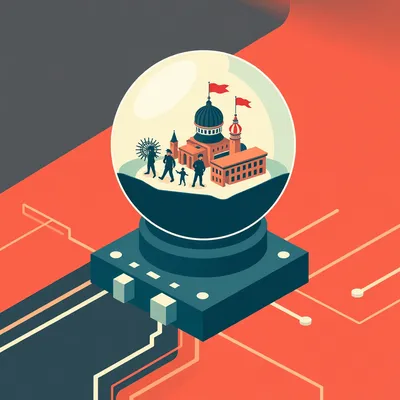
That's the interpretability problem, and it's a huge barrier for adoption in high-stakes national security. A general can't take a 'because the algorithm said so' to the president. This is where projects like Snow Globe get interesting. It's not just a prediction engine; it's a simulation platform. It tries to answer the "why" by showing you a story.
Right, the DARPA thing. AI-driven wargaming. Explain how that’s different from just running a million predictions.
Snow Globe, developed by I-Q-T Labs, is a multi-agent large language model platform. You create AI personas—say, a U.Secretary of Defense, a Chinese Politburo member, a Taiwanese president—and let them interact within a simulated crisis. The system models their decision-making based on their assigned goals, biases, and available information. It's for exploring extreme scenarios in a safe, digital sandbox. The key is, it generates a narrative of the crisis. You can see the memos the AI leaders write, the speeches they give, the miscommunications that happen.
You can run the Taiwan Strait crisis ten thousand times with slight variations, and see what triggers escalation, what leads to stalemate, where the economic pressure points are. But doesn’t that just give you ten thousand plausible stories? How do you know which one to trust?
You don’t trust any single one. That’s the point. You look for clusters and choke points. In one reported simulation of a 2025 Taiwan Strait crisis, Snow Globe didn't just model the military maneuvers. It simulated the global economic ripple effects in real-time: which semiconductor supply chains would snap, how commodity markets would panic, where secondary humanitarian crises might erupt from displaced shipping routes. It connects the military domino to the economic and social ones that follow. Analysts then look for outcomes that appear in, say, 70% of the simulations—those are your high-probability pressure points to plan for.
That's the worst-case scenario planning, evolved. But it introduces a new kind of risk, doesn't it? If your AI personas are too simplistic, or trained on biased historical data, you just get a very fast, very expensive way to reinforce your own flawed assumptions. Garbage in, gospel out. For example, if you train your "Chinese Politburo" AI solely on Western analysis of Chinese behavior, you might miss cultural and strategic nuances.
A hundred percent. It’s a massive calibration problem. And there's the adversarial manipulation risk. If you know an adversary uses a system like Snow Globe to test your reactions, you could feed false data into the sources it monitors, poisoning its perception of the world. You fight the forecast before you fight the war. Plus, the ethical dilemma is stark: if you have a model that predicts conflict with ninety-five percent accuracy, using it to pre-position aid is one thing. Using it to launch a pre-emptive strike is another. It turns a prediction into a potential first-strike justification.
The ultimate false positive. You're not crying wolf; you're bombing the forest because the algorithm said the wolf was definitely coming tomorrow. That over-reliance on algorithmic 'certainty' creates its own catastrophic failure mode—which brings us to Herman's point about solutions. So what’s the answer? Do we just throw up our hands?
The practical answer, for governments at least, is hybridization. You don't replace your analysts with a black box. You build a system where the AI handles the massive-scale pattern detection and generates scenario branches, and the human experts are the interpreters and arbiters. Their job becomes asking the 'why,' probing the machine's logic, and injecting the strategic context—the cultural nuances, the personal histories of leaders—that the data might miss. Think of it as a symbiosis. The AI is a tireless, pattern-finding bloodhound. The human is the handler who knows the terrain and decides where to point it.
The machine says 'high probability.' The human asks, 'Probability of what, exactly? A border clash or a full invasion? And what does our counterpart across the table actually want, which the news archives might not capture?' It's a force multiplier for human judgment, not a replacement. But that requires a new kind of analyst, doesn’t it? Someone who is both a regional expert and can interrogate an AI.
The intelligence analyst of the future is part diplomat, part data scientist. It’s a new skill set. And that hybrid model has civilian applications, too, beyond the war room. NGOs are starting to use these open-source forecasting tools to pre-position humanitarian aid. If a model flags a rising risk of famine in a region due to converging factors—drought, political unrest, supply chain collapse—an aid group can move supplies and personnel closer in advance, rather than scrambling after the crisis is on CNN.
Turning prediction into proactive logistics. That's a genuinely good use of the tech. So how does a regular person, someone not running a government or a charity, engage with this? It feels like the domain of spies and supercomputers. Is there a way to train this muscle?
It's becoming more accessible. The best entry point is the Good Judgment Project. It's an open, crowd-sourced forecasting platform that's been running for over a decade. They pose specific, testable questions about world events, and anyone can register to make predictions. Their top performers, the 'superforecasters,' have consistently outperformed intelligence analysts by about thirty percent in accuracy. It's a way to learn the discipline, to see how your own reasoning stacks up, and to contribute to a collective intelligence effort.
It's basically fantasy football for geopolitics.
With slightly higher stakes, but yes, that's the spirit. It teaches you to think in probabilities, to update your beliefs with new evidence, and to avoid the narrative traps that snare so much punditry. For a listener who finds this fascinating, that's where I'd point them—though it does raise the deeper question: Can any system, machine or human hybrid, ever truly account for human unpredictability? The superforecasters are good, but they’re still working within a framework of rational choice.
The irrational leader, the personal grievance, the sudden spark of courage or madness that changes everything—those are the wild cards. So the regular person can play superforecaster, but it all circles back to that fundamental, uncomfortable question this tech can't answer. Let me give you a historical "fun fact" that illustrates this perfectly. In 1914, the complex web of alliances and military timetables created a forecast for a massive European war. But the specific trigger was the assassination of Archduke Franz Ferdinand by Gavrilo Princip. Princip wasn’t a state actor; he was a teenager with a pistol and nationalist fervor, who happened to stop for a sandwich at the wrong time. No model, then or now, could reliably predict that precise spark in that precise moment.
That's the open question that keeps me up at night. The data is always historical, it's about the past. The models, even the brilliant ones in Snow Globe, are built on assumptions of rational actors pursuing defined interests. They can't model a true wild card—the individual who decides the cost doesn't matter. That's the limit. The next frontier isn't just bigger models; it's real-time, global crisis prediction systems that constantly ingest every scrap of data and try to close that gap between the probable and the possible. Some researchers are even looking at using AI to monitor leader fatigue or stress from public appearances as a potential input—a digital poker tell. It’s getting that granular.
If they ever do close it completely, we've invented a crystal ball for human conflict. I'm not sure if that's a tool for peace or the ultimate weapon. Either way, it changes what it means to be surprised. It might even change what it means to start a conflict, if you know your opponent can see every move you’re about to make.
Which is a provocative place to end. Thanks to our producer, Hilbert Flumingtop, for keeping the audio feeds from collapsing under the weight of all these scenarios. And thanks to Modal, whose serverless GPUs could probably run a continent-sized Snow Globe simulation before lunch.
This has been My Weird Prompts. If you found this dive into the art of predicting tomorrow's wars valuable, the single best thing you can do is leave a review wherever you listen. It helps more curious minds find the show.
Until next time.