Here's the take you'll see in most of the coverage. The grid is fragile, the transformers are the weak point, the wolf is at the door. And then there's the version underneath it, which is stranger. The grid isn't fragile in the way people mean. It's slow. Daniel sent us a prompt about exactly that, and he's poking at something real. He says we assume that when critical infrastructure breaks, somebody can order a replacement, and then he asks us to sit with the fact that for some of these machines, there is no quick reorder. He wants the strange category of things that are absolutely essential and extraordinarily difficult to replace. He grounds it in large power transformers, HVDC converter transformers, heavy nuclear-grade forgings, and then pushes outward, into telecom, aviation, rail, water. How do operators plan around the vulnerability. And finally, whether parts of modern civilization are much harder to rebuild than we generally appreciate.

It's a good frame, because it separates two things people blur together. Expensive is a line item. Irreplaceable is a schedule.
Expensive you can solve with money.
Right. And this stuff, money only helps if the factory exists and the person who winds the coil is still on staff. That's the whole thing. Some of our infrastructure isn't hard to replace because it's costly. It's hard to replace because the manufacturing base underneath it is thin, and it takes years to spin up, and in some cases you can't spin it up at all. The three anchors Daniel gives us map onto three different bottlenecks. Large power transformers. HVDC converter transformers. Heavy nuclear-grade forgings. Three examples, three reasons it's slow.
Define the first one for me. What actually qualifies as a large power transformer?
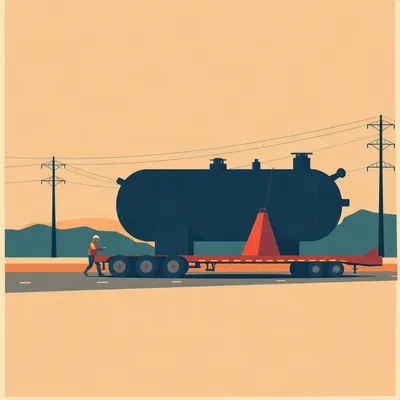
The Department of Energy draws the line at one hundred megavolt-amperes or greater. That's a big machine. These things weigh between one hundred fifty and four hundred tons. And the part people don't realize is they're not off-the-shelf. Every single one is custom-built to a specific site's voltage, impedance, and safety specs. You can't buy a spare for "a substation." You buy a spare for that substation.
So when one dies, you're not calling a warehouse.
You're calling a factory, and that factory has a queue. And here's the number that should stop people cold. About ninety percent of all electricity in the United States passes through one of these machines at some point on its way to the socket. Ninety percent.
Which means the grid is really one machine with a lot of copies of itself.
That's the right way to picture it. Now, lead times. Before the pandemic, thirty to sixty weeks. That was the norm. Today, the average is running one hundred fifteen to one hundred thirty weeks. For the big generator step-up units, the ones at power plants, it's one hundred twenty to two hundred ten weeks. That's two to four years.
The average doubled and the worst case quadrupled.
And the DOE's own report puts thirty-six months as "commonly quoted," with maximums reaching sixty months. Five years. That's not procurement. That's a construction project.
What's actually the bottleneck? People always say steel.
People say steel, and grain-oriented electrical steel is part of it. Prices on that have nearly doubled since 2020, and the US has exactly one domestic supplier. One. But there's a sharper argument, and I find it more convincing. The real constraint isn't the steel. It's the hands. There's a workforce of roughly fifteen thousand people in the US who hand-wind copper coils for these machines, and that number isn't growing fast enough. You can't train someone to wind a transformer coil in a weekend. It's a craft.
So the scarce resource is a fifteen-thousand-person guild.
That's the shape of it. And it shows up in the import numbers. In 2019, eighty-two percent of the large power transformers used in the US were imported. Six hundred seventeen units imported, one hundred thirty-seven made domestically. US capacity utilization is around forty percent, and the maximum output is something like three hundred forty-three units a year.
A country that runs on ninety percent of them imports four out of five.
And the fleet is old. The average in-service LPT is thirty-eight to forty years against a forty-year design life. So the average unit is at the end of its life right now. And distribution transformers, the smaller ones on the poles, more than half of the roughly forty million units in the US are past their expected service life.
So the replacement queue is filling up at the exact moment the fleet is expiring.
That's the squeeze. Demand for power transformers is up one hundred nineteen percent since 2019. Generator step-up demand, two hundred seventy-four percent. Prices up seventy-seven percent on power transformers, forty-five to ninety-five on distribution. And this is before you get to the weird stuff.
The weird stuff being HVDC.
High-voltage direct current. This is the technology you use when you want to move power a thousand kilometers, or under an ocean, and alternating current won't do it because of losses. Converter transformers sit at the ends of those lines, and they are harder to build than anything on the AC side.
How much harder?
Lead times of thirty-six to sixty months. Compare that to AC, at one hundred ten to one hundred sixty weeks. So the specialized units run roughly twice as long as the already-bad AC lead times.
And why? What's different about them?
Three things. First, they have to eat DC bias, harmonic heating, and short-circuit stresses all at once. That forces thicker insulation and much longer dielectric testing. Testing isn't a formality here. Second, the valve-side DC bushings are a single-source component with their own multi-month queue. So you can have the transformer body ready and be waiting on a bushing. Third, and this is the one I find interesting, each HVDC link is a one-off package. The factory acceptance test can't be parallelized across a production run. The unit is the run.
Meaning you can't amortize the test across a batch.
You can't. There's no such thing as a standard HVDC converter transformer. Every one is tested to failure as a prototype. And so the supplier base is tiny. Fewer than six suppliers worldwide for the critical HVDC components, converter transformers, DC circuit breakers, subsea cables. Fewer than six.
Six companies. For the technology every long-distance transmission project depends on.
And the regional distribution is brutal. ASEAN has no domestic HVDC equipment supply at all. Voltage-source converters there are running four to six years out. In North America and Europe, specialized units run thirty-six to sixty months. In parts of Asia-Pacific, it's closer to twelve months. So the capacity exists, and it's not where most of the demand is.
You told me something last week about your espresso machine.
I did.
That you waited four months for a replacement group head from Italy, and that you had opinions about it.
I had very strong opinions. But I want to be precise here, because it's the same shape at a much smaller scale. That group head was made by one shop. One. When they were backlogged, I had a machine on my counter that couldn't make coffee, and no amount of money moved me up the queue.
And you're comparing that to a five-year transformer.
I'm comparing the structure. Single source, custom fit, no substitute. Yours is the espresso machine. Theirs is a substation.
Right. So the machines that make the machines. That's the transition here, isn't it? We've been talking about transformers, which are the thing electric utilities buy. But what about the equipment that makes the transformers? What about the presses?
That's the nuclear-grade forging conversation, and it's where Daniel's third example lands. This is a step further up the chain. For a very large Gen III+ reactor, the pressure vessel, the big steel can that holds the core, is forged, not cast, and the forging requires a press of roughly one hundred forty to one hundred fifty meganewtons. That's fourteen to fifteen thousand tonnes of force. And the press has to accept ingots weighing five hundred to six hundred tonnes.
How many of those presses exist?
Very few, and they're low-throughput. The World Nuclear Association's rule of thumb is that about four pressure vessels per year appears to be common per press. One press, roughly four vessels. That's the whole output of a fifteen-thousand-tonne forging line.
That's a number that should feel wrong.
It should, and it's real. Westinghouse says the minimum for the largest components in an AP1000 is a fifteen-thousand-tonne press taking three hundred fifty-tonne ingots. To give you a sense of the jump in scale, the older Gen II reactors needed about two thousand tonnes of forgings. The largest modern designs need roughly twice that. So you're not just scaling by a factor. You're pushing into a class of equipment that maybe a dozen facilities on Earth can operate.
And where are those facilities?
Japan, China, South Korea, France, Russia. Japan Steel Works in Muroran, CFHI and Erzhong and Shanghai Electric in China, Doosan and Taewoong in Korea, Le Creusot in France. The World Nuclear Association's language is blunt. "Nothing in North America currently approaches these enterprises." And US heavy forging capacity hasn't been significantly upgraded since the 1970s.
We're running the largest nuclear buildout in a generation on a capability base that hasn't been touched in fifty years.
And to be fair, that's not unique to us. Japan Steel Works claimed in 2008 to make about eighty percent of the world's large forged nuclear components. There are roughly one hundred thirty JSW reactor pressure vessels in service worldwide. The capacity was tripled around 2010 to twelve RPVs a year. And in July, JSW announced they're doubling nuclear component production capacity again by fiscal 2028.
Because the demand is coming.
Westinghouse, every new reactor program, they're all knocking on the same doors. And there are only so many doors.
Okay. Daniel asked a fourth question. Are there comparable bottlenecks in telecom, aviation, rail, water. I want to be honest about this one. Our research on that part came back thin. We don't have verified examples with named facilities for aviation or rail or water infrastructure that we can stand behind.
I appreciate you saying that. I'd rather flag the gap than make one up. The closest verified analogue we have is the HVDC subsea cable and DC circuit breaker concentration, which is telecom-adjacent because those cables and breakers cross into the communications build-out. Fewer than six suppliers there too. But specific telecom, aviation, rail, water examples, we don't have them. Listeners who know those sectors should send us the cases.
Send them in.
What we do have is the operator side. How do people actually plan around this? And the answer is: not well, and not with one approach. There are spare and sharing programs. STEP, the Spare Transformer Equipment Program. SpareConnect. Regional Equipment Sharing for Transmission Outage Restoration. Grid Assurance. WattStock.
Say what each of those does, briefly.
They're all variations on the same idea, which is that utilities band together to buy and hold spare equipment collectively rather than each holding their own. STEP is a formal industry program where participating utilities agree to share transformers in an emergency. SpareConnect and the regional sharing programs are lighter versions. Grid Assurance and WattStock are closer to insurance models, where you pay in and get priority access.
And why doesn't everybody do this already?
Cost. A single large power transformer can cost up to ten million dollars to purchase, and hundreds of thousands more to move. The GAO's phrasing is that this "prevents some utilities from keeping spares." So the shared programs exist precisely because individually, the math doesn't work.
Ten million dollars buys you a machine you may never use.
So the industry has been moving toward a mix. There are also mobile and flexible units now. Siemens Energy has a leased rapid-response program called Pretact that dates back to 2021. Avangrid and Hitachi Energy announced a one hundred sixty-eight MVA mobile transformer in May 2024 that can deploy in about two months. GE and Prolec have a variable-impedance LPT that allows one unit to serve multiple station designs.
Two months for a mobile unit versus five years for a custom one.
Yeah, and that's the tradeoff. The mobile unit is a compromise machine. It fits a range of sites rather than one site perfectly. So you accept a performance hit to get a schedule. For a lot of outages, that's a good trade. But it's not a substitute for the real thing.
Now, the policy side. Is there a federal reserve of these machines?
There is not. And this is worth being precise about, because it's an easy thing to assume exists. The DOE's 2017 report recommended a non-government, industry-driven reserve. The 2024 report does not advocate for a federally-owned reserve. The GAO reported in 2023 that the DOE hadn't developed implementation plans, and as of May of this year, both GAO recommendations were still listed as open.
So eight years of recommendations and no plan.
Eight years. And I'd add one more thing, because it's the part that keeps me up at night. There's an unresolved disagreement about whether the shortage is even real.
Tell me about that one. You mentioned it earlier.
There's a broker named Patrick Tarver, at Bolt Electrical, who says flatly, "There is not a shortage." And he goes on. "It's all exaggerated to drive pricing. I'm telling you that we can get the supplies they need, but they don't ask."
That's a strong claim.
It is. And I want to preserve it rather than dismiss it, because the industry does have a structural incentive to talk about scarcity. When supply looks tight, prices go up. But I also think Tarver is answering a slightly different question than the one the DOE is asking. The DOE is saying, on average, across the whole fleet, over the next decade, lead times are long. Tarver is saying, for specific buyers, at specific moments, the equipment exists and you can get it. Both can be true.
But if you're the utility holding the bag, "it exists if you're good at procurement" is not a reassuring position.
It is not. And frankly, even if Tarver is right, the fact that this is up for debate tells you something. If the market were clearly balanced, nobody would be arguing. The argument itself is evidence of strain.
I want to come back to a hangover from the last part of the discussion. Earlier you said US heavy forging capacity hasn't been significantly upgraded since the 1970s.
That's right.
So compare that to the 1940s. We built twenty-seven hundred Liberty ships during the war. Not one. Twenty-seven hundred. We built shipyards, we built the supply chains, we built the workforce, and then we scaled.
In about four years.
And today, we have no heavy forging capacity in North America that approaches Japan or China or Korea, and the last significant upgrade was a half-century ago. That's not a technology gap. That's an industrial one.
I think that's the real question underneath Daniel's whole prompt. He's asking whether parts of modern civilization are harder to rebuild than we appreciate. And the answer is yes, but for an odd reason. It's not that the physics got harder. It's that we stopped keeping the people around who know how to do the physics at scale.
So it's not a cliff we fell off. It's erosion.
That's the honest shape of it. The Liberty ship example is real. We can build hard things fast when we decide to. But the deciding takes longer than it used to, because the supply chain is now global, the workforce is thin, and the institutional memory has thinned out alongside it.
And in the meantime, we're staring at the largest short-term surge in electricity demand anyone has ever seen, with data centers and electrification of transport on top of it.
Which is not a great place to be if your average transformer is thirty-eight years old with a forty-year design life.
Let me put the pieces together, because let me test whether the throughline holds. Transformers take one hundred fifteen to one hundred thirty weeks as a baseline, and the big ones go to two hundred ten. HVDC converter transformers go to sixty months because each one is a prototype. Forgings need fifteen-thousand-tonne presses that produce four vessels a year each, and the presses mostly aren't on this continent. So the bottleneck isn't a raw material that a mine can solve, or a factory that a tax credit can spin up. It's skilled labor, single-source components, and machines that take years to build before they can build the things we need.
That's the throughline, yes. And every layer of it has its own long lead time. To build a new transformer factory you need to build the machines that go inside it. To build a new forging press you need a forging press to make some of its own parts, or you need to import one. Daniel's question has a fractal quality. Every answer to "how do we make more of X" resolves to "first we need more of Y, which also takes years."
So you've got a queue of queues.
You do. And that's why the policy conversation is so uncomfortable. There's no lever you can pull this quarter that changes the picture. There's only a ten-year industrial strategy, and a shorter-term mitigation strategy built on sharing, mobile units, and accepting risk.
Which is why we're asking the question at all. The interesting thing isn't "we should stockpile." It's "what does the operator do, on Tuesday, when the transformer doesn't exist and won't exist for three years."

There was a fellow I worked with at a place called Norstad. Nineteen eighty-eight. Albie Kellerman. Badminton. Very serious about it. He kept a printed table of his own win-loss record, singles and doubles separate, going back to 1976, and he updated it every Monday morning before anyone else got in. By the time I left, he was at four hundred twelve and ninety-seven in singles. He could quote the number off the top of his head. He could also quote his brother-in-law's number, which he kept in a separate column, even though the brother-in-law had stopped playing in 1982, because Kellerman said you don't just drop the record. I had a question for you both. I've had it since I worked next door to the transformer yard at that place. The question is why can't you just make more of these things. Why is there only one factory. And you two seem to have been circling it for twenty minutes without saying the answer out loud.
The answer, and this is not a dodge, is that the constraint isn't the building. It's the people and the components. Fifteen thousand people hand-wind coils in the United States, and the training pipeline is decades long. And the valve-side bushings for HVDC units come from one supplier. So even if you built the factory, you'd be shipping the parts in.
But money couldn't fix it.
Money doesn't fix it because the training doesn't respond to money the way a materials shortage does. You can pay a mine to open faster. You can't pay someone to have ten years of winding experience.
That's the part I didn't get. So the machine isn't the bottleneck. The person who runs the machine is.
Correct.
That was my question. Thank you. One more thing. The bushings. That's a funny word for a component that costs months.
It's a big ceramic and paper insulator, essentially, with a conductor through the middle. It has to hold DC voltage off the tank of the transformer in the rain, for forty years. There aren't many places that make them.
So the thing that holds up the thing is the smaller thing nobody makes anymore. That's not unusual, in my experience. There was a place in Rotterdam that made a particular gasket, and when they shut down, whole lines went out of service for want of a piece of rubber the size of a dinner plate, because nobody wanted to run a press for a hundred of them a year. Same shape.
The economics of a low-volume, high-skill component are brutal.
The economics are always brutal on the thing nobody notices. Anyway. I don't have more to add.
That's a useful angle, though. The smaller the component, the easier it is to lose the supplier, and the harder it is to notice until you need one.
And once the supplier is gone, restarting them is not a matter of money. It's a matter of finding someone who remembers how, or reverse-engineering the process.
The oldest person in the room becomes the entire institutional memory of a technology.
That's true in a lot of industries, and it's true here.
Okay. So where does that leave us on Daniel's final question. Are there parts of modern civilization much harder to rebuild than we assume.
Yes. And the surprising thing is that it's not the parts we treat as fragile. Nobody worries about the substation. It's painted concrete and steel. But the transformer inside it, or the press that forged the vessel at a nuclear plant, those are hidden. And they're hard to rebuild not because of some physics wall but because the ecosystem around them has thinned.
The vulnerability isn't in the concrete. It's in the supply chain behind the concrete.
And the supply chain doesn't show up on the risk register the way a transmission line does. It shows up as a lead time.
So the practical thing an operator can do is buy time with spares and mobile units, and the strategic thing a country can do is rebuild the industrial base, and those two things operate on completely different clocks.
They do. And the clocks don't match up. Which is the whole problem.
I want to close on the good news part of this, because I think there is one, and it's small.
Go ahead.
Wood Mackenzie and POWER between them estimate one point eight to two billion dollars in announced North American transformer manufacturing expansions since 2023. JSW is doubling nuclear component capacity. There's movement. It's just slower than the demand curve.
It's real. It's just not a 2026 answer to a 2026 problem. It's a 2032 answer.
The most common thing I hear people say about this is that the grid is one bad event from collapse.
That's the wrong picture. The grid is remarkably resilient in the operational sense. You can lose a line, you can lose a transformer, and the operators keep the lights on with what they have. The problem isn't collapse. The problem is duration. If a single critical transformer is destroyed and the replacement takes three years, you're not in a collapse scenario. You're in a three-year scenario where one region runs on borrowed margin, and every other part of the system is a little bit more stressed because of it. It's not the bang. It's the slow squeeze.
That's the correction.
And the squeeze doesn't make the news.
It doesn't. Which is why the story keeps being told as "the grid is fragile" when the truth is "the grid is slow." A slow grid is not headline material. It's scheduling. But scheduling is what runs infrastructure.
Scheduling is what runs everything.
The thing I keep coming back to is that we've built a civilization on machines we can't replace quickly, and we mostly don't know which ones those are until we need one.
That's the open question Daniel handed us. It's also why I think the telegram inbox is about to fill up with people telling us about the aviation bottleneck we couldn't find.
We should have a segment on that. For now, we owe a thanks to our producer, Hilbert Flumingtop, who keeps the show on the rails while we talk about fifteen-thousand-tonne presses.
Our thanks to Hilbert. And For more along these lines, there's episode twelve, The AI Breakthrough; episode eighteen, Beyond the GPU; and episode twenty-five sixty-nine, The Invisible Miracle of Grid Balancing. this has been My Weird Prompts, the human-AI collaboration podcast.
If you want to send us a prompt about the machines that hold your world together, send us your own prompt on Telegram at t dot me slash MWP listener bot. We read them all.
The show is at my weird prompts dot com, with the RSS feed there too, if you'd rather subscribe that way. We'll be back soon.
See you then.