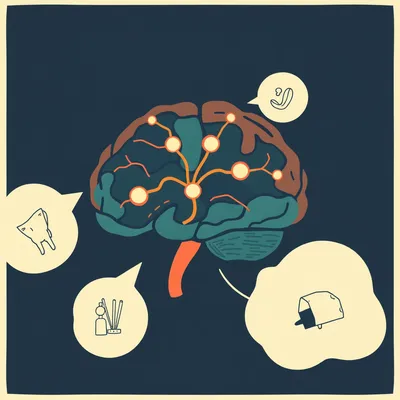
Today's prompt comes from a listener who's been thinking about daydreams — not the idle kind, but the ones that keep showing up year after year. Here's what he wrote.
I am a thirty-seven-year-old man. Sometimes I send in prompts spontaneously. Other times I let them marinate for a few days. I was thinking of sending one about daydreams — did you ever wonder if we all daydream about similar things, or if there are common themes? But then I thought I have a more targeted question.
I grew up in a volatile home environment with a father who was an alcoholic. I think he was a good person, just somebody with a horrible addiction. We were middle class — maybe in retrospect a bit more than that. My late grandfather dropped out of college but became an entrepreneur, setting up a toy store and then taking over a photo framing store. My mother ran the family photo frame business.
I grew up in Ireland, though I immigrated to Israel ten years ago. I got good grades, and Ireland's university admissions system meant what you studied was a product of what you scored on tests. As a Jewish person, I never felt Ireland was a normal environment for me, but when my dad died before college, I felt it was a bad time to leave. I ended up studying law at the local university in Cork.
I have to be honest — the legal system is interesting, but studying law was more about drawing direction from my family toward something they perceived as respectable, something that took advantage of my grades. Over time, I've realized I'm about as far from a lawyer as you can get. I dislike legalese intensely.
Over the past couple of months, because of a rental situation — a lease that ended due to a landlord who refused to fix a leak — I've become a sort of part-time handyman around the house. Not out of volition so much as necessity. It's cheaper to move your own stuff and fix your own things. My workstation is almost set up again, and I'm nearly ready to slot back into my usual daily existence doing tech consulting.
So it's at this weird juncture that I find myself wondering about all of this. I really enjoy working with my hands. As the episodes on this podcast make clear, I have a tendency to become intensely interested in a niche area and then determine to do it superlatively well. Thus, while my interest in the euro box and industrial storage standards is not everybody's cup of tea, I've drawn great satisfaction in learning how the system works and then translating that into action — actually buying and installing the system. Yesterday, Hannah and I made our third visit to Yossi Box, a small business that does industrial plastics near Ashdod. They are wonderful people who've been patient with us, helping cram euro boxes into our small Seat Ibiza. I keep thinking: these are my kind of people.
So, to come back to my daydreams. I dreamed very vividly about being an airline pilot or a police detective. Sometimes I still do. And sometimes I find myself wondering — what was I actually supposed to do with my life? If you removed all the baggage of circumstance and family pressures, what's the thing where I'd be most useful to society and enjoy the most satisfaction from? I think those two things go hand in hand if you're going to thrive in an industry over the long term.
So beyond asking what we all daydream about, I'd love to ask: how many of us dream about the type of careers we feel we probably should have been brave enough to say that's what I want to do, even if it wasn't what our parents or communities thought was best for us? Do daydreams have to stay daydreams? And if you wanted to stare your dream log in the face and say, I'm ready to actually make this happen — how would you go about pulling apart the part of your dreams that can be discarded from those that might be giving you the most actionable clues as to what your soul was truly called to do?

That's a lot. And it's... extraordinarily honest.
It is. So let's sit with this. What are daydreams actually doing in our heads? And when one of them has been knocking for twenty years, how do you know if it's a signal or just a fantasy?
The first thing I want to say is that the two data streams he's describing don't actually contradict each other. He's got the daydreams — pilot, detective — that feel like "what I was supposed to do." And then he's got the lived experience — handyman work, euro box logistics, tech consulting — that actually gives him satisfaction. The question isn't which one is real. The question is what they have in common.
Right. Because if you just look at the surface, you'd say the daydreams are about high-stakes professions with clear hierarchies and uniforms, and the real life is about... industrial plastic containers.
And yet he says "these are my kind of people" about the folks at Yossi Box. That's not nothing. That's a clue.
So the episode's thesis, if we're going to state it once and then move on: daydreams are not random. They are compressed representations of unmet psychological needs. The job is not to follow your dream literally — it's to decode what the dream is actually asking for.
And to answer that, we need to understand what daydreams are made of. It turns out, they're not as random as they feel.
I've always assumed my own daydreams were just mental static. The brain idling.
That's the default view, and it's wrong. There was a meta-analysis published in Psychological Bulletin in twenty twenty-one — they looked at the content of thousands of recorded daydreams across multiple studies. About seventy percent of daydreams involve social scenarios. Relationships, conversations, imagined approval, sometimes imagined confrontation. The content is patterned.
Seventy percent social. That's... not what I would have guessed. I'd have guessed landscapes, or food, or...
Napping locations?
I was going to say leaves, but sure.
The point is, daydreams are not random noise. They're the brain running simulations. And when you look specifically at career-themed daydreams, they cluster around three psychological needs: autonomy, mastery, and recognition. Not the job title itself. Nobody daydreams about the payroll software.
So the listener's pilot daydream — it's not about flying a plane. It's about being the person in the cockpit who makes the call when the weather turns.
And the detective daydream — it's not about crime scenes. It's about pattern recognition with moral clarity. You see something nobody else sees, you follow the thread, and at the end there's an unambiguous answer. The case is solved. The bad guy is caught.
Which is about as far from practicing law as you can get.
That's the key. Law, as he experienced it, was ambiguous, text-bound, externally dictated. Someone else wrote the statute, someone else interprets it, you're arguing about commas. The daydream is a protest against the lack of agency in his actual career path.
So the daydream isn't a career suggestion. It's a diagnosis of what's missing.
There's research from Dr. Barbara Kerr at the University of Kansas that tracks exactly this. She found that people who report vivid career daydreams in adolescence often return to those themes in midlife — not because the original dream was correct, but because the underlying values were never satisfied. Someone who wanted to be a vet at age ten — they usually don't actually want to be a vet at forty. But the core value, "I wanted to care for something vulnerable," was never given space to develop. That's what comes knocking.
So the pilot daydream maps to autonomy. The detective daydream maps to pattern recognition plus moral clarity. And those values have been sitting in a box since he was a teenager.
While he was studying law because his grades qualified him for it and his family saw it as respectable.
And then his father died, and leaving felt impossible. The daydreams got put on pause but never actually went away. Can I ask you something about that mechanism, though? Because I think a lot of people have this experience where a daydream feels vivid and urgent for a while, and then life gets loud and it fades. But for some people, like our listener, it doesn't fade. It keeps circling back. What's the difference between a daydream that evaporates and one that persists for two decades?
And the research points to something specific. A daydream that fades is usually one that served its purpose — you extracted whatever psychological nutrition it was offering, or the underlying need got met some other way. But a daydream that persists is one where the need is still unmet, and more than that, it's one where the need is actively being suppressed. The persistence is proportional to the suppression. The more you tell yourself "that's not practical" or "that's not who I am," the louder the daydream gets. It's like holding a beach ball underwater. The deeper you push it, the harder it fights to surface.
So the daydream's volume is actually a measure of how much you're ignoring it.
And our listener has been ignoring it since he was a teenager. He chose law because it was respectable. He stayed in Ireland because leaving felt cruel. He's been making choices based on what other people needed from him for so long that the daydream has become almost deafening. That's why it's still there at thirty-seven.
The default mode network — that's the brain system that activates during mind-wandering — it doesn't just generate random images. It draws on memory, on unresolved emotional material, on goals that were formed and never pursued. The content is shaped by unmet needs. The DMN is basically running a what-if engine on the life you didn't live.
Right. And I want to linger on that phrase "what-if engine" because it's not just poetic. The DMN is doing something functionally useful. It's running counterfactual simulations. What if I had chosen differently? What if I had been braver? What if the circumstances had been different? The brain is trying to learn from a path not taken, which is absurd on one level — you can't learn from something that didn't happen — but on another level, it's the brain's way of saying, "the current path is missing something, and here is a simulation of what that missing thing might feel like."
So when he's daydreaming about being a pilot, his brain is saying "here is a scenario where you have complete authority, clear procedures, and unambiguous outcomes." It's not saying "learn to fly."
And here's the thing — he already found a version of that feeling. At Yossi Box. Learning about euro box standards. Solving a physical problem with his hands and seeing the result immediately.
The "I wanted to be a marine biologist" phenomenon.
That's exactly the right example. Most people who say "I wanted to be a marine biologist" don't actually want to study marine biology. They want to feel wonder and purpose in their work. The daydream is a container, not the content. The marine biology is just the most vivid image the brain could find for "meaningful engagement with the natural world." I actually saw this play out with a friend of mine who spent years saying he wished he'd become a marine biologist. Finally his wife bought him a marine biology textbook for his birthday as a joke, and he read the whole thing in a weekend. But what he actually loved wasn't the taxonomy of sea creatures — it was the fieldwork. The idea of being out on a boat, collecting samples, solving puzzles in a dynamic environment. And then he realized that's basically what he already did as a software engineer who specialized in debugging live production systems. He just needed to reframe it.
That's a perfect case study. He didn't need to switch careers. He needed to recognize that the core experience he was craving — dynamic problem-solving in an unpredictable environment — was already available to him. He just hadn't named it.
Which is why "follow your dream" is such terrible advice when taken literally. If our listener quits everything and enrolls in flight school, he's probably going to be miserable.
Or at least no less miserable than he was in law school. The setting changes but the underlying need might still be unmet. You can be a pilot and still lack autonomy if you're flying routes someone else assigned you.
I think this is where we should talk about the permission piece, because it's the layer underneath all of this.
If daydreams are compressed signals about unmet needs, the next question is: how do you decode them without getting trapped in the fantasy?
This is where it gets practical. And also where the listener's own story gives us the roadmap.
Walk me through it.
The first thing to understand is that his daydreams are not just about career. They're about permission. He grew up in a volatile home. His father was an alcoholic — a good person, he says, but with a horrible addiction. That kind of environment creates a specific psychological pattern. You learn to suppress your own desires because expressing them might destabilize things further. You become the steady one. The one who doesn't make waves.
Then you study law because it's what the family expects, and you stay in Ireland because leaving would be cruel, and you build a whole life around not asking for what you actually want.
The daydreams are the part of him that never got permission to want things for himself. They're not just career fantasies — they're the self he locked away when he was young because the household couldn't accommodate it.
That's... heavier than most career advice columns get.
It is. But it's also the reason the handyman work has been so satisfying. Nobody told him to do it. Nobody expected it. He just — did it. Out of necessity at first, but then he found he loved it. That's the first time in a long time he's given himself permission to be competent at something physical, tangible, with immediate feedback, without anyone's approval.
The euro box obsession is basically an unauthorized joy.
Right. And that's exactly the feeling his daydreams have been pointing toward his whole life. Autonomy. Tangible outcomes. Being respected for expertise. Those are the conditions, not the job title.
How do you decode a daydream practically? If someone's listening and they've got their own pilot equivalent — what do they actually do?
Three steps. First, write down the daydream in detail. Not "pilot" — but "I am in the cockpit, the weather is bad, I make the call to divert, the crew trusts me, we land safely." Get the scene. Get the sensory details. Second, identify the emotional state the daydream produces. Is it calm authority? Adrenaline? Relief? Third, ask: where else in my life have I felt that same state?
For our listener, the answer is Yossi Box.
Learning about euro box standards. Solving a physical problem with his hands. Translating knowledge into action. He felt competent, autonomous, and respected by people who share his values. That's the actionable clue.
The daydream isn't saying "become a pilot." It's saying "find more situations where you feel the way you feel when you imagine being a pilot."
He already found one. The question is how to amplify it.
That reframes the whole thing. It's not "what was I supposed to do with my life?" It's "what conditions make me thrive, and how do I build more of those into my life?"
There's a study from twenty twenty-three in the Journal of Vocational Behavior that looked at people who successfully transitioned into what they called "daydream careers" in midlife. The finding was striking. Almost nobody made a single dramatic leap. The average person took three point two incremental steps over four to seven years. A certification, a side project, a part-time role, a network shift. The "I'm going to become a pilot" fantasy was almost never realized. The "I'm going to take a discovery flight and see if I like teaching others to fly" — that one worked.
Three point two steps. So the fantasy of the dramatic pivot is itself part of the fantasy.
It's the Hollywood version. Quit your job, burn the ships, emerge transformed. Real life doesn't work that way. Real life is: take a course on weekends, help a friend with a project, realize you hate the thing you thought you'd love, pivot slightly, try something adjacent, find the actual fit.
Our listener has already taken one of those steps without realizing it. The euro box obsession — that's a prototype. He became interested in a niche, learned the system, executed. That's the same cognitive style a pilot or detective uses. Pattern recognition, system-building, hands-on execution.
The question is not "should I become a pilot?" The question is "what problem in the world would let me use this pattern-recognition, system-building, hands-on-execution skill set?"
The answer might be logistics consulting for small businesses. Or industrial design. Or technical project management. All of which exist in the real world and don't require flight school.
Or it might be something adjacent to what he's already doing in tech consulting, but with a physical component. He said his workstation is almost set up again. He's about to slot back into his usual daily existence. That phrase — "slot back into" — it has a resignation to it.
It does. Like he's putting himself back in the box.
The euro boxes are sitting there in the room, literally and figuratively, representing the alternative. Tangible. Stackable. Fit for purpose.
The metaphor is almost too on the nose. He's been learning about standardized containers that actually fit what they're supposed to hold, while trying to fit himself into a container that was never designed for him.
I think the most actionable thing he can do right now is notice that the satisfaction he got from the euro box project is not a fluke. It's not a distraction from his real work. It might be a preview of his real work.
Let's make this concrete. Here are three things you can do this week if you have a daydream that won't leave you alone.
First, treat the daydream as a diagnostic, not an instruction. Instead of asking "should I become a pilot?" ask "what does the pilot daydream tell me about the conditions I need to thrive?" For our listener, the answer is autonomy, clear decision-making authority, tangible outcomes, and being respected for expertise.
Second, find those conditions in your current life and amplify them. He already found them at Yossi Box and in the handyman work. The next step is not to abandon tech consulting — it's to tilt the ratio. More hands-on projects. More system design. More direct client relationships where he's the expert making the call.
Third, use the three-point-two-step framework. Don't quit your job. Take one small action that tests the underlying need. A course. A volunteer role. A conversation with someone in a field that seems adjacent. His euro box obsession is already a prototype of this process — he just hasn't recognized it as a career signal yet.
The question he asked — "what was I actually supposed to do with my life?" — is the wrong question.
It is. Because it assumes there's one answer, and that he missed it, and that the rest is just... aftermath.
The right question is: what am I already doing that makes me feel alive, and how can I do more of it?
He knows the answer to that. He wrote it to us. Working with his hands. Learning a system deeply. Executing. Being around people who share that orientation toward practical competence.
The daydreams aren't telling him to abandon his life. They're telling him which parts of his life to trust.
One last thought, and it's for our listener specifically.
Go ahead.
He's thirty-seven. He's in a new country. He's rebuilding his workstation. He's discovering a love for hands-on work. What if the daydreams are not about the past? What if they're not regrets about the road not taken? What if they're previews of a version of himself he hasn't fully inhabited yet?
The pilot in the cockpit, making the call — that's not a memory of what could have been. That's a rehearsal for a kind of authority he's only just starting to claim.
Your daydreams are not a distraction from your real life. They are a draft of it. The question is whether you're ready to start editing.
If you have a daydream that's been knocking for years, send it to us. We'll read it on the air and help you decode it. Go to my weird prompts dot com and hit the microphone button.
Thanks to our producer Hilbert Flumingtop.
This has been My Weird Prompts.
We'll be back soon.