Daniel sent us this one — he wants to talk about the chemistry of epoxy, what makes it a step up from brittle superglue, and for anyone doing renovation projects or home repairs, what the different kinds and grades actually mean in practice. And the core question underneath all of that: how strong can this stuff really get?

This is one of those topics where the answer is genuinely surprising. Most people think of epoxy as just "stronger glue," but the chemistry is doing something fundamentally different from superglue. And the strength numbers — we're talking about bonds that can exceed the strength of the materials you're joining. I love this stuff.
I know you do. You've been waiting for an excuse to talk about crosslinking density for weeks.
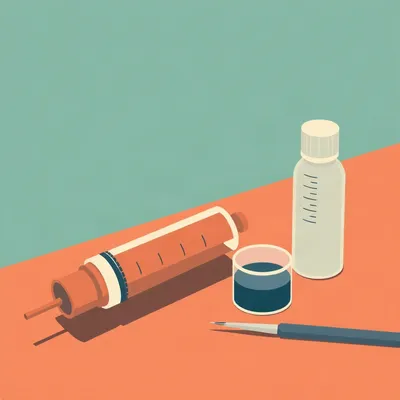
I mean, have I been dropping hints? But let's start with what's actually happening when you mix those two syringes, because the chemistry is elegant in a way that most hardware store products just aren't.
What's actually happening inside those two syringes? Let's start with the chemistry that makes epoxy different from every other glue in your drawer.
At its core, epoxy is a two-part system — a resin and a hardener — that undergoes what's called exothermic crosslinking polymerization. Each word matters. Exothermic means it generates heat as it cures. Crosslinking means the polymer chains form a three-dimensional network, not just linear strands. And polymerization is the chemical reaction that builds those chains in the first place.
Superglue isn't doing that.
Not at all. Superglue — cyanoacrylate — forms linear chains through anionic polymerization, triggered by the thin layer of moisture on almost every surface. The molecules line up end to end like a single zipper. That's why superglue is so brittle — stress concentrates at one point, and the whole thing unzips catastrophically.
Epoxy is less zipper, more...
A three-dimensional fishing net. Every strand connects to multiple other strands. When stress hits one point, the load distributes across dozens or hundreds of bonds. That's why epoxy resists peel forces and impact in ways superglue simply cannot. Superglue has great tensile strength — pull it straight apart and it holds remarkably well — but introduce any prying or peeling force and it snaps immediately. Epoxy's crosslinked network gives it what engineers call fracture toughness.
Which is a very polite way of saying "doesn't shatter when you look at it wrong.
And this difference comes down to the chemistry of the epoxide ring — a three-membered ring structure with an oxygen atom under significant ring strain. When the hardener, typically an amine, attacks that ring, it opens up and forms a covalent bond. The key is that both the resin molecule and the hardener molecule have multiple reactive sites. The most common epoxy resin is based on bisphenol A diglycidyl ether — BADGE for short — and each molecule has two epoxide groups. The hardener has multiple amine groups. So each molecule can react at multiple points, and that's how you build the network.
that's really what they called it.
I wish I were making it up. The epoxy industry is not known for elegant naming. But here's what's fascinating — the very first commercial epoxy resin was patented by a Swiss chemist named Pierre Castan in nineteen thirty-eight. And independently, almost simultaneously, an American named Sylvan Greenlee filed a patent in nineteen thirty-nine for essentially the same chemistry. Two researchers on different continents arriving at the same molecular solution within a year of each other.
That's one of those moments in science history where you wonder if the idea was just... Floating around waiting for someone to crystallize it.
The chemistry was waiting, but the applications weren't obvious at first. Castan licensed his patent to Ciba, and the earliest uses were in dentistry — dental adhesives and coatings. It took World War Two to really push epoxy into structural applications, particularly in aircraft manufacturing. The need for lightweight, high-strength bonding drove rapid development.
We went from teeth to bomber planes in about five years. That's quite a trajectory. But not all epoxies are created equal. The hardener you choose — and how fast you want it to cure — fundamentally changes what you're building.
Right, and this is where things get practical. When you're standing in the hardware store looking at epoxy, you're making three choices whether you realize it or not. First, the chemistry type of the hardener — amine versus polyamide versus anhydride. Second, the cure speed — five-minute versus twenty-four-hour. Third, the viscosity — thin penetrating versus thick gap-filling. Each of these decisions changes what the epoxy can do and where it will fail.
Let's go through the hardener families. I know amines are the most common, but there's apparently a whole taxonomy within that.
There is, and it matters. Amine hardeners come in three broad categories: aliphatic, cycloaliphatic, and aromatic. Aliphatic amines — things like diethylenetriamine, or DETA — cure fast at room temperature, which is convenient, but they have a notorious problem called amine blush.
That greasy film that shows up on cured epoxy sometimes.
What's happening chemically is that unreacted amine groups at the surface react with carbon dioxide and moisture in the air to form ammonium carbamate. It's a waxy, greasy layer that will absolutely ruin any paint or secondary bond you try to apply on top of it. If you've ever had paint peel off an epoxy repair in sheets, amine blush is the likely culprit.
You have to wash it off.
With warm water and a scuff pad, between every coat. Boat builders using West System epoxy know this ritual intimately. It's not a defect — it's just chemistry doing what chemistry does.
The other amine types avoid this?
Cycloaliphatic amines — isophorone diamine is the big one — produce much less blush and give you better UV resistance. The cured epoxy won't yellow as quickly in sunlight. They're more expensive, but for anything that's going to see daylight, they're worth it. Aromatic amines, like MDA — methylene dianiline — give you outstanding heat resistance, glass transition temperatures up to a hundred and fifty degrees Celsius or more, but they're toxic, classified as potential carcinogens, and typically require a post-cure heating cycle. You're not buying aromatic amine epoxies at the hardware store. These are industrial products for aerospace and chemical processing equipment.
For the home renovator, we're mostly looking at aliphatic and cycloaliphatic amines, or the other big family — polyamides.
Polyamide hardeners are, in my opinion, the forgiving choice for home users. They're made from dimerized fatty acids — basically, processed vegetable oils. The chemistry is less aggressive. They're more flexible when cured, they tolerate moisture on the substrate better, they're significantly less toxic, and they don't blush nearly as much. The trade-off is lower chemical resistance and lower heat resistance. A polyamide-cured epoxy might start softening at fifty degrees Celsius, where an aromatic amine system would be fine at a hundred and fifty.
If I'm fixing a cast iron radiator, maybe not polyamide. But for most things around the house — wood, metal, ceramic — it's probably the right call.
It's the "I'd rather it work pretty well than fail perfectly" option. And I mean that as a genuine compliment. The best epoxy is the one you'll use correctly, and polyamides are more tolerant of imperfect surface prep and mixing ratios.
Now the cure speed question. This is where I think most people get it wrong. The assumption is that five-minute epoxy and twenty-four-hour epoxy are the same stuff, just one has more patience built in.
That assumption will lead to failed repairs. The difference is chemical, not just chronological. Fast-cure epoxies use highly reactive amines — often short-chain aliphatic amines with lots of available hydrogens. When you mix them, the reaction kicks off violently by polymer standards. And remember, this is an exothermic reaction. In a five-minute epoxy, the heat builds up fast because the reaction rate is high. That heat accelerates the reaction further — it's a feedback loop, the Arrhenius relationship in action. You can actually feel the mixing cup getting warm.
Which feels satisfying, like something's happening.
It's happening, but not in a good way. That thermal runaway creates internal stresses as different parts of the curing mass expand and contract at different rates. You get micro-cracks forming in the polymer network. The crosslinking happens so fast that chains don't have time to organize into the most stable configuration. You end up with lower crosslink density, more dangling chain ends, and a bond that's measurably weaker.
The slow stuff is literally building a better polymer.
Molecule by molecule, with time to find the optimal arrangement. A twenty-four-hour epoxy allows the polymer chains to relax, reorganize, and achieve higher crosslink density without thermal stress. The lap shear strength numbers bear this out consistently. On aluminum substrates tested to ASTM D1002, five-minute epoxy averages around eighteen hundred psi. Twenty-four-hour epoxy averages twenty-eight hundred psi. That's more than a fifty percent increase in bond strength, just from giving the chemistry time to do its job properly.
Fifty percent is not subtle. That's the difference between a repair that holds and one that fails a week later.
For context, a heat-cured structural film adhesive — the kind used in aircraft manufacturing, like 3M AF 163 — can exceed forty-five hundred psi. That's with controlled heat ramps, vacuum bagging, the whole aerospace treatment. But the principle is the same: controlled cure conditions produce stronger bonds.
What about viscosity? You mentioned thin versus thick, and I know this matters for how the epoxy actually engages with the surface.
This is the wetting question, and it's probably the most underappreciated factor in adhesive performance. Low-viscosity epoxies — something like West System 105 resin with 205 hardener, which has a consistency between maple syrup and warm honey — penetrate porous surfaces. On wood, they flow into the grain structure, into the cellular voids, and create what's called mechanical interlock. The epoxy doesn't just sit on top; it becomes part of the substrate's topography.
Like roots growing into soil.
That's a perfect analogy. And when that epoxy cures, you're not just relying on chemical adhesion — the molecular attraction between the epoxy and the wood — you've got physical interlocking at the microscopic level.
The thick stuff can't do that.
High-viscosity epoxies, like J-B Weld, are thixotropic — gel-like at rest but flowing under pressure. They'll stay put on a vertical surface without sagging, which is useful. But they can't penetrate the way a thin epoxy can. They rely much more heavily on chemical adhesion to the surface. And because they're filled — J-B Weld Original is forty to sixty percent steel powder by volume — the filler particles can actually interfere with wetting if the surface is rough.
The steel in J-B Weld isn't just marketing. It's actually a structural component.
It serves several purposes. The steel filler reduces shrinkage during cure — epoxy shrinks as it polymerizes, and filler particles don't shrink, so the overall volume change is lower. It adds compressive strength. And it gives the cured epoxy machinability — you can drill and tap J-B Weld after it cures, which you can't do with unfilled epoxy. But the steel isn't making the polymer itself stronger. If anything, the filler creates stress concentration points. The strength of J-B Weld comes from smart formulation for a specific use case — cast iron repair, where you need gap-filling, machinability, and high-temperature tolerance — not from superior polymer chemistry.
The steel-filled epoxy is the glockenspiel of the adhesive world. Impressive in its specific niche, but you wouldn't use it for everything.
So we know the chemistry. But when you're standing in the hardware store aisle, what do those numbers on the package actually mean for your project?
This is the part where I want hard numbers. Not "very strong" — actual psi, actual failure modes, actual limits.
Let's put epoxy in context with other adhesives. General-purpose epoxy — the kind in the double syringe at the hardware store — has a lap shear strength on aluminum of roughly fifteen hundred to thirty-five hundred psi. Superglue tests around two thousand to three thousand psi — so it's actually in the same range for pure tensile shear. But again, that's only in ideal conditions: clean surfaces, thin bond line, pure shear loading. Introduce peel, and superglue drops to near zero.
Construction adhesive, like the stuff in caulking tubes?
Polyurethane construction adhesive — Liquid Nails, that family — runs about five hundred to a thousand psi. It's much weaker, but it's flexible and fills gaps, which is what you need for subfloor installation. Structural acrylics — the two-part adhesives used in automotive assembly — can hit three thousand to four thousand psi, sometimes higher. They're the closest competitor to epoxy, and they cure faster, which is why auto plants use them.
Epoxy isn't the strongest adhesive in pure numbers — structural acrylics can beat it — but it's the best balance of strength, versatility, and forgiveness.
The numbers only tell part of the story. Lap shear is a specific test: two aluminum coupons overlapped by half an inch, pulled apart at a controlled rate. In the real world, your repair is experiencing a mix of tension, shear, peel, and cleavage. Epoxy's crosslinked structure handles that mixed-mode loading better than almost anything else available to consumers.
There's a catch, isn't there? The numbers on the package assume perfect conditions.
The numbers assume laboratory conditions that almost nobody achieves at home. And this is where the distinction between adhesion and cohesion becomes critical. Cohesive strength is the strength of the cured epoxy itself — in compression, that can exceed six thousand psi. The epoxy is stronger than the concrete you might be bonding. But adhesion — the bond between the epoxy and the substrate — is limited by surface energy and contamination. You can have the world's strongest epoxy, and if you apply it to a greasy surface, your bond strength might be five hundred psi.
The joint fails at the interface, not in the epoxy.
Often, the failure is actually in the substrate. If you bond two pieces of pine with epoxy and then break the joint, the wood usually fails before the epoxy does. The adhesive bond is stronger than the wood's internal cohesion. That's the gold standard for structural bonding — substrate failure rather than adhesive failure.
Which is both impressive and slightly frustrating, because it means you can't really know how strong the epoxy bond was. It exceeded the wood, and that's all you can say.
This is why engineers talk about "minimum guaranteed strength" rather than "maximum possible strength." You design for the lower bound.
Let's talk about the hidden killers. Temperature and moisture. Because I've had epoxy repairs fail in bathrooms and outdoors, and I suspect those two factors are behind most of the failures people experience.
The glass transition temperature — Tg — is the single most important number that almost never appears on consumer packaging. For a room-temperature-cured epoxy, Tg typically falls between fifty and eighty degrees Celsius. Below Tg, the polymer is glassy and rigid. Above Tg, it becomes rubbery. The modulus drops dramatically. If your epoxy repair is on something that gets hot — a car engine part, a radiator fitting, even a dark-colored surface in direct sunlight — you can exceed Tg without realizing it.
A rubbery bond isn't a bond.
It's a bond that's slowly creeping toward failure. And here's the insidious part: moisture absorption lowers Tg over time. Most epoxies absorb one to three percent moisture by weight at saturation. Those water molecules work their way between polymer chains and plasticize the matrix — they act like molecular lubricants. The Tg can drop by ten to twenty degrees Celsius. So an epoxy that started with a Tg of seventy degrees might, after a few years in a humid environment, have an effective Tg of fifty degrees. A hot summer day could put it right at the transition.
Which explains why outdoor epoxy repairs often fail after a couple of seasons, even if they seemed rock-solid at first.
"marine grade" epoxies — West System, TotalBoat, the products actually formulated for constant water immersion — include additives to slow moisture absorption and are formulated to maintain Tg even when saturated. But they're not waterproof. No epoxy is truly waterproof. They're water-resistant to varying degrees. The technical data sheets will specify "water immersion resistance" or "maximum moisture absorption," not "waterproof." It's a spectrum, not a binary.
"marine grade" actually means something specific — controlled blush, UV inhibitors, certified for constant immersion, formulated to maintain properties when wet.
Construction grade — the stuff sold in caulking tubes as "heavy duty epoxy" — is typically a filled epoxy with lower crosslink density. Cheaper per ounce, but significantly weaker. It's designed for gap-filling and convenience, not maximum strength. And then there's casting or art grade — ArtResin is the brand most people know — formulated for UV stability, zero blush, and in some cases food-safe certification once fully cured. But food-safe means it's passed extraction testing for incidental food contact. It doesn't mean you should use it as a cutting board surface.
The "food-safe" label on epoxy is doing a lot of work that people don't read the fine print on.
Fully cured epoxy is generally inert — the reactive groups have all found partners. But "fully cured" is doing the heavy lifting. If the mixing ratio was off, if the cure temperature was too low, if it hasn't had the full cure time — and for food safety certification, that can be weeks, not hours — there can be unreacted amine or epoxide groups available to leach out. The chemistry is safe when complete, but "when complete" is not trivial.
Let's get into surface preparation, because I'm convinced this is where ninety percent of epoxy failures actually happen. People mix it perfectly, apply it carefully, and it still fails because the surface wasn't ready.
I'd put the number even higher. Epoxy needs what's called a high-energy surface. Think of surface energy as the surface's willingness to form intimate contact with a liquid. High surface energy means the epoxy spreads out and wets the surface. Low surface energy means it beads up. Water has high surface tension — about seventy-two dynes per centimeter. Epoxy needs the substrate surface energy to be higher than that for proper wetting.
Most surfaces, as they exist in the real world, are low-energy because they're contaminated.
Oils from your fingers, dust, oxidation layers, release agents from manufacturing — all of these lower surface energy. On metals, the protocol is: abrade to eighty to a hundred and twenty grit — that increases surface area and creates mechanical tooth — then degrease with acetone or isopropyl alcohol. Not mineral spirits — mineral spirits leave a residue that lowers surface energy. And then you have a window. On aluminum, a fresh oxide layer starts forming within minutes. You want to apply the epoxy within thirty minutes of surface prep.
That's a tighter window than most people realize.
On plastics, it's even more demanding. Most plastics — polyethylene, polypropylene, nylon — have inherently low surface energy. Epoxy won't wet them without treatment. Flame treatment — passing a torch briefly over the surface, just enough to oxidize the outermost layer without melting it — creates polar groups that raise surface energy. Without this step, you're basically applying epoxy to Teflon in terms of adhesion potential.
Glass is tricky because it's smooth at the molecular level — there's no mechanical interlock possible. You need chemical bonding. The traditional approach is etching with hydrofluoric acid, which is terrifyingly dangerous and not something anyone should do at home. There are specialized glass epoxies that include silane coupling agents — molecules that bond to the silica in glass on one end and the epoxy polymer on the other. If you're bonding glass, buy the epoxy formulated for glass.
Wood, which is probably the most common home application.
Sand to open the pores — eighty grit is good. Remove the dust. But here's the thing about wood: oily species like teak, rosewood, and even some mahogany contain natural oils that interfere with epoxy adhesion. You need to wipe these with acetone immediately before applying epoxy. The solvent pulls the surface oils away long enough for the epoxy to wet the wood fibers. And moisture content matters — wood above about twelve percent moisture content will inhibit cure at the interface because water competes with the epoxy for bonding sites.
The chair leg repair that failed — the one where someone used five-minute epoxy and it broke again a week later — that's probably multiple failures compounding.
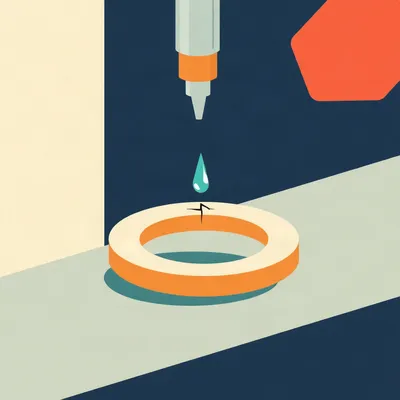
Let me walk through that failure analysis, because it's instructive. Chair leg repair. You've got end grain exposed, which is the most absorbent and weakest orientation of wood. The joint is experiencing peel loading every time someone sits down — the leg acts as a lever prying the joint apart. Five-minute epoxy was used, so lower ultimate strength and potential micro-cracking from thermal runaway. The wood probably had ambient moisture. If it was an oily wood, the surface energy was compromised. If amine blush formed and wasn't washed off before painting, the paint would peel. And if the bond line was too thick — which happens when you're trying to fill a gap in a broken chair leg — you get a weak joint because epoxy is brittle in bulk.
Every single factor stacked against success, and the user probably blamed the epoxy.
The epoxy did what five-minute epoxy does. The failure was in matching the material to the application. A flexible epoxy like G/flex, with proper surface prep, a thin bond line, and twenty-four hours to cure — that repair might have outlasted the chair.
Let's cut through the marketing and give you a practical framework. Here's how to choose the right epoxy for your specific job — and how to apply it so it actually works.
Decision tree time. First question: how fast do you need it? If you need a repair functional within an hour and strength isn't critical — a decorative item, a non-structural fix — five-minute epoxy is fine. Accept that you're leaving maybe thirty to forty percent of potential bond strength on the table. It'll hold, but don't hang a shelf with it.
If strength matters?
If you need maximum strength and can wait twenty-four hours, use a slow-cure epoxy with an amine or polyamide hardener. This is your go-to for anything structural — furniture repair, tool handles, anything that takes load. The twenty-four-hour cure gives you that fifty percent strength increase we talked about. It's not just patience — it's better polymer architecture.
What about bonding different materials together? Wood to metal, plastic to ceramic?
That's where flexibility becomes critical. Different materials expand and contract at different rates with temperature changes. A rigid epoxy bond between aluminum and wood will eventually fail as the aluminum expands in summer heat while the wood stays relatively stable. Flexible epoxies — G/flex is the standout example, it uses a modified amine formulation — can absorb that differential movement. Polyamide-based epoxies are also more flexible. For dissimilar materials, flexibility isn't a nice-to-have; it's the difference between a permanent bond and a time-delayed failure.
Outdoor or wet environments?
Specifically formulated for UV resistance and moisture tolerance. West System, TotalBoat, System Three — these are real marine epoxies with technical data sheets you can read. They cost more, but they're formulated for the conditions that destroy general-purpose epoxy.
Now the surface prep protocol. If people remember one thing from this episode, I want it to be this.
Sand to eighty to a hundred and twenty grit. That's coarse enough to create mechanical tooth, fine enough not to create deep scratches that trap air. Clean with acetone or isopropyl alcohol — ninety percent or higher, not the seventy percent rubbing alcohol. Apply the epoxy within thirty minutes of cleaning. For plastics, sand and then flame-treat — a quick pass with a propane torch, just enough to see the surface change slightly, you're not trying to melt it. For glass, use a glass-specific epoxy with silane coupling agents.
The mixing discipline. I've watched people squeeze out approximate blobs and stir for ten seconds.
That's the number one cause of epoxy failure. You need to measure by weight, not volume. The resin and hardener have different densities — a one-to-one volume ratio might be a one-point-two-to-one weight ratio. Use a gram scale. Mix thoroughly for a full two minutes, scraping the sides and bottom of the mixing cup. The stuff on the sides is unmixed, and it will not cure properly. Apply within the pot life, which is shorter in warm conditions — if the technical data sheet says fifteen minutes at twenty-five degrees Celsius, it might be eight minutes at thirty-five degrees.
The pot life isn't just about it getting stiff. The chemistry is advancing.
Once the epoxy starts to exotherm in the cup, the reaction is well underway. If you apply it after that point, you're applying partially polymerized material that won't wet the surface properly and won't form a strong bond. When it starts getting warm, you're racing the clock, and you've already lost time you didn't know you'd lost.
The clamp or weight rule — this is another one people get wrong. Either they don't clamp at all, or they crank it down like they're trying to squeeze every last molecule out.
Epoxy needs constant pressure during cure — five to fifteen psi is the sweet spot. That's enough to ensure intimate contact between the surfaces and squeeze out excess epoxy and air bubbles. Too little pressure, and you get a thick bond line. Epoxy is brittle in bulk — a thick glue line is a weak glue line. The optimal bond line thickness is one to five thousandths of an inch. That's about the thickness of a sheet of paper.
A sheet of paper. Most people are applying ten or twenty times that thickness.
Wondering why it fails. But too much pressure is equally bad — you squeeze out all the epoxy and create a starved joint with voids and dry spots. The clamping pressure should be firm but not crushing. If epoxy is squeezing out around the entire perimeter, you've got enough pressure. If nothing squeezes out, you probably don't have enough.
The ideal glue line is almost invisible. If you can see a thick amber line between your two pieces, that's a warning sign.
Shrinkage during cure creates internal stresses in thick bond lines. The epoxy shrinks as it crosslinks, and if the bond line is thick, that shrinkage pulls the interface inward, creating tensile stresses at the very point where the bond is supposed to be strongest. A thin bond line minimizes the volume of shrinking material.
The rule is: clamp firmly, not aggressively, and aim for paper-thin.
Leave the clamps on for the full cure time. Not the "handling strength" time — the full cure time. Five-minute epoxy might be handleable in five minutes, but it reaches full strength in hours. Twenty-four-hour epoxy needs twenty-four hours under clamp. I know it's inconvenient. Borrow more clamps. The chemistry doesn't care about your schedule.
What about temperature during cure? I've done epoxy repairs in a cold garage and had them stay tacky for days.
Most epoxies have a minimum cure temperature — typically around fifty degrees Fahrenheit, ten degrees Celsius. Below that, the reaction slows dramatically. Some formulations, particularly polyamide-based, can remain slightly tacky indefinitely if cured too cold. The technical data sheet will specify the minimum temperature. If your workspace is colder than that, bring the piece indoors, or use a heat lamp — but be careful not to overheat and cause thermal runaway.
Humidity matters too.
High humidity during cure can cause amine blush to form more aggressively, and in extreme cases can actually interfere with the curing reaction at the surface. The ideal cure conditions are room temperature, moderate humidity, and dust-free. A bathroom after a shower is not the place to cure epoxy.
To summarize the decision framework: fast repair and low stakes, five-minute epoxy. Maximum strength, slow-cure amine or polyamide. Dissimilar materials, flexible epoxy. Outdoor or wet, marine grade. And in every case, sand, clean, mix by weight, apply within pot life, clamp to paper-thin, and wait.
That's the cheat sheet. And if you follow it, your epoxy repair might outlast the original part. The chemistry is that good. The failure point is almost always the application, not the material.
Let's look forward a bit. What's happening in epoxy formulation that might change what's on hardware store shelves in the next few years?
Two trends worth watching. The first is bio-based hardeners. Traditional epoxy hardeners are petroleum-derived, and there's a push toward renewable sources. Cashew nutshell liquid is already used commercially — it contains cardanol, a phenolic compound that can be modified into an epoxy hardener. Lignin, the structural polymer in wood, is being researched as an epoxy precursor. Sicomin's GreenPoxy line is one of the first commercial bio-epoxies, with something like fifty to sixty percent renewable carbon content.
Does it match petroleum-based performance?
For general applications, it's competitive. The glass transition temperatures tend to be slightly lower, and the moisture resistance isn't quite as good yet. But the gap is closing. The real question is whether consumers will pay a premium for bio-based when petroleum epoxy is cheaper and proven.
The second trend?
Hybrid epoxy-acrylate adhesives. These combine epoxy's toughness and chemical resistance with acrylic's fast cure and UV stability. They're already used in automotive assembly — they can be cured with UV light in seconds and then undergo a secondary thermal cure for full strength. The potential for consumer products is significant: an adhesive that sets in seconds under a UV flashlight but develops full epoxy-like strength over time. Several companies are working on consumer versions.
The line between epoxy and other adhesive chemistries is blurring.
It's converging. The future of structural adhesives is probably not "epoxy or acrylic" but "hybrid formulations optimized for specific use cases." And that's exciting, because it means the products on the shelf will get better at solving real problems rather than requiring users to understand polymer chemistry.
Which, ironically, we just spent half an hour explaining.
The chemistry will always matter for understanding failure. But making the product more forgiving — that's good engineering. Epoxy is already the most forgiving high-performance adhesive available to consumers, but forgiving doesn't mean foolproof. The chemistry is elegant, but the application is craft. Respect the cure time, respect the surface, and your repair might outlast the original part.
If it fails, at least now you know which of the seventeen things you did wrong to blame.
That's the gift of knowledge. You get to be precisely disappointed instead of vaguely frustrated.
Now: Hilbert's daily fun fact.

In the nineteen-tens, early phonograph cylinders manufactured by the Edison company occasionally traveled as far as the Gilbert Islands — modern-day Kiribati — where missionaries used them to teach hymns. The word "phonograph" itself derives from Greek roots meaning "sound writing," making it a direct etymological cousin of "phonetic" and "graphite" — all three words share the same ancestral morphemes for sound and for marking.
...right.
This has been My Weird Prompts. Thanks to our producer Hilbert Flumingtop. You can find every episode at myweirdprompts dot com, and if you've got a question about chemistry, adhesives, or anything else you'd like us to overanalyze, send it in. We'll be here.