Daniel sent us this one — and it's a direct follow-through. He says that after our episode on LCL consolidation, the reason Alibaba's shipping quotes are so absurdly expensive finally clicked. The platform assumes you're shipping a full container even when you're buying a hundred small widgets. But now he wants the operational specifics. If you're buying from Alibaba and using an LCL freight forwarder on the Chinese side, which Incoterm makes the most sense? Do you just put the forwarder's dock as the delivery address? Do the seller and forwarder need to communicate directly, or is it on you as the importer to relay everything? And since one model requires the forwarder to pick up the goods and the other doesn't, which arrangement is actually most common in practice?

This is the episode where we stop talking about why Alibaba's shipping is broken and start talking about how to actually fix it. And the operational question Daniel's asking — which Incoterm, who talks to whom, what's the actual workflow — that's where most small importers get tripped up. They understand consolidation in theory, but the handoff between seller and forwarder is where shipments disappear into the void.
The void being a warehouse in Shenzhen where nobody knows your pallet exists.
So let's map this out concretely. You're sitting at your computer, you've found a supplier on Alibaba for, say, two hundred kilograms of electronics components. The seller quotes you five hundred dollars for the goods. Alibaba's built-in shipping quote says four thousand dollars for ocean freight. You now know that's a full container rate. You've found a freight forwarder in China who'll consolidate your shipment into a shared container for maybe three hundred dollars. The question is: how do you get the goods from the seller to that forwarder, and what does the seller actually need to do?
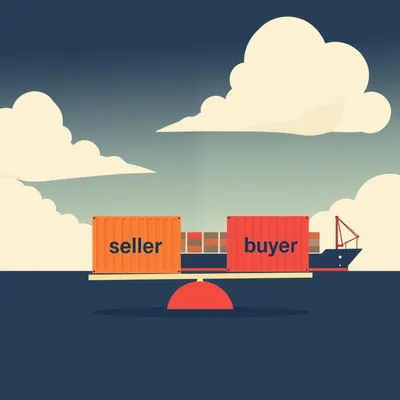
That's where the Incoterm becomes the whole game. Because the Incoterm defines exactly where the seller's obligation ends and yours begins. Pick the wrong one, and you're suddenly arranging trucking in a country where you don't speak the language.
Let's walk through the three that matter here. EXW, FOB, and FCA. And I want to be concrete about what each one actually means at the operational level, because the textbook definitions don't capture the chaos.
EXW — Ex Works. The seller makes the goods available at their factory or warehouse. That's it. They don't load them onto a truck. They don't handle export clearance. They put the boxes by the loading dock and their job is done.
This is the most buyer-burdensome term in international trade. Under EXW, you or your forwarder has to arrange pickup from the factory, handle all export documentation, and assume risk from the moment the goods are made available. For LCL consolidation, this means your freight forwarder sends a truck to the factory in — let's say Dongguan — picks up the goods, and brings them to the consolidation warehouse in Yantian or Shanghai. You pay for that truck. You pay for the loading. If something gets damaged between the factory floor and the truck, it's on you.
The seller loves EXW because it's the least work they can possibly do. They don't even have to put the boxes on the truck. A lot of Chinese suppliers default to EXW for exactly that reason. It's familiar and it's easy for them.
Here's the thing. EXW is not actually the simplest option for the buyer, even though it sounds like it should be. "Just give me the goods and I'll handle the rest" feels like control. But what it really means is you're now a logistics coordinator in a country where you don't have relationships, don't know the carriers, and can't verify whether the truck that showed up is actually the one you booked.
It's the illusion of control. You feel like you're managing everything, but you're actually just holding a very expensive bag of problems.
Now, FOB — Free on Board. This is the classic port-to-port term. The seller delivers the goods to the port, clears them for export, and loads them onto the vessel. Risk transfers to the buyer once the goods are on board the ship. This works beautifully for full container loads. The seller brings a sealed container to the port, it gets loaded, done.
For LCL, FOB is awkward. Because your freight forwarder doesn't want the goods at the port. They want them at their consolidation warehouse, which is usually inland from the port, where they palletize your shipment with a dozen other small shipments heading to the same destination. If the seller delivers to the port under FOB, the forwarder still has to get the goods from the port to their warehouse, and that introduces an extra handling step, extra cost, and a gap in responsibility that nobody wants to own.
The forwarder's consolidation warehouse might be in Yantian, which is near the port of Shenzhen, but it's not the port. Under FOB, the seller's obligation technically ends when the goods cross the ship's rail — or, under the newer rules, when they're placed on board. But the forwarder needs physical possession before that point to consolidate. So you end up with this awkward middle ground where the goods are at the port but not yet with the forwarder, and someone has to bridge that gap.
Which brings us to FCA — Free Carrier. And this is the sweet spot for LCL consolidation.
FCA is the term that was basically designed for containerized freight and consolidation. Under FCA, the seller delivers the goods to a named place — and critically, that named place can be the forwarder's warehouse. The seller handles export clearance. Risk transfers when the goods are handed over to the carrier at that named place. For LCL, you specify the forwarder's consolidation warehouse as the named place. The seller arranges local delivery to that address. The forwarder receives the goods, signs for them, and takes it from there.
This is the term where everything clicks. The seller is responsible for getting the goods to the forwarder's dock. You're not arranging trucking in a foreign country. The forwarder knows the goods are coming because the delivery address is literally their warehouse. And the handoff is clean — seller drops off, forwarder signs, risk transfers, done.
Yet FCA is wildly underused by small importers. Most Chinese sellers default to EXW or FOB because those are the terms they've been using for decades. FCA has been around since the nineteen nineties, but it hasn't penetrated the Alibaba ecosystem the way it should have. You often have to explicitly request it, and some sellers will push back simply because they're not familiar with it.
I've seen sellers say "we only do EXW or FOB" as if those are the only two Incoterms that exist. It's not malice. It's just that their standard contract template has two options and FCA isn't one of them.
Let's make this operational. Scenario A: EXW. You buy fifty electronics components from a factory in Shenzhen. Total weight, two hundred kilos. You've hired a freight forwarder with a consolidation warehouse in Yantian. Under EXW, the seller says "goods are ready, come get them." You email your forwarder. The forwarder arranges a truck. The truck drives to the factory, loads the goods, drives to Yantian. You pay for the truck — maybe a hundred fifty dollars for a local run. You pay for loading labor if the seller won't load. The forwarder receives the goods and begins consolidation.
Scenario B: FCA. Same goods, same factory, same forwarder in Yantian. You tell the seller: "Incoterms FCA, named place: the forwarder's warehouse at this address in Yantian." The seller arranges a truck from their factory to Yantian. They load the goods. They handle export clearance if needed. The goods arrive at the forwarder's dock. The forwarder signs. You pay the seller for the goods plus whatever local delivery cost they baked into the price — which is almost certainly less than what you'd pay arranging it yourself, because they have local carrier relationships.
That's the key insight. The seller can almost always arrange local trucking cheaper than you can. They're in the market. They have accounts with local carriers. They know which trucking companies are reliable and which ones will ghost you. Under FCA, you're leveraging their local knowledge instead of fighting against it.
The answer to Daniel's first question — which Incoterm makes the most sense — is FCA, almost always. EXW gives you the illusion of control at the cost of actual complexity. FOB is designed for a different workflow entirely. FCA is the term that aligns with how LCL consolidation actually works.
Now, Daniel's second question: do you just put the forwarder's dock as the delivery address? The answer is yes, but with a caveat. You don't just paste an address into the Alibaba order form and hope for the best. You need to communicate that address clearly, with a contact name and phone number at the forwarder's warehouse, and you need to make sure the seller understands that this is the named place under FCA.
The address alone isn't enough. A warehouse in Yantian might receive hundreds of shipments a day. If your goods show up with no reference number, no contact name, and no shipping mark, they're going into a black hole.
Which brings us to the third question — the coordination piece. Do the seller and forwarder need to communicate directly? And the answer is: it depends on the forwarder, but in most cases, you are the bridge. The seller and forwarder typically do not communicate directly unless you broker the introduction. Your job as the importer is to send the forwarder everything they need to know about the incoming shipment, and to tell the seller what to expect.
This is the part that surprises people. They think the freight forwarder is like a concierge who handles everything once you give them an order number. That's not how it works. The forwarder is a logistics provider. They need information. If you don't give it to them, they can't act.
Here's the actual coordination workflow. Step one: before you even place the order, you contact the freight forwarder and get a quote based on your estimated cubic meters and weight. You also get their warehouse address and a reference number for your shipment. Step two: you place the order on Alibaba, specifying FCA with the forwarder's warehouse as the named place. You include the reference number in the order notes. Step three: you send the forwarder a package of documents — the commercial invoice, the packing list, the seller's contact information, and the expected delivery date. Step four: you tell the seller that the forwarder is expecting the goods and give them the warehouse contact details. Step five: the seller delivers. The forwarder receives, checks the goods against the packing list, and confirms receipt to you.
If any of those steps gets skipped, the shipment goes sideways. The most common failure mode I've seen is the importer places the order, gives the seller the forwarder's address, and then never tells the forwarder the goods are coming. So a truck shows up at the warehouse with unlabeled boxes, no reference number, and no advance notice. The warehouse refuses delivery or puts the goods in a holding area and charges storage fees while they try to figure out who they belong to.
The second most common failure pattern: the seller ships to the wrong address. Maybe they use an old address from a previous shipment. Maybe they misread the address you provided. Maybe they just put the port name and assume the forwarder will find it. This is why you need the forwarder's address in writing, in Chinese, with a contact phone number, and you need to verify with both parties that the delivery happened.
Let's talk about labeling, because this is where small importers lose their goods. Every carton needs a shipping mark. That's a unique identifier — typically your name or company name, the order number, the destination port, and the forwarder's reference number. Something like "CORN-IMPORT-301-YANTIAN-LAX-REF-8842." That mark goes on every box. Without it, your two hundred kilos of electronics components look identical to the next guy's two hundred kilos of electronics components, and the forwarder has no way to know which is which.
The shipping mark is the difference between your goods arriving in Los Angeles and your goods spending six months in a Shenzhen warehouse while everyone tries to figure out who owns them. I cannot stress this enough. Label every carton. Take photos of the labels. Send the photos to the forwarder. This is not optional.
Daniel also asked which arrangement is most common in practice. And honestly, it's a mix. EXW is probably the most common because it's the default — sellers offer it, buyers accept it without understanding the implications, and everyone muddles through. But among importers who know what they're doing, FCA is the standard. It's cleaner, cheaper, and reduces the number of things that can go wrong.
There's a case study I want to walk through because it illustrates the cost difference perfectly. Importer buys two hundred kilos of auto parts from a factory in Ningbo. The freight forwarder's consolidation warehouse is in Shanghai, about two hundred kilometers away. Under EXW, the forwarder arranges a truck from Ningbo to Shanghai. That's a two-hundred-kilometer run. Cost: about a hundred fifty dollars. Under FCA, the seller delivers to Shanghai using their own local carrier. Cost: about eighty dollars, baked into the product price. The importer saves seventy dollars and avoids the headache of coordinating a truck they never see.
The savings compound. If you're importing regularly, that seventy dollars per shipment adds up. But the bigger savings isn't the trucking cost — it's the avoided disasters. The shipment that doesn't get lost. The warehouse fees you don't pay because the forwarder knew the goods were coming. The customs delay that doesn't happen because the paperwork was right.
Let's talk about what happens inside the forwarder's warehouse, because that's the part of the process most importers never see. The forwarder receives your goods, checks them against the packing list you provided, and assigns them to a consolidation group — other shipments heading to the same destination port. Your two hundred kilos of auto parts might share a container with someone's ceramic mugs, someone else's textile samples, and a pallet of LED strips. The forwarder palletizes everything, creates a consolidated bill of lading — called a house bill — and ships the container. You get a single freight bill for your share, calculated by volume or weight, whichever is greater.
That calculation matters. LCL is typically charged per cubic meter, or CBM, or per one thousand kilograms — whichever is greater. There's almost always a minimum charge of one CBM, even if your goods take up less space. So if you're shipping half a cubic meter of feathers, you're paying for a full cubic meter. If you're shipping half a cubic meter of lead that weighs twelve hundred kilos, you're paying for one point two CBM based on weight.
The weight-to-volume conversion is called the chargeable weight, and it's where a lot of importers get surprised. The standard conversion is one cubic meter equals one thousand kilograms. So if your goods are dense — think metal parts, machinery, batteries — you'll be charged by weight. If they're voluminous but light — think foam, empty boxes, insulation — you'll be charged by volume. The forwarder calculates both and charges whichever is higher.
Which is why you need accurate dimensions and weight from the seller before you get a forwarder quote. If the seller says "about two cubic meters" and it turns out to be three, your freight cost just went up fifty percent.
That brings us to the break-even point — when does LCL stop making sense and FCL become cheaper? The rough rule of thumb is around eight to ten cubic meters. Below that, LCL is almost always cheaper. Above that, you should start comparing full container rates. A twenty-foot container from China to the US West Coast might cost twenty-five hundred dollars. At eighty dollars per CBM for LCL, eight CBM costs six hundred forty dollars — way cheaper than the full container. But at twelve CBM, LCL costs nine hundred sixty dollars while the full container is still twenty-five hundred — still cheaper to go LCL. At fifteen CBM, LCL hits twelve hundred — now you're getting close. The exact break-even depends on the route, the carrier, and the season, but eight to ten CBM is the zone where you should run both quotes.
I've seen importers ship twelve CBM via LCL because they didn't bother checking the FCL rate, and they effectively paid for a third of a container while using half of one. That's just leaving money on the table.
Now let's talk about what can go wrong, because the failure pattern are specific and avoidable. We already covered the unannounced delivery — goods show up at the forwarder's warehouse with no notice, no reference number, no shipping mark. The fix is simple: email the forwarder before the seller ships. Send the packing list, the commercial invoice, and the seller's contact info. Ask for confirmation that they're expecting the shipment.
Second failure pattern: paperwork mismatch. The commercial invoice says one thing, the packing list says another, and the bill of lading says a third. Customs in the destination country sees the discrepancy and flags the shipment for inspection. Now your goods are sitting in a bonded warehouse accruing storage fees while a customs officer tries to figure out whether you're importing auto parts or something else entirely.
The fix: create a single document package and send the same version to the seller, the forwarder, and your customs broker. Consistency is more important than perfection. If the invoice says "electronic components, model XJ-400" then the packing list should say exactly the same thing, not "XJ400 parts" or "electronic spares.
Third failure pattern: surprise warehouse fees. The forwarder receives your goods but the consolidation group isn't shipping for another two weeks. So your goods sit in the warehouse. Some forwarders include a grace period — maybe five to seven days of free storage. After that, you're paying daily storage fees. If you didn't ask about this upfront, you'll find out when you get the final invoice.
Always ask about free storage days and the daily rate after that. And coordinate your timing so the seller delivers close to the consolidation sailing date. If the forwarder's next LCL sailing to your destination is in three days, don't have the seller deliver three weeks early.
Let's pull together the concrete checklist Daniel was asking for. If you're importing from Alibaba using LCL consolidation, here's the workflow. Step one: find a freight forwarder in China with consolidation services to your destination port. Get a quote based on estimated CBM and weight. Get their warehouse address, contact name, phone number, and a reference number for your shipment.
Step two: negotiate with the seller using FCA terms. The named place is the forwarder's warehouse. If the seller pushes back and insists on EXW, ask them to quote FCA instead — most will do it if you ask. The price might be slightly higher to cover local delivery, but it'll still be cheaper than arranging trucking yourself.
Step three: place the order. In the order notes, include the forwarder's warehouse address, contact name, phone number, and your shipment reference number. Specify FCA clearly. Don't just assume the seller will read the notes — confirm in the Alibaba chat that they understand the delivery address and the Incoterm.
Step four: create a coordination document. This is a single page that includes the seller's name and contact, the order number, item descriptions, quantities, total weight, total dimensions, the forwarder's address and contact, and the shipment reference number. Send this to the forwarder with the subject line "Incoming shipment — reference number whatever." Attach the commercial invoice and packing list.
Step five: tell the seller the forwarder is expecting the goods. Give them the warehouse contact details again. Ask for the expected delivery date and the trucking company name if available. Forward that information to the forwarder.
Step six: label every carton with the shipping mark. Your name, order number, destination port, forwarder reference number. Take photos of the labeled cartons. Send the photos to the forwarder.
Step seven: confirm receipt. When the seller says the goods were delivered, ask the forwarder to confirm they received them and that the carton count matches. If something's off, catch it now — not when the container is already on the water.
Step eight: the forwarder consolidates, ships, and sends you the house bill of lading and the freight invoice. You pay the freight bill. You send the bill of lading to your customs broker at the destination port. The broker clears the goods. You arrange final delivery from the destination port to your warehouse or fulfillment center.
That's the full loop. And notice how much of it happens before the goods even leave the seller's factory. The coordination is the work. The shipping is just the result.
That's the thing most first-time importers don't appreciate. They think the hard part is finding the product and negotiating the price. But the logistics is where the real skill lives. The difference between a profitable import and a money pit is almost always in the shipping and coordination, not the product cost.
There's a structural reason for this. Alibaba has spent twenty years optimizing the product discovery and payment experience. It's genuinely good at that. But the logistics layer — especially for small and medium importers — is still fragmented. Alibaba's built-in shipping is optimized for large buyers moving full containers. The platform hasn't built a native consolidation experience. So the importer who learns to work with independent freight forwarders is operating in a space that the platform doesn't serve well, which means less competition and better margins.
That's the open question I want to leave on the table. As LCL becomes more accessible — and as digital freight forwarders like Flexport and Freightos make booking easier — will Alibaba eventually integrate consolidation into its platform? Or will the freight forwarder ecosystem remain the better path because it's more flexible and more personal?
My bet is the forwarder ecosystem stays dominant for small importers. A good freight forwarder does things a platform can't easily replicate — they check your goods when they arrive, they notice if the carton count is off, they have relationships with the carriers and the customs brokers. That's not an algorithm. That's a person who knows your business.
That's the structural advantage. The importer who builds a relationship with a reliable forwarder in China has something that can't be commoditized by a platform update. It's a moat.
Daniel, to answer your questions directly: FCA is the Incoterm you want, with the forwarder's warehouse as the named place. Yes, you put the forwarder's dock as the delivery address, but with a contact name, phone number, and reference number — not just an address. The seller and forwarder typically don't communicate directly unless you introduce them. Your job is to be the information bridge. And in practice, EXW is still common out of inertia, but FCA is the arrangement that actually makes sense for LCL.
Now: Hilbert's daily fun fact.

The name "Tajikistan" as we know it today was formalized in the nineteen twenties when the Soviet Union carved the Tajik Autonomous Soviet Socialist Republic out of the Uzbek SSR, but the decision sparked a succession crisis within the Basmachi movement — the Central Asian anti-Soviet resistance — because the new borders split the movement's leadership between those who accepted the Soviet administrative framework and those who rejected any territorial division that didn't align with the former Emirate of Bukhara's claims.
a lot of syllables for a fun fact.
I need a nap.
You always need a nap.
This has been My Weird Prompts. If this episode saved you from a bad Incoterm choice, share it with one person who's still paying full container rates for a pallet's worth of goods. We're at my weird prompts dot com. I'm Herman Poppleberry.
I'm Corn. Good luck with your shipments.