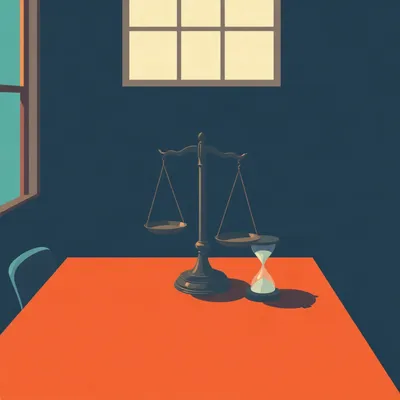
Imagine weaponizing time itself in a debate — not with better arguments, but by just... not stopping. Daniel sent us this one, and I'm going to read it pretty much in full because there's a lot packed in here. He writes: Let's talk about the history of filibustering — one of the strangest hacks that somehow exists in democratic and parliamentary systems. If it were not often employed to attempt to achieve rather disturbing defeats of democracy, it would be a transparently comical idea: use the passage of time as a weapon to either bore people or overcome some administrative block. Today's topic: chart the history of filibustering, how it is particularly associated with US politics but has been employed recently here in Israel, and how one might find use for its techniques in their own life, taking the fundamental tactic of massively elongating speech and finding application for it in a non-legislative setting.

There's a lot in there. And I love that he calls it a hack, because that's exactly what it is — an exploit. Somebody looked at the rules, saw they didn't cap speaking time, and thought... what if I just don't stop?
The world's least efficient weapon. A man, a microphone, and a bladder of steel.
Right. So let's strip away the political noise and ask: what is this thing, really? A filibuster is using extended debate to delay or block a vote. The goal isn't to persuade anyone — nobody's mind is getting changed in hour fourteen. The goal is to exhaust the clock or exhaust the opposition. It's time-as-weapon.
And it only works because parliamentary systems have this built-in assumption that debate is good and should be unlimited. A bug nobody patched.
The assumption is that legislators will speak, make their points, and sit down. The filibuster exploits the gap between that norm and the actual rule. The norm says be reasonable. The rule says there's no limit. And once someone notices that gap, the whole system tilts.
So today we trace the filibuster from ancient Rome to the US Senate to the Knesset floor — then steal its playbook for our own lives. Because if you can talk for fifteen hours to block a bill, you can probably talk for fifteen minutes to get a refund.
To understand the filibuster, we have to go back — way back — to ancient Rome. Sixty BCE. Julius Caesar is trying to pass a land reform bill, and one senator, Cato the Younger, decides he's not having it. So Cato gets up and speaks. And speaks. And keeps speaking until sunset, when the Senate rules required the session to end. Bill blocked.
Sunset. The original cloture rule was the sun going down.
Which is beautifully simple. You can't filibuster the rotation of the earth. But it also tells you how old this tactic is — two thousand years, give or take. Cato wasn't trying to win the argument. He was trying to run out the clock, and he did.
And the word itself — filibuster. Where does that come from?
Dutch, originally. Vrijbuiter — meaning pirate or freebooter. Someone who raids and plunders. It entered American political vocabulary in the eighteen-fifties, applied to senators who were, quote, pirating the legislative process. The idea being they were hijacking the floor.
A linguistic journey from Caribbean piracy to CSPAN. That's a good arc.
It really is. So the US Senate, for most of its early history, had no way to cut off debate. The rules just didn't provide for it. And for decades this wasn't a problem, because the norm held — you spoke, you sat down. But by the mid-eighteen-hundreds, senators started realizing they could just... keep going. The first major filibusters were over issues like the national bank and slavery. And the Senate had no mechanism to stop them.
So when does that change?
Nineteen-seventeen. President Wilson wanted to arm merchant ships ahead of US entry into World War One. A group of senators filibustered the bill. Wilson was furious — called them a "little group of willful men." And the public pressure was enough that the Senate finally adopted Rule Twenty-Two, creating cloture. Two-thirds of senators could vote to end debate.
Two-thirds is a high bar.
It's enormous. And it stayed at two-thirds until nineteen seventy-five, when they lowered it to three-fifths — sixty votes. Which is still a supermajority. The Senate has a hundred members, so you need sixty to break a filibuster. That's the number everyone knows.
So the filibuster effectively turns the Senate from a simple-majority body into a supermajority body. Fifty-one votes wins you nothing if the other side threatens to talk forever.
That's the structural distortion. And here's where it gets really interesting — the mechanism changed. Before the nineteen-seventies, if you wanted to filibuster, you had to actually hold the floor. Stand there. Talk continuously. No bathroom breaks, no sitting down, no leaning on your desk. The most famous example is Strom Thurmond in nineteen fifty-seven, filibustering the Civil Rights Act. Twenty-four hours and eighteen minutes.
What do you even talk about for twenty-four hours?
Thurmond read the Declaration of Independence, the Bill of Rights, George Washington's farewell address. He read state election laws. He read his grandmother's biscuit recipe at one point, according to some accounts. The rules required him to stand, not lean on his desk, and stay on topic — though "on topic" was interpreted loosely. He took a steam bath beforehand to dehydrate himself so he wouldn't need the bathroom. It was a physical endurance contest.
The steam bath detail is... that's commitment to a terrible cause.
It is. And that's the talking filibuster. But then the rules changed. In the nineteen-seventies, the Senate created a two-track system — they could set aside a filibustered bill and move on to other business without the filibustering senator having to hold the floor. This was supposed to make the Senate more efficient. Instead, it created the silent filibuster.
Explain that shift, because this is the part most people don't know.
So before the change, filibustering was costly. You had to physically stand there, you had to have allies to tag in, you ground the entire Senate to a halt. That cost meant filibusters were rare — about one per Congress in the nineteen-fifties. After the two-track system, all you had to do was threaten to filibuster. File a cloture motion, or just signal that you would. No talking required. The cost dropped to nearly zero, and usage exploded. By the twenty-tens, over two hundred filibusters per Congress.
Two hundred. From one.
From one to two hundred. The silent filibuster turned a rare procedural nuclear option into the default setting. Now virtually everything in the Senate needs sixty votes, because the minority can just say "we'll filibuster" and the majority either finds sixty votes or drops the bill.
So the talking filibuster — the dramatic, standing-for-hours, reading-recipes version — that's basically dead?
Mostly. But it does make comebacks. Chris Murphy in twenty-sixteen — fifteen hours on gun control after the Pulse nightclub shooting. Rand Paul in twenty-thirteen — thirteen hours on drone policy, specifically questioning whether the president could authorize a drone strike on a US citizen on American soil. Both were actual talking filibusters, and both generated enormous attention precisely because they were rare.
The rarity becomes the power. If everyone's silently filibustering everything, the one guy who actually stands up and talks for fifteen hours is suddenly news.
The talking filibuster is now a performance — a way to signal that this issue, this specific issue, matters enough to physically suffer for. Murphy's legs were shaking by hour twelve. He had to lean on his desk. He wasn't allowed to sit or use the bathroom. And that physical cost is what made it compelling. It's the legislative equivalent of a hunger strike.
The body as argument.
Right. And it's worth noting — the filibuster has no fixed political valence. It's been used by segregationists to block civil rights, and it's been used by progressives to block corporate-friendly bills. It's been used by conservatives to block gun control, and by liberals to block surveillance expansions. The tactic itself is morally neutral. It's a tool.
A tool that, I have to say, is also just inherently funny. The most powerful legislative body in the world can be defeated by a man refusing to stop talking about his grandmother's biscuit recipe.
It is deeply absurd. And that absurdity is part of why it works — it's a hack that reveals the system's assumptions. The Senate assumes good faith. The filibuster exploits that assumption.
So the US Senate has turned the filibuster into a supermajority machine. But what about other democracies? Daniel mentioned Israel specifically.
The Knesset works differently. There's no unlimited debate rule. Each MK gets a limited time to speak on a bill — typically ten minutes at first reading. But here's the thing: when you have dozens of opposition MKs, and each one takes their full ten minutes, and they coordinate, you can still eat up hours and hours of floor time.
Ten minutes each, times forty MKs, that's... a lot of minutes.
Nearly seven hours. And if they all speak at second reading and third reading too, you're looking at a full day or more of delay. The coalition can limit debate through closure motions, but those take time to pass, and in the meantime the opposition is reading poetry, reading books, making long digressive speeches.
What's the most notable recent example?
July twenty twenty-three. The judicial overhaul — specifically the reasonableness standard bill. Opposition MKs filibustered for hours, reading from children's books, reciting poetry, telling personal stories. One MK read the entire text of the Declaration of Independence in Hebrew. Another read from a phone book. The goal wasn't to kill the bill — they didn't have the votes for that — but to delay it, to generate media coverage, to signal to the public that this was being rammed through.
And did it work?
It delayed the vote by a day or so. The bill passed anyway. But the filibuster served a different function in Israel than in the US. It's not a blocking mechanism — it's a protest mechanism. A way to say "we can't stop this, but we will make you work for it, and we will make sure everyone is watching."
So the Israeli filibuster is more symbolic than structural.
Right. And there's another key difference. In the US, the filibuster is individualistic — one senator can do it, or a small group. In Israel, it's collective. You need dozens of MKs coordinating, each taking their slot, passing the baton. It's less a marathon and more a relay race.
The twenty-eighteen Nation-State Law debate — similar dynamic?
Very similar. Opposition MKs used extended speeches to delay the vote, reading from Israel's Declaration of Independence, making the point that the new law contradicted it. Again, the bill passed. But the filibuster created a public record of opposition that resonated beyond the Knesset chamber.
It's interesting — the filibuster in Israel is weaker structurally but maybe stronger narratively. The US silent filibuster is more powerful as a blocking tool, but nobody sees it. The Israeli version is less effective at stopping bills, but everyone watches.
The US filibuster is a supermajority requirement wearing a trench coat. The Israeli filibuster is political theater — and theater matters. It shapes public opinion, it rallies the base, it creates clips that circulate online. Different goals, same underlying tactic: use time as leverage.
So we've seen the tactic in legislatures. Now let's steal it for our own lives. Daniel asked how one might apply the fundamental tactic of massively elongating speech in non-legislative settings.
I love this. The micro-filibuster. Here's the core principle: in any interaction where someone wants a quick resolution and you want more time or leverage, you can use verbal elongation to shift the cost of delay onto them.
Give me a concrete scenario.
Car dealership. You're negotiating. The salesperson wants to close — they have monthly targets, they want you to sign today. They say "what do I need to do to get you in this car right now?" Classic pressure move. Your micro-filibuster response: ask detailed questions about the warranty. Ask about the extended warranty. Ask what's covered, what's excluded, what the deductible is, whether it transfers if you sell the car. Ask about the financing terms — the APR, the prepayment penalty, the exact amortization schedule. Ask them to show you each number in writing. Restate their answers back to them to confirm. Then ask about something else.
You're not saying no. You're just... not saying yes.
You're being perfectly polite, perfectly reasonable. You're just elongating the interaction until the salesperson's time pressure starts working in your favor. They need to close by end of month. You can talk about undercoating until Tuesday.
And the dynamic flips. Suddenly they're the ones who want the conversation to end.
That's the filibuster move. The person who's willing to outlast the other has the power. In a legislature, it's the senator who can stand for twenty-four hours. In a negotiation, it's the person who can ask follow-up questions for forty-five minutes without breaking a sweat.
What about customer service? Everyone has a story about fighting an insurance denial or a bogus charge.
Polite persistence. Here's the playbook. You call about a disputed charge. They give you a scripted answer. You say "I understand, and I appreciate that, but I'd like to understand the specific policy that applies here. Can you read me the relevant section? And could I get your name and employee ID for my records? And your supervisor's name? And the case number for this call?" Every question extends the interaction. The agent's metric is calls per hour. Your filibuster is destroying their metric, politely. Eventually, escalating to a supervisor who can actually resolve the issue becomes easier for them than continuing to talk to you.
The bureaucracy's own time pressure becomes your weapon.
Yes. And this isn't being a jerk — you're not yelling, you're not abusive. You're just... thorough. Exhaustingly thorough. The kind of thorough that makes a system designed for quick resolutions short-circuit.
There's a reverse application too, right? Using filibuster tactics against someone who's dominating a conversation?
The counter-filibuster. Someone's been talking for ten minutes in a meeting, not letting anyone else speak. You don't interrupt rudely — you use procedural time-management. "I want to make sure we hear from everyone — could we do a quick round-robin?" Or "this is really valuable, could we put the extended discussion in the parking lot and come back to it?" Or simply "I'm conscious of time — can I suggest we table this part and move to the next agenda item?"
You're not arguing with them. You're arguing with the clock, and the clock is on your side because everyone else in the meeting also wants to leave.
The filibuster, in all these forms, is about recognizing that time is a resource. Most people treat time as a constraint — something they're running out of. The filibuster mindset treats time as a weapon — something you can deploy.
Which brings us to the ethical question. The filibuster is obstruction. In personal life, when is it fair to use?
I'd draw the line at coercion versus fair process. If someone is pressuring you — rushing you into a decision, denying you information, trying to steamroll you — the micro-filibuster is self-defense. You're using time to create space for yourself. That's ethical. If you're using it to block someone else from speaking or to prevent a group from making any decision at all, that's... less so.
So it's a shield, not a sword.
Ideally. Though I'll note that even in legislatures, people disagree about which is which. One person's principled obstruction is another person's anti-democratic sabotage. The tool doesn't judge.
The silent filibuster — just the threat of delay — is something you can use too. You don't actually have to talk for hours. You just have to signal that you're willing to.
This is maybe the most practical takeaway. In a salary negotiation, you don't need to filibuster. You just need to communicate, subtly, that you're not in a hurry. "I'm exploring a few options" — that's a silent filibuster. "I'd like to take some time to think about this" — silent filibuster. You're signaling that you have time, that you won't be rushed, that the cost of delay falls on them if they want to close quickly.
The Cato maneuver. When you sense a bad decision being rushed, ask for a delay. "Can we table this until next meeting?" "I need twenty-four hours to review." You're invoking the filibuster's core principle: slow down the process to change the outcome.
Cato couldn't stop Caesar forever. But he could stop him until sunset. Sometimes that's enough. Sometimes the thing that would have been rushed through on Tuesday looks different on Wednesday.
And the person pressuring you knows that. That's why they're rushing.
Which is the tell. If someone is insisting you decide right now, ask yourself why. What happens if you wait? The answer to that question is usually the reason they're rushing.
The filibuster is a tool of time. But is it a tool of democracy or a bug in the system?
It's both. It can protect minority rights — giving a voice to the opposition, forcing deliberation, preventing majorities from ramming through radical changes without debate. That's the democratic safeguard argument. But it can also enable minority rule — a small group blocking what the majority wants, which is the democratic failure argument. The answer depends entirely on who's using it and what they're blocking.
And that's why it's so hard to reform. Everyone hates the filibuster when they're in the majority and loves it when they're in the minority.
The procedural version of "it depends whose ox is being gored." And I think that's why it persists. No majority wants to give up a tool they might need when the tables turn.
One thing that strikes me — as legislative bodies worldwide become more polarized, we're probably going to see more filibustering, not less. The time weapon is cheap and effective, and it doesn't require money or votes. Just endurance.
And in the age of social media, the theatrical filibuster — the Israeli model, the Chris Murphy model — has a new power. It's not just about the chamber anymore. It's about the clips that circulate afterward. A filibuster is content now.
A twenty-four-hour livestream with a senator reading biscuit recipes. The founders definitely anticipated that.
They anticipated many things. That was not among them.
So here's what I'd leave listeners with. This week, in one interaction where you feel rushed, deliberately slow down the conversation. Ask more questions. Restate positions. Request clarifications. Notice how the other party reacts. You're not being difficult — you're using time as a shield. And you might be surprised how often the thing that couldn't wait until tomorrow suddenly can.
The person who controls the clock controls the outcome. That's true in the Senate, in the Knesset, and in your insurance company's call center.
Thanks to our producer Hilbert Flumingtop. This has been My Weird Prompts. If you enjoyed this episode, leave us a review — it takes less time than a filibuster, I promise. And send us your weird prompts at my weird prompts dot com.
We'll be back soon. Try not to filibuster anyone between now and then.
Unless they deserve it.