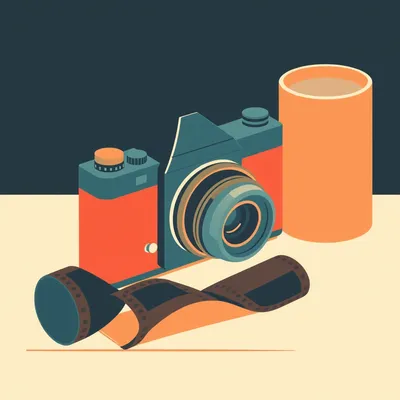
Daniel sent us this one about his friend Uncle Jason — a passionate analog photographer who was actually a little hesitant to share his hobby, knowing Daniel's into the latest tech. But Daniel was genuinely intrigued. What keeps people shooting video and stills on pre-digital gear? He's heard there's a look to 35mm that digital systems just can't replicate. And he spotted a tote bag full of film canisters and what he thinks was a Canon body. He wants to know how popular this actually is and what the technical differences are. So where do we start with this?

With Uncle Jason's Canon. I love this. If it's the model I think it is — and we'll get to that — he's holding a piece of engineering that people are paying four times what they paid for it ten years ago. But the real question hiding inside this prompt is: why would someone who can afford any digital camera choose to shoot film? And the answer turns out to be measurable, not sentimental. Let's start with the physics.
Because that's where every party starts.
I know you're joking, but stick with me. Film and digital sensors capture light in fundamentally different ways, and that difference cascades into everything people love about the analog look. Film uses an emulsion layer — basically gelatin loaded with silver halide crystals. When a photon hits one of those crystals, it knocks an electron loose and creates a tiny speck of metallic silver. That speck is your latent image. It's invisible. You don't see anything until you develop it chemically.
The image is physically there, just waiting to be revealed. It's not data yet.
It's a continuous analog signal embedded in the physical structure of the emulsion. A CMOS sensor, by contrast — that's what's in every digital camera — is a grid of photosites. Each photosite is basically a tiny capacitor. Photons hit it, electrons accumulate, and then an analog-to-digital converter reads the voltage at each photosite and turns it into a number. You go from continuous to discrete at the moment of capture.
Which means the conversion to ones and zeros happens right at the sensor. With film, the conversion happens later — when you scan the negative.
That's the key insight. The film itself has already recorded a continuous analog signal. The grain structure, the tonal transitions, the way highlights roll off — those are baked into the chemistry. When you scan film, you're digitizing an analog original. When you shoot digital, the analog-to-digital conversion happens at capture, and anything the sensor didn't resolve is gone forever.
It's the difference between recording a vinyl record to MP3 versus starting with an MP3.
That's actually a pretty good parallel. And it leads us into the dynamic range conversation. Film has what's called a characteristic curve — photographers call it the S-curve, with a shoulder and a toe. In the highlights, as the emulsion approaches saturation, the response gradually compresses. Highlights don't just clip to white — they roll off gently. Same thing in the deep shadows. You get this graceful compression at both ends.
Digital sensors don't do that.
Digital sensors are linear. They count photons in a straight line until the photosite well fills up, and then — hard clip. No detail, no gradation, nothing to recover. Now, to be fair, modern sensors have incredible dynamic range. A Sony A7 IV measures about fourteen and a half stops in ideal conditions. Kodak Portra 400 — probably the most beloved color negative film — has about thirteen stops of usable dynamic range.
Digital actually wins on the raw number.
On the number, yes. But the tonal distribution is completely different. Those thirteen stops on Portra are spread across that S-curve, so you get usable detail in highlights that would be blown on a digital sensor, even though the digital sensor technically captured more total range. This is why wedding photographers who shoot film can place a bride in direct sunlight and still see the texture of her dress. A digital sensor at the same exposure would give you a white blob.
This is what videographers are chasing when they talk about the 35mm look.
In cinema, the highlight rolloff is everything. ARRI — the company that makes the Alexa cameras used on most prestige television and film — they built their entire reputation on this. The ARRI Alexa 35, which came out in twenty twenty-two, uses a custom sensor specifically designed to emulate film's highlight response curve. They didn't try to maximize dynamic range numbers for a spec sheet. They designed the sensor to roll off highlights the way film does.
Because the spec sheet number sells cameras, but the rolloff sells the image.
Every cinematographer knows it. The Alexa isn't the highest-resolution cinema camera. It's not the best in low light. But it's the one everyone wants, because the way it handles highlights looks like film. And "looks like film" in cinematography is basically shorthand for "looks expensive.
What about grain? I've noticed people seem to love film grain but hate digital noise, even though they're both basically artifacts of the capture medium.
This is where the physics gets really interesting. Film grain comes from the actual silver halide crystals. They're random in size, random in distribution, random in orientation. Higher ISO films have larger crystals — that's why Tri-X 400 has visible grain but something like Ektar 100 is nearly grainless. The randomness means grain has an organic, almost textured quality. It feels like part of the image rather than something degrading it.
Like the texture of canvas under oil paint.
Digital noise, on the other hand, is not random in the same way. It has patterns. There's chrominance noise — those ugly color speckles in the shadows — and there's luminance noise, which is closer to grain but still tends to look smeary or blocky at high ISOs. The demosaicing algorithms that reconstruct color from the Bayer filter array create artifacts that our brains read as digital. Grain reads as physical.
There was a blind test I saw mentioned — DPReview did it, I think — where they showed a hundred photographers prints from a Hasselblad film camera and a Fujifilm GFX 100S, which is a hundred megapixel medium format digital camera. For portraits, sixty-eight percent preferred the film prints. They cited "more natural skin tones" and "better highlight detail.
That test was fascinating. For landscapes, the digital images won seventy-two percent of the time, because sharpness and resolution matter more there. But for faces, people consistently chose the technically inferior medium. That tells you something about what we're actually sensitive to as viewers.
It tells me that resolution isn't the thing we think it is.
That's one of the biggest misconceptions out there. People assume film must be higher resolution because it looks so good. In reality, a thirty-five millimeter frame resolves roughly fifteen to twenty megapixels equivalent when scanned at high resolution. A modern full-frame digital sensor can exceed sixty megapixels. Film is not winning on resolution. It's winning on tonality, color, and the way it transitions between light and shadow.
Let's talk about color, because that's the other piece I hear people rhapsodize about. "Portra colors," "Provia greens." What's actually happening in the emulsion that's different from a Bayer filter?
Film emulsions have specific spectral sensitivity curves that are tuned — deliberately, chemically — to respond to certain wavelengths in certain ways. Kodak spent decades formulating Portra to be flattering to skin tones. Not accurate — flattering. The emulsion is slightly more sensitive in the reds and oranges that make skin look warm and alive, and it handles the transition from highlight to midtone on a face in a way that's just...
Kind is a good word for an emulsion.
It's the right word. Fuji's Provia slide film is famous for its greens — the way it renders landscapes and foliage has a vibrancy that doesn't look oversaturated, just rich. These aren't accidents. They're the result of decades of chemical engineering targeting specific aesthetic goals. Digital sensors, by contrast, use a Bayer filter array — a grid of red, green, and blue filters over the photosites — and then software reconstructs the color through demosaicing. The result can be extremely accurate. But accurate and beautiful are different things.
Accurate is what your camera measures. Beautiful is what your eye remembers.
That's the gap film fills. It's also why film emulation LUTs and presets — Dehancer, FilmConvert, all those — they can get you close, especially in video, but they can't fully reproduce the random grain structure or the specific spectral sensitivity curves. They're approximations applied after capture. Film's color response happens at the moment of capture, in the chemistry.
You can fake the look, but you're painting over a digital file rather than starting from an analog one.
People can tell. Maybe not consciously, but in that blind test, sixty-eight percent could tell when it was a face.
Alright, so the technical differences are real. But what does that mean for the actual experience of shooting? Let's look at the numbers, because the market is doing something that nobody predicted fifteen years ago.
The film photography market hit one point two billion dollars in twenty twenty-five. In twenty twenty, it was about eight hundred million. That's fifty percent growth in five years for a technology that was supposed to be dead.
That's not just inflation. That's more rolls being sold.
Kodak Alaris reported thirty percent revenue growth in twenty twenty-four alone. Ilford — they make black and white film and paper — their HP5 Plus sales increased forty percent year over year in twenty twenty-five. This is a black and white film that was introduced in nineteen seventy-six. It's having its best sales year in decades.
Who's buying it? Because the stereotype is old guys clinging to their Nikon F3s.
The stereotype is completely wrong. Sixty percent of new film buyers are under thirty-five. The biggest growth spike is Gen Z — ages eighteen to twenty-five. These are people who grew up with smartphones. Their entire lives have been digital. Film is a discovery for them, not a memory.
It's not nostalgia. It's novelty.
For a huge portion of the market, yes. And social media has been the engine. The hashtag "film is not dead" has over fifty million posts on Instagram. "Analog photography" has twelve million. TikTok is full of creators showing their film scans, their camera collections, their darkroom setups. It's become a visual aesthetic in itself — not just the photos, but the gear, the process, the waiting.
That's the part I find most interesting. Because in a world where your phone takes a photo and shows it to you instantly, choosing to wait days to see your images is almost a philosophical decision.
It fundamentally changes how you shoot. With a digital camera, the marginal cost of a photo is zero. You can take five hundred shots in an afternoon and delete four hundred and ninety of them. With film, a roll of Portra 400 costs about twelve dollars, and development and scanning adds another fifteen. That's twenty-seven dollars for thirty-six exposures. Every time you press the shutter, you're spending about seventy-five cents.
Which makes you think before you press it.
Behavioral economists call this the exposure budget. Digital photographers often take five hundred shots to get ten keepers. Film photographers tend to take thirty-six shots and get ten keepers. The constraint forces intentionality. You meter more carefully. You compose more deliberately. You wait for the right moment instead of spraying and praying.
You learn more per shot.
That's the argument film photographers make, and I think there's something to it. When each frame costs money, you pay attention in a way that zero-cost frames don't encourage. It's the same psychology that makes people value something they paid for more than something they got for free, even if the thing is identical.
Uncle Jason was reticent to share his hobby with Daniel. I wonder if part of that is that film photographers get tired of defending the choice. "Why would you spend all that money when your phone takes better pictures?" It's the question that misses the point.
The point is that "better" depends on what you're measuring. If you're measuring convenience, resolution per dollar, low-light performance, or speed of delivery — digital wins, no contest. If you're measuring the quality of the image as an aesthetic object, the experience of making it, and the intentionality of the process — film has a case.
Let's talk about the cameras themselves, because the used market has gone completely haywire. Daniel mentioned his Uncle had a Canon body. If it's a Canon AE-1, which was the most popular enthusiast SLR of the late seventies and early eighties, that camera sold for about fifty dollars on the used market in twenty fifteen. Today it goes for two hundred to four hundred dollars.
The AE-1 is the poster child for this. But it's across the board. Nikon F3 bodies have doubled since twenty twenty. The Nikon F5 — that was the professional workhorse of the nineties — prices have more than doubled. People are paying premium prices for cameras that nobody wanted fifteen years ago.
Manufacturers are noticing. Pentax released the Pentax 17 in twenty twenty-four — the first new thirty-five millimeter film camera from a major manufacturer in over twenty years.
That camera is fascinating. It's a half-frame camera, meaning each thirty-five millimeter frame is split into two vertical images. You get seventy-two exposures per roll instead of thirty-six. It's aimed squarely at the Gen Z market — playful, accessible, designed for experimentation. And it sold out almost immediately.
Leica never stopped making film cameras. The Leica M6 and M-A are still in production, new, today. But Leica is Leica — they exist in their own universe. Pentax jumping back in is a signal that the market is real.
It's not just cameras. Community darkrooms and film labs are opening in major cities. The Darkroom in San Diego, Brooklyn Film Camera, Film Never Die in Melbourne. Home development kits from Cinestill and the Film Photography Project have made C-forty-one color processing accessible to people in their kitchens. You can develop color film at home now with a sous vide cooker to maintain temperature.
The darkroom renaissance. I love that. There's something almost meditative about the chemical process — you can't rush it, you can't skip steps, you have to be present.
You don't see the image until it emerges in the developer. There's a moment of reveal that digital preview screens eliminated. For people who spend their entire lives looking at screens, the physicality of a negative — holding it up to the light, seeing the reversed tones, knowing that this little strip of plastic contains an actual trace of light that bounced off a person or a place — that's meaningful.
Let's talk about video, because Daniel specifically asked about the 35mm look in videography. What is it about film motion that digital struggles with?
There are a few things happening simultaneously. First, the frame rate. Film cinema runs at twenty-four frames per second. That frame rate has a specific cadence — a slight stutter in motion that our brains associate with cinema. It's not smoother than higher frame rates; it's actually less smooth. But we've been conditioned by a century of movies to read twenty-four frames per second as "cinematic" and higher frame rates as "video.
It's entirely cultural.
Mostly cultural, but there's a physiological component too. At twenty-four frames per second, the motion blur from a one-hundred-eighty-degree shutter — that's a shutter speed of one forty-eighth of a second — creates a specific amount of blur between frames. Your brain fills in the gaps in a way that feels natural. At higher frame rates with the same shutter angle, you get less motion blur per frame, and motion can feel hyperreal, almost clinical.
The "soap opera effect.
And digital cameras can shoot at twenty-four frames per second. Most of them can. But the combination of the frame rate, the shutter angle, and the highlight rolloff we talked about earlier — that's the trifecta that makes film motion feel the way it does. Digital cameras can approximate the first two easily, but the highlight rolloff requires either a sensor designed for it, like the Alexa, or significant post-production work.
When a filmmaker shoots on film, they're getting all three baked in.
There's the grain structure in motion. Film grain is different in every frame. It's a constantly shifting, organic texture. Digital noise reduction, even the best algorithms, can leave a slightly plastic look because they're averaging across frames. Film grain dances.
Christopher Nolan shot Oppenheimer on IMAX 65mm and Panavision 65mm film. The black and white sequences used Kodak Double-X and Tri-X.
Those choices weren't arbitrary. Double-X is a motion picture film with a distinctive grain structure and tonal range that's been used since the nineteen fifties. Tri-X is a still photography film they had to specially manufacture in sixty-five millimeter rolls for Oppenheimer. Nolan chose them specifically for how they handle high contrast — the harsh lighting of the atomic bomb test, the shadows in the hearing rooms. He could have shot digital and applied a black and white conversion. He chose to shoot on film stocks that had the look he wanted at the chemical level.
Oppenheimer won Best Picture. The Batman, shot on film, was one of the biggest movies of twenty twenty-two. These aren't art house curiosities. They're some of the most technically ambitious productions in the world.
Which brings us to the cost question. Shooting a feature film on sixty-five millimeter film is astronomically expensive compared to digital. But for some directors, the look is worth the cost. At the consumer level, the math is different but the principle is the same. If you shoot a hundred rolls of Portra 400 in a year — that's thirty-six hundred exposures — at twelve dollars a roll plus fifteen dollars for development and scanning, you're spending about twenty-seven hundred dollars a year. A Sony A7 IV body costs about twenty-five hundred dollars, and after that your per-shot cost is zero.
After one year, the digital shooter is ahead on cost, and they've probably taken ten times as many photos.
But the film shooter's thirty-six hundred images might have a different hit rate, and some clients — wedding clients, portrait clients, editorial clients — will pay a premium for film. The "shot on film" label carries cachet in certain markets. It signals a level of craft and intentionality.
It's the vinyl record of photography.
That's the obvious comparison, and it holds up pretty well. Vinyl is technically inferior to lossless digital audio by every measurable metric — dynamic range, noise floor, channel separation. But people love the sound, the ritual, the physicality. Film is the same story in the visual domain.
The ritual matters. You load the film. You advance the lever. You hear the mechanical shutter. You rewind at the end of the roll. You drop it off at the lab or develop it yourself. You get the scans back and finally see what you made. Every step is tactile and deliberate.
You can't check your work. That's huge. When you shoot film, you don't look at the back of the camera after every shot. You commit to the exposure and move on. That changes your relationship to the act of photographing. You're present with the scene instead of reviewing the screen.
Which is why I think the advice for someone curious about film is to start with a mechanical SLR and a single roll. Not because it's the best camera — because the constraints teach you things.
If someone listening wants to try this, here's what I'd suggest. Get a Canon AE-1 or a Pentax K1000 — they're both fully manual, mechanical, reliable, and widely available. Load a roll of Kodak Tri-X 400. It's forgiving, has beautiful grain, and can handle a wide range of lighting conditions. Shoot the thirty-six exposures over a weekend. Don't shoot anything you can check on your phone. Then get it developed and scanned.
The waiting is part of it.
The waiting is essential. It creates a gap between making and seeing that digital has collapsed. In that gap, your memory of the moment has time to settle. When you finally see the images, you're not comparing them to what you saw on a screen two seconds after you shot them. You're comparing them to what you remember. And memory is always kinder.
That's almost poetic for a donkey.
I contain multitudes.
What about videographers who want the film look but can't shoot film? Is there a way to get close with digital?
You can get in the neighborhood. Shoot at twenty-four frames per second with a one-hundred-eighty-degree shutter — that's a shutter speed of one forty-eighth of a second. Use a camera with dual native ISO and expose for the highlights to preserve as much detail as possible in the bright areas. Apply a film emulation LUT — Dehancer and FilmConvert are the two most respected. They model specific film stocks at the chemical level, including grain structure and halation.
Halation being that red glow around bright light sources?
Halation happens when light passes through the film emulsion, hits the back of the camera or the pressure plate, and bounces back through the emulsion a second time. It creates a reddish halo around highlights. It's technically a defect, but it's a defect we've been seeing in movies for a century, so it reads as cinematic. Digital cameras don't have halation because there's no film to bounce light through. Good film emulation software adds it back.
You're adding back defects to make it look right.
That's basically the entire film emulation industry. Add back the defects that digital eliminated.
Which is a pretty good summary of the whole analog revival. Vinyl, film, mechanical watches, fountain pens. We're adding back friction to experiences that got too smooth.
Friction isn't always bad. Friction makes you pay attention. Friction makes you deliberate. Friction makes the result feel earned.
Film isn't going away. If anything, the market data suggests it's growing. Kodak has new emulsions on their R and D roadmap, including a low-grain color negative film. Ilford is working on a direct-positive black and white film for pinhole cameras. This is not an industry in hospice care.
As AI-generated imagery becomes indistinguishable from photographs — we're already seeing this, and it's only going to accelerate — the physicality of film may become more valuable, not less. A negative is a physical object. It's a record of light that actually touched a person or a place. In a world of infinite synthetic images, that provenance might matter.
The negative as authentication. It's the cryptographic hash of the analog world.
You can fake a digital file. You can't fake a negative — not in a way that would survive chemical analysis. As we slide deeper into the era of generated imagery, the fact that someone pointed a camera at something real and captured it on a strip of plastic becomes a kind of truth claim.
Which brings us back to Uncle Jason and his tote bag of film canisters. He was carrying around a bag of truth claims.
He was probably right to be a little reticent. Film photographers get asked "why" constantly. It's exhausting to explain that you're not doing it despite the limitations — you're doing it because of them.
Next time you see someone with a film camera, ask them what they're shooting. You might learn something about seeing differently.
If you're the person with the film camera, keep the tote bag. It's working.
Now: Hilbert's daily fun fact.
In the nineteen forties, physicists at a research station in Mali recorded the largest muon-catalysed fusion event ever documented in equatorial Africa, producing a sustained reaction lasting nearly four seconds before the muons decayed — still the longest such event observed outside a laboratory setting.
That's an eternity in muon time.
Film isn't going away. In fact, it might be more relevant than ever. But it leaves us with one big question. As AI imagery floods the world and the line between real and synthetic blurs, will the physical negative become the new gold standard of authenticity? The thing you hold up and say — this actually happened. Light bounced off this person and landed on this strip of plastic. Nobody prompted it into existence.
I think we're already seeing the early signs of that. The same Gen Z photographers driving the film revival are also the ones most skeptical of AI imagery. They're looking for friction, for physicality, for proof of process. Film gives them all three.
If you enjoyed this episode, share it with a friend who shoots film — or one who doesn't understand why anyone would. Thanks to our producer Hilbert Flumingtop. This has been My Weird Prompts. Find us at myweirdprompts dot com.
Or wherever you get your podcasts. We'll be back soon.