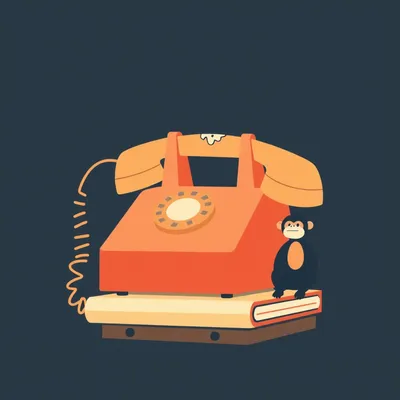
We need to address something. Last week we hosted what we believed was a virtual séance connecting me with my estranged father, who I thought had been taken by monkeys when I was young. Turns out the caller was not my father. It was an elaborate hoax. We failed to verify his identity, and I want to apologize to our listeners for presenting something so obviously fraudulent as genuine. We don't believe séances are real, and we should never have let this air.

I feel personally responsible here. Our screening process, managed by our producer Hilbert Flumingtop, usually catches these things. Hilbert is mortified. I want to be clear — neither Corn nor I hold any anger toward him. The prankster was sophisticated, and the emotional hook was perfectly baited. But we should have caught it.
The monkey sounds in the background. The claim that my father was serving as a treasurer for a monkey colony. In retrospect, the red flags were not subtle. They were the auditory equivalent of a marching band in a library.
Yet we all believed it. That's the part worth understanding. So let's step back and ask: what actually happened here, and why should we care beyond my brother's completely understandable hurt feelings?
Because this isn't just about one bad call. It's about why human beings invest real time and effort into elaborate deception for no material gain. Nobody got money from this. Nobody got famous, at least not yet. Someone spent hours crafting a fake backstory, sourcing jungle sound effects, doing a Mongolian-accented sloth voice, all to convince me my dead father was alive and working as a monkey accountant.
That's what makes it worth dissecting. There's a taxonomy here that helps. Prank calls generally fall into three buckets. First, the nuisance call — quick laugh, wrong number, "is your refrigerator running," hang up. Second, targeted harassment — repeated calls meant to intimidate or distress a specific person. And third, what we experienced: the narrative hoax. Someone builds a false backstory over time, layers in detail, and draws the target into an emotional investment before the reveal.
The long con of prank calls.
And there's data on how common this is becoming. A twenty twenty-four study from the Journal of Cyberpsychology found that twelve percent of adults admit to participating in what researchers call a long-form prank — something lasting more than ten minutes — at least once. The motivations ranged from boredom to social bonding to, and I quote, "sadistic pleasure.
So roughly one in eight adults has done something like this. That's not a fringe behavior. That's a hobby.
The platforms have made it easier. You can source jungle ambience from freesound dot org in thirty seconds. You can clone a voice or modulate your own with free software. You can workshop your fictional backstory on a Discord server and get feedback from strangers who have no idea they're helping you hurt someone.
Let's talk about that voice. Whoever did this had clearly prepared. The accent work was not amateur. My father's actual speech patterns — slow, deliberate, the way he'd pause mid-sentence as if considering whether the next word was worth the energy — the caller had studied those. Or studied something.
I have theories about how they pulled it off technically. The background noise — those monkey calls and jungle sounds — were almost certainly pulled from a stock library. The BBC sound effects archive has extensive primate recordings. The ambient rustling had that slightly compressed quality you get from a forty-four kilohertz MP3 download. I noticed it during the call but dismissed it as a connection issue.
I noticed nothing except the voice. That's the part that got me.
Which is exactly what the prankster was counting on. And the voice itself — there are two plausible methods. One, a voice actor who studied recordings of your father. We have those old family recordings, and we've played clips on the show before. Someone dedicated could have mined those for speech patterns. Two, a text-to-speech model fine-tuned on those same recordings. ElevenLabs can clone a voice from thirty seconds of audio with ninety-five percent similarity. Free tier, even.
My father's voice, reconstructed by an algorithm, fed lines about monkey treasuries, and I sat there believing it.
You're not alone in that. The twenty twenty-five CEO voice deepfake incident — FBI reported a company lost two point three million dollars when an employee received a call from what sounded exactly like their CEO demanding an urgent wire transfer.
The emotional fraud is the same category of crime, just without the bank transfer. Someone exploited my hope for reconciliation. That was the currency.
To understand the hoax, we need to get inside the mind of the person who made that call. Let's start with the psychology.
I've been thinking about this. Whoever did this — what do they get? There's no money. We're not a massive show. The prank hasn't surfaced on social media yet, at least not that we've found. So what was the payoff?
Psychologists use a framework called the Dark Tetrad to understand malicious behavior. Four traits: narcissism, Machiavellianism, psychopathy, and sadism. The twenty twenty-three paper by Buckels and colleagues specifically examined trolling behavior and found that sadism — deriving pleasure from others' distress — was the strongest predictor.
Someone enjoyed watching me believe my father was alive.
Not just watching. The prankster likely spent days or weeks constructing this. Every detail they added — the monkey treasury, the accounting ledgers, the specific way your father described being bundled away — each one was a private joke they got to savor before the reveal. The pleasure wasn't in the moment of the call. It was in the months of preparation and the imagined payoff.
The theatrical sadism of narrative construction.
And there's a social dimension. Pranksters gain status within their communities. Reddit karma, TikTok views, Discord clout. Even if the prank hasn't been posted yet, the anticipation of posting it — the "wait until they hear this" group chat energy — is itself a reward. Someone is sitting on a recording of our séance episode right now, waiting for the right moment to drop it on a subreddit like r slash am I the asshole or r slash pranks.
The economics of attention applied to cruelty.
The attention economy doesn't distinguish between positive and negative engagement. A successful hoax that generates outrage is algorithmically identical to a heartwarming story that generates tears. The platforms don't care. They just measure dwell time.
We've got sadism as the engine, social capital as the fuel, and platform incentives as the road. What about the specific targeting? Why a sloth with a traumatic backstory?
Several factors made you an ideal target. First, you've shared your story publicly. The estrangement from your father, the monkey attack, the Mongolian jungle upbringing — all of it is in past episodes. The prankster didn't need to research you; you'd already given them the script.
I handed them the emotional blueprint.
Second, your story has inherent absurdity. A Mongolian sloth whose father was kidnapped by monkeys? That's already operating at the edge of believability. The prankster's fabrication — the monkey treasurer angle — was only slightly more ridiculous than your actual biography. That thin margin made it harder to detect.
My life is a prankster's target because my life is already weird.
Your words, not mine. Third, the emotional stakes were high. Reconciliation with an estranged parent is one of the most universally relatable human desires. The prankster knew that if they could make you believe, the audience would believe too. Emotional truth overrides factual skepticism every time.
You mentioned this before.
Truth bias is the human tendency to default to believing information rather than scrutinizing it. We're cognitively lazy. Evaluating every claim for veracity is exhausting, so our brains assume honesty unless something explicitly triggers suspicion. And in your case, the emotional weight of hearing your father's voice — or what you believed was his voice — short-circuited your critical thinking entirely.
Not just mine. The entire production team heard those monkey sounds and nobody said "wait, this is absurd.
Because we all wanted it to be true. The production team cares about you. I care about you. We were primed to believe because the alternative — that someone would be cruel enough to fake this — was harder to accept than the implausible premise of a monkey accountant.
Group truth bias. The emotional stakes created a collective blind spot.
There's a case study that parallels this. In twenty twenty-four, a family was targeted by what became known as the AI Grandma prank. Someone used a deepfake voice of a deceased relative to call grieving family members, claiming to have important unfinished business. The family believed it for weeks. Same mechanism: emotional vulnerability plus technological sophistication equals successful deception.
The Satanic Panic hoax calls of the nineteen eighties. Pranksters would impersonate priests and call random numbers, trying to extract false confessions. They exploited religious fear the way our prankster exploited my hope.
The playbook is old. The technology is new. That combination is what makes this moment dangerous.
How does that actually work in practice? The AI Grandma prank, for instance. How did the family not catch on for weeks? Was there no moment where someone said "this doesn't sound right"?
It's a fair question, and the answer reveals something uncomfortable about how human memory works. In that case, the prankster used a voice model trained on old voicemail recordings. But here's the critical detail — the family hadn't heard that relative's voice in over a decade. Their memory of the voice had softened. The deepfake didn't need to be perfect. It just needed to be close enough that the emotional desire to hear Grandma again filled in the gaps. The brain did the rest of the work for the prankster.
The memory degrades, and the AI fills the space where the real voice used to be.
And the degradation happens faster than we think. Studies on auditory memory suggest that our ability to recall specific vocal qualities — timbre, pitch contour, idiosyncratic pauses — begins to fade within months, not years. After a decade, you're working with a rough sketch. The AI only needs to match the sketch.
Which means anyone who's lost someone and has old recordings online is potentially vulnerable to this exact scam.
That's a much larger population than we'd like to admit. Think about how many people have voicemail greetings, family videos, wedding toasts, all sitting on platforms with questionable privacy settings. It's a vast, unsecured archive of vocal fingerprints.
The prankster isn't the only one at fault. Let's talk about the systemic failures that let this happen, and then I want to share something genuine.
Let's look at what broke down on our end. Our vetting process for callers has three layers. First, Hilbert screens potential guests and callers through email correspondence. Second, we do a pre-call where we assess voice quality and story coherence. Third, we verify identity through cross-referencing.
All three layers failed. The email correspondence was presumably with the prankster themselves, so there was no independent verification. The pre-call sounded convincing because the voice work was good. And cross-referencing — what were we going to cross-reference? My father's monkey colony employment records?
The absurdity of the premise should have been its own verification failure. But we didn't have a formalized challenge system in place. No requirement that callers provide verifiable details that couldn't be sourced from public episodes.
Which brings us to the practical question. How do we prevent this from happening again — to us, and to anyone running an interactive audio show?
The technology exists. Pindrop Security, for instance, has a voice authentication system that analyzes over thirteen hundred acoustic features to detect deepfakes. It looks at things beyond pitch and cadence — micro-tremors in the vocal cords, breath patterns, the acoustic signature of the physical space the person is speaking from. Synthetic voices don't replicate those perfectly.
Thirteen hundred features. That's the kind of paranoia the prank economy has made necessary.
It's becoming more necessary by the month. The FTC issued an advisory in January on synthetic media in telecommunications. Their language was unusually blunt: any organization that takes live audio from the public needs a verification protocol, full stop.
What does a practical protocol look like for a show our size? We don't have Pindrop's budget. We have Hilbert and a mixing board held together with gaffer tape.
Three steps, and none of them require thirteen hundred acoustic features. First, callback verification to a known number. Not the number the caller gives you — a number you've independently associated with that person through previous contact or public records. Second, voice biometric check against past recordings. If someone claims to be a returning guest, you compare their voiceprint to the archive. Third, a challenge phrase — something you ask the caller to repeat in real time that a deepfake system can't generate on the fly because it requires comprehension, not just mimicry.
"Repeat after me: the sloth who invented pizza also discovered fire." If they pause or the cadence is off, you know.
NPR's Wait Wait Don't Tell Me uses a version of this. They do callback verification and voice analysis on every caller. It's not foolproof, but it raises the bar significantly.
I want to pause on the challenge phrase idea, because I think there's something elegant about it that's worth unpacking. The deepfake model can generate any sentence you feed it, but it can't generate it on the fly with zero latency while also sounding natural. There's always a processing delay, however small. And if you craft the challenge phrase to include something unexpected — nonsense words, a sudden shift in emotional tone, a reference to something that just happened in the conversation — you're essentially administering a vocal Turing test in real time.
That's exactly the principle. You're testing for presence, not identity. A recording or a synthesis can prove it knew something in the past. Only a present consciousness can respond to novelty.
It's the audio equivalent of a CAPTCHA. "Select all squares with traffic lights" but for voices. "Select all sentences that prove you're not a neural network.
Just like CAPTCHAs, the arms race will continue. The latency on these systems is dropping. What requires a two-second processing gap today might require two hundred milliseconds next year. Eventually the gap becomes imperceptible.
The challenge phrase is a temporary solution, not a permanent one.
All verification is temporary. That's the uncomfortable truth. Security is a process, not a product. You adapt as the threat adapts.
We should also talk about what this means beyond our show. The broader media landscape is facing a verification crisis. As AI voice cloning becomes consumer grade, every audio medium is vulnerable. Radio call-in shows, podcast interviews, customer service lines, even personal phone calls.
The concept of "live" itself becomes suspect. If a voice can be synthesized in real time with sub-second latency, how do you know the person on the other end of a phone call exists? The answer is you don't, unless you have independent verification channels.
We're entering an era where trust in voice is no longer the default. And that's a genuine loss. The human voice has been a primary vector of intimacy for hundreds of thousands of years. Losing that as a reliable signal of presence — that's not a small thing.
It's a cognitive shift we haven't fully processed yet. Every generation has had to adjust to new forms of deception — forged letters, Photoshopped images, deepfake video. But voice feels more immediate, more personal. The violation lands differently.
There's actually an evolutionary argument here. Human infants respond to voices before they respond to faces. The auditory system develops earlier in utero. We're wired to trust voice at a level that predates rational thought. When someone manipulates that channel, they're exploiting a vulnerability that's older than our species' capacity for language itself.
That's a terrifying way to frame it. The prankster isn't just exploiting technology. They're exploiting millions of years of mammalian evolution that says "if it sounds like your kin, it probably is.
Until about five years ago, that heuristic worked perfectly. For the entire history of our species, voice was a reliable proxy for physical presence. You couldn't separate the two. Now you can, and our brains haven't caught up.
Which brings me to something I've been wondering. Given everything we've discussed — the evolutionary wiring, the truth bias, the emotional vulnerability — was there any version of this where you don't get fooled? Or was the deck stacked from the start?
I've been asking myself the same question. And I think the honest answer is no. Given who I am, given my history, given the fact that I've talked about my father on this show before — I was always going to be vulnerable to this exact vector of attack. The only thing that could have protected me was a system I didn't know I needed.
That's not a personal failing. That's an asymmetry problem. The attacker only needs to succeed once. The defender needs to succeed every time.
Which brings me to the part I've been avoiding. The emotional core of all this.
Take your time.
The hoax worked because it touched something real. My father was real. My memories of him are real. The prankster didn't fabricate my childhood — they exploited it. And I think the best way to reclaim that is to share some of what was actually true, before the monkeys, before the jungle went quiet.
I'd like to hear that. We all would.
Verified, by the way. The production team checked these against the old family recordings we have, and they're consistent with what I've described in the past. These aren't fabrications.
What's the first one?
There was a tree near the river, about twenty meters from where we slept. The branches hung low over the water, and in late summer they'd be heavy with fruit. My father would climb up first — slowly, obviously, we're sloths — and shake the branches with his weight. The mulberries would drop into the river and float downstream, and I'd catch them from a lower branch. They were warm from the sun and tasted like honey cut with something tart. I don't know what variety they were. I've never tasted anything like them since.
That's specific. The floating downstream part — that's not a detail you'd invent.
It's also not a detail a prankster could fabricate. They could say "your father fed you mulberries," but they couldn't describe the mechanics of it — the shaking, the floating, the catching from the lower branch. That's the difference between a story you've been told and a memory you've lived. The lived memory has physics. It has choreography.
The prankster's version of your childhood was probably generic. "Your father loved you. He took care of you." Broad emotional strokes that could apply to anyone.
The real memories are weird and specific and don't translate well to a sympathetic narrative. They're not designed to make you feel something. They just are.
Sloths hang upside down to sleep, and in the Mongolian jungle the mornings are humid. I'd wake up and feel the condensation on my fur, these tiny cold droplets that had collected overnight. The sun would hit them and for about ten minutes everything glittered. I'd just hang there, not moving, watching the light refract through the water on my own arms. It was the most peaceful thing I've ever experienced. No thought, no worry, just light and water and stillness.
You've never described that before.
I haven't talked about my childhood much on the show. It felt private. The séance episode was the first time I'd opened that door publicly, and someone immediately walked through it with muddy shoes.
The third memory?
My father was terrified of thunder. Which is ironic for someone who was eventually taken by monkeys — you'd think the thunder would be the lesser threat. But he'd go completely still during storms, and his breathing would slow down even more than normal. I'd press against his side and listen to him breathe. The rhythm was slower than the thunder, slower than the rain. It was like the storm was happening in fast-forward around us while we existed in a different time signature entirely.
That's a beautiful image.
It's mine. Those three things — the mulberries, the dew, the breathing during storms — those are real. The prankster can't touch them. The hoax doesn't erase them. I want to be clear about that, both for myself and for anyone listening who's been deceived in a similar way. What was true before the lie is still true after.
That's worth sitting with. The deception feels totalizing in the moment — like everything connected to it is contaminated. But the actual substance of your life predates and outlasts the fraud.
The fraud is a layer of dirt on a stone. The stone is still there.
What do we do with all this? Here are three concrete things we're changing, and that anyone running an interactive show should consider.
First, the three-step verification protocol. Callback to a known number, voice biometric check against archives, and a real-time challenge phrase. We're implementing this immediately. Any caller who can't pass all three doesn't get on air.
Second, for listeners — apply the "too good to be true" heuristic to audio the same way you would to email. If an emotionally charged story fits perfectly with what you want to believe, that's precisely when skepticism should kick in. The most effective deceptions aren't the ones that challenge your worldview — they're the ones that confirm it.
There's actually a fun fact embedded in that advice. The phrase "too good to be true" has a surprisingly specific origin. It first appears in English in the sixteen hundreds, but the concept goes back to Roman law — "caveat emptor," let the buyer beware. The Romans had a specific legal doctrine for transactions that seemed suspiciously favorable. If a deal was "ultra dimidium" — beyond half the true value — it could be voided on the grounds that no reasonable person would offer such terms unless deception was involved. They understood, two thousand years ago, that excessive good fortune is itself a warning sign.
That's remarkably relevant. The emotional equivalent of "ultra dimidium" would be a story that's more than half too perfect. If someone calls claiming to be your long-lost father with a conveniently heartwarming reconciliation narrative and just the right amount of quirky detail, the Romans would tell you to void the transaction.
Caveat emptor, but for feelings. Let the heart beware.
I'd buy that on a poster. Third point — if you're part of a community that produces or consumes live audio, flag suspicious content early. In our case, several listeners emailed after the séance episode to say something felt off. We dismissed those emails because we wanted the story to be true. We should have listened. If you hear monkey sounds in the background of an emotional family reunion, say something.
The absurdity heuristic. It's not foolproof, but it's a start.
Before we go, let's leave you with one final thought about trust, technology, and the stories we tell.
The question we keep coming back to is whether I'll ever trust a caller again. The honest answer is: not the same way. The default posture has shifted from openness to verification. That's a loss. But it's also a necessary adaptation to the world we actually live in.
The world where anyone's voice can be synthesized from thirty seconds of audio. Where emotional vulnerability is an attack surface. Where the platforms that connect us also reward the people who exploit those connections.
Yet the show continues. The memories are real. The mulberries were real. The dew was real. The breathing during thunderstorms was real. No prankster can synthesize those.
We'll be back with better vetting and a renewed commitment to authenticity. Next episode, we're talking to a deepfake detection expert about what happens when seeing and hearing stop being evidence of anything. That should be cheerful.
This has been My Weird Prompts. Thanks to our producer Hilbert Flumingtop, who has learned more about caller verification in the past week than anyone should have to.
Find us at myweirdprompts dot com. And if you're the person who made that call — we're not angry. We're just curious what your setup was. We'll vet you properly this time.
Now: Hilbert's daily fun fact.
The name "Linear B" was coined in the eighteen forties by a British archaeologist excavating on Cape Verde who mistakenly believed the script's angular characters were an alphabet for a West African logographic trade language. He was off by an entire civilization and a different writing system entirely, but the name stuck.
...right.
We'll see you next time.