Daniel sent us this one — he's recovering from gallbladder surgery and struggling with bloating after meals. The standard advice is low-fat, which makes sense, but he's also hitting the gym a few times a week and needs to keep protein up. So he's asking us to go through two food groups. First, meats and fish — what's naturally lower in fat compared to the rest? Second, cheese and dairy — beyond the obvious low-fat cottage cheese, what other options actually deliver protein without the fat load? Practical question, and I suspect a lot of people hit this exact wall.

They absolutely do, and the post-surgery dietary guidance most people walk out of the hospital with is remarkably thin. It's basically a pamphlet that says eat less fat, good luck. There's a real gap between that and actually building meals day to day, especially if you're trying to maintain muscle.
The bloating is the body's way of saying you got the math wrong.
So let's get concrete. The mechanism here is worth naming because it explains everything downstream. Without a gallbladder, you don't have that concentrated bile reservoir that dumps in response to a fatty meal. Your liver still makes bile, but it just drips continuously into the small intestine — it's dilute, it's uncoordinated, and it's often insufficient for a big fat load. Undigested fat ferments in the colon, gut bacteria feast on it, and that produces gas. Hence the bloating.
The leaky faucet instead of the fire hose.
That's exactly the image. So the question becomes: how much fat can you handle per meal before the faucet can't keep up? And that threshold varies person to person, but the Mayo Clinic's guidance for post-cholecystectomy patients recommends keeping a food diary for about two weeks to find your personal limit. Some people handle ten grams per meal fine, others start having trouble at five or six.
Which means the protein strategy is really about finding sources where the fat-to-protein ratio is as favorable as possible — maximizing the grams of protein you get per gram of fat you have to process.
Let's do meats and fish first, since that's where most gym-goers anchor their meals. The leanest land animal protein, by a significant margin, is skinless chicken breast. A hundred grams cooked gives you about thirty-one grams of protein and roughly three and a half grams of fat. Turkey breast is nearly identical — thirty grams of protein, about two grams of fat per hundred grams cooked.
Those are the benchmarks. Everything else is measured against skinless chicken breast.
Next tier down would be lean cuts of pork — specifically pork tenderloin. A hundred grams gives you about twenty-six grams of protein and around four grams of fat. That's still very workable. Lean beef cuts like eye of round or top sirloin with all visible fat trimmed — you're looking at twenty-six grams of protein but fat jumps to around six to eight grams per hundred. Still manageable for many people post-surgery, but you're creeping up.
What about the cuts people actually order when they're out? A ribeye, a strip steak?
Ribeye is a fat bomb. A hundred grams of ribeye can easily hit twenty grams of fat or more. That's not one meal's worth for someone without a gallbladder — that's potentially three meals' worth of fat arriving all at once. New York strip is better but still in the ten to twelve gram range. If you're eating steak post-cholecystectomy, you want filet mignon or you want a very lean sirloin, and you want a modest portion. Four ounces, not twelve.
The hierarchy is basically: the more a muscle works, the leaner it tends to be. Breast flies, so it's lean. Tenderloin doesn't do much, so it's lean but also why it's tender. The chuck and the rib section do heavy lifting, so they're marbled.
That's exactly the anatomical cheat code. Now, fish is where this gets interesting, because fat in fish isn't inherently bad for digestion — the fat structure is different — but quantity still matters. The absolute leanest fish are white-fleshed: cod, haddock, pollock, tilapia. A hundred grams of cod gives you about twenty-three grams of protein and less than one gram of fat. It's practically a protein isolate that happens to be a fish.
The chicken breast of the sea.
The chicken breast of the sea, and arguably even leaner. Next are things like halibut, flounder, sole — similar profile, maybe a gram or two of fat. Tuna is interesting. Canned light tuna in water: about twenty-five grams of protein, less than one gram of fat. Yellowfin tuna steak is lean too. But then you get to the fattier fish — salmon, mackerel, sardines, herring — and those are genuinely healthy fats, omega-threes, anti-inflammatory, all of that, but from a pure bile-management standpoint, a hundred grams of farmed Atlantic salmon is around thirteen grams of fat. That's more than a lean sirloin.
Which doesn't mean don't eat it. It means portion it.
A three-ounce piece of salmon is about eighty-five grams, so you're looking at roughly eleven grams of fat. If your personal threshold is ten to twelve grams per meal, that's your whole fat budget for that meal. You can't also have olive oil on the vegetables and cheese on the salad.
What about the in-between meats? Lamb, veal, game meats?
Veal cutlet is quite lean — similar to pork tenderloin. Lamb varies wildly. Lamb loin chop trimmed of fat is around eight grams of fat per hundred grams. Lamb shoulder, much higher. Game meats are the sleeper category here. Bison, venison, elk — these are extremely lean. Bison top sirloin is about twenty-eight grams of protein and roughly two and a half grams of fat per hundred grams. That's competitive with chicken breast. Venison is even leaner — often under two grams of fat. The catch is availability and cost, but nutritionally, game meats are almost purpose-built for this situation.
They're not factory-farmed, so the fat profile tends to be better anyway.
Now, there's one more category in the meat section that I want to flag because it trips people up: processed lean meats. Deli turkey breast, deli chicken breast. These can be extremely lean — sometimes under one gram of fat per serving — but you have to read the label because some brands add oils or skin in processing. The same goes for things like turkey pepperoni or chicken sausage. They market themselves as healthier alternatives, but they can still pack six to eight grams of fat per serving.
The turkey bacon paradox. People think turkey means lean, and then they look at the label and it's got the same fat as the pork version.
Turkey bacon is one of the great nutritional heists of the modern grocery store. All right, should we shift to dairy?
Let's do it. So the prompt specifically says besides low-fat cottage cheese — which is the obvious go-to, high protein, low fat, everyone knows about it.
Cottage cheese is the benchmark in dairy. Nonfat or one percent cottage cheese gives you about twelve to fourteen grams of protein per half-cup serving with less than one gram of fat. It's essentially casein in edible form. But there's a whole landscape beyond it. Let me run through a hierarchy, leanest to richest. At the very top: nonfat plain Greek yogurt. A hundred-and-seventy-gram container — that's a standard single-serving size — gives you about seventeen grams of protein and zero grams of fat. It's a nutritional unicorn. The straining process removes the whey and concentrates the protein, and if you get the plain version, there's no added sugar.
The fat-free version of Greek yogurt doesn't have the textural punishment that fat-free regular yogurt has. It's still thick.
That's the straining. The protein structure gives it body even without fat. Next tier: skyr, which is the Icelandic version of strained yogurt. Even thicker, even more protein — about nineteen grams per hundred-and-fifty-gram serving, fat-free versions available. It's essentially Greek yogurt that went to finishing school. Then you've got quark, which is a Central European fresh cheese that's having a moment in North America. It's somewhere between yogurt and cream cheese in texture, and the nonfat versions deliver about twelve to fourteen grams of protein per half-cup with virtually no fat.
I've seen quark in stores but never quite knew what to do with it.
It's incredibly versatile. You can use it as a sour cream substitute, you can mix it with herbs as a dip, you can put it on toast with smoked salmon, you can blend it into smoothies. It doesn't curdle under heat the way yogurt sometimes does, so it's actually more forgiving in cooking. But moving down the cheese list: part-skim ricotta. This is a big one. A quarter-cup of part-skim ricotta gives you about seven grams of protein and around five grams of fat. That's not zero fat, but the protein-to-fat ratio is favorable, and it's a completely different culinary niche than cottage cheese. You can use it in pasta dishes, you can spread it on toast with honey, you can stuff it into peppers.
Ricotta is whey-based, right? It's made from the whey left over from other cheese production.
Which is why the protein is mostly lactalbumin rather than casein — different amino acid profile, but still high quality. Next: part-skim mozzarella. This is the low-fat cheese that actually melts properly. A twenty-eight-gram serving — that's about a one-ounce slice — has around seven grams of protein and four and a half grams of fat. Compare that to full-fat mozzarella at six or seven grams of fat per ounce, or cheddar at nine grams of fat per ounce. Part-skim mozzarella is the workhorse low-fat cheese.
It's not some sad diet product. It's what goes on most pizzas anyway.
It's the default mozzarella in most pizzerias. Now, moving into the harder cheeses where things get less forgiving. Reduced-fat Swiss cheese — sometimes labeled as light Jarlsberg or reduced-fat Emmental — comes in around seven grams of protein and four grams of fat per ounce. Reduced-fat provolone is similar. But once you get into the hard aged cheeses — parmesan, aged cheddar, gruyère — the fat content is inherently high because they're concentrated. A good parmesan is around thirty percent fat by weight. The saving grace is you use very little of it. A tablespoon of grated parmesan is maybe five grams, so the absolute fat load is small. It's a seasoning, not a protein source.
For someone who wants to hit, say, thirty grams of protein in a meal while keeping fat under ten grams, what does a plate actually look like?
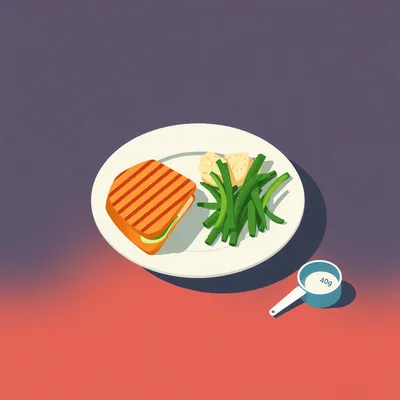
Let me build a few. Meal one: a hundred and fifty grams of cod fillet, baked with herbs — that's about thirty-four grams of protein, one and a half grams of fat. Add a side of nonfat Greek yogurt with dill and cucumber as a sauce, that's another five grams of protein, zero fat. You're at nearly forty grams of protein, under two grams of fat. You've got room for some roasted potatoes with a teaspoon of olive oil and you're still under ten grams of fat total.
That's a lot of food for very little fat.
Meal two, land-based: four ounces of bison sirloin, which is about a hundred and thirteen grams cooked. That's roughly thirty-two grams of protein, three grams of fat. Top it with a slice of part-skim mozzarella melted on top — add seven grams of protein, four and a half grams of fat. You're at thirty-nine grams of protein and seven and a half grams of fat. You can still have a pile of steamed vegetables and you're under ten.
What about something that feels more like comfort food? Because I think that's where people fall off the wagon. They can do the lean protein and steamed vegetables for four days, and then they want a lasagna.
That's the compliance problem. So here's a rebuild of comfort food: lasagna made with part-skim ricotta, part-skim mozzarella, lean ground turkey breast — ninety-nine percent fat-free — and no-boil noodles. A generous square of that, depending on portion, can come in around twenty-five grams of protein and eight to nine grams of fat. It's not zero fat, but it scratches the itch without blowing the budget.
The lean ground turkey is doing a lot of work there. What's the fat on ninety-nine percent fat-free ground turkey?
A hundred grams gives you about twenty-eight grams of protein and roughly one gram of fat. It's basically chicken breast in ground form. Compare that to regular ground turkey, which can be seven or eight grams of fat per hundred grams because they often grind in the skin and dark meat. The labeling is deceptive — ground turkey sounds lean, but unless it specifies ninety-nine percent fat-free or extra lean, assume it's not.
Ground chicken breast is the same deal.
Now, there's one more dairy category I want to hit because I think it's underappreciated: whey protein isolates and concentrates. If someone is really struggling to hit protein without fat, a scoop of whey isolate in water or in a nonfat Greek yogurt smoothie gives you twenty-five grams of protein with less than a gram of fat. It's not a food, it's a supplement, but in the context of post-surgery recovery and gym maintenance, it's a legitimate tool. The isolate versions have had almost all the lactose and fat removed.
For someone who's bloating after meals anyway, whey isolate is less likely to cause additional issues than whey concentrate, because the lactose is what gets a lot of people.
And post-cholecystectomy, some people develop secondary lactose sensitivity that they didn't have before, because the altered bile flow changes gut transit time and the microbiome adjusts. It's not universal, but it's common enough that I'd suggest someone in this situation try isolate before assuming they can't handle whey at all.
That's a good flag. So we've got the meat hierarchy: skinless chicken and turkey breast at the top, then lean pork tenderloin, then lean game meats like bison and venison, then very lean beef cuts like eye of round, then white fish which is essentially zero fat, then tuna, then the fattier fish like salmon which are healthy but need portion control. And for dairy, nonfat Greek yogurt and skyr and quark at the top, then part-skim ricotta, part-skim mozzarella, reduced-fat Swiss, and then hard aged cheeses used as seasoning rather than protein sources.
That's the landscape. But I think there's a deeper principle here that's worth surfacing. The conventional post-gallbladder advice is eat low fat, and that's true, but it's incomplete. The more useful framing is fat per eating occasion. You don't have to eat low fat all day — you have to keep any single meal's fat load under your personal threshold. So you might eat six times a day instead of three, keeping each meal's fat under eight grams, and total daily fat could still be forty or fifty grams. That's not a low-fat diet by the old definitions. It's a fat-distributed diet.
Which maps perfectly onto the gym schedule anyway. If you're eating four or five times a day to support training, you're already distributing.
And the protein pacing research supports this beyond just the gallbladder context. Spreading protein intake across four or five meals of twenty-five to thirty-five grams each is more effective for muscle protein synthesis than two big boluses. So the post-surgery dietary constraint and the gym goal are actually aligned, not competing.
That's the rare case where the medical restriction and the fitness goal shake hands instead of fighting.
The other piece that doesn't get enough attention is cooking method. The same chicken breast can be three grams of fat or fifteen grams of fat depending on whether you poach it or pan-fry it in butter. Dry heat methods without added fat — grilling, broiling, baking, air frying, poaching, steaming — these preserve the protein without adding to the fat load. A nonstick pan with a spray of cooking oil adds maybe half a gram of fat. A tablespoon of butter adds twelve grams. That's someone's entire meal budget.
Restaurants are the minefield here. Even a grilled chicken breast at a restaurant has often been finished with butter. You don't see it, you don't taste it as a distinct thing, but it's there.
Restaurant cooking is butter-forward in ways that would shock most people. A piece of fish that's listed as grilled on the menu has almost certainly been basted or finished with butter. The vegetables are sautéed in oil. The rice has butter stirred in. None of this is malicious — it's why restaurant food tastes good — but for someone managing bile flow, a restaurant meal can easily deliver forty or fifty grams of fat without looking indulgent.
What's the strategy there? Just ask for everything dry?
Ask for the fish grilled with no butter, sauce on the side, vegetables steamed plain. It's not glamorous, but it's the difference between enjoying your evening and spending the next three hours in discomfort. Most kitchens will accommodate it. The other move is to order two appetizers instead of an entree — smaller portions, easier to control. A shrimp cocktail and a side salad with dressing on the side is a completely reasonable post-cholecystectomy restaurant meal.
Shrimp itself — where does that land on the fat spectrum?
Shrimp is essentially zero fat. A hundred grams of shrimp is about twenty-four grams of protein and less than one gram of fat. Same with scallops, crab, lobster. Shellfish in general are protein-dense and fat-poor. The danger with shrimp is what it's cooked in — scampi means butter, fried means oil. But steamed shrimp, boiled shrimp, grilled shrimp with lemon, cocktail shrimp — those are ideal.
Shellfish is the secret weapon.
Shellfish and white fish together are the most fat-efficient animal proteins available. If someone is really struggling to keep fat under ten grams per meal while hitting thirty-plus grams of protein, tilapia and shrimp with a side of nonfat Greek yogurt is basically impossible to beat.
Let's talk about egg whites, since we're in the protein space. Whole eggs are fairly fatty — about five grams of fat per large egg, most of it in the yolk. But egg whites?
Egg whites are almost pure protein. One large egg white is about three and a half grams of protein, zero fat. A carton of liquid egg whites makes it easy — you can pour a cup, which is about twenty-six grams of protein, zero fat. Scramble that with some spinach and a slice of part-skim mozzarella, you've got a high-protein, low-fat breakfast that takes five minutes. The yolks aren't forbidden — they've got nutrients, choline, all of that — but if you're trying to maximize protein while minimizing fat, you use mostly whites and maybe one yolk for flavor and color.
The omelet stops looking pale and sad.
One yolk fixes the whole aesthetic. Now, there's one more category I think we should cover because the prompt didn't ask about it but it's the logical next step: plant proteins. Tofu, tempeh, seitan, legumes. Not everyone wants to eat animal protein at every meal, and some of these are surprisingly good on the protein-to-fat ratio. Extra-firm tofu: a hundred grams gives you about ten grams of protein and five grams of fat. Not as efficient as chicken breast, but still workable. Tempeh is better — about nineteen grams of protein and eleven grams of fat per hundred grams. Seitan is the standout: twenty-five grams of protein, less than one gram of fat per hundred grams. It's basically wheat gluten, so if someone's not gluten-sensitive, it's an extremely lean protein.
Seitan is underrated in general. It's got a meaty texture, it takes marinades well, and the macros are absurd.
The macros are absurd. The only knock is it's not a complete protein — it's low in lysine — but if you're eating it alongside other protein sources over the course of a day, that doesn't matter. The body pools amino acids. You don't need every protein source to be complete at every meal.
To bring this back to the prompt's two groups. For meats and fish, the top tier is skinless chicken and turkey breast, white fish like cod and tilapia, shellfish, lean game meats, and egg whites. The second tier is pork tenderloin, very lean beef like eye of round, and light tuna. The be-careful tier is salmon and other fatty fish — healthy but portion-limited — and any processed meat where you haven't read the label. For dairy, top tier is nonfat Greek yogurt, skyr, quark, and nonfat cottage cheese. Second tier is part-skim ricotta and part-skim mozzarella. Third tier is reduced-fat hard cheeses like Swiss, and then aged cheeses like parmesan used as a seasoning rather than a main protein.
That's the framework. I'd add one practical tool: a kitchen scale. Eyeballing portions is how people accidentally double their fat intake without realizing it. That piece of salmon you think is four ounces is actually six and a half. That sprinkle of parmesan you think is a tablespoon is actually three. Weighing food for even two weeks builds an accurate mental model, and after that you can usually eyeball.
The two-week diary and the scale go together. It's not a forever thing, it's calibration.
Calibration is exactly the right word. You're recalibrating your sense of what a portion looks like for a body that now processes fat differently.
The payoff is real. You get to eat normally, you get to train, you get to avoid the bloating. You just have to be more deliberate than the average person about what's on the plate.
The other thing I'd say is that this gets easier over time. The body does adapt somewhat after gallbladder removal. The bile duct dilates a bit, the sphincter of Oddi adjusts, the gut microbiome shifts. Someone six months post-surgery typically has a higher fat tolerance than someone six weeks post-surgery. The early period is the hardest, and that's when being really disciplined about these food choices matters most.
The message is: you're not sentenced to a life of dry chicken and steamed broccoli. There's actually a lot of variety within the constraints, you just have to know where everything sits on the fat spectrum and portion accordingly.
The gym goal is not at odds with the medical constraint. If anything, the meal frequency and protein focus that support training are exactly what make the post-surgery diet sustainable.
One last thing on dairy — what about protein-fortified milk? Fairlife, things like that?
Fairlife skim milk is ultra-filtered, so it's got about thirteen grams of protein per cup with zero fat. Regular skim milk is eight grams of protein, zero fat. The ultra-filtering removes some of the lactose too, so it's easier on the stomach for a lot of people. If someone wants a glass of milk with a meal, that's a solid option. Fairlife also makes a protein shake with thirty grams of protein and two and a half grams of fat per bottle. That's a convenient post-gym option that doesn't blow the fat budget.
It's actual milk, not a protein powder suspended in water.
It's just milk that's been filtered to shift the macro ratios. The ingredient list is essentially milk, lactase enzyme, and vitamins. It's one of the cleaner products in that space.
I think we've given this a thorough mapping. Meats and fish, dairy and cheese, some bonus categories, and the underlying principle about fat per meal rather than fat per day.
And now: Hilbert's daily fun fact.
Hilbert: In seventeen twenty-four, a French mineralogist traveling through what is now South Sudan documented a luminous blue-green fluorite deposit near the Bahr el Ghazal River, describing it as "stone that burns cold with captured moonlight." The deposit was lost to colonial record-keeping for nearly two centuries before being rediscovered in nineteen-oh-eight by a British survey team that had been looking for copper.
Hilbert's getting poetic.
Cold-burning stone. Sounds like something I'd put on a DJ flyer.
The open question for anyone in this situation: what's the meal you keep coming back to that actually works? Because the dietitians give you lists, but the lived experience of finding your five or six go-to meals that don't cause trouble — that's the real adaptation. We've given the framework, now it's about building the rotation.
If you're just starting this journey, give yourself the two weeks of tracking. The scale, the diary, the honest accounting. It's tedious, but it's temporary, and what you learn about your own thresholds is worth more than any general advice.
That's it for this one. Thanks to our producer Hilbert Flumingtop for the fact and the production work. This has been My Weird Prompts. Find us at myweirdprompts dot com or wherever you get your podcasts.
See you next time.