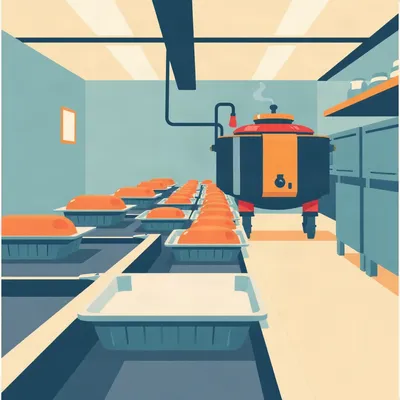
You know that metal pan at the salad bar? The one that's always slightly warm or cold, holding the diced chicken or the shredded lettuce? You've eaten from it hundreds of times — Subway sandwich line, hotel breakfast buffet, Delta first-class meal tray — and you've never thought about it. That pan has a name, a history, and a standard that quietly reshaped how the world eats. So Daniel sent us this one — he wants to talk about the gastronorm pan, the GN pan, the chef pan. How it came to be, who standardized it, and how this unassuming rectangle of stainless steel enabled the global proliferation of fast-casual dining, airline catering, and every buffet you've ever stood in line at. It's the shipping container of food service, and almost nobody talks about it.

The GN pan is one of those rare examples where a standard actually worked — where competing manufacturers agreed on something and the entire industry built on top of it. That almost never happens. Look at screws, look at power outlets, look at anything else. The GN pan is a unicorn. I mean, think about the screw. We've got Phillips, flathead, Torx, hex, Robertson — and that's just the drive types, never mind the thread pitches. A century and a half after the industrial revolution, we still can't agree on how to turn a piece of metal into wood. But a bunch of German kitchen equipment manufacturers in the nineteen sixties managed to agree on a pan size that now covers the planet. How did that happen?
Where do we even start with this? What actually defines a gastronorm pan?
It's beautifully simple. The master size is the one-over-one pan — five hundred thirty millimeters by three hundred twenty-five millimeters. That's about twenty point nine inches by twelve point eight. Every other size is a fraction of that master. A one-half pan is exactly half the width, two hundred sixty-five millimeters. A one-third pan is one-third the width, one hundred seventy-six millimeters. And it keeps going — one-quarter, one-sixth, one-ninth. The depths are standardized independently — twenty millimeters, forty, sixty-five, one hundred, one hundred fifty, two hundred. So you can have a one-third pan that's sixty-five millimeters deep, and it'll sit perfectly next to a one-sixth pan at the same depth in the same counter cutout. It's a coordinate system for food.
A coordinate system for food. So the width fractions are independent of the depth. You can mix and match any depth with any fractional size, and everything still fits together. It's almost like a grid system for a city — the streets are the counter cutouts, and the buildings can be any height, but the footprint has to match the lot.
Just like a city grid, once the lots are platted, you can build anything on them. A one-third lot can hold a tall building or a short one — a deep pan or a shallow one. The infrastructure doesn't care what you put in the space, as long as the footprint conforms. And that's what makes it modular in a way that consumer kitchen products almost never are. Your Pyrex dishes, your mismatched Tupperware — none of them were designed to interoperate. A Rubbermaid lid from 2019 won't fit a Rubbermaid container from 2023. But a GN one-third pan made by Vollrath in Wisconsin will slot perfectly into a countertop cutout designed for GN pans in Singapore, sitting next to a pan made by a German manufacturer. That's the power of the standard.
How does that actually work in practice? If I'm a kitchen designer in Singapore, I've never met the engineer at Vollrath in Wisconsin. How do we both build to the same spec and trust that it'll work?
That's the beauty of a published standard. DIN sixty-six thousand seventy-five doesn't just say "about five hundred thirty millimeters." It specifies the exact dimensions, the tolerances, the corner radii, the rim profile, the material gauge. A manufacturer in Wisconsin buys the standard document — it's not free, by the way, standards bodies charge for these — and builds their tooling to match. A kitchen designer in Singapore buys the same document and designs their counter cutouts to match. They never talk. They don't need to. The standard is the contract. And because the tolerances are tight — we're talking fractions of a millimeter on the rim dimensions — a pan that meets the spec in one factory will fit a counter that meets the spec in another factory on the other side of the world.
The materials vary depending on what you're doing with them.
The workhorse is eighteen-ten stainless steel — that's eighteen percent chromium, ten percent nickel. It's dishwasher-safe, nearly indestructible, won't react with acidic foods. Then you've got aluminum, which is lighter and conducts heat faster but warps over time and can react with tomato sauce or vinegar-based dishes. Polycarbonate for cold holding — salad bars, chilled desserts. And there's a heavier-gauge variant sometimes called Gastronorm Plus with reinforced rims for high-volume operations where pans are getting slammed around all day.
What about the thermal properties? You mentioned aluminum conducts heat faster — does that actually matter in a buffet setting?
It matters enormously, and it's a trade-off. Aluminum heats up faster and cools down faster. If you need to bring a pan of soup from fridge temperature to holding temperature quickly, aluminum will get you there in less time. But it also loses heat faster if the power goes out or if someone leaves the lid off. Stainless steel is slower to heat up but more thermally stable once it's there — it holds temperature longer. For a buffet that's running for three hours, stainless is better. For a catering operation where you're cycling pans in and out rapidly, aluminum might be the call. And this is the kind of decision that a chef makes based on their specific operation — but the GN standard means they can make that decision without worrying about whether the pan will physically fit.
Who actually came up with this? And why did it take until the nineteen sixties to standardize something that seems so obvious in hindsight?
This is where the story gets interesting. Before the GN standard, commercial kitchens were a mess of proprietary pan sizes. If you bought a Rational combi-oven in the nineteen fifties, it only worked with Rational's own pans. Your Zanussi blast chiller required Zanussi trays. Your bain-marie from one manufacturer wouldn't fit pans from another. Kitchens were locked into single-vendor ecosystems — you bought the oven, you bought the pans, and you were stuck.
Like printer cartridges, but for feeding hundreds of people.
Exactly like printer cartridges. And it was worse than printer cartridges, because at least a printer cartridge is a consumable you expect to replace. A commercial pan is a capital expense that should last ten or fifteen years. If you switched oven brands, you had to replace every pan in your kitchen. That's tens of thousands of dollars. So kitchens didn't switch. Manufacturers had captive customers, and innovation stagnated because there was no competitive pressure on the consumables. And it was a German industry group called GEDE — the Association of Food Service Equipment Manufacturers — that decided to fix this. In the nineteen sixties, they began developing a universal pan standard. The key figure was a German engineer named Dr. Hans-Joachim Klein, who was working at Rational, the combi-oven company. He pushed hard for a pan size that would work across combi-ovens, blast chillers, bain-maries, and refrigerated counters — regardless of who manufactured them.
A German engineer pushing for standardization. There's a stereotype in there somewhere.
I'll own it. But the result was DIN sixty-six thousand seventy-five, codified in nineteen seventy-five. That's the German industrial standard for gastronorm pans. It was later adopted as an international standard — ISO eighteen forty-six in nineteen eighty-five — and eventually became the European norm EN six thirty-one dash one. What started as a German industry agreement became the global default.
Wait — so it took ten years from the DIN standard to the ISO standard, and another decade or so to become a European norm? Why so long?
Standards adoption is always slow, and it's slow for a reason. Every country that already had a domestic pan industry had manufacturers who had invested in their own tooling, their own sizes, their own customer bases. France had its own pans. Italy had its own pans. The UK had its own pans. Telling a French manufacturer "you need to retool your entire factory to match a German standard" is not a popular conversation. So the adoption happens in stages. First, the standard exists as a DIN document. German manufacturers adopt it. Their export customers — in the Netherlands, in Scandinavia — start using it because they're buying German equipment anyway. Then the international standards body takes it up, which gives it legitimacy beyond Germany. Then the EU harmonizes it as a European norm, which means it becomes the de facto requirement for new commercial kitchen construction across the continent. Each step takes years of committee meetings, negotiations, and compromise. And that's the boring, unglamorous work that actually changes the world.
What's striking is that the standard isn't just about the pan dimensions. It's about how the pan interacts with everything around it.
This is the part that most people miss. The GN pan is designed to sit in a bain-marie — a water bath — with a precise five-millimeter gap around the perimeter. That gap allows steam to circulate evenly around all four sides. It means the pan heats uniformly from edge to edge. No hot spots, no cold corners. If you've ever eaten at a buffet where the mac and cheese is scorched on one side and lukewarm on the other, that's what happens when someone uses a non-GN pan in a GN well. The engineering tolerances actually matter for food safety.
That's the difference between a safe buffet and a bacterial breeding ground.
It really is. Food needs to be held above one hundred forty degrees Fahrenheit to prevent bacterial growth. If you've got cold corners in your pan, you've got a food safety violation waiting to happen. The GN standard bakes temperature consistency into the physical design. It's not just about convenience — it's about public health at scale. And this is where the standard becomes almost invisible in its importance. A health inspector doesn't need to check every pan's temperature distribution — they can verify that the equipment is GN-compliant and that the bain-marie is functioning, and the physics takes care of the rest. The standard is a proxy for safety. It's a form of distributed trust.
That's a fascinating way to put it. The standard is a proxy for safety. You're outsourcing the thermal engineering to the DIN committee.
And that's what good standards do — they encapsulate expertise so that the rest of us don't have to become experts. A restaurant manager doesn't need to understand fluid dynamics or heat transfer coefficients. They just need to know: buy GN pans, put them in GN wells, keep the water at the right temperature. The standard handles the physics.
We've got a standard. It's elegant, it's precise, it's German. What happens next?
Once the standard existed, it didn't just sit in a drawer. It enabled an entire industry to build on top of it. And the first big domino was the combi-oven. Rational launched the first commercial combi-oven in nineteen seventy-six — the year after the DIN standard was codified — and it was designed from the ground up around GN pan dimensions. A combi-oven combines convection heat, steam, and combination modes in one unit. It's the Swiss Army knife of commercial cooking. And because Rational built it for GN pans, every other combi-oven manufacturer — Alto-Shaam, Electrolux, Miele, all of them — followed the same standard.
The pan standard enabled the oven standard, which reinforced the pan standard. A virtuous cycle.
More combi-ovens in kitchens meant more demand for GN pans. More GN pans meant more equipment designed around them. By the nineteen nineties, if you were building a commercial kitchen anywhere in the world, you designed your counters, your hot-holding wells, your refrigerated prep tables, and your oven racks around GN dimensions. It became the platform. And here's the thing about platforms — once they reach critical mass, they're almost impossible to dislodge. Even if someone invented a "better" pan shape tomorrow, they'd have to convince every equipment manufacturer, every kitchen designer, every health department, and every restaurant chain to switch. The switching costs are astronomical. The GN pan won.
Let's talk about Subway. Because that's where most people have encountered these pans without knowing it.
Subway is the perfect case study. Their entire sandwich assembly line is a grid of one-sixth GN pans — that's one hundred seventy-six millimeters by one hundred sixty-two millimeters — sitting in a one-over-one countertop cutout. Each topping lives in its own one-sixth pan. Olives in one, jalapeños in another, pickles in a third. When a pan runs low, an employee pulls the empty one-sixth out and slides a full one in. It takes seconds. The entire line can be reconfigured — swap a one-sixth of banana peppers for a one-sixth of roasted red peppers — without touching the counter. The counter doesn't care what's in the pans. It just cares that they're one-sixth GN.
That modularity is the secret to fast-casual scaling. You can open a Subway in Des Moines or Dubai, and the counter is the same. The pans are the same. The training is the same.
That's the insight. Standardization enables scaling. Subway has over thirty-seven thousand locations worldwide. Every single one of them uses the same GN pans. The counter fabricator makes the same cutouts whether the store is going into a strip mall in Ohio or a shopping center in Singapore. The pans come from the same suppliers. The employees move from store to store and everything is where they expect it to be. You cannot scale to thirty-seven thousand locations with custom counter dimensions. The operational complexity would eat you alive. Somebody at Subway corporate in the early days — and I don't know who this person was, but they deserve a statue — looked at the GN standard and said, "this is our platform." And that decision, made once, has been compounding for decades.
It's not just Subway. Chipotle, Sweetgreen, every build-your-own bowl chain — same system.
Chipotle's line is a beautiful example of the modularity in action. They use one-third GN pans for beans, rice, and meats — those are the high-volume ingredients. Then one-sixth GN pans for salsas, cheese, and lettuce — lower volume, more variety. But here's the clever part: a store can swap a one-third pan slot for two one-sixth pans if they want to offer more topping variety. Or they can go the other direction — two one-sixth slots become one one-third if a particular protein is selling like crazy. The counter cutout doesn't change. The flexibility is built into the standard.
If Chipotle launches a new protein that's wildly popular, they don't need to remodel the store. They just swap pan sizes.
They don't even need to send a technician. The store manager does it in thirty seconds. That's the kind of operational agility that a proprietary system can never give you. And it's not an accident — it's a direct consequence of the fractional sizing system in the GN standard. The fractions were designed so that combinations add up to the master size. Two one-sixths make a one-third. Three one-ninths make a one-third. You can subdivide and recombine the counter space without changing the counter. It's genuinely elegant mathematics applied to lunch.
It's like a physical API. The counter is the interface, the pan is the payload, and as long as the payload conforms to the spec, the system works.
And it extends far beyond restaurants. Let's talk about airline catering, because this is where the GN pan becomes invisible infrastructure.
Delta first class, the meal tray.
Aircraft galleys are designed around GN pan dimensions. A Boeing seven thirty-seven galley has slots sized for one-over-one GN pans. An Airbus A three eighty first-class galley uses one-half GN pans for more elaborate meal presentations. The entire in-flight meal pipeline — from the catering kitchen where the food is prepared, to the trolleys that roll onto the truck, to the aircraft galley oven, to the passenger tray — is a GN pan ecosystem. The tray that lands in front of you at thirty-five thousand feet was assembled from GN pans on the ground, loaded into a trolley that fits GN pans, wheeled onto a plane with a galley built for GN pans, and reheated in an oven that accepts GN pans. Every link in that chain depends on the standard.
If the standard didn't exist, every airline would have proprietary galley dimensions, every catering kitchen would need different pans for different airlines, and the whole system would be vastly more expensive and error-prone.
You'd have United pans that don't fit Delta galleys, Lufthansa trolleys that don't accept Air France trays. The logistical nightmare would make modern airline catering impossible at current prices. The GN pan is why your in-flight meal costs the airline a few dollars instead of twenty. And it's why an airline can switch catering vendors at a hub without replacing every piece of equipment in the galley. The standard decouples the food from the aircraft from the caterer. Each can change independently as long as they all conform to GN.
There's something almost moving about that. This humble metal rectangle, designed by a German engineer in the nineteen sixties, is quietly enabling the entire global food service industry. And nobody knows its name.
It's been to space, by the way. NASA uses GN pans on the International Space Station for food rehydration and heating. The galley on the ISS was designed with GN-compatible slots. So this pan has been in low Earth orbit. It's been to the bottom of the ocean in submarine galleys. It's served billions of meals. And you can buy one for about eighteen dollars.
Wait — the ISS galley uses the same pan standard as a Subway in Ohio?
The same standard. Not necessarily the exact same pans — the ISS uses specialized versions with features for microgravity, magnetic retainers, sealed lids for rehydration — but the dimensional footprint is GN-compatible. The engineers at NASA didn't reinvent the rectangle. They looked at what already worked on Earth and adapted it. That's the ultimate endorsement of a standard: when you're designing the most expensive galley in human history, in the most hostile environment humans have ever built in, and you still choose the DIN sixty-six thousand seventy-five pan dimensions. It's not broken. Don't fix it.
Which brings us to the home user. Because the prompt mentions using these for leftovers, and I want to be honest about what they're good for and what they're not.
Let's address the elephant in the room. GN pans are not designed for long-term food storage. The lids are not airtight — they're flat stainless steel or polycarbonate covers designed for short-term holding during service, not for sealing leftovers in a freezer for three months. If you put a GN pan of soup in your freezer with a standard GN lid, you will get freezer burn. The seal is imperfect by design, because in a commercial kitchen, you're not storing food for weeks — you're holding it for hours during service.
The home user who buys GN pans expecting Tupperware-level sealing is going to be disappointed.
But that doesn't mean GN pans aren't useful at home. They're fantastic for specific applications. Sous vide — a one-over-one GN pan is the perfect vessel for a sous vide bath. Roasting — a one-over-one sixty-five millimeter deep pan fits most home ovens and is more durable than any consumer roasting pan. Fridge organization — a set of one-third and one-sixth pans for meal prep ingredients stacks beautifully and lets you see everything at a glance. The stackability is the killer feature. No more Tupperware avalanche when you open the cabinet.
The Tupperware avalanche. A universal human experience.
We've all been there. You open the cabinet, a lid from two thousand nineteen falls out, you can't find the container it goes with, the container you do find has a warped rim from the dishwasher. GN pans eliminate all of that. They don't warp in commercial dishwashers, so your home dishwasher is a gentle spa day by comparison.
If you do need an airtight seal for freezer storage — what then?
Then you use a GN pan for the prep and portioning, but you transfer to a vacuum bag or a freezer-specific container for long-term storage. Or you use the GN pan with a snap-on polyethylene lid designed for cold storage — some manufacturers make those, and they seal better than the flat stainless lids. But even those aren't rated for months in a freezer. The right tool for the right job. GN pans excel at the mise en place, the cooking, the holding, the serving. They're not freezer containers. Know the limits.
The material choice matters for home use. You mentioned eighteen-ten stainless.
If you're buying GN pans for home, get eighteen-ten stainless steel. Aluminum is lighter and cheaper, but it warps in high heat and reacts with acidic foods — tomato sauce, citrus marinades, anything with vinegar. Polycarbonate is great for cold storage but can't go in the oven. Eighteen-ten stainless does everything — oven, fridge, freezer, dishwasher. It's heavy, but it'll outlast you.
The cost is surprisingly reasonable.
This is one of the best-kept secrets in kitchen equipment. A one-over-one sixty-five millimeter deep eighteen-ten stainless GN pan from a brand like Vollrath or Winco costs about fifteen to twenty-five dollars at a restaurant supply store. A comparable consumer roasting pan — similar size, similar material — might run you forty, fifty, sixty dollars at a kitchen store. The commercial product is higher quality and half the price, because it's sold business-to-business with no retail markup, no fancy packaging, no lifestyle branding.
No photograph of a smiling family gathered around a roasting pan on the box.
No box at all, usually. It comes in a plastic bag. The money went into the pan, not the marketing. And that's the broader lesson here — there's a whole world of commercial-grade products that are better and cheaper than their consumer equivalents, if you know where to look and what to search for. Restaurant supply stores are one of the great arbitrage opportunities for the informed consumer. Sheet pans, mixing bowls, cutting boards, tongs, spatulas — the commercial versions are almost always better and cheaper. The GN pan is just the most elegant example.
Where do you actually buy these things?
WebstaurantStore online is the big one — it's the Amazon of restaurant supply. But if you live near a city, there's probably a cash-and-carry restaurant supply store that's open to the public. Restaurant Depot requires a membership, but many others don't. Search for Vollrath, Winco, or Thunder Group GN pans. Look for the words "eighteen ten stainless" and "GN one-over-one." The sixty-five millimeter depth is the sweet spot for home use — deep enough for roasting and sous vide, shallow enough to fit in a standard oven.
For meal prep, you'd recommend the fractional sizes.
A set of one-third pans is perfect for portioning ingredients. They're about six inches by twelve inches — roughly the footprint of a standard meal prep container, but shallower and stackable. Label the lids with painter's tape. The whole stack goes in the fridge and takes up less space than a jumble of mismatched containers. You can see everything from above. Nothing gets lost in the back.
The GN system as lifestyle upgrade. But I want to zoom out, because the prompt is really about standardization as a concept. The GN pan is one example. What are the others hiding in plain sight?
The shipping container is the famous one — the ISO container standard that Malcolm McLean pushed through in the nineteen fifties and sixties. But there are so many others. The EUR-pallet — twelve hundred millimeters by eight hundred millimeters — is the GN pan of logistics. Every warehouse in Europe is designed around that pallet dimension. The Eurobox — six hundred by four hundred millimeters — is the GN pan of storage. Those are the stackable plastic bins that fit perfectly on EUR-pallets and on commercial shelving.
We've talked about Euroboxes before. And commercial shelving itself is standardized — Metro shelving uses eighteen by thirty-six inch or twenty-four by forty-eight inch shelves that fit Euroboxes perfectly.
If you've got a garage full of random storage bins that don't stack, the solution is not to buy more random bins. It's to adopt the commercial standard. Euroboxes on Metro shelving. Your garage can be as organized as a commercial kitchen, because the standards already exist — you just have to opt into them. And this is the thing that frustrates me about consumer products — the standards exist, they're proven, they're cheap, but they're invisible to the average person because they're sold through different channels. Nobody markets a Eurobox to a homeowner. Nobody puts a GN pan in a Williams Sonoma catalog. The knowledge gap is the barrier.
The light bulb socket. The E twenty-six base in North America, E twenty-seven in Europe. That's a standard that's been around for over a century and still works.
The Edison screw base, patented in eighteen ninety, still the dominant socket design. That's a hundred thirty-six years of backward compatibility. Try finding a USB cable that works with a device from ten years ago.
The file folder. The A-four paper size. These are standards so deeply embedded that we forget they were choices. Someone had to decide that a sheet of A-four paper would be two hundred ten by two hundred ninety-seven millimeters, and now billions of sheets are cut to that size every year.
The A-four standard has a beautiful mathematical property — the aspect ratio is one to the square root of two. When you fold it in half, you get A-five, with the same aspect ratio. Fold it again, A-six. It's a fractal paper system. The GN pan doesn't have that property — the fractional sizes change the aspect ratio — but it has the modular interoperability that makes it useful in the real world. Different kinds of elegance for different kinds of problems.
There's a philosophical question underneath all of this. As 3D printing and custom manufacturing become cheaper, do we see a backlash against standardization? Or does the GN pan's success prove that modularity always wins?
I think the answer is both. Custom manufacturing is great for things where individual fit matters — prosthetics, custom furniture, bespoke clothing. But for infrastructure, for anything that needs to interoperate with other things, standards are unavoidable. The question is whether the standards are open or proprietary. The GN pan is an open standard — anyone can manufacture to the spec. The Lightning cable was a proprietary standard — only Apple could make it, and they charged a license fee. Open standards win in the long run because they create ecosystems. Proprietary standards create walled gardens. And walled gardens can be very profitable for the gardener, but they limit the growth of the ecosystem. The GN pan ecosystem is vast because nobody owns it.
The next frontier for standardization is probably digital. APIs, data formats, protocols. The GN pan of the internet.
We're already seeing it. HTTP, JSON, OAuth — these are the digital equivalents of the GN pan. They're open standards that anyone can implement, and they enable an entire ecosystem to build on top of them. The lesson of the GN pan is that a well-designed standard, maintained by a neutral body, with clear specifications and no licensing fees, can reshape an industry. It happened in food service. It's happening in software. It'll happen in whatever comes next.
What about the argument that standards stifle innovation? That once you lock into a pan size, you can't invent a better pan?
That's the classic critique, and it has some truth to it. Standards do create inertia. But the GN pan shows that a good standard creates a platform for innovation on top of it, rather than stifling innovation in the thing itself. The pan dimensions are fixed, but everything around them has innovated wildly. Combi-ovens got smarter. Blast chillers got faster. Bain-marie temperature controls got more precise. Food safety protocols got better. The standard didn't freeze the industry — it freed it to innovate on the things that actually matter, by removing the pointless friction of dimensional incompatibility. Nobody needed a better rectangle. They needed better cooking, better cooling, better holding. The standard let them focus on that.
What does this mean for someone sitting in their home kitchen right now, listening to this, looking at their mismatched containers?
It means you can opt in. For under a hundred dollars, you can buy a set of GN pans that will organize your kitchen better than anything you'd find at a consumer store. A one-over-one sixty-five millimeter deep pan for roasting and sous vide. Two one-third pans for meal prep. Four one-sixth pans for mise en place. A couple of lids. That's it. You've got a professional kitchen organization system for less than the cost of a single Le Creuset dutch oven.
The durability is the quiet selling point. These things are designed to survive commercial kitchens where they're dropped, slammed, run through industrial dishwashers hundreds of times a week. Your home kitchen is a retirement home for a GN pan.
A retirement home. That's exactly right. A GN pan in a home kitchen will outlast you. Your grandchildren will be arguing about who gets the GN pans.
The great GN pan inheritance dispute of twenty eighty-six.
I can see it now. "You got the one-over-one, I only got the one-sixth!" "The one-sixth is perfect for mise en place, you'll thank me later.
Before we wrap this up — there's one more thing I want to touch on. The prompt mentions that the GN pan epitomizes what standardization done well achieves. And I think there's a political dimension to that, even if it's subtle. This is a standard that emerged from a German industry association, was codified by a national standards body, and then adopted internationally. It's a triumph of boring, effective, multilateral cooperation. No grand treaty, no summit, no celebrity endorsement. Just engineers agreeing on measurements.
That's how most of the things that actually work in the world came to be. The IEC C thirteen and C fourteen connectors — the power cables that plug into your computer and monitor. The shipping container. The GN pan. None of these were imposed by government mandate. They emerged from industry cooperation, often with a single country's standards body taking the lead, and then spreading because they solved real problems for real businesses. It's a model of bottom-up coordination that works better than top-down regulation in a lot of cases. The government didn't mandate the GN pan. The market didn't spontaneously generate it either. It came from an intermediate layer — an industry association, a standards body — that had the trust of the participants and the patience to see it through.
The invisible infrastructure of civilization. You don't notice it until it's not there.
When it's not there, you get what commercial kitchens had in the nineteen fifties — chaos. Proprietary pans, vendor lock-in, higher costs, worse food safety. The GN pan solved all of that with a simple rectangle and a five-millimeter gap. It's a reminder that the most impactful innovations are often not the flashy ones. They're the ones that make everything else work smoothly, quietly, in the background, while we pay attention to the things that are actually different and interesting.
The next time you grab a scoop of salsa at Chipotle, look down. That little metal pan is a masterpiece of industrial design. It's been to space. It's been to the bottom of the ocean. And it's holding your pico de gallo at exactly the right temperature, thanks to a German engineer most people have never heard of.
Hans-Joachim Klein. Remember the name. Or don't — he probably wouldn't mind either way. The pan speaks for itself.
Now: Hilbert's daily fun fact.

In early medieval cooperage in the Azores, coopers crafting barrels for whale oil would sometimes quench their hot iron hoop drivers in seawater, which introduced a thin chloride-rich scale to the metal surface — unintentionally providing a measure of corrosion resistance against the very oil the barrels would hold.
...right. Thanks, Hilbert. A medieval accidental metallurgical discovery, tangentially related to our episode because — barrels? Standardized containers? I see what you did there.
Barrels were among the earliest standardized commercial containers, yes. The Portuguese whale oil barrel had a regulated volume in the fifteen hundreds.
There it is. The GN pan of the sixteenth century.
Here's where I want to leave this. The GN pan is one example of a business-to-business standard hiding in plain sight. But there are dozens more. The EUR-pallet. The E twenty-six socket. The A-four page. The question is: what else is out there that you're not seeing? What other pieces of invisible infrastructure could you be using at home? Go buy a GN pan. Use it for a week. See how it changes the way you think about your kitchen — and maybe about standardization itself. Thanks to our producer Hilbert Flumingtop. This has been My Weird Prompts. Find us at myweirdprompts dot com, or wherever you get your podcasts.
If you try the GN pan thing, we want to hear about it. Especially if it starts a family inheritance dispute. Send us photos of your GN pan setups. We'll feature the best ones. And if you've got another piece of invisible infrastructure you think we should cover — something hiding in plain sight that makes the world work — send us that prompt too. That's how this whole episode happened. Daniel sent us a prompt about a metal pan, and now here we are, forty-five minutes later, moved by a rectangle.
A rectangle with a five-millimeter gap. Don't forget the gap.
Never forget the gap.