Daniel's been weaning off a small dose of Seroquel for sleep, and the last stretch of the taper has dragged on far longer than he'd like. His point isn't really about his own situation though. It's about the structural problem underneath it. Most medications come in a handful of commercial strengths, and those strengths are designed for stable therapeutic dosing. They're not designed for the tiny, ever-shrinking increments that safe withdrawal actually requires. You can't divide a twenty-five milligram Seroquel tablet into twenty-five equal pieces. It's not liquid soluble. And even when a drug is, patients are at home hoping the suspension stays evenly mixed. Daniel's question is whether anyone has made real progress on this. Compounding exists, tapering strips exist, but access is patchy and the economics are terrible. He's asking if there's been movement, experiments, anything that could make precise tapering work for the millions of people stuck on drugs they no longer want or need but can't safely stop.

The thing that most coverage of withdrawal gets wrong is that the relationship between dose and receptor activity isn't linear. It's hyperbolic. Steep at low doses, flattening at higher doses. So when a patient does a linear taper, cutting one milligram every few weeks, each successive cut produces a bigger and bigger change in what's actually happening at the receptor. The final steps are the most destabilizing, and that's exactly where commercial formulations offer the fewest options.
So the dose-response curve is shaped like a ski slope, and patients are walking down it with steps that keep getting taller as the ground gets steeper.
That's the image. Peter Groot, the Dutch researcher who developed tapering strips, has an illustration with venlafaxine. The last small step of eighteen point seven five milligrams has roughly three times the effect on serotonin transporter occupancy as all eight previous reductions of over two hundred milligrams combined. The last step to zero can be the biggest physiological event of the entire taper.
Which explains why the final stretch of Daniel's taper keeps dragging. It's not that he's failing at the easy part. He's at the part where every fraction of a milligram matters most.
And the clinical shortcuts people reach for at that point are often actively harmful. Alternate-day dosing is the classic one. Take the pill every other day to effectively halve the dose. An in silico analysis published this year found that prolonging the interval between doses at low doses increases receptor-occupancy variation and likely worsens withdrawal. The brain doesn't average out the gap. It experiences a spike, then a deficit, then a spike.
So the doctor's friendly suggestion to skip days is actually introducing a sawtooth pattern into the brain chemistry.
Exactly the wrong waveform. And it's still standard practice in a lot of places because it requires no compounding, no special formulation, no cost. The model says it makes things worse.
So what does work?
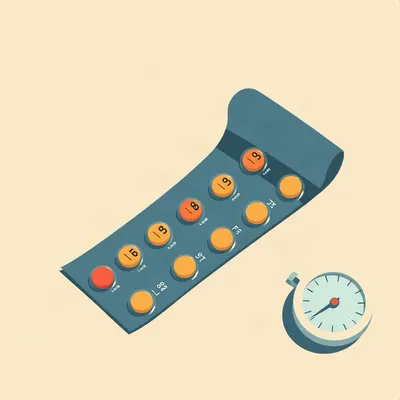
The Dutch tapering strip. It's a roll of twenty-eight daily pouches, each one numbered and dated, each containing the same or a slightly lower dose than the one before it, following a hyperbolic curve. The patient tears off a pouch a day and the dose shrinks by fractions of a milligram. Over one or more strips, you build a full taper schedule.
And these are made from raw active ingredient powder mixed with filler, not crushed pills.
Right, that's the key manufacturing detail. A pharmacist named Paul Harder at the Regenboog Apotheek in Bavel solved it. You start with the active pharmaceutical ingredient powder, mix it with lactose or microcrystalline cellulose, and you can hit doses like zero point four milligrams, zero point seven, one point three. Doses that simply don't exist in commercial form. Every batch is quality-controlled by the independent laboratory of the Royal Dutch Pharmacists Association.
So this isn't a garage operation. It's a real pharmacy with independent verification.
And the range is substantial. Over sixty drugs, including quetiapine at one, two, five, ten, and twelve point five milligram increments. Risperidone, sertraline, venlafaxine, paroxetine, the benzodiazepines and Z-drugs. The prescribing model is simple. Doctor and patient agree on start dose, end dose, and duration. The pharmacy computes the hyperbolic schedule. There's even a free tapering recommendation service.
What's the evidence that it actually works?
Observational, but substantial. Four studies over roughly five years, more than twenty-eight hundred participants combined. About seventy percent tapered completely. And sixty-eight percent of the completers were still off the drug one to five years later. The bigger prospective study from van Os and Groot followed nearly four thousand Dutch patients who received strips between twenty nineteen and twenty twenty-two. Six hundred and eight of them provided daily withdrawal ratings. Withdrawal was limited and inversely related to the rate of taper. Slower meant less withdrawal. Weekly larger steps, averaging a thirty-three percent reduction, produced more withdrawal than daily tiny steps.
So the daily small decrement is doing real work. It's not just placebo or hand-holding.
The caveat is all of this is observational. Self-selected patients, often the difficult cases, no randomized comparator. A large randomized trial has been discussed but never published. So the effect size has to carry an asterisk. But the direction is consistent across every study that exists.
And the origin story here is worth sitting with. This wasn't a pharmaceutical company or a regulator that identified the problem. It was a Dutch wood carver named Harry Leurink who in two thousand four had the idea for a medication withdrawal strip. Then Peter Groot, a patient-researcher who spent twenty years trying to get off venlafaxine, picked it up and worked with the pharmacy to make it real. Groot has said he speculates he could have come off venlafaxine ten or fifteen years earlier if he'd had access to a gradual enough taper.
Patients as the innovators. The Royal College of Psychiatrists only acknowledged severe and persistent withdrawal in twenty nineteen. Before that, the official line in a lot of places was that withdrawal from antidepressants was mild and short-lived. Groot's metaphor is that this is like allowing pharmaceutical companies to sell cars without verifying the brakes work. You can start the drug, but nobody checked whether you can stop it.
The brakes metaphor is exactly right. The regulatory framework for drug approval is built around efficacy and safety during use. It has almost nothing to say about the exit. And the exit is where the damage concentrates.
And the precision paradox is the cruelest part. The closer to zero you get, the more each milligram matters. That's where commercial formulations offer the fewest options. Seroquel comes in twenty-five, fifty, one hundred, two hundred, three hundred, four hundred. Nothing below twenty-five. Benzodiazepines are worse. The final doses for some people need to be as little as zero point two milligrams of diazepam. Opioids, zero point one milligrams of buprenorphine or one milligram of methadone. Those are doses that don't exist in any pharmacy.
So the patient who needs the most precision is handed the bluntest tools. A pill splitter and a jewelry scale.
The systematic review of dosage form manipulations found only sixteen studies on accuracy, and none of them investigated accuracy across the full dose range of a taper. So the evidence base for the DIY approach, tablet splitting, bead counting, liquid titration at home, is essentially absent. People are doing it because they have no alternative, and nobody has measured whether it works.
Daniel mentioned bead counting with Effexor XR. Hundreds of tiny beads in a capsule, and you're supposed to remove a precise number each day. Static electricity alone makes that a nightmare.
Groot's line is that it should not be necessary to instruct patients to make these brakes at home themselves. And yet that's the standard of care in most countries.
So the tapering strips exist and they work. What's the access problem?
They're prescription-only and shipped from the Dutch pharmacy. They can be sent internationally in accordance with the receiving country's legislation, but opioids can't be shipped abroad at all. In the US, UK, and Canada, patients typically pay out of pocket. A full taper can run from hundreds to low thousands of dollars. Some European countries reimburse, but the American patient is generally importing a prescription product through customs, with no insurance coverage, or working with a local compounding pharmacy.
And compounding in the US is its own maze.
State pharmacy board oversight, FDA sections five-oh-three-A and five-oh-three-B governing patient-specific and outsourcing facilities. A compounded liquid might run thirty to eighty dollars per thirty milliliters. Capsules cost more because of the manual labor. And the key fact is compounded medications are generally not covered by insurance. So access tracks ability to pay, not clinical need.
Which means the unit economics are the whole story. The technology to make custom doses exists. It's the labor and distribution that make it expensive. A pharmacist has to measure, mix, encapsulate, verify. That's manual work, and manual work doesn't scale.
Which is exactly why the three-dimensional printing developments are the thing to watch. This is the potential unlock. If a pharmacy can print any dose at quarter-milligram increments on demand, the per-unit labor cost collapses. The machine does the precision work.
And this is actually starting to happen, not just as a concept.
AtrimusRx in Sweden became the first community pharmacy operator in the country to implement validated three-dimensional printing compounding earlier this year. Dose individualization starting from two milligrams, with adjustments at quarter-milligram increments, explicitly supporting tapering regimens. It's part of an EU-funded project called RoboPharma for decentralized pharmacy manufacturing.
Quarter-milligram increments. That's the difference between a tolerable step and a destabilizing one at the end of a benzo taper.
And in March, a case report from the University of Tartu in Estonia described printing personalized zopiclone doses for an elderly patient with dependence where no suitable commercial formulation existed. That's the model in miniature. The patient needs a dose that doesn't exist. The pharmacy prints it.
There's also a Toronto company, PharmaTher, that's building something called PERSONALIZ3D. Telehealth plus three-dimensional printing plus pharmacy fulfillment, explicitly targeting personalized doses, combinations, release profiles. They announced in August they'd selected a US compounding pharmacy as their center of excellence.
The ambition is the right one. Instead of shipping a standard dose from a central factory, you decentralize manufacturing to the pharmacy. The prescription becomes a data file. The printer produces the exact dose for that patient. The telehealth layer handles the prescribing. It's personalized medicine as a logistics problem.
But it's still pre-commercial. The company itself says it hasn't commenced commercial operations.
Right, and that's the honest assessment. Three-dimensional printed tapering is promising but not yet a real patient option at scale. The Swedish pharmacy is doing it in one location. The Estonian case is a case report. The Toronto platform is under development. The gap between demonstration and availability is still wide.
The market framing numbers are enormous, but they're also the kind of numbers that make me skeptical. Grand View Research estimates personalized medicine growing from five hundred seventy billion dollars in twenty twenty-four to one point two trillion by twenty thirty-three. Those projections always assume the reimbursement problem gets solved.
And that's the real gatekeeper. Insurance. Even where compounding exists, the fact that it's excluded from US formularies means the technology might as well not exist for most patients. A quarter-milligram increment is worthless if the patient can't pay for it.
The seven and a half thousand compounding pharmacies out of fifty-six thousand community pharmacies in the US is a telling ratio. The capability is there in a minority of locations, but the payment pathway isn't.
And Daniel's question about whether there have been inroads has a frustratingly two-part answer. The clinical and manufacturing innovation has happened. Tapering strips are real, validated, and effective in observational data. Three-dimensional printing is starting to demonstrate feasibility. But the access layer, the part that actually gets these tools to the patient who needs them, is still stuck.
There's a finding from the twenty twenty-one cohort study that I keep turning over. Of the eight hundred twenty-four people who wanted to stop their drug and used strips, fewer than forty percent heard about them through a clinician. The internet was the most common source. That means the patients are ahead of the prescribers. They're finding the solution themselves and then going to their doctors to ask for it.
Which inverts the normal flow of medical innovation. Usually the clinician brings the new treatment to the patient. Here the patients are doing the research, finding the Dutch pharmacy, paying out of pocket, and the doctors are the last to know.
That's a systemic failure of continuing medical education, but it's also a signal about where the demand is. Patients are not passive about this. They're desperate. They're willing to import medication through customs because their local system has nothing to offer.
And the desperation is rational. The hyperbolic curve means the final stage of withdrawal is the most dangerous. People who've been on a drug for years can find themselves unable to function for months if they step down too fast. The consequences aren't abstract. Lost jobs, broken relationships, relapse onto the drug they were trying to quit, or onto something worse.
Daniel's framing about the few dosages covering treatment needs for many patients but being imperfect for almost all of them is the larger point. This isn't just about tapering. It's about the entire model of fixed-dose pharmaceuticals. We've accepted that everyone gets twenty-five or fifty or one hundred milligrams because that's what the factory can stamp out efficiently.
And for most therapeutic purposes, that's fine. If you need an antihypertensive and the standard dose controls your blood pressure, the bluntness doesn't matter. The problem arises at the margins, and tapering is the margin where precision matters most.
There's also the compounding quality question. Daniel mentioned patients resorting to hackery and hoping the concentration remains stable in liquid titration. That's not an unfounded worry. Suspensions settle. The active ingredient can distribute unevenly. A patient shaking a bottle at home is not the same as a validated manufacturing process.
The PCAB accreditation exists as a voluntary quality marker for compounding pharmacies, but the patient has no way to verify what they're getting. They're trusting a label on a bottle. The Dutch strips at least have independent laboratory verification through the Royal Dutch Pharmacists Association. That's a meaningful difference.
So the quality spectrum runs from validated tapering strips at one end to a person crushing pills with a spoon at the other, with compounding pharmacies somewhere in between depending on their standards.
And the systematic review found we don't even know how accurate the DIY methods are. Sixteen studies on dosage form manipulation accuracy. None across the full taper range. The evidence gap is exactly where the patients are doing the most dangerous work.
What would it take to actually fix this in a place like the US?
Three things. First, a domestic manufacturer. The fact that no standalone US-based tapering strip product exists, that patients have to import from the Netherlands, is absurd. The market is demonstrably there. Second, insurance coverage. Compounded medications need to be treated as medically necessary when a commercial dose doesn't exist for a legitimate taper. And third, the three-dimensional printing infrastructure needs to move from demonstration to deployment.
The first two are regulatory and commercial problems. The third is an engineering problem. And the engineering problem is the one that's actually showing progress.
The Swedish model is the one to watch. A community pharmacy with a validated printer, making quarter-milligram adjustments on demand. If that scales across the EU through RoboPharma, you've got a template for what decentralized personalized dosing looks like. The printer becomes a standard piece of pharmacy equipment, like an autoclave or a laminar flow hood.
And then the unit economics flip. Instead of a pharmacist hand-measuring a custom capsule for forty-five minutes, the printer runs for five minutes and the pharmacist verifies the output. The labor cost drops far enough that insurance might actually cover it.
That's the hope. The caution is that we've seen pharmacy technology promises before. The gap between a press release and a working reimbursement pathway is where these things die.
Daniel's question about whether this would be a major move toward personalized medicine. The answer is yes, but it's personalized medicine in the least glamorous possible form. Not gene therapy, not custom cancer vaccines. Just a pill with the right number of milligrams in it.
Which is somehow harder to deliver than the glamorous stuff. The unsexy problem of getting zero point seven milligrams of quetiapine into a capsule and into a patient's hand, affordably, reliably, at scale.
The Groot quote about cars without brakes keeps coming back. The regulatory system has spent decades optimizing for the start of treatment. The entire apparatus, clinical trials, FDA approval, marketing, insurance formularies, is built around getting people onto drugs. The off-ramp is an afterthought.
And the off-ramp is where the harm concentrates. The twenty twenty-one study finding that patients find tapering strips through the internet, not their doctors, means the medical system is actively failing at the off-ramp. Not just underfunding it. Failing to know it exists.
There's something darkly funny about the fact that a wood carver in the Netherlands had to invent the solution because the entire pharmaceutical and regulatory establishment didn't think the problem was worth solving.
Groot's own story is twenty years on venlafaxine because he couldn't taper slowly enough. Twenty years of taking a drug he didn't want because the exit was too steep. And he's the one who had to build the staircase.
What does the hyperbolic curve actually look like for Seroquel specifically? Daniel's on a small dose for sleep. Twenty-five milligrams or less. At that dose, quetiapine is mostly hitting histamine receptors, which is why it's sedating. The antipsychotic effects don't kick in until much higher doses.
Right, at low doses quetiapine is essentially a very expensive antihistamine with a lot of off-target effects. The histamine receptor occupancy at twenty-five milligrams is already substantial. Going from twenty-five to twelve point five is a big step in receptor terms. Going from twelve point five to six is bigger. The final step to zero is the biggest of all.
So Daniel's experience of the taper dragging out at the end is exactly what the pharmacology predicts. He's not being overly cautious. He's at the steep part of the curve.
And the fact that he's been on it for sleep, off-label, means the original prescribing decision was probably a convenience move. Seroquel for insomnia is common because it's sedating and not a controlled substance. But the exit cost was never factored in.
The off-label prescribing culture around quetiapine is its own rabbit hole. It's one of the most prescribed drugs in the US, and a huge fraction of that is low-dose off-label use for sleep. Most of those patients have no idea what they're signing up for when they start.
Rebound insomnia is the withdrawal symptom, and it's the thing that keeps people on the drug. Daniel mentioned there's rarely a good time to experience rebound insomnia with a small child. That's the trap in one sentence.
So the prescribing decision was easy, the deprescribing decision is hard, and the tools for the hard part don't exist in his pharmacy. That's the structural failure.
And it's not just quetiapine. The same logic applies to every benzodiazepine, every Z-drug, every antidepressant with withdrawal effects, every opioid. The hyperbolic curve is a general property of receptor pharmacology. The tools for hyperbolic tapering are what's missing.
The opioid angle is worth noting because it's the one place where the stakes are highest and the access is worst. The Dutch strips can't ship opioids internationally at all. So the patients who need the most precise taper, methadone, buprenorphine, are the ones with the least access to the tool.
The final doses for opioids are vanishingly small. Zero point one milligrams of buprenorphine. One milligram of methadone. Those doses don't exist in any commercial formulation. Patients are doing liquid titration at home with syringes and hope.
And the consequences of getting it wrong are relapse or precipitated withdrawal. Both of which can be fatal.
The Horowitz paper on pharmacological principles for safe benzodiazepine and Z-drug dose reduction is the most recent formal statement of the problem. Final doses for some people will need to be very small, so that the last step down to zero is not larger than prior tolerated reductions. That's the clinical principle in one sentence.
The last step should not be bigger than the steps that came before. And yet with commercial formulations, the last step is always the biggest. You go from twenty-five milligrams to zero because there's nothing in between.
The tapering strip solves that by making the last step zero point one milligrams. The three-dimensional printer solves it by making the dose whatever the prescription says. The problem isn't the technology. It's the distribution.
Let's talk about what patients actually do right now, in the absence of these tools. Daniel mentioned hackery. What does that look like in practice?
Tablet splitting is the most common. A pill splitter costs a few dollars. But tablets aren't designed for even splitting. The active ingredient isn't necessarily distributed uniformly. A twenty-five milligram tablet split in half might give you twelve and thirteen, or eleven and fourteen. At the low end of a taper, that error is enormous.
And some tablets shatter. Seroquel is film-coated. It doesn't split cleanly.
Liquid titration is the next step. If the drug is soluble, you dissolve it in a measured volume of water and use an oral syringe to draw off a fraction. The problem is stability. Some drugs degrade in solution. Some don't dissolve evenly. The patient is doing chemistry at the kitchen counter and hoping.
Bead counting for extended-release capsules. Effexor XR is the classic. Hundreds of beads in a capsule, and the patient removes a specific number each day. The beads aren't uniform in size. Static electricity makes them jump around. The error rate is unknown because nobody's studied it.
The systematic review found exactly that. Sixteen studies on manipulation accuracy. None across the full taper range. So a patient spending six months counting beads is doing an unvalidated experiment on their own brain chemistry.
The alternative is paying out of pocket for a compounding pharmacy, which most patients don't know exists and couldn't afford if they did.
The thirty to eighty dollars per thirty milliliters for a compounded liquid sounds reasonable until you realize the taper lasts months and insurance won't touch it. The full cost lands on the patient at exactly the moment they're trying to reduce their medication burden.
The system externalizes the cost of deprescribing onto the patient, while the cost of prescribing was fully covered. The incentives are exactly backwards.
The pharma companies have no incentive to fix it. A patient who can't get off the drug is a revenue stream. The commercial dose range is optimized for maintenance, not for exit. Nobody files a new drug application for a zero point five milligram quetiapine tablet because there's no profit in it.
Which is why the three-dimensional printing angle is exciting, not just hype. It decouples the dose from the manufacturing batch. The printer doesn't care if it's making a hundred twenty-five milligram tablets or a hundred zero point three milligram tablets. The marginal cost is the same.
That's the unit economics collapse I was talking about. Batch manufacturing has economies of scale that favor large standard doses. Additive manufacturing has no such constraint. One pill, one dose, one patient. The printer doesn't need a minimum order.
The Swedish pharmacy doing quarter-milligram increments is the proof that this works in a real pharmacy setting. Not a research lab. A community pharmacy with patients walking in.
The RoboPharma project is the infrastructure play. If the EU funds decentralized pharmacy manufacturing across enough sites, you've got a network effect. The more pharmacies with printers, the more the cost drops, the more the reimbursement case strengthens.
The US is behind on this, which is unusual for a country that leads in most medical technology. But the regulatory structure, the FDA's approach to compounding, the insurance formularies, all of it is built around the batch model.
The PharmaTher approach of pairing telehealth with printing and pharmacy fulfillment is trying to route around the existing system. Build a parallel network rather than retrofit the old one. It's the same playbook as a lot of direct-to-consumer healthcare.
Whether that works depends on whether they can get insurers to pay. The telehealth layer doesn't matter if the patient is still paying out of pocket for the printed pills.
That's the open question the research can't answer yet. No randomized trial, no US-based product, no commercial three-dimensional printing at scale. The pieces are all there, but nobody has assembled them into something a patient in Cleveland can actually use.
Daniel's framing about millions of patients worldwide is not an exaggeration. Antidepressant prescribing alone is in the tens of millions in the US. A meaningful fraction of those patients will try to stop at some point. The ones who hit withdrawal and can't taper are a huge population.
The twenty thousand Dutch patients who've received tapering strips is the proof of demand. That's one small country, one pharmacy, one product line. Scale that to the US population and you're talking about millions of potential users.
The Dutch patients found it through the internet, not their doctors. Which means the demand is latent. There are people stuck on drugs right now who don't know the tool exists.
The underreporting is itself a finding. No Hacker News discussion, no recent open-news coverage on antidepressant withdrawal or deprescribing. This is a slow-burn issue, not a news cycle. It doesn't generate headlines because the victims are isolated and quiet.
A person lying awake at three in the morning, six months into a failed taper, doesn't write a press release. They just go back on the drug.
The cycle continues. The drug that was easy to start becomes impossible to stop, and the medical system shrugs because there's no billing code for deprescribing.
The thing that strikes me about the Groot story is that he wasn't a pharmacologist or a physician. He was a patient who got angry enough to build the solution himself. That's not how medical innovation is supposed to work.
The wood carver detail is even better. Harry Leurink, a guy who carves wood for a living, had the original idea in two thousand four. The entire clinical establishment was out-innovated by a wood carver and an angry patient.
Because they were the ones experiencing the problem. The regulators and the pharma companies were experiencing the revenue.
The Royal College of Psychiatrists only acknowledged severe withdrawal in twenty nineteen. That's fifteen years after the wood carver's idea. The institutional lag is staggering.
Where does this leave Daniel's actual question? Have there been inroads? Yes. Tapering strips are real and validated. Three-dimensional printing is demonstrating feasibility. But the access layer is still broken, and the US is the worst offender.
The inroads are real but uneven. Europe is ahead. The Netherlands has a functioning system with twenty thousand patients served. Sweden is deploying the printing technology. The US has neither a domestic strip product nor a scaled printing network. American patients are importing from the Netherlands or paying out of pocket for compounding.
The insurance problem is the bottleneck. Every other innovation, the strips, the printers, the telehealth platforms, all of it runs into the same wall. Compounded and personalized medications aren't covered. Until that changes, the technology will remain a boutique option for the affluent.
The fix has to come from the reimbursement side. If Medicare or a major insurer decided to cover compounded tapering for patients with documented withdrawal, the market would respond overnight. The pharmacies would expand, the printers would deploy, the prices would drop.
But that requires recognizing deprescribing as a medical necessity, not a lifestyle choice. And the system is not built to recognize that.
The Horowitz paper is the clinical foundation for that argument. It establishes that precise hyperbolic tapering is a pharmacological necessity, not a preference. The final doses need to be vanishingly small. That's a medical fact.
The alternate-day dosing study is the counter to the cheap shortcut. The system's default answer, take the pill less often, is actively harmful. So the cheap option is off the table. The only options are the expensive precise ones.
Which brings us back to the unit economics. The only way to make precise tapering affordable is to automate it. Three-dimensional printing is the only technology on the horizon that does that.
The sequence is: establish the medical necessity, deploy the automation, then force the reimbursement. The clinical case exists. The technology is emerging. The reimbursement is the missing piece.
The patients are already voting with their wallets. Paying hundreds or thousands out of pocket for Dutch strips. That's the market signal the insurers are ignoring.
Daniel's own taper is a microcosm of the whole problem. He's at the steep part of the curve, the tools he needs don't exist locally, and he's doing the best he can with what's available. Multiply that by millions.
The fact that he's been dragging out the end of the taper for longer than it should, because life got difficult, is exactly what the hyperbolic curve predicts. The end is the hardest part. A structural one.
The apartment move with a small child is the kind of life event that makes a careful taper impossible. Rebound insomnia on top of moving stress on top of a toddler. Of course the taper stalls.
The clinical term is that withdrawal symptoms are context-dependent. The same physiological change is tolerable in a calm environment and intolerable in a chaotic one. The brain's stress systems are already activated, and the withdrawal adds more activation on top.
The timing problem isn't just about finding a quiet week. It's about the fact that the final steps are the most destabilizing, and life doesn't offer quiet weeks at the exact moment you need them.
Which is why the precision matters so much. If you can make the steps small enough, the withdrawal stays below the threshold of what life can absorb. The taper proceeds in the background. The patient doesn't have to put their life on hold.
The Dutch data supports that. The daily tiny steps produced less withdrawal than the weekly larger ones. The precision isn't just about comfort. It's about making the taper compatible with ordinary life.
That's the promise of the whole approach. Not just getting people off drugs, but getting them off without derailing their lives in the process.
The current system offers two options: cold turkey, which is brutal, or a DIY taper with unvalidated tools, which is uncertain. The middle path, precise, gradual, affordable, doesn't exist for most patients.
The tapering strip is that middle path, but it's in the Netherlands. The three-dimensional printer is that middle path, but it's in Sweden and Estonia. The gap between where the solution exists and where the patients are is the entire problem.
It's a distribution problem, not a knowledge problem. We know what to do. The hyperbolic curve is understood. The manufacturing techniques exist. The clinical data is consistent. What's missing is the will to build the infrastructure.
The personalized medicine market projections, five hundred seventy billion to one point two trillion, are mostly about oncology and rare diseases. The unglamorous end, getting the right milligram dose to a patient tapering off an antidepressant, is a rounding error in those projections.
But it's the part that affects the most people. Everyone knows someone on an antidepressant. A huge fraction of those people will eventually try to stop. The tools they need are the ones nobody is building.
Because there's no blockbuster in it. A zero point five milligram quetiapine tablet will never be a billion-dollar product. It's a commodity. The money is in the printer, not the pill.
The printer is exactly what's being built. Just slowly, in Europe, with EU funding, while the US watches.
The American angle is frustrating because the compounding infrastructure exists. Seven and a half thousand pharmacies. The regulatory framework exists, five-oh-three-A and five-oh-three-B. The patients exist. The missing piece is the payment.
The payment won't come until someone in a position of power experiences the problem personally. That's how these things always change. A senator's wife can't get off her benzo, and suddenly there's a hearing.
The cynical version is that the current system works for the people who make the rules. They can afford the compounding pharmacy. They can import the Dutch strips. The access problem is for everyone else.
The everyone else is the majority. The people who can't pay three hundred dollars a month for a custom taper, who can't take three months off work to weather a cold turkey withdrawal, who can't afford to be incapacitated by rebound insomnia.
They stay on the drug. Not because they need it, but because the exit is too expensive.
That's the downstream problem Daniel mentioned. People taking medications they no longer wish to be taking, or may no longer need, because they can't safely or comfortably get off. The cost of that, in human terms and in healthcare spending, is enormous.
It's invisible. The patient who stays on quetiapine for years because the taper was too hard doesn't show up in any statistic. They're just a maintenance prescription, renewed monthly, forever.
The twenty thousand Dutch patients who used tapering strips are the visible tip of an invisible iceberg. The ones who found the tool, got off the drug, and stayed off. The ones still stuck are uncounted.
The sixty-eight percent still off after one to five years is the number that should be on every psychiatrist's wall. That's the success rate of a proper taper. Compare that to the relapse rates for cold turkey or rapid tapers, which are dismal.
The seventy percent complete-taper rate across the observational studies. Seven out of ten people who wanted to stop, stopped. That's a remarkable success rate for a population that was self-selected as difficult cases.
The limitation is the lack of a randomized trial, and I'll say it plainly. We don't have the gold-standard evidence. But the observational data is consistent across four studies, and the pharmacology makes sense. The hyperbolic curve is not controversial. The intervention matches the mechanism.
Sometimes the mechanism is clear enough that waiting for the randomized trial is its own kind of harm. Patients are suffering now. The tool exists. The evidence is good enough to act.
The risk of the tool is minimal. It's the same drug, just in smaller increments. The safety profile is the same. The only question is whether the taper schedule is tolerable, and the data says it is.
What's the one thing from all this that should stick?
That the hardest part of stopping a drug is the last step, and that's exactly where the medical system offers the least help. The precision paradox. The closer to zero, the more each milligram matters, and the fewer options exist.
The tools to fix it, the tapering strips, the three-dimensional printers, are real but stuck behind a wall of access and reimbursement. The technology isn't the problem. The will to deploy it is.
Which means the future of this isn't a new drug. It's a new pharmacy. A printer in every pharmacy, making the exact dose the patient needs, covered by insurance because it's medically necessary. That's the vision.
Until then, patients will keep counting beads and shaking bottles and hoping. The wood carver's idea will keep saving people in the Netherlands while the rest of the world waits.
There's an open question I keep circling. If the three-dimensional printing scales, what happens to the batch manufacturing model? Do we still need hundred-milligram tablets if every pharmacy can print any dose on demand?
The batch model won't disappear. It's too efficient for the common cases. But the long tail, the unusual doses, the taper schedules, the pediatric adjustments, that's where the printer wins.
The long tail is bigger than anyone admits. It's not just