Daniel sent us this one. He says a twenty-five floor building in Jerusalem has become completely unremarkable — nobody even glances up anymore. But the engineering required to make that building just stand there, day after day, in wind and heat and on uneven limestone... that's anything but ordinary. He wants to know what cutting-edge technology actually comes to fruition when we see a building like that standing.

He's right to ask. We treat tall buildings like they're just... But every floor you add above about ten introduces compounding physics problems that didn't exist a century ago. Problems that would have made a Roman engineer weep.
Today we're pulling back the curtain. Tuned mass dampers, self-healing concrete, elevator systems that break the laws of what elevators are supposed to be — all the invisible engineering that makes the modern skyline possible. The stuff you never think about when you're waiting for the elevator.
I love this topic because it's the definition of a mature technology. When something works so reliably that it becomes boring — that's the highest compliment engineering can get.
The boring twenty-five floor building as a triumph of human ingenuity. Let's get into it.
Before we get into the physics, let's define what we're actually talking about when we say skyscraper. Because from an engineering perspective, "tall" isn't about how impressive a building looks on the skyline. It's about when certain forces stop being minor annoyances and start dominating every design decision.
And that threshold is surprisingly low. Once you cross about ten to twelve floors, you've left behind what standard building codes can handle with rule-of-thumb calculations. At twenty floors and above, you're in a regime where three forces are fighting your building simultaneously, and none of them will compromise.
Walk me through them.
First, gravity — what everyone thinks about. That's your dead load, the weight of the building itself, plus live loads from people and furniture. Second, lateral forces — that's wind and seismic, pushing sideways. And third, something most people never consider: what the ground underneath can actually hold. Soil bearing capacity. If the earth beneath you can't take the load, nothing else matters.
You've got the building crushing down, the wind shoving sideways, and the ground possibly saying "no thanks.
And here's the counterintuitive part that surprises even engineers-in-training: above roughly twenty floors, gravity is not your biggest problem. Lateral forces are. Wind loads scale with the square of wind speed — so a hundred kilometer per hour gust doesn't push twice as hard as a fifty kilometer per hour gust. It pushes four times as hard. And as you go higher, wind speeds increase because there's less ground friction to slow the air down. So doubling the height can more than quadruple the wind force.
Which is why a twenty-five floor building in Jerusalem is quietly doing something remarkable every time the wind picks up. And nobody notices.
That's the paradox Daniel's pointing at. The engineering is so reliable it's become invisible. And that's actually the definition of a mature technology — when it disappears into the background of everyday life. You don't think about the metallurgy in your car engine or the error correction in your phone's memory. You just expect them to work. Same with tall buildings.
Let's talk about what the wind is actually doing to a tall building. It's not just pushing it over like a hand against a cardboard box. The real problem is something called vortex shedding. As wind flows around a building, it creates alternating low-pressure zones on either side — little spiraling vortices that peel off in a rhythm. If that rhythm matches the building's natural frequency, you get resonance. The building starts swaying in sync with its own vortex wake.
The wind isn't just shoving. It's finding the building's frequency and playing it like a tuning fork.
That's exactly the image. And that swaying isn't just a structural problem — it's a human one. People start feeling nauseous when acceleration hits about fifteen to twenty milli-g's. That's well below what would actually damage the structure. So you have to design for occupant comfort, not just survival.
Which is where the tuned mass damper comes in. I've seen pictures of the one in Taipei 101. It's this enormous gold sphere just hanging in the middle of the building like a piece of public art.
Six hundred and sixty metric tons of steel, suspended between the eighty-seventh and ninety-second floors. It's the largest tuned mass damper in the world, and it's deliberately visible — you can go visit it. When the building sways in one direction, that sphere swings the opposite way, pulling the building back toward center. It reduces sway by up to forty percent. Think of it as a counterweight that's always a half-step behind the building's motion, canceling it out.
A six hundred sixty ton metronome keeping the building still.
It's not the only approach. The Burj Khalifa doesn't have a giant visible damper. Instead, its entire shape is the solution. The Y-shaped floor plan — three wings radiating from a central core — disrupts vortex shedding by making the wind hit staggered surfaces at different angles. Combined with the stepped setbacks as it rises, the shape alone reduces wind forces by about thirty percent compared to a rectangular tower of the same height.
The architecture isn't just aesthetic. The Burj Khalifa looks like that because the wind demanded it.
Every spire, every taper, every twist you see on a supertall — there's usually a wind tunnel test behind it. Engineers build scale models, blow smoke across them, and watch where the vortices form. Then they reshape until the building and the wind reach a kind of truce.
All of this — the dampers, the aerodynamic shaping — all of it assumes the building is anchored to something solid. What's happening underground?
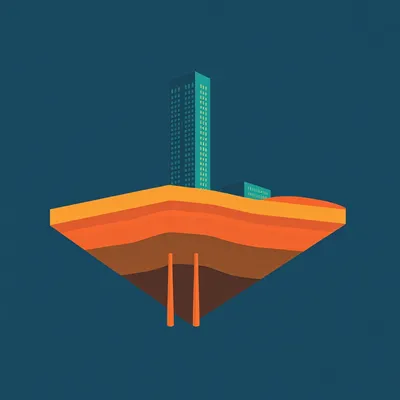
In Jerusalem, we're actually in a decent position. The limestone bedrock here has good bearing capacity — it can take serious load. But the rock quality varies. You hit seams, cavities, softer layers. So you can't just pour a slab and call it done. Modern high-rises here use deep pile foundations — concrete columns drilled down into the bedrock, sometimes thirty or forty meters deep, until they hit competent stone. Each pile friction-grips the rock or transfers load directly to it.
If you're building somewhere without bedrock near the surface — say, Dubai?
Then you're using friction piles. The pile doesn't hit rock at all. It just goes deep enough that the friction between the pile's surface and the surrounding soil can carry the building's weight. Some of those piles run eighty meters or more. It's counterintuitive — you're holding up a skyscraper with what's essentially a very long stake driven into sand.
The building is basically floating.
In a sense, yes. And that brings us to something subtle that kicks in above twenty stories — the P-Delta effect. When a tall building deflects sideways under wind, the top is no longer directly above the base. Now gravity is pulling down on a structure that's slightly off-center. That offset creates an additional bending moment — an extra load that amplifies the deflection, which increases the offset, which increases the load. It's a feedback loop.
The building leans, gravity punishes it for leaning, so it leans more.
You have to design for that iteratively. You can't just calculate it once. You model the deflection, recalculate the loads with the new geometry, remodel, and keep going until the numbers converge. For a twenty-five floor building it's manageable. For a hundred-floor building, it's a major design constraint.
Between the vortex shedding trying to resonate the building apart, the foundations threading through unpredictable rock, and this P-Delta loop amplifying every lean — the miracle isn't that some buildings fail. It's that a twenty-five floor tower in Jerusalem stands perfectly still while you're drinking coffee on the eighteenth floor, and you don't feel a thing.
That's the invisible engineering Daniel was asking about. And we haven't even gotten to what the building is actually made of.
We've solved the sway problem with dampers and clever shapes. But that's just the physics. What about the actual stuff the building is made of? Because the concrete in a twenty-five floor tower is not the same concrete in your driveway.
I was going to say — concrete feels like the least exciting material on earth. It's gray, it's heavy, we've had it since the Romans.
That's exactly the misconception. Modern high-rise concrete is a materials science revolution hiding in plain sight. Standard concrete you'd use for a sidewalk has a compressive strength around twenty to thirty megapascals. The stuff going into skyscrapers today? Eighty to a hundred and twenty megapascals. That's four to six times stronger.
What actually makes it that much stronger?
A few things. Silica fume — an ultrafine industrial byproduct — fills the microscopic gaps between cement particles, making the matrix denser. Superplasticizers let you use far less water while keeping the mix workable, and less water means fewer voids when it cures. Sometimes they add steel or polypropylene fibers too. The result is concrete so dense and strong you can use thinner columns, which means more rentable floor space. For a developer, that's the difference between profit and loss.
The concrete itself is engineered at the particle level. But you mentioned something earlier that really got me — self-healing concrete. That sounds like science fiction.
It's real, and it's already in the ground. There are two main approaches. One uses bacteria — specifically bacillus strains — embedded in the concrete mix with a food source like calcium lactate. The bacteria lie dormant for years. When a crack forms and water seeps in, the bacteria activate, metabolize the food, and produce limestone that fills the crack. The other approach uses microcapsules of healing agents that rupture when a crack propagates, releasing a resin or mineral compound that hardens on contact with air or moisture.
The building literally patches its own wounds.
For high-rise foundations, this is enormous. You're pouring concrete piles that need to last fifty, seventy, a hundred years. Micro-cracks from settlement or thermal cycling are inevitable. Normally that means expensive inspection and repair — digging down to foundation elements, injecting grout. Self-healing concrete handles the small stuff automatically before it becomes big stuff. It's been deployed in select high-rise foundations in the last few years, though it's still an emerging technology. Not every building has it, but the ones that do are making a bet on lower lifetime costs.
The concrete is smarter than I am. But let's say the building is standing, the concrete is healing itself — how do people actually get to the top? Because at some point, the elevator cable itself becomes the problem.
This is one of my favorite constraints in the whole field. A conventional steel elevator cable has a practical limit around five hundred meters. Beyond that, the cable's own weight exceeds its tensile capacity — it can't even hold itself up, let alone a car full of people. Long cables in a tall shaft oscillate, especially during wind events, and you can't have elevator cars banging around in there.
The Burj Khalifa, at over eight hundred meters, had to solve this.
The Burj Khalifa uses a stacked sky lobby system — you take an express elevator partway up, then switch to a local elevator. It works, but it eats up floor space and adds transfer time. The real leap is ropeless elevators. ThyssenKrupp's MULTI system, first installed in a test tower in Rottweil, Germany in twenty-seventeen, uses linear motors — same principle as a maglev train — to move cars vertically and horizontally. No cables at all.
So the elevator can go sideways.
It can move in loops. Multiple cars running in the same shaft, passing each other, even moving between shafts. That increases shaft capacity by about fifty percent. You wait less, the building needs fewer shafts, and there's no height limit imposed by cable weight. The first commercial installations are happening now, and for supertalls this changes what's possible.
The elevator shaft becomes more like a vertical rail network.
And that brings us to another system most people never think about until it goes wrong: fire safety. In a twenty-five floor building, you can't just pull the fire alarm and have everyone run down the stairs. The stairs alone could take fifteen minutes to clear, and that's if nobody panics.
You've got smoke rising through the building faster than people can descend.
Which is why modern high-rises use pressurized stairwells. Giant fans force air into the stair shaft to keep smoke out — the pressure differential means when a door opens, air rushes out, smoke doesn't rush in. Fire-resistant glazing on the facade prevents fire from jumping floors externally. And the whole strategy has shifted from "everyone evacuate" to something called defend-in-place. Occupants on unaffected floors stay put while firefighters handle the fire floor. It's counterintuitive — we're taught to get out — but in a properly designed tall building, your apartment or office is a fire-rated compartment designed to protect you for hours.
Water doesn't exactly flow uphill without help.
Sprinkler systems in tall buildings are zoned and pumped in stages. You can't just put a pump in the basement and expect it to push water two hundred meters straight up — the pressure at the bottom would burst the pipes. So you have intermediate pump rooms every twenty or thirty floors, each boosting pressure to the next zone. It's a relay race for water.
Which means the building has to dedicate entire floors just to pumps, tanks, and mechanical systems.
And that's before we even get to how you build the thing. Tower cranes don't just appear at full height. They climb with the building — a process called jacking. The crane is mounted inside the building's core, and as each new floor is completed, hydraulic jacks lift the entire crane assembly up one level. The crane literally pulls itself up by its own bootstraps.
The concrete for the top floors is coming from the ground.
The Burj Khalifa set the world record — concrete pushed six hundred and six meters straight up, requiring specialized high-pressure pumps operating above two hundred bar. At those pressures, the concrete mix has to be precisely engineered so it doesn't segregate — the aggregate separating from the cement paste — or set too fast in the pipe. They had to cool the pipes with ice during the hottest months just to keep the mix workable long enough to reach the pour point.
You're racing thermodynamics and gravity simultaneously, while a crane lifts itself floor by floor, pumping a material that's been engineered down to the microscopic level, through pipes cooled with ice, to build a structure that will then spend the next century patching its own cracks with bacteria.
When you put it that way, it's absurd that anyone walks past a twenty-five floor building without stopping to stare.
All of this technology — the concrete, the elevators, the fire systems — has to work together seamlessly. And that integration is itself an engineering achievement. A twenty-five floor building isn't just a stack of floors. It's a system of systems, each one compensating for the others' limits.
That's the thing Daniel's prompt really gets at. The building is boring because the integration is flawless. The tuned mass damper doesn't rattle. The pressurized stairwells don't whistle. The pumps don't thrum through your apartment walls. You don't notice any of it because noticing it would mean it failed.
Next time someone's in a tall building — what should they actually look for? What's the giveaway that all this engineering is humming along beneath the surface?
First, find the core. In most buildings, the central concrete or steel column that houses the elevators, stairs, and mechanical shafts — that's the spine. Everything hangs off it. Second, notice what you don't feel. If you're on the eighteenth floor and there's a storm outside and you feel absolutely nothing, thank the tuned mass damper. Or the aerodynamic shaping.
The third thing?
Elevator wait times. It sounds trivial, but it's actually a proxy for how well the vertical transportation was designed. If you're waiting more than thirty seconds during peak time, the shaft capacity wasn't planned right. Someone skimped on the elevator study.
Impatience is a structural critique.
In a properly engineered building, even your boredom is accounted for.
What about the limits, though? We've talked about supertalls pushing three hundred meters and beyond, but what about the ordinary skyscraper — the twenty-five, thirty, forty floor building? Is there a practical ceiling there, or does it just keep inching up as materials get better?
The ordinary skyscraper has room to grow, but it's incremental, not revolutionary. Every time concrete gains another ten megapascals of compressive strength, columns can get a little thinner, floor spans a little wider. Every improvement in damping technology means you can go a few floors higher before sway becomes perceptible. It's not glamorous — it's just steady optimization. But over thirty years, that optimization adds twenty floors to what counts as unremarkable.
The boring building of twenty-fifty-six will be forty floors, and nobody will blink.
And it'll have ropeless elevators and self-healing foundations as standard, and we'll still walk past it checking our phones.
There's a question that's been hanging over this whole conversation. We've solved the twenty-five floor building. We've solved the supertall. But the mile-high building — Frank Lloyd Wright proposed it in nineteen fifty-six, the Illinois, five hundred and twenty-eight floors — still doesn't exist. What's the breakthrough we're actually waiting for?
The honest answer is it's probably not one thing. Steel and concrete as we know them hit a practical ceiling somewhere around a kilometer. Beyond that, the weight of the structure itself consumes so much of the material's strength that you're just building a pyramid — wider and wider at the base to support what's above. Carbon fiber structural elements could change that. Carbon fiber has a strength-to-weight ratio five times that of steel. The problem is cost and joining — you can't weld it, you can't bolt it the same way. The connection engineering isn't there yet.
That's the other path. Instead of a passive tuned mass damper, you use computer-controlled actuators that sense building motion and push back in real time. Like noise-canceling headphones, but for a million-ton structure. The sensor and control technology exists. Scaling it to a mile-high building is a power and reliability problem — if the system fails during a windstorm, you've got a catastrophe.
The mile-high building is waiting on either carbon fiber joints or building-sized noise cancellation. Either way, not boring.
Not boring at all. And that's really the invitation here. Daniel asked us to demystify the twenty-five floor building, and we've barely scratched the surface of what's hidden in plain sight. So send us your weird prompts about the built environment. What everyday marvel do you want us to pull apart next? Bridges, tunnels, dams, the plumbing in a hundred-story hotel — whatever you walk past every day without thinking about it.
Because the most impressive engineering is the kind you never think about. If you notice it, something's probably wrong.
Now: Hilbert's daily fun fact.
Hilbert: In the mid-nineteen-eighties, Patagonian farmers were cultivating fewer than two hundred distinct varieties of heritage wheat, down from an estimated one thousand landraces documented in the region a century earlier.
...right.
This has been My Weird Prompts. Thanks to our producer Hilbert Flumingtop. If you've got a question about something hiding in plain sight, email the show at show at my weird prompts dot com. We'll see you next time.