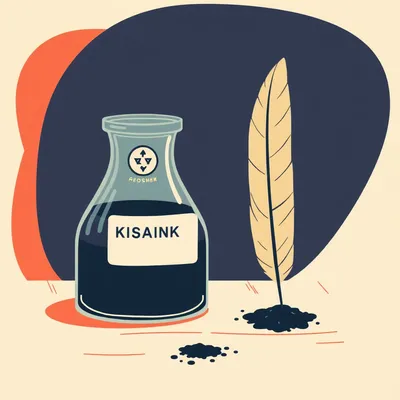
Here's a weird one — I was trying to touch up my Tefillin the other day, the black paint on the boxes was flaking a bit, and I thought, can I just use a Sharpie on this? Which sent me straight down a rabbit hole of halachic ink chemistry, ancient Talmudic recipes, and a modern market where a tiny bottle of certified kosher ink costs more than a decent bottle of wine. And I realized — this is a whole world. There are specific formulations for Torah scrolls versus Tefillin boxes versus Tefillin straps, and as with everything in Jewish law, there are fierce debates about what's actually required.

The debates get wonderfully technical. We're talking about whether shellac counts as tree sap in the halachic sense, whether lampblack from olive oil is superior to lampblack from paraffin, whether synthetic acrylic binders invalidate the ink even if they perform better on leather. It's exactly the kind of niche where ancient material science crashes into modern chemical engineering, and millions of dollars of commerce hang in the balance.
What exactly is this ancient ink, and why does it matter in twenty twenty-six? Let's start with the basics.
There are really two distinct ink domains here, and confusing them is where most people go wrong. The first is the ink for actually writing sacred scrolls — what's called STaM, which stands for Sifrei Torah, Tefillin, and Mezuzot. That ink is called d'yo, and it has extremely strict halachic requirements. The second domain is the ink for painting or blackening the Tefillin boxes and straps — the batim and retzu'ot — and that's where the debates get messy.
The core principle behind d'yo?
It has to be permanent in a very specific way. The ink must bond with the parchment, it cannot be erasable by water, and it has to be made from particular ingredients. The Talmud in Tractate Shabbat twenty-three A and Tractate Soferim specifies three components: soot from burning oils, which they called smoke of oils, tree sap — specifically gum arabic or a similar plant resin — and copper sulfate, which they called kankantum. Each of these has a chemical job. The soot provides the black pigment, the gum arabic acts as the binder that glues the carbon particles to the parchment, and the copper sulfate serves as a mordant and preservative.
That's one of those words that sounds like you're casting a spell.
It basically helps the pigment fix to the surface and resist fading. Copper sulfate also has antimicrobial properties, which matters when you're storing parchment scrolls for centuries in less-than-ideal conditions. The Talmudic rabbis may not have understood the chemistry, but they knew empirically that ink without copper sulfate didn't last.
They stumbled onto a remarkably stable formulation through trial and error.
And here's where it gets interesting — the recipe didn't freeze in the Talmudic period. In the medieval era, probably around the twelfth century, Maimonides codified an expanded recipe in his Mishneh Torah, Hilchot Tefillin one-four, that added gall nuts to the mix. Oak galls, specifically. And that changed everything.
Because gall nuts introduce gallotannic acid, which reacts with iron sulfate to create iron-gall ink.
And iron-gall ink was the standard writing ink across all of Europe for centuries — it's what the Magna Carta was written with, what Leonardo da Vinci used for his notebooks, what basically every medieval manuscript employed. The reason Jewish scribes adopted it is that it penetrates parchment more deeply than pure carbon ink. Carbon particles sit on the surface, held there by the gum binder. Iron-gall ink actually chemically bonds with the collagen in the parchment, so it's incredibly durable against abrasion.
There's a downside.
A big one. Iron-gall ink is acidic. Over centuries, it literally eats through the parchment. That's why so many medieval manuscripts have holes where the letters used to be — the ink has corroded the page. For a Torah scroll that's supposed to last indefinitely, that's a serious problem. Modern sofrim, the scribes, have to manage this tension between penetration depth and long-term stability.
What does a modern scribe actually use? What's in the bottle in twenty twenty-six?
The standard d'yo sold by major suppliers — Ktav Stam in Israel, Sofer On The Go in the United States — is still fundamentally carbon-based. The ingredient list for Ktav Stam Classic D'yo reads: lampblack from olive oil, gum arabic from acacia trees, copper sulfate pentahydrate, and distilled water. No preservatives, no synthetic binders. The manufacturing process is surprisingly involved. They burn olive oil or other vegetable oils in a controlled chamber and collect the soot, then grind it to a specific particle size — under ten microns. That's finer than a human hair, which is about seventy microns across. Then they mix it with the gum arabic solution and age the whole batch for two to four weeks.
The aging lets the gum arabic fully hydrate and the carbon particles disperse evenly. If you use it too fresh, the ink can be uneven, streaky. A scribe can tell immediately if the ink hasn't been aged properly because it won't flow consistently off the quill.
The quill itself — that's a whole other rabbit hole.
Goose or turkey feathers, hand-cut, specific angle requirements. But we'll stay focused on ink for now. The key point is that this formulation hasn't fundamentally changed in fifteen hundred years. The Talmudic scribe and the modern scribe in Mea Shearim are using recognizably the same substance.
Although I imagine the Talmudic scribe wasn't buying his ink from a website with a kosher certification logo.
That certification layer is fascinating. In twenty twenty-six, most d'yo carries a hechsher — a kosher certification — from organizations like the Badatz or the Israeli Chief Rabbinate. But it's not certifying that the ink is kosher to eat, which is what a hechsher normally means. It's certifying that the ink meets halachic standards for scribal use. The certifiers are testing for three things: no synthetic resins, carbon source is from a permitted oil, and no animal-derived ingredients.
Wait, animal-derived?
Some historical recipes used animal glue as the binder instead of gum arabic. Glue made from boiling hides and bones. It works — it's a decent adhesive — but it introduces a potential problem. If the animal wasn't slaughtered according to kashrut, or if it was a non-kosher animal, the ink could be invalid. Gum arabic sidesteps all of that because it's plant-based. Acacia sap, essentially.
The market settled on a plant-based binder partly for halachic simplicity.
And it's worth noting that gum arabic is also just a better binder for this application. It's more flexible when dry, it doesn't become brittle and crack, and it's water-soluble during writing but water-resistant once cured. Animal glue tends to be more brittle and more sensitive to humidity changes.
Which brings us to the nineteenth-century shift, and the first major controversy in modern ink history.
The invention of aniline dyes and synthetic pigments in the eighteen hundreds created a fork in the road. Suddenly you could buy commercial India ink — carbon black suspended in shellac — that was cheap, consistent, and readily available. Some Jewish communities, especially in more isolated areas, started using it for Torah scrolls. And that triggered a halachic crisis.
Because shellac isn't tree sap in the traditional sense.
Shellac is a resin secreted by the lac beetle. It's processed and dissolved in alcohol to create a binder. The Chazon Ish, Rabbi Avraham Yeshaya Karelitz, who was one of the most influential halachic authorities of the twentieth century, ruled that shellac-based India ink is invalid for STaM. His reasoning: the Talmud specifies tree sap, and shellac is an insect secretion, not a plant product. It fails on both counts — wrong source organism, and it's not even sap, it's a processed resin.
The biological origin of the binder becomes a make-or-break issue.
Most Orthodox scribes today follow the Chazon Ish on this. Synthetic binders are rejected for STaM ink. It has to be gum arabic or a functionally equivalent plant resin. There are some minority opinions that allow certain synthetic binders if they're chemically identical to natural ones, but the mainstream position is conservative — stick to what the Talmud described.
That's the story of scroll ink — ancient, stable, and non-negotiable. But Tefillin ink? That's where things get weird.
Here's the transition. The Talmud in Menachot thirty-five A says the Tefillin boxes must be black on the outside. But it doesn't specify what kind of black. It doesn't use the word d'yo. It just says black. And that ambiguity has spawned a spectrum of opinions that ranges from anything goes to the strictest possible standard.
Let's map that spectrum.
On the lenient end, you have Rav Ovadia Yosef, the twentieth-century Sephardic chief rabbi of Israel and arguably the most influential Sephardic posek of the modern era. He ruled that any permanent black marker or paint is fine for Tefillin boxes and straps, as long as it's actually black and doesn't peel off easily. His reasoning: the requirement is for the appearance of blackness, not for a specific chemical composition. The mitzvah is visual — the boxes must look black. If the paint achieves that, it's valid.
Many Sephardic communities follow this.
On the strict end, you have the Chazon Ish again, and Rav Moshe Feinstein, who was the leading Ashkenazi posek in America. They ruled that the ink for Tefillin must also be d'yo — the same formulation as scroll ink. Their reasoning: whenever the Talmud uses the word ink without qualification, it means d'yo specifically. The substance matters, not just the color.
Ashkenazi Haredi communities largely follow that.
Which creates a practical problem. D'yo is formulated to bond with parchment, not with painted leather boxes or flexible leather straps. If you paint gum arabic-based ink onto a Tefillin box, it might not adhere well. On the straps, which flex constantly, it'll crack and flake off within weeks.
The market invented a compromise.
Products labeled Tefillin ink that use carbon black pigment — so the colorant is the same as d'yo — but with a different binder system, usually a synthetic acrylic resin. Acrylic adheres beautifully to leather, it's flexible, it doesn't crack, and it's permanently black. Ktav Stam's Tefillin Black, for example, is carbon black in an acrylic emulsion. It's marketed as halachically acceptable but not mehudar — not the most beautified option. The strictest communities won't use it, but many others do.
The debate hinges on whether acrylic counts as a valid binder.
Which it doesn't, by the strict standard. Acrylic is entirely synthetic, derived from petroleum. It's not tree sap, it's not plant-based, it's not anything the Talmud could have envisioned. The poskim who reject it say: the binder must be natural. The poskim who accept it say: the requirement for the boxes is just that they be black, and the binder is irrelevant as long as the black stays put.
Where does the Sharpie question land?
This is where your original dilemma gets answered. Sharpie ink is dye-based, not pigment-based. That's a crucial distinction. A pigment is solid particles suspended in a binder — the carbon particles in d'yo, for instance. A dye is a molecule that dissolves in the solvent. Dye-based inks fade in ultraviolet light — leave something written with a Sharpie in the sun for a few months and it'll be noticeably lighter. They're also removable with alcohol. Most poskim say Sharpies are invalid for Tefillin touch-ups for both reasons: they're not permanent in the halachic sense, and they use dye rather than pigment.
I can't just grab the Sharpie from my desk drawer.
You should not. But the market has an answer. There are kosher Tefillin markers — the Stam Marker by L'Chaim is one brand — that use carbon pigment in a xylene-free solvent. They're essentially permanent markers with a hechsher. They cost about eight to twelve dollars each, compared to maybe three dollars for a regular Sharpie. Same form factor, same application method, completely different ink chemistry.
The irony being that in a blind test, they'd perform identically.
For the first year or two, absolutely. The difference only shows up over time — the Sharpie fades, the carbon pigment doesn't. And the halachic difference is significant regardless of the practical performance. A Torah scroll written with Sharpie ink would be pasul, invalid, even if it looked perfect on day one.
Let's walk through what you'd actually see if you walked into a sofer supply store in Jerusalem in twenty twenty-six. Paint me the shelves.
You walk into Ktav Stam on Rechov Malchei Yisrael, which is ground zero for this stuff. The first thing you notice is the smell — it's acrid, smoky, almost like a campfire mixed with vinegar. That's the lampblack. The shelves are organized by application. First section: d'yo for scrolls. Hundred-milliliter bottles, twenty-five to forty dollars each, with a prominent hechsher on the label. That one bottle can write an entire Torah scroll — three hundred four thousand eight hundred five letters. The ink is surprisingly thin, almost like water, because it needs to flow through a quill without clogging.
It's black, but not the deepest black you've ever seen.
Carbon black has a slightly warm undertone compared to synthetic blacks. It's a very specific shade. Next section: Tefillin box ink. Fifty-milliliter bottles, fifteen to twenty-five dollars, labeled for batim only. This is thicker, more like paint, because you're brushing it onto a three-dimensional surface. Then Tefillin strap ink — thirty-milliliter bottles with a brush built into the cap, twelve to twenty dollars. This is formulated to be flexible, so it won't crack when the leather bends.
Then the markers.
Kosher markers, eight to twelve dollars each, black only. You'll never find a blue or red kosher marker because there's no application for it. Then the quills — kulmusim — goose or turkey feathers, hand-cut at specific angles, five to fifteen dollars each depending on quality. A sofer might go through several quills per scroll. Then the parchment — klaf — processed from goat or deer hide according to specific halachic requirements. And then the specialty items.
There's gold ink, which some Sephardic traditions use for writing God's name. That's controversial — most Ashkenazi authorities forbid it because the ink must be black, but some Sephardic communities have historical precedent for it. There are eraser solutions for correcting mistakes — a mixture of water and a mild acid that can lift fresh ink from parchment without damaging it. And there are various additives that sofrim mix into their ink to adjust flow and drying time.
Some sofrim don't buy ink at all.
The ones in Mea Shearim, particularly the most traditional, make their own. They burn olive oil in a controlled lamp, collect the soot, grind it by hand, mix it with gum arabic and copper sulfate, and age it for thirty days. They'd argue that this is the only truly mehudar ink — made with full intentionality, every step done lishma, for the sake of the mitzvah. The commercial stuff is valid, but the homemade version carries a certain prestige.
Like the difference between a factory loaf and sourdough you fermented yourself.
That's exactly the right analogy. Same basic ingredients, vastly different level of personal investment. A sofer in Brooklyn who buys Ktav Stam ink is writing a perfectly kosher scroll. The sofer in Mea Shearim making his own ink is doing something that's considered more beautified, but not more valid in the binary sense.
Let's talk economics. What does a working sofer actually spend on supplies?
A sofer might spend two hundred to three hundred dollars a month on ink and supplies. The ink itself is the cheap part. The real cost is parchment and labor. A single sheet of klaf can cost fifty to a hundred dollars depending on size and quality, and a Torah scroll uses about sixty to eighty sheets. The global market for STaM supplies is estimated at fifty to a hundred million dollars annually, concentrated about sixty percent in Israel, twenty-five percent in the United States, and fifteen percent in Europe.
The ink market specifically?
A tiny fraction of that. Maybe a few million dollars a year globally. The ink manufacturers are small operations — Ktav Stam probably has a handful of employees making ink in what's essentially a specialized chemical workshop. It's not a growth industry. The number of sofrim is relatively stable, the number of Torah scrolls commissioned each year is relatively stable. It's the definition of a niche market.
Which makes it fascinating from a business perspective. You have captive customers who cannot substitute your product with anything else, but the total addressable market is minuscule.
The barriers to entry are high. You can't just start a kosher ink company. You need a hechsher, you need relationships with the rabbinical authorities who will endorse your product, you need to convince sofrim — who are a conservative bunch by nature — to trust a new formulation. The existing players have been doing this for decades, in some cases generations.
Let me ask about something that's been nagging at me. The Chazon Ish rejected shellac because it's an insect secretion, not tree sap. But gum arabic — where does it actually come from?
Acacia trees, primarily Acacia senegal and Acacia seyal, mostly harvested in the Sahel region of Africa — Sudan, Chad, Nigeria. The trees are tapped, the sap oozes out, it dries into hard nodules, and those are collected and processed. It's genuinely tree sap, which satisfies the halachic requirement.
It's a global supply chain. The acacia trees in Sudan don't know they're producing kosher ink for Jewish scribes.
That's created some interesting supply chain issues. There have been periods where gum arabic was hard to source because of conflicts in Sudan. The ink manufacturers had to stockpile or find alternative sources. There's also a quality variation — different batches of gum arabic have different viscosities and impurities, and a sofer who's particular about his ink will notice if the formulation changes.
Which brings me to a broader question. You mentioned that the standard formulation hasn't changed much in fifteen hundred years. But the manufacturing process has. Controlled burn chambers, particle size measurement in microns, quality control testing — these are modern industrial techniques applied to an ancient recipe. Is there any halachic discussion about whether that changes the status of the ink?
There is, actually. Some authorities have raised the question of whether machine-ground lampblack is halachically equivalent to hand-ground. The concern is about intentionality — if a machine is doing the grinding, is the ink being produced lishma? The consensus is that it's fine, because the lishma requirement applies to the act of writing, not to the manufacture of the ink. But it's been debated.
The scribe's intentionality when writing is what matters, not the factory worker's when mixing.
And that's consistent with how other ritual objects work. The parchment has to be processed lishma — the person treating the hide has to verbally declare that they're doing it for the sake of the mitzvah. But the ink? No such requirement. The ink just has to be the right substance. The sanctity enters through the act of writing.
Let's pivot to the practical takeaway. After all this, what should someone actually do if their Tefillin needs a touch-up?
The short answer: buy a Tefillin marker or Tefillin-specific ink from a reputable sofer supply store. Ktav Stam, Sofer On The Go, your local Judaica store if they stock certified products. Do not use a regular Sharpie. The dye-based ink will fade and most poskim deem it invalid. Cost is about ten dollars, and one marker will last you years because you're only touching up small areas.
For the boxes versus the straps?
Box ink is thicker, more paint-like. Strap ink is more flexible. Use the right one for the right application. If you're unsure, ask the store — they know exactly what to recommend. And if you're in a community that follows the stricter opinions, you might want to have a sofer do the touch-up with actual d'yo. But for most people, the kosher marker is the practical solution.
For Torah scroll ink — never substitute. Only use d'yo with a hechsher from a recognized authority. The ink is cheap relative to the scroll. A thirty-dollar bottle writes an entire Torah. The risk of using invalid ink is that the scroll becomes pasul, requiring costly rewrites of every affected section.
That's not a theoretical risk. There have been cases where entire Torah scrolls were discovered to have been written with invalid ink — sometimes India ink, sometimes a synthetic formulation — and they had to be either corrected letter by letter or, in severe cases, buried and replaced. The financial cost can be tens of thousands of dollars.
The broader lesson here is that ancient material constraints create modern niche markets. This isn't unique to scribal ink. Kosher wine has similar dynamics — the difference between regular wine and mevushal wine, which is flash-pasteurized so it can be handled by non-Jews without becoming invalid. Kosher gelatin is a whole industry built around the question of whether gelatin from non-kosher animals is chemically transformed enough to be considered a new substance. Kosher electronics for Shabbat observance — elevators that stop on every floor, ovens with Sabbath modes, light switches that use indirect mechanisms.
In every case, you have the same pattern: a small number of rabbinical authorities issuing rulings, a niche industry emerging to serve the demand created by those rulings, and a market where the certified product costs significantly more than the generic equivalent despite being functionally similar or identical.
The hechsher is the value-add. It's not that the ink is chemically superior to a Sharpie — in some ways it's worse, it's less convenient, it costs more. The value is in the certification that it meets the halachic standard.
That's a fascinating economic model. You're paying for compliance, not performance. It's like paying more for a UL-listed electrical component even though the unlisted one is electrically identical. The difference is that UL listing is about safety, and hechsher is about religious validity. But the market structure is the same.
For the curious listener who wants to see this world firsthand — if you're in Jerusalem, walk into Ktav Stam on Rechov Malchei Yisrael. Ask to see the different inks. Smell them — the d'yo has that distinctive smoky, acrid odor from the lampblack that you'll recognize forever once you've encountered it. If you're not in Israel, soferonthego dot com has a comprehensive catalog.
The quills are worth looking at too. A hand-cut goose feather quill is a beautiful object. The scribe cuts it at a specific angle — usually around forty-five degrees — and splits the tip so it holds ink. The skill involved in cutting a good quill is substantial, and a well-cut quill makes the difference between smooth writing and constant frustration.
After all this, I have an open question. Synthetic biology is advancing fast. We can engineer yeast to produce insulin, we can engineer bacteria to produce spider silk. Could we engineer a tree or a microbe to produce the perfect gum arabic substitute — chemically identical to the acacia sap but produced in a bioreactor? Or a microbe that excretes lampblack-quality carbon particles? The halachic implications would be fascinating. Is bio-engineered ink natural? If a yeast cell produces gum arabic proteins, is that tree sap in the halachic sense?
That's exactly the kind of question that's going to land on some rabbi's desk in the next decade. The halachic system has categories for natural versus synthetic, but it doesn't have a well-developed category for biologically engineered. If the yeast produces molecules that are chemically identical to acacia gum, is that the same substance or a different substance? The answer probably depends on whether you prioritize chemical composition or biological origin.
Whichever way the poskim rule, the market will follow. If they say bio-engineered gum arabic is valid, someone will start manufacturing it and selling it with a hechsher. If they say it's not, the acacia harvesters in Sudan will have job security for another generation.
The Tefillin ink debate is a microcosm of a larger tension in Orthodox Judaism between chumra, stringency, and kula, leniency. As new materials emerge, the poskim will have to rule on them, and those rulings will shape markets. It's a living legal system applied to material science.
It all started with me wondering if I could use a Sharpie.
That's how the best weird prompts work. A simple practical question opens a door into a world you didn't know existed.
Now: Hilbert's daily fun fact.

In the nineteen thirties, French botanists studying moss reproduction in Djibouti discovered that a single square meter of desert moss can release over four hundred million spores in a single rainy season — meaning, per square kilometer, moss produces roughly four hundred trillion spores, which is approximately the number of stars in four thousand Milky Way galaxies.
...right.
That leaves us with a question for the future — not just about ink, but about how ancient legal systems adapt to technologies their authors couldn't have imagined. If you've got a weird prompt of your own, something that started as a simple question and spiraled into an obsession, send it our way. This has been My Weird Prompts. I'm Corn.
I'm Herman Poppleberry. Find us at myweirdprompts dot com, and if you enjoyed this, leave us a review wherever you listen.
Until next time.