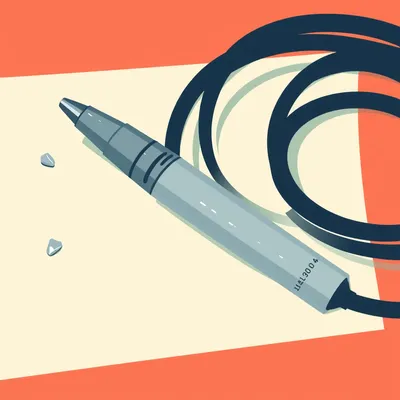
Daniel sent us this one — he's been marking his camera and sound cables with a silver Edding paint pen, and the thing that caught my attention is why. He says it's a domestic peace treaty. Silver on the underside of electronics. Doesn't trigger aesthetic objections from the household. But the real question underneath that is: are metallic paint pens actually an industrial marking tool, or are we just talking about a craft supply that happens to look nice on a black cable?

The answer, which I genuinely did not expect when I started digging into this, is that electricians and stagehands and industrial maintenance crews have been quietly using silver paint markers for years while the rest of us were fussing with white ones that fail. The silver Edding specifically — the seven fifty-one — shows up on forums where people are marking stainless steel in commercial kitchens, labeling breaker boxes, tagging cables backstage. This isn't a craft product that accidentally works. It's an industrial product that happens to look good.
Why does a silver pen solve a problem that white pens can't touch? Let's start with what's actually inside that little metal barrel.
The metallic glossy markers — and I'm going to focus on the Edding series since that's what was asked about, the seven fifty silver, seven fifty gold, seven fifty-two copper — these are oil-based paint markers. That's the first thing to understand. They're not alcohol markers, they're not water-based. The solvent system is xylene and toluene, which is aggressive stuff. And the binder is a ketone resin. But the pigment is where things get interesting.
Walk me through the silver first. What's making that mirror finish?
Tiny little platelets of aluminum, ten to fifty microns across. They're suspended in that xylene-toluene solvent, and when you apply the ink, something called the leafing mechanism takes over. The aluminum flakes float to the surface as the solvent evaporates, and they orient themselves parallel to the surface — like a thousand tiny mirrors all aligning flat. That's what creates the metallic sheen. It's not just shiny because it's silver-colored. It's shiny because the pigment particles are physically arranged to reflect light in a coherent way.
So they rise to the top like cream in milk.
And it's not just cosmetic. When those aluminum flakes form a continuous layer at the surface, they also seal the binder underneath. You get a protective metallic skin on top of the resin. White pigment — titanium dioxide — doesn't do this. Titanium dioxide particles stay dispersed throughout the binder. They don't float, they don't align, and they definitely don't form a protective cap.
This is where the durability difference comes from. It's structural, not just chemical.
It's both, actually. Let's talk about titanium dioxide first, because this is the key insight. Titanium dioxide has a bandgap of three point two electron volts. What that means in practical terms is that UV light — sunlight — excites it. When a UV photon hits a titanium dioxide particle, it kicks an electron into the conduction band and creates what's called an electron-hole pair. That hole is incredibly reactive. It'll rip electrons from anything nearby — including the organic binder that's supposed to be holding your white mark onto the surface.
The white pigment is eating its own binder.
It's a photocatalyst. The same property that makes titanium dioxide great for self-cleaning windows and air purification is what makes it terrible for outdoor paint durability. The pigment literally catalyzes the degradation of the resin around it. That's why white paint markers chalk and fade and flake off after a few months outside. The pigment is destroying the mark from the inside.
Of course it is. The thing that makes it white is also the thing that makes it self-destruct. That's almost poetic.
It really is. And aluminum flakes don't do this. They're reflective, not photocatalytic. Instead of absorbing UV and turning it into chemical destruction, they bounce it back. They act as a UV barrier. Plus, because they leaf to the surface, they form that protective cap I mentioned. You're getting two mechanisms at once: the aluminum isn't destroying the binder, and it's physically shielding the binder from UV exposure.
The silver pen isn't just a white pen with a different color. It's a fundamentally different failure mode — or rather, a fundamentally different success mode.
And this explains what the prompt describes. Silver on camera cables, holding up. White on the same surface, failing. It's not that the silver is stronger in some generic sense. It's that the white is actively working against itself.
What about the gold and copper? Are they aluminum flakes with different coatings, or is it a different metal entirely?
Different metal entirely. Gold metallic pigment is typically a copper-zinc alloy — about eighty-five percent copper, fifteen percent zinc. It's sometimes called bronze powder in the industry. Copper pigment is just copper. And here's where the durability story takes a turn, because copper oxidizes.
The gold pen goes green.
In humid conditions, that copper-zinc alloy will develop a patina within six to twelve months. It's the same chemistry as a bronze statue turning green in a park, just accelerated because the particles are so fine — high surface area means faster reaction with oxygen and moisture. The gold look fades to a dull greenish-brown. The copper pen does the same thing but faster and more dramatically.
Which is why electricians reach for silver.
Silver is the workhorse. Aluminum is chemically stable. It forms a thin oxide layer almost instantly, but that oxide is transparent and self-limiting — it doesn't keep growing the way iron oxide does. So the silver mark stays silver. The reflectivity also has a practical benefit on hot surfaces. If you're marking near a heat sink or on a piece of equipment that runs warm, a silver mark reflects some of the infrared radiation rather than absorbing it. It's a tiny thermal management bonus.
The gold and copper are decorative, and the silver is the one you use when you need the mark to still be there next year.
That's the headline. Gold and copper have their place — if you're marking a guitar pedal and you want it to look good, or you're personalizing a tool that lives indoors, go for it. But if you're labeling breaker boxes in a humid basement or tagging cables that live in a gear bag, silver is the only metallic that makes sense.
Let's talk about what's actually in the Edding barrel. You mentioned xylene and toluene.
The seven fifty-one silver, seven fifty gold, and seven fifty-two copper all use a xylene-toluene solvent blend with a ketone resin binder. The technical data sheet for the seven fifty-one specifies tack-free drying in three to five minutes, with a full cure at twenty-four hours. The nib is a one to two millimeter round tip made of polyester fiber — and that material choice matters, because polyester resists swelling from the aggressive solvents. A nylon tip would soften and lose its shape in xylene.
The pigment loading? How much actual metal is in there?
Edding doesn't publish the exact pigment loading, but based on the opacity and the leafing behavior, it's substantial — probably in the range of fifteen to twenty percent by weight. That's enough to create a dense metallic film. The trade-off is that these pens need aggressive shaking before use. The aluminum flakes settle during storage. If you don't shake the pen for a solid thirty seconds — with the cap on — and then prime it on scrap paper until the ink flows consistently, you'll get a weak, translucent mark that's mostly solvent and resin with hardly any metal.
How much of the user's positive experience do you think comes down to that prep step? Shaking versus not shaking.
It's huge. I'd guess a significant fraction of negative reviews for metallic paint pens are from people who didn't shake them. You can hear the mixing ball rattling in there — it's a little steel ball, like in a spray paint can — and if you don't hear it moving freely, the pigment is caked at the bottom and you're basically writing with tinted varnish.
Like adopting a feral cat. You have to earn its cooperation.
actually a remarkably good comparison. The pen will work beautifully if you put in the effort upfront, and if you don't, it'll ignore you completely and make you look foolish.
Okay, so the chemistry explains the durability. But chemistry doesn't matter if you put the ink on the wrong surface or skip the prep. Let's talk about where these pens actually work and how to make them stick.
This is the part where most people fail, and it's not their fault — the pen says "permanent" on it, and people assume that means it'll stick to anything without effort. It won't. But the range of surfaces it does work on is impressive if you do the prep.
Give me the material compatibility matrix. What sticks, what doesn't?
The seven fifty-one works on steel, aluminum, brass, copper, glass, ceramics, and most plastics — ABS, polycarbonate, PVC, acrylic. It works on rubber, including the neoprene and EPDM jackets on professional audio cables. It works on powder-coated surfaces. What it does not work on, at all, is polypropylene, polyethylene, Teflon, and silicone. Those are low-surface-energy materials. The ink basically beads up and wipes off.
Your average Tupperware lid is a no-go, but a metal camera body is fine.
And there's a nuance here for painted metal. Xylene can soften some enamels. If you're marking on a painted surface, you need to test on a hidden area first. I've seen people ruin a beautiful paint job by going straight in with a xylene-based marker on an enamel finish that wasn't compatible.
What about the surface itself? You mentioned prep.
Surface prep is the difference between a mark that lasts three years and a mark that rubs off in three days. The single biggest factor is oil. Human skin oil is a remarkably effective release agent. If you handle a stainless steel tool, set it down, and then mark it without cleaning, you're basically applying ink on top of a microscopic oil slick.
The isopropyl alcohol step isn't optional.
It's not. Minimum seventy percent isopropyl, ideally ninety-nine percent. Wipe the surface, let it evaporate completely — which takes about ten seconds — and then mark. That alone can double the lifespan of the mark. For smooth surfaces like polished stainless steel or anodized aluminum, you want to go one step further: light abrasion. Four hundred grit sandpaper or a Scotch-Brite pad, just enough to knock the shine off. You're not trying to gouge the surface, you're creating micro-scratches that give the ink something to key into.
Mechanical adhesion versus chemical adhesion.
The xylene solvent does provide some chemical etching — it'll partially dissolve the surface of PVC or ABS, creating a bond at the molecular level. But on metal, you're relying mostly on mechanical adhesion, and a smooth polished surface has almost nothing for the resin to grip. A few seconds with a Scotch-Brite pad changes that completely.
On rubber cable jackets?
That's where the xylene really shines. PVC and neoprene cable jackets are partially soluble in xylene. When you apply the ink, the solvent slightly etches the surface, and the resin bonds into that etched layer. The aluminum flakes then leaf to the surface, creating a flexible metallic skin. Flexible is the key word here — the mark moves with the cable when you coil it. A brittle mark would crack and flake off after a few uses.
Which is probably why the silver pen specifically impressed on the sound cables. White paint markers tend to be more brittle because the titanium dioxide loading makes the resin film stiffer.
Titanium dioxide at high loadings increases the glass transition temperature of the resin — it makes it harder and more brittle. Aluminum flakes, because they're platelets that can slide past each other slightly, don't have the same stiffening effect. You get a more flexible film.
We've got a flexible, UV-resistant, self-sealing metallic mark. No wonder electricians like it. What can one realistically expect for durability? Give me numbers.
Let's break it down by stressor. Heat resistance: the Edding seven fifty-one is rated for two hundred degrees Celsius continuous. The industrial seven eighty series goes up to four hundred degrees Celsius intermittent. So on a piece of equipment that runs hot — a lighting fixture, an amplifier, a heat sink — the silver mark will survive temperatures that would boil water and then some. It won't survive direct flame or a soldering iron tip, but for normal hot-surface marking, it's solid.
Fully waterproof after the twenty-four hour cure. Not water-resistant — waterproof. You can submerge it. Commercial kitchen users report silver marks surviving daily dishwasher cycles at eighty degrees Celsius with alkaline detergents. After six months of that, the marks showed about thirty percent fading but remained legible. Gold marks, by contrast, failed completely in the same conditions due to copper corrosion.
The dishwasher is basically an accelerated aging test for the gold and copper.
It's a copper corrosion chamber that also happens to clean dishes. The alkaline detergent accelerates oxidation. Silver shrugs it off; gold turns green and disappears.
Two to three years of outdoor exposure before noticeable fading for silver. Gold and copper, six to twelve months. The silver fades gradually — it loses some reflectivity as the aluminum surface oxidizes, but the mark remains legible. The gold and copper don't just fade, they change color, and the contrast against the substrate drops to the point where the mark becomes hard to read.
This is the weakest point. A silver paint mark will survive moderate handling — being plugged and unplugged, being coiled and uncoiled, being wiped with a cloth. It will not survive heavy scuffing. If you're marking something that gets dragged across concrete or constantly rubbed against other metal objects, the mark will wear through. For high-wear applications, you can apply a clear overcoat — a UV-curable epoxy or even a clear nail polish — to protect the mark.
It's not permanent in the engraving sense. It's permanent in the "this will last several years of normal use and I can reapply it in thirty seconds" sense.
That's the right framing. Laser engraving is truly permanent and costs hundreds of dollars for equipment. Embossing requires a tool and a work surface. A silver paint pen costs about eight dollars and fits in your pocket. The sweet spot is temporary-to-semi-permanent identification on existing equipment. Inventory numbers, cable labels, tool marking. If the mark fades after three years, you spend thirty seconds reapplying it.
Which, for most people, is a perfectly reasonable trade-off. The thing I keep coming back to is the domestic angle. The prompt mentions "less domestic resistance" and "tactfully placed on the underside." There's something useful about a marking tool that doesn't make your gear look like it's been tagged for evidence.
The silver on black is handsome. It's the labeling equivalent of a well-designed logo — it looks intentional. White on black looks like a correction. Gold on black looks like you're trying too hard. Silver on black looks like industrial design.
The glockenspiel of corporate approachability.
Silver has this quality of being simultaneously functional and refined. It's the color of precision instruments. When you mark a black camera body or a black cable with silver, it reads as "this is professional equipment" rather than "someone wrote on this with a pen.
Build me a chair nobody notices they're sitting in.
The mark does its job without announcing itself. And that matters when your gear lives in shared spaces.
Let's talk about the electrician connection. I'd heard the same thing — that electricians prefer silver for panel labeling. Is that actually borne out?
It shows up consistently in trade forums and supply catalogs. Electricians are marking dark gray breaker panels, black cable sheathing, and stainless steel enclosures. White doesn't contrast well on stainless steel — it blends into the metallic surface. Silver on stainless steel actually has better contrast because the reflectivity is different. The silver mark catches light at a different angle than the brushed steel background.
It's not just about durability. It's also about legibility on metallic surfaces.
And there's a thermal angle too. Breaker panels and electrical enclosures can run warm. White marks on a warm, dark surface are subject to thermal cycling — expansion and contraction — which accelerates the titanium dioxide photocatalysis problem we talked about. Silver marks handle thermal cycling better because the aluminum flakes can accommodate some movement.
What about the tip size? A one to two millimeter round nib seems awfully specific for labeling cables.
It's actually perfect for the task. A cable label needs to be legible but small enough to fit on a cylindrical surface that might be five or eight millimeters in diameter. The one to two millimeter nib lets you write small enough to fit "CAM A" or "MIC 3" on an XLR cable without the letters wrapping around and becoming unreadable from any single angle.
The polyester fiber — you said it resists swelling. Does that mean the tip stays consistent over the life of the pen?
Yes, and that's a bigger deal than it sounds. With alcohol markers, the tip can dry out between uses and need re-priming. With these xylene-based paint markers, the tip stays wet and dimensionally stable as long as the cap is on properly. The failure mode isn't tip degradation, it's pigment settling. And that's solved by shaking.
The pen's weakness is user error, not design flaws.
Shake it properly, prime it on scrap paper until the flow is consistent, store it horizontally so the pigment doesn't settle into a hard cake at one end. Those three habits eliminate ninety percent of the complaints people have about metallic paint pens.
That's new.
If you store the pen vertically with the tip down, the aluminum flakes settle into the tip and can clog it. If you store it vertically with the tip up, the flakes settle at the back of the barrel and you have to shake even longer to re-suspend them. Horizontal storage keeps the pigment distributed along the length of the barrel and makes re-suspension faster.
That's the kind of detail that separates someone who uses these pens from someone who understands them.
It's the kind of thing that should be printed on the pen barrel and isn't.
Let's build the buyer's guide. Someone's listening, they've got a marking project, they want to know what to buy and how to use it. Give me the decision tree.
Start with the surface. If you're marking electronics, cables, tools, or metal equipment — anything where legibility and durability matter — buy the Edding seven fifty-one silver. That's the default recommendation. It costs about eight to ten dollars, it's widely available, and it'll handle ninety percent of what most people need.
If you're marking something that runs hot? Above two hundred degrees?
Step up to the Edding seven eighty industrial series. It's rated for four hundred degrees Celsius intermittent. It's harder to find — you'll probably need to order it online — and it costs more, but if you're marking engine components or industrial ovens or stage lighting fixtures, it's worth it. The seven eighty also has better chemical resistance, which matters if the marked surface gets cleaned with aggressive solvents.
For the decorative cases? The gold and copper?
Buy the seven fifty gold or seven fifty-two copper if the mark lives indoors and you care about how it looks. Guitar pedals, custom tools, gift items, art projects. Just know that the gold will tarnish in six to twelve months if there's any humidity. The copper will go even faster. You can slow this down with a clear coat — spray lacquer or UV-curable epoxy — but you're fighting entropy.
The gold and copper are basically high-maintenance pets.
Beautiful, charming, and absolutely going to disappoint you if you don't take care of them. Silver is the reliable one that never asks for anything.
Surface prep checklist. Walk me through it as if I'm about to mark a piece of gear right now.
Step one: clean with isopropyl alcohol. Ninety-nine percent if you have it, seventy percent if you don't. Wipe thoroughly, let it evaporate. Step two: assess the surface. If it's smooth metal — polished stainless, anodized aluminum — give it a light scuff with four hundred grit sandpaper or a Scotch-Brite pad. You're not trying to remove material, just create texture. Wipe away the dust. Step three: if it's a painted surface, test the marker on a hidden spot. Wait thirty seconds and see if the paint softens or wrinkles. If it does, stop — the xylene is incompatible. Step four: shake the pen for a solid thirty seconds with the cap on. You should hear the mixing ball. If you don't, shake harder. Step five: prime the pen on scrap paper until the ink flows consistently — you'll see the metallic sheen appear. Step six: apply in thin, even strokes. Multiple thin layers cure better than one thick blob. Step seven: let it cure. Tack-free in five minutes, full cure in twenty-four hours. Don't handle the marked item during that cure window.
If you're marking a cable?
Same process, but skip the sanding. The xylene will etch the jacket enough on its own. Write on a straight section of the cable, not on a bend, so the mark doesn't distort when the cable flexes. And let it cure fully before coiling.
You mentioned numbers earlier, but summarize it.
Indoor marking on metal: three to five years. Outdoor marking: one to two years for silver, six to twelve months for gold and copper. Cables that get handled regularly: two to three years before the mark starts to show wear. The mark doesn't fail catastrophically — it fades gradually, so you'll have plenty of warning. Reapply when contrast drops below what you need for quick identification.
The reapplication process?
Clean the old mark with alcohol — it won't remove it completely, but it'll remove surface oils and loose pigment — and apply a fresh mark right over the top. The new ink bonds to the old resin. It takes thirty seconds.
The maintenance cost is essentially zero. The pen lives in a drawer, you grab it once every few years, you're done.
That's the beauty of it. For eight dollars and some basic prep, you get a marking system that covers almost everything a normal person needs to label. It's not the right tool for marking surgical instruments that go through an autoclave, and it's not the right tool for labeling polyethylene storage bins. But for the vast middle ground of metal, plastic, and rubber gear that most of us own, it's close to ideal.
What's the biggest misconception you ran into while researching this?
That gold and copper are as durable as silver. They're not. The packaging doesn't distinguish them — they're all sold as "metallic paint markers" with the same durability claims. But the chemistry is completely different. Aluminum doesn't, not in a way that matters. If you buy the gold pen expecting the same performance as the silver, you'll be disappointed within a year.
The second biggest?
That you don't need surface prep on metal. People assume "permanent marker" means "sticks to anything." But metal is smooth and often oily. Without cleaning and light abrasion, the mark is sitting on top of contaminants, not bonded to the surface. The isopropyl alcohol wipe is not optional. It's the foundation everything else depends on.
We've covered the chemistry, the surface prep, the durability expectations, the buyer's guide. What's the open question? Where does this technology go next?
The thing I'm watching is hybrid metallic-ceramic coatings in a pen form factor. Think Cerakote — the ceramic firearm coating — but in a marker. Cerakote is incredibly durable, heat-resistant, and chemical-resistant, but it requires spray application and oven curing. If someone can formulate a room-temperature-cure ceramic-metallic hybrid that flows through a pen nib, that bridges the gap between paint markers and industrial durability.
You think that's coming?
I'd expect UV-curable metallic pens in the next two to three years. UV-curable ink is already widely used in printing — it's instant-drying, solvent-free, and extremely durable. Putting metallic pigments into a UV-curable formulation for a pen is an engineering challenge — the pigment loading has to be high enough for opacity, but the flakes can't block the UV light that cures the resin. Someone will solve it.
As electronics get smaller and darker — black anodized aluminum, carbon fiber, matte black everything — high-contrast metallic marking becomes more valuable, not less.
The trend in consumer and professional electronics is toward darker, more monolithic designs. Black camera bodies, black audio interfaces, black cable sheathing. White marks look harsh and cheap on those surfaces. Silver looks like it belongs. The aesthetic and the functional are converging.
The silver paint pen is simultaneously a niche industrial tool and a quietly perfect consumer product that most people don't know exists.
Which is kind of the best kind of product. It doesn't advertise itself. It just works, for years, and the people who know about it keep buying it.
Now: Hilbert's daily fun fact.

In the nineteen forties, researchers studying cuttlefish camouflage discovered that the chromatophore organs in their skin contain granules of a pigment called ommochrome, chemically similar to the compound that gives human hair its color, suspended in a protein matrix that can shift the granules' distribution in under a second — making cuttlefish the fastest color-changers in the animal kingdom.
Cuttlefish are basically running a metallic paint pen inside their own skin.
With better surface prep.
This has been My Weird Prompts. Our producer is Hilbert Flumingtop, and if you enjoyed this episode, rate us five stars wherever you listen — and send us your weirdest marking challenge. We'll find the right pen for it.
I'm Herman Poppleberry.
I'm Corn. We'll catch you next time.