The name on the breaker panel in your basement. The sticker on the UPS under the desk. The grey cabinet bolted to the wall in the back of a factory that nobody has opened in eleven years.

You've seen it a hundred times. You've never once read it.
Which is exactly what Daniel is poking at. He wrote in this week. He says Schneider Electric is one of the biggest names in industrial electrical equipment, and yet outside engineering and industry, it's barely known at all. He keeps running into the Schneider name on everything from pretty basic electrical components up to sophisticated industrial and power-management systems. And he's got two questions. First, what does Schneider Electric actually make, and where does its equipment fit into the electrical infrastructure around us. He wants a tour using real environments — a factory, a commercial building, a data center — showing what the different categories of equipment actually do. Second, why did this company get so enormous and so influential, how did it build that position, and what is it about a manufacturer that makes it so brutally difficult to displace once its equipment, its standards, and its ecosystem are embedded in the infrastructure.
That's the good version of the question. Not "tell me about Schneider." It's "I keep seeing this name and I can't place it."
Right. The paradox Daniel's pointing at is a company that is disproportionately important in the electrical and industrial world while being almost invisible to consumers.
Which is the whole thing. So let's start with the stuff you'd actually recognize, and then follow the wire upward.
Before we walk through the factory, the building, and the data center, let's get the scale of this thing straight. Schneider was founded in 1836.
Eighteen thirty-six. As Schneider and Company. Schneider-Creusot, named for the town.
By two brothers, Eugène and Adolphe Schneider. And it was not an electrical company.
Not remotely. Iron foundry, steel, heavy machinery, armaments. Le Creusot, in Burgundy. For most of its first century and a half, this is a French industrial heavyweight in the same category as Krupp. Steel and guns.
So the company that makes the breaker in your basement started out casting cannon barrels.
Cannon barrels, locomotive parts, armor plate. And then in the nineteen eighties and nineties it does something unusual. It divests the steel business. It divests shipbuilding. And it starts buying up the electrical industry, brand by brand, for four decades. Then in 1999 it renames itself Schneider Electric to make the pivot legible to the market.
That's the whole story in one move. A steel company that decided the future was electrons.
Bigger than that, honestly. Revenue for 2025 was forty point one five billion euros. Operating income six point six nine billion. Net income four point three five billion. About a hundred and seventy-seven thousand employees. Headquartered in Rueil-Malmaison, just outside Paris. Listed on Euronext Paris, a CAC 40 component, Euro Stoxx 50.
And their own description of what they do — this is their language — is "leading the convergence of electrification, automation, and digital intelligence into what we define as energy technology."
That word is doing work. Energy technology. They use it instead of "electrical equipment" because the equipment is only half of it now.
The other half being the software on top.
The software on top, and the sensor data underneath the software, and the systems that decide when to move power and where.
Now the thing that makes Schneider hard to hold in your head as a single company. It isn't one thing. It's a portfolio of acquired brands, each of which owns a slice of the electrical chain, and most of them kept their names.
Which is why you can walk into your own house and find two Schneider products that have never been introduced to each other. Square D panel in the basement. APC UPS under the home office desk. Same parent company.
And the homeowner has no idea. That's the invisibility Daniel's talking about, in its purest form.
Schneider organizes itself around six end-markets. Data centers, industries, buildings, homes, power and grid, and infrastructure. We're going to walk three of them concretely.
Okay. Let's start with the box in your basement and follow the wire upward.
Square D. Acquired 1991. And this is the one a North American listener has actually touched, even if they don't know it. The QO and Homeline load centers and circuit breakers. Millions of homes and small commercial buildings.
Define the load center, because I think people look at that grey box and don't know what they're looking at.
It's the metal box in the basement or the utility closet. The utility feed comes in and splits into branch circuits. Each branch gets a breaker that protects the wiring downstream. If you've ever flipped a switch in that box after a hair dryer tripped it, you've operated a Square D QO breaker, most likely.
QO specifically is the default in a huge share of US residential and light commercial work. Not just common. Default.
It's the thing a spec writer writes without thinking, because it's what they've always written, and it's what the supply house has on the shelf, and it's what the inspector expects.
And then the other consumer-adjacent brands. Clipsal in Australia, acquired 2004 — switches, sockets, wiring devices. Merten in Germany, 2006. PDL in New Zealand. These are the things that go on walls.
And APC, 2007, six point one billion dollars. That's the one most people know. The UPS brand from the office server room and the home office.
Luminous in India — inverters and power backup. Again, the kind of brand that's household-famous in one country and unknown everywhere else.
Now take all of that and scale it up. Because the reason Square D matters is not that the breaker is fancy. It's that it's the bottom rung of a ladder that goes all the way up to the utility feed.
Walk us up the ladder. Factory first.
Power comes in at medium voltage. That's the utility's delivery point. It lands in switchgear — Merlin Gerin, Schneider's own name on it.
And switchgear, I want to be careful here, because "switchgear" is one of those words that means nothing until you see it.
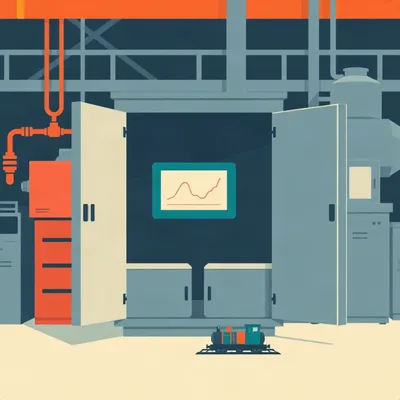
It's the big metal-clad cabinets. Lineup of them, usually against a wall in an electrical room. Inside are the breakers and disconnects that protect and route the main power. These are the devices that have to interrupt fault currents in the tens of thousands of amps without destroying themselves or the building.
These are the ones Herman was talking about on the show once — vacuum interrupters, or SF6 gas, extinguishing a twenty-thousand-amp arc.
Same principle, different scale in a factory versus a substation, but yes. And at the medium-voltage level the equipment's job is: take the utility feed, break it safely, and pass it downstream.
Then it steps down.
Transformers drop it to the utilisation voltage — four hundred eighty volts in a US plant, four hundred in Europe. Then it distributes through MasterPacT air circuit breakers and panelboards. MasterPacT is the big air circuit breaker family for main distribution. That's the device between the transformer and the whole plant's downstream loads.
So you've got a hierarchy now. Utility feed, medium-voltage switchgear, transformer, main breaker, panelboards, branch circuits. Every layer is a Schneider box if you're in a Schneider plant.
And then you get to the machinery. Modicon PLCs.
Say what a PLC is, because it's load-bearing for the rest of this.
Programmable logic controller. It's the industrial computer that runs the machine. It reads inputs from sensors — is the part in position, is the temperature in range, is the door closed — and drives outputs — start the motor, open the valve, fire the actuator. It's the thing in the control cabinet that a factory's whole operation hangs on.
And Modicon is historically significant how?
Modicon is one of the pioneers of the PLC category itself. The first programmable controller is a Modicon product — the thing was built in 1968 for General Motors, to replace relay logic in car plants. So when Schneider bought Modicon in 1997, it wasn't buying a product line. It was buying a chunk of the origin story of industrial automation.
Then the physical layer that actually moves things.
Telemecanique, acquired 1988. Contactors, motor starters, sensors, drives. Contactors are the heavy-duty relays that switch motor power. Motor starters are the combination of contactor plus overload protection that lets you start a motor without cooking it. Drives are variable-frequency drives — they let you run a motor at a speed other than fixed line speed, which is most of how a modern plant saves energy.
And the process side, for the plants that are making chemicals or food or pharmaceuticals rather than assembling parts.
Foxboro, which came in through the Invensys acquisition in 2014. Process control and emergency shutdown. That's the layer where the system isn't just running a machine, it's holding a reactor at a setpoint and shutting everything down safely if it drifts.
Then software ties it together.
AVEVA, and EcoStruxure. EcoStruxure is Schneider's own platform. It's how the energy data from the meters, the status from the breakers, and the runtime from the PLCs all get reported up into one place. So the plant manager can see, in one screen, what the plant is drawing and what it's producing.
And that's a factory. Now do a commercial building.
Different shape, same ladder. Square D or Merlin Gerin panelboards and breakers distribute the power. That's the electrical room on the ground floor or the basement. From there, Merten or Clipsal switches and sockets in the offices.
The wall hardware.
And then building automation — TAC, acquired 2003 — controlling HVAC and lighting. Because the biggest energy consumers in a commercial building are usually not the computers, they're the air conditioning and the lights. And EcoStruxure Building sits on top managing the energy.
So the building's nervous system. Sensors and controls across HVAC and lighting, reporting up into the same software stack that the factory uses.
Same platform, different vertical. That's a real part of why this company is so sticky. The building manager and the plant engineer are using the same underlying software.
Okay. Data center. And I want to go slow here, because this is where Daniel's question gets sharpest. Everything Schneider is doing right now is bending around this environment.
It is. Follow the power. Utility feed lands in switchgear, same as the factory. Then it goes to the UPS — and this is the APC layer. The UPS is the battery-backed power conditioning that keeps the racks alive during the gap between the grid dropping and the generator coming up. That gap is not instantaneous. It's seconds. And seconds are enough to crash everything.
Then how does the generator actually get online in that gap?
ASCO, acquired 2017. Automatic transfer switches. The ATS is the device that senses the grid is gone and switches the load from the utility feed to the generator feed. It's the physical changeover. In a data center, the ATS is one of the most consequential single components in the building. If it doesn't transfer, the generator is just a very expensive piece of parked machinery.
On the rack side, though, the UPS output isn't going straight to servers.
Right, it goes through PDUs and busway. Power distribution units, which are the rack-level distribution. Busway is the overhead or underfloor distribution system — instead of pulling individual cables everywhere, you run a busway down the row with tap-off boxes you can move as racks change. And then rack PDUs at the cabinet itself.
And now the part that's actually interesting. AI racks.
This is where Schneider's own white paper gets blunt about it. They published this in 2023, and the argument was that existing data centers aren't buff enough for AI. That's their framing, not mine.
What do they actually say is needed?
Two-forty, four-fifteen volt distribution. PDUs above sixty amps. Racks that average around two tons at forty-eight U. And liquid cooling above twenty kilowatts per rack.
Two tons. Per rack.
A rack is a cabinet of servers. Traditional enterprise racks run maybe five to ten kilowatts and weigh a few hundred kilos. AI racks can run fifty, a hundred kilowatts and weigh more than a car.
So the floor loading, the cooling, the power distribution — everything in the building changes.
And that's why Schneider bought Motivair in October 2024. About eight hundred fifty million dollars. Motivair does liquid cooling and advanced thermal management. And then in December 2024, they announced a partnership with Nvidia to co-design data center cooling systems for AI workloads.
So the actual AI infrastructure supply chain, not just a peripheral vendor.
Directly in it. And it's not just the cooling. It's the switchgear, the UPS, the busway, the transfer switches, the monitoring software. Every layer of a data center has a Schneider product in it, and the AI transition means every layer gets redesigned.
Which is both an opportunity and an exposure for them.
It's the most interesting moment in the company's modern history, honestly.
Close the loop for us on the software and grid side, so the tour is complete.
Here's roughly what else is in the portfolio. Areva T&D, 2010, with Alstom — transmission and distribution, grid automation, smart grid. That's the utility-side layer. AVEVA, majority in 2017, fully acquired January 2023 for about eleven billion dollars — industrial engineering and operations software for the whole plant. OSIsoft, 2020, the PI System, which is industrial time-series data; it's how plants store and query all of their process data. ETAP, 2020, electrical power systems simulation, so you can model your own electrical system before you change it. And then a cluster of smaller companies — AutoGrid, EnergySage, EV Connect, Zeigo — doing distributed energy, the solar marketplace, EV charging, and power purchase agreements.
That's the whole chain. Breaker in the basement. Switchgear in the factory. UPS in the data center. Software to run it all. And grid automation on top.
Utility substation down to the wall socket. That's the claim, and it's roughly true.
So that's what Schneider makes and where it sits. The harder question is why it's so hard to get rid of once it's there.
Which is the actual question Daniel's asking second. Why is this company so durable.
And I want to push on the framing before we get into mechanism. Because there's a version of this story that sounds like Schneider won on superior engineering. And I don't think that's the right story.
It isn't. On raw performance, Schneider is roughly at parity with ABB, Siemens, Eaton, and a handful of others. Big competent industrial companies that all make breakers and switchgear that meet the same UL listings and the same IEEE standards.
Then why isn't it a commodity? Buyers should just pick the cheapest option that meets spec, and this whole story falls apart.
That's the misconception to bust, and the answer is switching costs. But let's start with how the position was actually built, because the durability was purchased, not earned gradually.
Forty years of acquisition.
Telemecanique 1988. Square D 1991. Merlin Gerin 1992. Modicon 1997. APC 2007. Areva T&D 2010. Invensys with Foxboro 2014. ASCO 2017. AVEVA 2017 through 2023. OSIsoft 2020. ETAP 2020. Motivair 2024.
Read that list as a who's-who of electrical brands and then realize it's the same company.
That's the point. None of those brands were invented by Schneider. They all existed independently, and each of them was the incumbent in its own niche. The roll-up is the strategy.
So it's not a company that bet on one technology and won. It's a company that bought every position of strength in the electrical industry, one at a time, over four decades.
And then connected them. Which is the thing Siemens and ABB were also doing, but Schneider did it with more brands and a cleaner segmentation story.
Okay. Now the mechanism. Why is embedded electrical equipment so sticky.
Six factors, and they compound. Standards and code, installed base, software ecosystem, familiarity and training, risk aversion, and regulatory burden.
Start with code.
Breakers, panelboards, and switchgear are UL-listed and code-driven. A Square D QO panel accepts Square D QO breakers. You can't mix brands. Once a building is wired with a given panel family, every future circuit addition, every renovation, every repair buys that same brand.
Even the small parts.
Handle ties — the little metal bars that mechanically connect two breakers so they trip together — are brand-specific. Square D's handle tie for QO is a specific part number. You can't substitute.
So the panel itself is a lock-in, and every part downstream of it is another lock-in.
Then the installed base compounds. Every panel, breaker, and PLC that gets installed creates decades of aftermarket demand for replacements, spares, and expansions. The original panel sale is a one-time event. The aftermarket is a perpetual annuity, and the manufacturer owns it.
Razor and blades, but the blades last thirty years and cost more than the razor.
Roughly. And every new circuit addition is a new blade.
Software ecosystem is the third one, and I think this is the biggest recent shift.
It's the one that changed the shape of the moat. Modern Schneider gear is tied together by EcoStruxure, AVEVA, and the data center software — DCIM for infrastructure management, EPMS for electrical power management. Once a plant's automation, energy management, and data flows all run on Schneider software, switching vendors means re-engineering the whole stack, not swapping a box.
Because the software isn't a separate purchase. It's the layer that makes the equipment legible to the operator.
The equipment still works without the software. But nobody runs it without the software, because the software is what tells you what everything is doing.
Fourth — training and familiarity.
Electricians, integrators, and engineers are trained on specific platforms. A spec writer defaults to what they know and trust. That's a human-capital moat, not a technical one. It doesn't show up on a datasheet, and it's more durable than any patent.
If every electrician in a metro area has been pulling Square D QO their whole career, then a competitor's superior breaker is interesting but irrelevant.
The switching cost isn't just the part. It's the years of muscle memory in the workforce.
Fifth. Risk aversion.
In critical infrastructure — data centers, hospitals, grids — downtime is catastrophic. Buyers overwhelmingly choose the proven incumbent over the unproven cheaper alternative. And the asymmetry is enormous. Saving ten percent on a breaker is nothing compared to one hour of downtime.
Ten percent of a breaker is a rounding error against a production stoppage.
On a data center outage, one hour can be more than the whole annual breaker budget. So the decision isn't "which is cheaper." It's "which one am I confident works."
And the sixth. Regulatory and safety burden.
Arc-flash assessments, load analyses, code compliance. All of these make substitution slow and expensive, because any change means re-documenting and re-certifying. And Schneider's own white paper on data centers emphasises arc-flash risk at higher voltages — which is not just a technical point. It's a reason buyers stay with the vendor whose documentation and training they already have, because the paperwork already exists.
So the moat isn't one wall. It's six walls. And they're all pointing inward.
They reinforce each other. Code lock-in makes the installed base sticky. The installed base makes the aftermarket sticky. The software ties them together. The trained workforce defaults to the incumbent. The risk-averse buyer won't switch. And the regulatory burden means switching is a project, not a purchase.
That's what makes "picking the cheapest breaker" not a real option. Even in a category you'd think was a commodity.
And on top of all of that, Schneider is riding three of the biggest capital-spending trends of this decade.
Electrification, AI buildout, decarbonisation.
Electrification in the sense of everything moving to electricity — vehicles, heating, industrial processes. AI buildout in the sense of data centers and their power and cooling demands. Decarbonisation in the sense of grid modernization and renewable integration. All three of those mean more of exactly the equipment Schneider sells.
And they're not standing still on the positioning side either.
They announced more than seven hundred million dollars of US investment through 2027. Their largest-ever US capital expenditure program, aimed squarely at serving energy and AI demand. And on the sustainability side, they were named number one on Corporate Knights' 2025 Global 100 index of the world's most sustainable companies.
That ranking is worth noting more for what it signals than for what it is. A century-and-a-half-old industrial company positioning itself as a sustainability leader is a very deliberate repositioning.
It sets them up for every ESG-driven procurement process that's now standard in a lot of commercial and public sector work.
And it's not a static story. There's governance drama too.
There is. Peter Herweck was removed as CEO after eighteen months in November 2024. Olivier Blum took over. Jean-Pascal Tricoire, the long-serving former CEO, is chairman. Abrupt CEO change at a company this size, with this kind of embedded position, is a real signal that the board wanted a different direction.
So the company is enormously durable, but the leadership layer moved fast. That's worth keeping in mind when you hear "embedded incumbent" as a description.
Embedded doesn't mean frozen.
That's the picture. Now hold on. I want to test one thing before we move on.
Everything we just said — code, installed base, software, training, risk aversion, regulation — is real. But I want to know what it feels like in the hands. Because Daniel's second question, at its core, is about what makes something hard to displace. And I don't think any of us has really said what it feels like when you actually try.
Hilbert: You're right, and it's the label inside the door.
The label inside the door.
Hilbert: Inside the load center door. There's a tiny printed label that lists exactly which breaker types are approved for that panel. Most people never read it, because the door is closed and the panel's covered. But that label is the thing.
So the spec is physically posted in the enclosure.
Hilbert: It's a piece of paper, but it's backed by the metal. Because the busbar stabs are a specific shape. Square D QO breakers have a particular geometry on the back that seats onto the busbar. A different brand's breaker won't seat. I watched someone try once. Young guy, first plant job, grabbed a breaker off the shelf that didn't match, comes back, tries to push it onto the busbar. Won't go. He pushes harder. Won't go. He checks the box. Wrong brand. Wrong panel family.
The metal refused.
Hilbert: It's not a legal problem. It's not a code problem. The code adds a layer on top. But the physical layer is where it starts. You cannot put a competitor's breaker in that panel, because the panel was built to accept one shape and the breaker was built to fit one shape.
The lock-in isn't just paperwork.
Hilbert: It's a stamped piece of copper. It's the shape of the busbar. It's a manufacturing decision made decades ago that shows up every time somebody tries to make a substitution, and there's nothing they can do about it short of ripping the panel out and starting over. Which is, obviously, not what anyone's going to do because a circuit needs a new breaker.
I want to be blunt about the handle ties too. Because those are the small ones and I think people dismiss them.
Hilbert: Handle ties are brand-specific. Square D QO handle tie for QO breakers. You need two breakers to trip together, and you need the manufacturer's tie, or it doesn't fit, or it fits but doesn't do the job. And the code requires the tie, and the panel door label requires the brand. So you've got the physical constraint and the code constraint agreeing with each other. That's the whole moat, in a stamped piece of copper and a printed label.
The moat isn't in the contracts.
Hilbert: It's engineered into the metal.
That's the thing. The lock-in is stamped into the metal. Which raises the question of what happens when the metal itself has to change.
There's a version of that already live. Data centers are moving from AC to DC power. An IEEE Spectrum piece in March of 2026 laid it out. The racks themselves don't care much — they take DC. But the distribution and protection equipment has been designed around AC for a century. If the underlying power architecture actually shifts, the breaker and switchgear requirements shift with it.
Which is exactly the moment when an embedded incumbent is most exposed and most motivated.
Both. Because they've got the engineering bench to lead a transition, and they've got the installed base to defend. But you can't defend a busbar shape against a change in what the busbar is carrying.
Which is the real question Daniel's second prompt leaves you with. Not "is the moat deep." It's "is the moat built out of something that can survive a change in the physics underneath it."
Sustainability reputation, acquisition machine, embedded standards, trained workforce — all of that. And then the actual power architecture of the building changes, and the moat becomes a liability as much as an asset.
The one thing from all of this. If you take one thing from this episode, it's that Schneider's position isn't about being a better breaker. It's about being the only breaker that fits in a specific slot that somebody already bolted into a wall.
That slot has a paperwork trail, a label inside the door, a trained workforce behind it, and a software stack reporting from it. Which is a lot harder to displace than a product.
That's the point. One more thought before we close.
Go ahead.
All of this is real. The lock-in is real, the standard is real, the moat is real. But the moat is built out of metal and code, and both of those can change. Data centers going DC is one example. If a breaker family's shape stops being what the industry wants, if the switchgear requirements move, then the twenty years of muscle memory and installed base and software integration becomes a drag rather than a defence. That's the open question for anybody watching this company for the next ten years.
An embedded incumbent's biggest asset and its biggest problem are the same thing.
Which is why we like this one. The structure is the story.
Thanks to Hilbert Flumingtop, our producer.
This has been My Weird Prompts. If you liked this one — head to my weird prompts dot com, that's where the archive lives, and the RSS feed is right there if you want to subscribe. Or email us at show at my weird prompts dot com.
We'll be back soon.
See you tomorrow.