Daniel's been watching those YouTube videos again — the ones where someone's hanging off a broadcast mast at six hundred feet changing a strobe light. He wants to know who actually does this work, and what they know beyond just not being afraid of heights. He's asking about three groups: the people who maintain high-voltage transmission lines, the ones who service radio and cell antennas on towers and rooftops, and the people who test lightning conductors on cathedrals and skyscrapers. The stuff you drive past and wonder who climbed up there.

And the answer to who climbed up there is almost always someone whose job title sounds like it was invented in a nineteenth-century guild hall. Steeplejack. That's a real title. There are people in England right now who call themselves steeplejacks and climb Lincoln Cathedral to test lightning rods.
Steeplejack sounds like a Dickens villain.
The BBC ran a piece on this literally today. There's a pair of them — Mateusz Pierwola and Neil Fillery — who work for a company called Dawson Steeplejacks. They climb three hundred thirty-eight steps to get to the tower level, then rope-access up the four central pinnacles at two hundred seventy-one feet. The lightning protection system at Lincoln Cathedral gets a full inspection once every ten years. Ten years. Lower levels get checked annually, but the actual air terminals up top, the pointy bits that do the job, a human being touches those once a decade.
So the most weather-exposed, most critical part of the system is the least frequently inspected. That makes sense in the way that nothing does. What are they even testing?
Ground resistance. The whole point of a lightning conductor is to give the current a path to earth that doesn't go through the building. The historic benchmark is ten ohms — if the resistance between the air terminal and the ground is above that, the system isn't doing its job properly. That standard goes back to the early nineteen hundreds and it's still the number. They're up there with a testing rig measuring whether a copper rod installed decades ago still has a clean path down.
And the engineer in that BBC piece said something that stuck with me. He called it a weird job because you're up that high on a Monday morning while most people are in an office. Then he said it's a thrill. The steeplejack said when he started he felt shaky, and now it feels like walking on the floor. The height stopped being the point.
That's the thing Daniel's actually asking about. He assumed these people aren't afraid of heights, and he's right that that's the entry ticket. But every single one of them says the fear fades and the real skill is something else entirely. The steeplejack said the danger isn't the height — it's forgetting something from the van. Because if you forget a tool or a fitting, you're not popping down to grab it. You're doing the whole descent, the walk across the cathedral grounds, the drive to wherever you parked, and then the whole climb again. The height is just the stage. The skill is logistics and rigging judgment.
So let's start with the most extreme version of this, because Daniel mentioned transmission lines first. There's a subset of linemen who work from helicopters. Not just inspecting from the air — actually getting dropped onto the tower tops, or dangling from a line while doing maintenance.
Salt River Project in Arizona has fifteen linemen who specialize in this. Their five hundred kilovolt barehand crew can inspect sixty to eighty towers a day. Each lineman climbs six to ten towers daily. That's not a maintenance call — that's a workday.
Wait, six to ten towers in a day? I get tired climbing six to ten stairs.
And that's the inspection pace. The training path is five to seven years. Four-year lineman apprenticeship, then journeyman work, then Human External Cargo training, which is the certification for being moved by helicopter. WAPA — Western Area Power Administration — requires a sixty-four-hour HEC course. Then two weeks of annual retraining, hoisting at twenty-five, fifty, and a hundred feet, practicing landings on a mock tower before touching real structures.
That's you. You're the cargo.
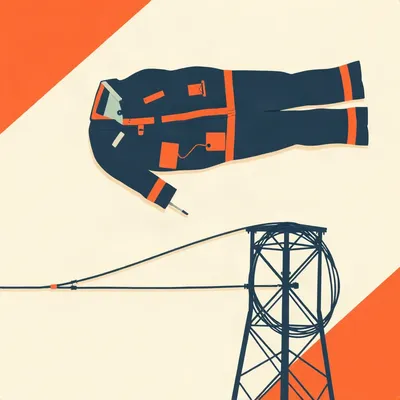
And the most counterintuitive part is the barehanding itself. On a live five hundred kilovolt line, the lineman bonds directly to the conductor. Current passes through him. That's the point. He's at the same potential as the line, so there's no path to ground and no shock. PG&E just brought barehanding back this summer after retraining their crews for three weeks in May and June. IBEW Local 1245 covered it. The lineman wears a conductive suit and the helicopter places him right onto the energized line.
So the safety system is to make sure the electricity has no reason to go anywhere. You're not insulated from it, you're joined to it. That's like saying the safest way to cross a river is to be the river.
And the lineman who does this work — David Katich at WAPA — says the biggest challenge is maintaining situational awareness and anticipating events before they happen. Tunnel vision is the killer. His mantra is "slow is fast." Which sounds like something our dad would have embroidered on a cushion.
Our dad didn't embroider. He claimed sloths invented embroidery.
Did he.
He claimed sloths invented most things. It was a whole thing. But the point about situational awareness tracks with what I've seen from the tower climbing side. The danger isn't the fall, it's losing track of what's around you. A guy named Matt Davis at SRP said some of these structures are on mountaintops next to canyons, and he can't figure out how they were built in the first place. He climbs them for a living and he's still impressed by the construction.
The construction is a whole separate episode. But let's talk about telecom tower climbers, because that's the group Daniel sees in those YouTube videos. These are the people who install and maintain antennas, radios, and fiber on towers that run from a hundred to six hundred feet. One job listing specifies climbing up to five hundred feet. The certifications read like a safety manual: OSHA ten and thirty, RF awareness, tower rescue, climbing safety, CPR and first aid.
RF awareness. That's the part most people don't think about. You're climbing past antennas that are actively transmitting. At certain frequencies and power levels, you can get radio frequency burns. It's not just about not falling.
And the workforce is tiny. Roughly ten thousand tower climbers in the entire United States. About eight hundred subcontracting firms, many of them small and short-lived. This is a heavily subcontracted industry — the carriers don't employ the climbers directly. They hire a contractor, who hires a subcontractor, who hires a crew.
And that daisy chain is where the safety problems live. ProPublica and PBS Frontline did a big investigation on this. Tower climbing ranked among the most dangerous jobs in America — death rate more than ten times construction. Nearly a hundred climbers killed since two thousand three, about half of them on cell sites.
The fine data is the part that makes me angry. The median OSHA fine for a safety violation linked to a fatal tower accident over nine years was three thousand seven hundred fifty dollars. That's the median. Half the fines were lower than that. For a death.
Three thousand seven hundred fifty dollars. That's less than the cost of the harness the guy should have been wearing.
And the accountability gap is structural. OSHA can only cite employers whose employees are at the work site. The carriers at the top of the chain set the deadlines and the pay rates, but the climber on the tower is employed by some small subcontractor. OSHA's deputy administrator at the time, Jordan Barab, said it plainly — as you go up the line, it becomes much more difficult to hold the companies at the top responsible. A former Kentucky OSHA investigator said the easiest way to avoid a citation is to not go to the job site.
So the business model is designed so that the people who profit from the tower never legally employ the person who climbs it. And when that person dies, the fine is a rounding error. That's not a safety culture problem, that's a liability architecture.
And free climbing — working without fall protection — was described as pervasive. There was a case in two thousand six, a climber named Michael Sulfridge fell. Investigators found lanyards in the back of the supervisor's truck. Some of them still in the packaging, never opened.
The safety equipment existed. It was in the truck. The guy was on the tower without it.
And that's the part that doesn't fit the YouTube narrative. The videos make it look heroic and skilled, which it is. But the industry has a documented, sometimes deadly, labor problem. The danger has been formalized, not eliminated. People still die — there was a foreman killed in Minnesota in July, struck by a transmission line while removing it from a three hundred foot tower. That was the industry's first fatality of the year, ending what had been its safest year on record. Which tells you how bad the baseline is.
First fatality of the year is the safest year on record. That's a sentence that should make everyone stop.
And there was a technician in India who was reportedly tied to a tower by angry villagers over poor fiveG service. Which is a different kind of labor relations problem entirely.
I have so many questions about that. Did they tie him to the tower because they wanted him to fix the service, or because they were angry about the service? Those are opposite incentives.
The report didn't specify. But it does suggest the job has hazards that don't appear in any safety manual.
Alright, so we've got three groups. The helicopter linemen doing barehand work on live five hundred kilovolt lines. The telecom climbers on a hundred to six hundred foot towers with a subcontracting problem and a median fine of three thousand seven hundred fifty dollars after a death. And the steeplejacks testing lightning rods on cathedrals once a decade. What ties them together?
The fear of heights thing is a myth in exactly the way Daniel suspected. Every one of these people says the height stops being the issue. The steeplejack at Lincoln said it feels like walking on the floor now. The real skills are rigging judgment, weather reading, situational awareness, and crew trust. You're trusting the person who packed the gear, the person who checked the rope, the person flying the helicopter.
And the weather reading is bigger than people think. You're not just checking if it's raining. You're watching wind speed at altitude, which is completely different from wind at ground level. You're thinking about thermal expansion on metal structures. You're thinking about whether the helicopter can hold position. Lightning is a real concern when you're the tallest conductive object for miles.
The historical version of this was even more stark. There's a documentary that came out this spring about the lightning rod men who climbed New York skyscrapers during storms in the early nineteen hundreds. They used bosun's chairs, manila rope, and block and tackle. Often no harnesses. There's a bosun's chair from nineteen ten stamped with a lightning rod contractor's name sitting in the New York City Municipal Building Museum.
They climbed during storms. The lightning rod men climbed during storms. To install or repair lightning rods. While lightning was happening.
That was the job. And it made sense in a grim way — if the rod was damaged, you needed to fix it before the next storm, and sometimes the next storm was already there. New York's building permits required a metallic conductor on any structure over a hundred twenty feet starting in eighteen eighty-seven. Chicago echoed it in eighteen ninety-four. By eighteen ninety-six, the Underwriters Circular said no rod, no insurance coverage for buildings above three stories. Lightning was the third leading cause of fire loss in the country in the eighteen nineties.
So there was enormous demand for this work, and the only way to do it was to go up in conditions that would get you fired today. The modern version is safer, but the underlying logic hasn't changed. Something at the top breaks, someone has to go look at it.
The inspection intervals are still surprisingly long. Lincoln Cathedral's full lightning check is once a decade. The annual visual inspection and comprehensive testing every three years is the code standard — IEC six two three oh five, NFPA seven eighty, LPI one seventy-five. But the actual human touching the air terminals at the top of a cathedral? Ten years.
It's because the systems are passive. A lightning rod is just a piece of copper pointing at the sky. There's nothing to break unless something physically damages it. The ten ohm ground resistance test is checking that the path to earth hasn't degraded. If nothing's changed, the number doesn't move.
That's why the maintenance feels invisible. These systems work by doing nothing most of the time. The people who maintain them are invisible too. Ten thousand tower climbers in the whole country. Fifteen aerial linemen at SRP. A handful of steeplejacks in England who can rope-access a cathedral pinnacle. It's a tiny workforce doing work that never shows up in anyone's daily life until the cell service drops or the power goes out.
The FCC chairman climbed a two thousand foot broadcast tower in North Carolina in April to spotlight these crews. That's a thousand feet higher than most of the towers we've been talking about.
Two thousand feet. The tallest broadcast towers in the country are around two thousand feet. And the chairman went up one. I don't know the details of that climb beyond the headline, but the fact that a regulator felt the need to physically go up there to draw attention to the workforce tells you how invisible these people are.
I keep thinking about the steeplejack's line about forgetting something from the van. That's the real job. The climb is the commute. The work is remembering every fitting, every tool, every carabiner, every meter of rope, because the cost of forgetting is measured in hours of descent and re-ascent. The height is just the reason the commute is annoying.
The rigging judgment is where experience shows. Knowing which anchor points are load-bearing, how to distribute weight, what a compromised bolt looks like. On a tower that's been up for forty years, the structure itself is part of the hazard. Rust, fatigue, previous repairs done badly. You're not just climbing a thing, you're evaluating it as you go.
The answer to Daniel's question is that the skills beyond not being afraid of heights are mostly unglamorous. Logistics, weather judgment, equipment knowledge, crew trust, and a very specific kind of patience. The heroism is real but it's not the point. The point is doing the climb correctly fifteen times in a row so that the sixteenth time, when something goes wrong, you have enough margin to catch it.
The industry is still figuring out how to make that margin real. The barehand crews at PG&E just got retrained after years of not doing the work. The tower climbing industry still has a subcontracting problem that shields carriers from accountability. The steeplejacks are the ones who seem to have it most figured out, and even they're working with a ten-year inspection gap.
Let's talk about the barehanding for a second, because I want to make sure I understand the physics. The lineman is in a conductive suit. The helicopter moves him into contact with a live five hundred kilovolt line. The moment he touches it, his body is at the same potential as the line. Current flows through him, but because there's no path to ground, there's no shock. Is that right?
That's right. The danger is the transition — the moment before he's bonded, when there's a potential difference between him and the line. If there's any gap, you get an arc. So the approach has to be careful and the bonding has to be complete. The suit is conductive precisely so there's no point on his body that's at a different potential. It's counterintuitive because we're taught that electricity and humans don't mix. But the rule isn't that electricity is dangerous, it's that current flowing through you to ground is dangerous. Remove the path to ground and you're just a conductor.
Like a bird on a wire, except the bird is wearing a conductive suit and got there by helicopter.
A bird with a five-to-seven-year training path and a sixty-four-hour HEC certification. And the bird inspects sixty to eighty towers a day.
I want to go back to the subcontracting thing for a minute, because I think that's the part of this that most people don't know. The tower climber who dies on a cell site is not an employee of the carrier whose name is on the tower. He's employed by a subcontractor who was hired by another subcontractor who was hired by a contractor who has a contract with the carrier. The carrier sets the deadline — we need this antenna up by Friday — and the pressure flows down the chain. The guy at the bottom feels the deadline pressure but has no relationship with the company that created it.
When he falls, OSHA investigates the employer at the site. That's the small subcontractor. The fine is three thousand seven hundred fifty dollars. The carrier issues a statement about their commitment to safety. The next subcontractor gets hired. The deadline pressure doesn't change.
The former Kentucky OSHA investigator said the easiest way to avoid a citation is to not go to the job site. Which is a sentence that should be written on the wall of every safety regulator's office.
The ProPublica investigation is from two thousand twelve, but the structure hasn't changed. The Wireless Estimator fatality tracker is still the best source, and it's still recording deaths. The Minnesota foreman in July was the first of this year, but the year before had a death in Atlantic City when a gin pole failed while lowering an abandoned FM pylon from a three hundred forty-seven foot tower.
A gin pole. That's a temporary crane you rig to the tower itself to lift or lower heavy components. When it fails, it fails catastrophically. The pylon is coming down and the rig that was supposed to control the descent is the thing that breaks.
That's a rigging judgment failure. Someone miscalculated the load, or the anchor point wasn't sound, or the weather shifted. The fall protection doesn't help you when the structure you're attached to is the thing that's failing.
The safety systems are necessary but not sufficient. The harness catches you if you slip. It doesn't catch you if the tower collapses, if the gin pole drops, if the helicopter loses position, if the arc flashes. The real safety system is the judgment of the crew.
That's why the training is so long. The five-to-seven-year path to helicopter lineman isn't gatekeeping. It's the time it takes to see enough situations that your judgment is worth something. You can't learn rigging judgment from a manual. You learn it by doing it wrong in situations where doing it wrong doesn't kill you, and then not doing it wrong again.
The steeplejack said the same thing in different words. When he started, he felt shaky. As the years went on, the height wasn't the problem. He got to know his equipment. The trust moved from his own nerves to his gear and his partner.
His partner is doing a different job. Neil Fillery is the lightning protection engineer. He's the one who knows what the test results mean, what the ten ohm reading tells him about the condition of the conductor. Pierwola is the access specialist — he gets them both up there safely. It's a two-person team where the skills don't overlap much but the trust has to be complete.
That's a good way to think about all of this work. It's always a team. Even the helicopter lineman isn't alone — there's a pilot, a ground crew, a spotter. The guy on the tower has a partner on the ground. The steeplejack has an engineer. The image of the lone climber against the sky is a YouTube artifact. The reality is a crew.
The crew is small. That's the thing that keeps coming back to me. Ten thousand tower climbers in the entire country. Fifteen aerial linemen at SRP. The whole workforce that keeps our cell service and power grid running from the top down would fit in a high school gymnasium.
With room for the steeplejacks.
The steeplejacks would be in the corner, telling everyone about the ten-year inspection gap.
What's the misconception here? If we had to name the one thing people get wrong about this work.
I think it's that the height is the hard part. Daniel's prompt even started from that assumption — these people must not be afraid of heights. But every single one of them says the height fades. The hard part is the judgment, the logistics, the weather, the trust. The height is just the reason the stakes are high.
The second thing people get wrong is that this is a heroic solo act. It's not. It's a crew, it's a system, it's a chain of responsibility that's supposed to protect the person at the top and sometimes doesn't. The heroism is real, but it's distributed.
Hilbert: I used to do this work. Well, not the helicopter part. I did tower work in the late two thousands. Cell sites mostly, some broadcast. The company was called Meridian Tower Services. We had a contract with one of the big carriers — I won't say which — and we were the second sub. The first sub had the contract, we had the work. The guy who owned the first sub never came to a site. Not once in the two years I was there. He had a truck with the company logo and he'd drive it to meetings at the carrier's office. That was his whole job.
That's the daisy chain in one sentence.
Hilbert: The reason we free climbed wasn't that we didn't have harnesses. We had them. They were in the truck. The reason was time. The carrier wanted the antenna swap done by Friday because there was a service deadline. The first sub told us we had four days. Four days for a job that should take six. So you climb faster without the lanyard. You don't clip and unclip at every transition. You just go. I did it. Everyone did it.
The harness was in the truck, in the packaging.
Hilbert: Sometimes. Sometimes it was on the tower but not on me. The rule was you had to have it on site. Nobody checked whether you were wearing it. The site supervisor was the same guy who told us we had four days. He wasn't going to write himself up.
The median fine after a death was three thousand seven hundred fifty dollars. That's less than the company probably spent on fuel that month.
Hilbert: We had a guy fall in two thousand eight. Not on my crew — a crew in the next county. He was on a two hundred foot monopole, doing a light swap. The strobe at the top. He climbed without a harness, got to the top, and the wind caught him. He went over. The company paid the fine. I think it was four thousand dollars. The carrier issued a statement. We all kept working.
Did anything change on your crew after that?
Hilbert: For about two weeks we wore the harnesses. Then the next deadline came and we stopped. The deadline was always the thing. The carrier needed the site live by a certain date because they'd sold service in that area. The first sub had promised the carrier. We were the ones who had to make it true. The harness was the thing that made us slower.
That's the pressure flowing down the chain in the most concrete way possible. The carrier's marketing promise becomes a deadline becomes a four-day job becomes a guy free climbing a monopole because clipping the lanyard takes too long.
Hilbert: The thing that finally got me out was a lightning job. We were doing maintenance on a broadcast tower in Oklahoma, and they hired a steeplejack crew to do the lightning system. Two guys from England. They showed up with their own rope, their own gear, their own rigging plan. They refused to start until they'd done a full inspection of the tower. Took them half a day. The company guy was furious. They didn't care. They said the tower was theirs once they were on it, and they'd decide when it was safe. I'd never seen anyone talk to the company guy like that. I quit about a month later.
The steeplejacks had the thing the tower climbers didn't. Leverage.
Hilbert: They had a skill nobody else had. You can't hire a temp to rope-access a cathedral pinnacle. So they could set their own terms. The tower climbers were replaceable. Ten thousand of us, and the next guy needed the paycheck. That's the whole story.
The workforce is small enough to be invisible but large enough to be replaceable. That's the trap.
Hilbert: I still have my old climbing helmet. It's in a box somewhere. I don't know why I kept it. Maybe to remind myself that I got out.
The helmet you wore while free climbing.
Hilbert: Yeah. It would have protected my head if I'd fallen. Not much else.
The industry has gotten better since then. The certification requirements are real now. The hundred percent fall protection standard is the norm at the utility level. But the structure — the subcontracting, the deadline pressure, the replaceability — that hasn't changed.
That's the thing I keep coming back to. The work is skilled, dangerous, and essential. The people who do it are a tiny, mostly invisible workforce. And the system around them is designed to make them replaceable rather than protected. The steeplejacks are the exception because their skill is too rare to be fungible. The helicopter linemen are the exception because their training is too expensive to waste. The tower climbers are the ones who get squeezed.
The answer to Daniel's question is that the skills beyond not being afraid of heights are real and substantial — rigging judgment, weather reading, situational awareness, crew trust, equipment knowledge. But the most important skill, the one that keeps you alive, is the ability to say no to a deadline. And that's the skill the industry is structurally designed to punish.
The one thing I'd add is that the next time you drive past a tower or a transmission line or a cathedral, the person who maintains it probably isn't the person you picture. They're not a daredevil. They're a professional who's been doing it long enough that the height feels like walking on the floor. And they're probably thinking about whether they forgot anything in the van.
The misconception is that this is a job for people without fear. The truth is it's a job for people with judgment. The fear fades. The judgment is the thing that keeps you alive.
The judgment is built on a crew, a training path, and a safety culture that some parts of the industry have and some parts are still fighting for.
Thanks to Hilbert Flumingtop for producing. This has been My Weird Prompts. Email us at show at my weird prompts dot com. We'll be back soon.