

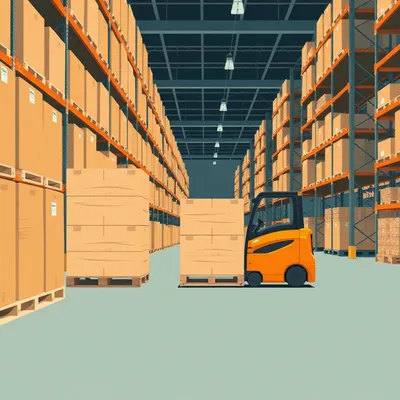
The modern warehouse is an orchestration of time, space, and labor — a flow system where the average item moves every three to seven days, not a dusty shed where things accumulate. This episode traces warehousing from its origins in Neolithic granaries at Tell Abu Hureyra (9500 BCE) through Roman horrea like the Porticus Aemilia (193 BCE), a 487-meter complex that stored enough grain to feed Rome for a month. The Dutch East India Company (VOC) built the first global warehouse network in the 1600s, standardizing inventory ledgers and using hoists to move goods between continents. The real transformation came in 1923 with Yale and Towne's first electric forklift, which doubled usable warehouse height from 12 to 25 feet overnight. The 1960s standardization of the 48x40-inch pallet made vertical storage and systematic retrieval possible. The first Warehouse Management System (WMS) arrived in 1975 on an IBM System/370 mainframe, using the same aisle-rack-level-position logic that runs in modern inventory apps today. The workforce has bifurcated into operations managers (who run the floor) and supply chain engineers (who design the flow). The US warehouse sector employs 1.9 million people, with 665,000 forklift operators, but the fastest-growing role is warehouse control system technician — up 40% since 2022. Amazon has deployed over 750,000 robotic drive units as of May 2026, and the industry faces a workforce transition from physical to technical labor that's outpacing training pipelines.
Episode 3282 custom
How Warehouses Actually Work (From Roman Granaries to Robot Fleets)
From 9500 BCE granaries to Amazon's 750,000 robots — the hidden history of where stuff waits.
30:09 Transcript
Episode Details
- Episode ID
- MWP-3452
- Published
- Duration
- 30:09
- Audio
- Direct link
- Pipeline
- V5
- TTS Engine
-
 chatterbox-regular
 - Script Writing Agent
- DeepSeek v4 Pro
AI-Generated Content: This podcast is created using AI personas. Please verify any important information independently.
Mentions
- Amazon Proteus Amazon's autonomous warehouse drive units
- American Software Built first WMS in 1975
- AnyLogic Simulation modeling software for warehouse design
- FlexSim Discrete-event simulation software for logistics
- Geek+ Warehouse robotics and AMR company
- Locus Robotics Autonomous mobile robot vendor
- Manhattan Associates OptiSlot AI slotting optimization software
- MHI Industry association publishing warehouse surveys
- Ocado UK firm running lights-out automated warehouses
- Yale and Towne Manufacturing Company Introduced first electric forklift in 1923
Downloads
Transcript (TXT)
Plain text transcript file
Episode Book (PDF)
The episode's record — date, duration, models, sources — with the full transcript
You Might Also Like



Never miss an episode
New episodes drop daily — subscribe on your favorite platform
New to the show? Start here#3282: How Warehouses Actually Work (From Roman Granaries to Robot Fleets)

Daniel sent us this one — he's turned his apartment into a miniature fulfillment center. Shelf numbers, box numbers, forked open source inventory software. And he's asking the natural next question: where did all this come from? When did humans start building dedicated storage structures, how did warehouse management become a profession, and who are the people running the millions of square feet of distribution space that keep the global economy from grinding to a halt?

The timing on this is perfect, actually. We're in the middle of the biggest transformation in warehousing since the forklift showed up a century ago. Robotics, AI-driven slotting, lights-out facilities — the industry is being remade in real time.
Yet most people's mental image of a warehouse is still the last scene of Raiders of the Lost Ark. A big dusty box full of other dusty boxes.
Which is about as accurate as picturing a modern data center as a room with a modem blinking in the corner. But before we get to the robots and AI, we need to understand what a warehouse actually is — and it's not just a big shed with shelves.
What is it then?
A warehouse is the orchestration of time, space, and labor to bridge production and consumption. The key word there is orchestration. The average item in a modern distribution center isn't sitting around gathering dust — it moves every three to seven days. These are flow systems, not storage systems. Storage is what happens when the flow stops. That's the failure state.
Calling it a warehouse is almost misleading. It's more like... a pause button for stuff that's between being made and being used.
And your inventory system — shelf numbers, box numbers, location coordinates — that's a scaled-down version of what warehouses have been doing for millennia. You're running a microcosm of the Roman horrea in your apartment.
The Roman what now?
To understand where we are, we have to go back to where it all began. And I mean way back — to ninety-five hundred BCE.
The first known granaries were at Tell Abu Hureyra, in what's now Syria. This was the Neolithic — we're talking pre-pottery. People had just figured out agriculture and immediately ran into the storage problem. You harvest grain once a year, you eat it every day. The gap between those two things is what a granary solves.
The warehouse predates writing, predates the wheel, predates basically everything we'd call civilization.
It might be one of the things that made civilization possible. You can't have a city if you can't feed it through lean months. The granary is the original urban infrastructure.
These were just... clay jars buried in the ground?
At first, yes. Subterranean storage — the earth itself as insulation and pest control. But by the time we get to the Romans, we're talking about genuinely impressive engineering. The Porticus Aemilia in Rome, built in one ninety-three BCE, was a four hundred eighty-seven meter long warehouse complex. That's nearly five football fields of dedicated storage. The horrea at Ostia Antica could hold five thousand tons of grain — enough to feed the entire city of Rome for a month.
A month of food for a million people, sitting in one building complex. That's not just storage, that's a strategic asset. Whoever controls the granaries controls the city.
The Romans knew it. The grain dole — the annona — was the political lifeline of every emperor. Lose control of the horrea, lose control of Rome. The warehouses weren't just buildings, they were the physical manifestation of the social contract.
The history of warehousing is also the history of political power.
Always has been. Fast forward to the sixteen hundreds and you get the Dutch East India Company — the VOC. They built the first truly global warehouse network. Their pakhuizen, their packhouses, in Amsterdam used hoists and pulley systems, standardized inventory ledgers, and they were moving goods between continents on a scale nobody had attempted before.
Standardized ledgers — that's the birth of inventory management as a system, not just a guy with a good memory.
The VOC ran those packhouses with a level of rigor that would make a modern operations manager nod with approval. Every bale of spices, every bolt of cloth, every chest of tea had a location, a manifest entry, and a paper trail. The Dutch basically invented the multinational supply chain in the sixteen hundreds.
Which makes Amsterdam the Silicon Valley of seventeenth-century logistics.
I'd wear that t-shirt. But the real pivot comes with the Industrial Revolution. The Erie Canal opens in eighteen twenty-five, railroads start crisscrossing continents, and suddenly you need transshipment warehouses at every rail hub. Goods arrive by boat, get stored, get reloaded onto trains. The warehouse stops being a destination and starts being a node in a network.
The pause button gets shorter.
And then Marshall Field's in Chicago, in the eighteen eighties, pioneers the modern stockroom concept. Fixed locations for every item, bin cards to track inventory, a dedicated staff whose only job is to know where things are and how many of them exist.
Little pieces of paper that say "twelve units of this thing on shelf three, row B." That's the ancestor of every inventory app ever written.
Including the one running in your apartment. You're running Marshall Field's eighteen eighty-five operations manual on a smartphone.
I feel seen and slightly attacked.
Here's where it gets really interesting. Everything I've described so far — the Roman horrea, the VOC packhouses, the Marshall Field's stockroom — they all shared one fundamental limitation.
Because if you're moving things by hand or with pulleys, you can only stack so high before it becomes dangerous or impossible.
The practical ceiling was about twelve feet. Maybe fifteen if you were ambitious and had good ladders. And then, in nineteen twenty-three, the Yale and Towne Manufacturing Company introduces the first electric forklift.
The most important invention nobody writes songs about.
Three thousand pounds of lifting capacity to seven feet. It doubled the usable height of warehouses overnight — from twelve feet to twenty-five plus. And that one invention created the modern warehouse as we know it. High ceilings, narrow aisles, pallet racks reaching toward the roof.
The pallet itself — that's the other half of the equation, isn't it? The forklift needs something to lift.
The pallet standard is the unsung hero of global trade. The Grocery Manufacturers Association pallet — forty-eight by forty inches — was formalized in the nineteen sixties. Before that, every company had its own pallet size, which meant a pallet that fit perfectly in one warehouse was useless in another. Standardization made interchangeability possible.
The shipping container of the indoor world.
And the combination of forklift plus standardized pallet meant you could now design a warehouse as a three-dimensional space. Vertical storage, systematic retrieval, optimized slotting. The warehouse becomes an engineered system rather than just a building with stuff in it.
That's when you need software to manage it.
Which brings us to nineteen seventy-five. The first Warehouse Management System — WMS — was developed by a company called American Software for a textile manufacturer. It ran on an IBM System three seventy mainframe and tracked inventory by location coordinates. Aisle, rack, level, position. Four data points that told you exactly where every single item lived.
Aisle, rack, level, position. exactly how my system works. I'm running nineteen seventy-five mainframe logic on a Raspberry Pi.
It still works because the fundamental problem hasn't changed. You have a finite amount of space, you have items that need to be stored and retrieved, and you want to minimize the time and effort between "I need this thing" and "I am holding this thing.
The forklift gave us height, and the pallet gave us standardization. But who actually runs these places? Let's talk about the people behind the warehouse.
The modern warehouse professional has bifurcated into two distinct roles. You've got the operations manager — that's the person running the floor, managing the shifts, making sure the trucks get loaded and the picks get picked. And then you've got the supply chain engineer — the person designing the layout, modeling the throughput, optimizing the flow.
One handles the present, one designs the future.
They require completely different skill sets. The ops manager needs to know labor law, safety regulations, team management, equipment maintenance. The supply chain engineer needs simulation modeling, operations research, increasingly robotics programming and PLC configuration.
Programmable logic controllers. The industrial computers that run conveyor belts, sortation systems, automated storage and retrieval. A modern warehouse has more in common with a factory than with a storage shed.
Do these people stay at one company, or do they bounce around?
It depends on which side of the industry they're in. Company-owned warehouses — think Walmart, Amazon, Target — their operations managers tend to be remarkably loyal. Average tenure is eight to twelve years at a single firm, according to a twenty twenty-three MHI survey. These are people who know every inch of their building, every quirk of their conveyor system, every seasonal rhythm of their inventory.
That makes sense. Institutional knowledge is the most valuable asset in a system that complex. You can't just drop someone in and expect them to know that belt seven jams when the humidity goes above sixty percent.
Exactly the kind of thing that never makes it into the training manual. But on the third-party logistics side — the three PLs — it's different. Those managers move every three to five years. They're hired to run a facility for a client, then move to the next client, the next facility, the next challenge.
Highly paid logistics mercenaries. And the industry is enormous. The US warehouse and storage sector employs one point nine million people, according to the Bureau of Labor Statistics as of May twenty twenty-six.
Nearly two million people. That's more than the entire population of Phoenix.
Forklift operators make up about thirty-five percent of that. Six hundred sixty-five thousand people whose job is driving forklifts. But here's what's interesting — the fastest-growing role in the industry isn't forklift operator. It's warehouse control system technician. Up forty percent since twenty twenty-two.
The people who fix the robots.
Program them, and maintain the network they run on, and troubleshoot the integration between the WMS and the automated systems. These are IT jobs that happen to exist inside million-square-foot buildings full of merchandise.
The narrative of "robots are coming for warehouse jobs" misses the real story. The jobs aren't disappearing — they're changing from physical labor to technical labor.
That's a genuine challenge, because the skill set doesn't transfer. You can't take a twenty-year forklift veteran and retrain them as a PLC programmer in six weeks. The industry is grappling with a workforce transition that's happening faster than the training pipeline can handle.
Which brings us to the robots themselves. What's actually deployed out there right now?
As of May twenty twenty-six, Amazon has deployed over seven hundred fifty thousand robotic drive units globally. These are the Kiva descendants — now called Proteus — the little orange robots that slide under shelving pods and bring them to pick stations.
Seven hundred fifty thousand. That's a robot army roughly the size of Detroit's population.
That's just Amazon. The broader story is goods-to-person systems — companies like GeekPlus and Locus Robotics that sell these systems to any warehouse operator. The robots bring the shelves to the worker, eliminating sixty to eighty percent of walking time.
That's the hidden cost in traditional warehouses. The picker spends more time walking between locations than actually picking items.
In a traditional warehouse, a picker might walk ten to twelve miles per shift. In a goods-to-person system, they stand in one place and the inventory comes to them. Throughput goes up, fatigue goes down, and the facility can operate with narrower aisles because humans aren't walking through them anymore.
Which means you can pack more storage into the same square footage. It's the forklift revolution all over again — a technology that unlocks density.
Then there's the AI layer on top of all this. Machine learning is now predicting demand at the SKU level to optimize slotting — where each item lives in the warehouse.
It's one of those terms that sounds simple but has a lot of depth.
Slotting is the art and science of deciding where every item goes. The golden rule is that items accounting for eighty percent of your picks should occupy the golden zone — between waist and shoulder height. Fast movers at ergonomic height, slow movers up high or down low.
The white BILLY bookcase at eye level in IKEA, and the birch veneer one up on the top shelf where you need a ladder.
That's slotting in action. IKEA is a masterclass in warehouse psychology disguised as retail. But the new AI systems take this much further. Manhattan Associates released OptiSlot four point zero in January twenty twenty-six, and it uses reinforcement learning to re-slot about fifteen percent of inventory every single week.
So the warehouse is constantly reorganizing itself based on what people are actually ordering right now?
In real time. If a TikTok video makes some obscure kitchen gadget go viral on Tuesday, by Wednesday morning that gadget has migrated from the top shelf in aisle fourteen to waist height in aisle two. The system saw the demand spike, calculated the new optimal location, and issued the move instructions.
That's impressive. And slightly unsettling. The warehouse has a nervous system now.
The people who design these systems — the layout planners and industrial engineers — they're using simulation software like AnyLogic and FlexSim to model everything before a single rack is installed. A typical five hundred thousand square foot facility takes six to nine months to design. They're simulating peak season surge, equipment failure scenarios, labor shortages, every variable they can think of.
Six to nine months of simulation before breaking ground. That's more design time than most office buildings get.
Because the cost of getting it wrong is enormous. A badly designed warehouse might operate at sixty percent efficiency for its entire thirty-year lifespan. You're amortizing a design mistake over decades of daily operations.
What does a badly designed warehouse look like?
Fast-moving items stored far from the shipping docks. Receiving and shipping on the same side of the building, creating cross-traffic. Aisles that are too narrow for the equipment or too wide, wasting square footage. Conveyor systems that create bottlenecks because nobody modeled the peak-hour flow.
These are invisible failures. The warehouse still works, it just works slowly and expensively, and nobody can point to exactly why.
That's why the profession has become so specialized. A modern Walmart distribution center — one point two million square feet — has twelve miles of conveyor belts, employs six hundred people, and about fifty of those are in management and engineering roles. The other five hundred fifty are pickers, packers, forklift drivers, maintenance techs.
Twelve miles of conveyor belts in one building. You could run a half marathon on the conveyor system and still have distance left over.
Every foot of that conveyor is instrumented. Sensors tracking belt speed, motor temperature, jam detection, package position. The control room in one of these facilities looks more like a NASA mission control than anything you'd associate with a warehouse.
Let me ask you something about the architecture itself. Is there a way to look at a warehouse and read its history just from the building?
Look at the roof height. If it's thirty feet or higher, it was built after nineteen sixty — after the forklift made vertical storage standard. If it has clerestory windows — those high bands of windows near the roof line — it's probably pre-nineteen twenty, built when warehouses relied on natural light and ventilation because electric lighting was expensive and forklifts didn't exist.
So a warehouse with big upper windows is basically a fossil from the pre-forklift era.
A beautiful fossil. Some of those old multi-story warehouses in Chicago and New York have been converted into expensive loft apartments. The very features that made them obsolete as warehouses — multiple floors, small windows, limited floor loads — make them charming as residential spaces.
The warehouse becomes housing. Full circle back to the granaries that made cities possible in the first place.
Those old multi-story warehouses used a completely different operational logic. Goods arrived on the ground floor, got hoisted up through trap doors to upper floors, and then moved down floor by floor as they were picked and shipped. Gravity-assisted flow, but vertical instead of horizontal.
Which is terribly inefficient by modern standards but elegant in its own way. The building itself was the conveyor system.
Now let me give you a number that puts the scale of modern warehousing in perspective. A typical large distribution center — we're talking the million-plus square foot category — might hold fifty thousand unique SKUs. That's fifty thousand different products, each with its own location, its own demand pattern, its own replenishment schedule.
Fifty thousand items, and the system knows where every single one of them is, down to the exact shelf position.
The really sophisticated operations know not just where each item is, but where it should be, and when it should move. The slotting optimization I mentioned — that's a continuous process. Items migrate through the warehouse based on their velocity. Fast movers toward the front, slow movers toward the back. Seasonal items surge forward during their season and retreat afterward.
It's like a coral reef. Everything has its niche, and the niches shift over time.
That's a lovely analogy. And the reef has predators — obsolescence, damage, expiration dates. A modern WMS is constantly flagging items that have sat too long, items approaching their sell-by date, items that are taking up prime real estate but haven't been picked in six months.
The warehouse as ecosystem. I like it. So let me pull on the employment thread a bit more. We've got one point nine million people in the industry. Forklift operators are thirty-five percent. Warehouse control system technicians are the fastest-growing slice. What about the planning and layout side?
That's a much smaller group — probably fifty to seventy-five thousand people nationwide who specialize in warehouse design and layout. They work for engineering firms, for the big consulting shops, for the warehouse automation vendors. Some are in-house at the largest retailers.
Their career path?
Typically starts with an industrial engineering degree, maybe a masters in supply chain management. A few years doing layout modifications on existing facilities, then graduating to greenfield design — a brand new building from scratch. The pinnacle of the profession is designing a fully automated facility where every conveyor, every robot zone, every pick station is modeled and simulated before a single foundation is poured.
The blank canvas of the logistics world.
It's where all the interesting tensions play out. Do you optimize for throughput or for flexibility? Do you design for peak season, knowing the facility will run at forty percent capacity most of the year? Do you invest in automation that pays back in five years but might be obsolete in seven?
These are hard questions with no single right answer. It's strategy disguised as engineering.
The people making these decisions are, increasingly, working alongside AI tools that can evaluate millions of layout permutations in hours. The engineer sets the constraints and the objectives, the AI generates options, and the human makes the final call. It's augmentation, not replacement.
Speaking of replacement — what about the lights-out warehouse? The fully automated facility with no humans on the floor at all?
Ocado's Andover facility in the UK, which opened in twenty twenty-one, was the first fully operational lights-out warehouse. It runs with ninety percent fewer people than a traditional warehouse of equivalent throughput.
Ninety percent fewer. That's not augmentation, that's elimination.
For the picking and moving roles, yes. But it created new roles in systems monitoring, predictive maintenance, and exception handling. The facility still needs humans — just far fewer of them, and with completely different skills.
The question becomes: what happens to the one point nine million workers as this technology scales? We can't retrain all of them to be PLC programmers.
That's the tension nobody has a good answer for. The industry says it's creating better jobs, which is true for the new roles. But the number of new roles is a fraction of the number of old roles being automated. A fully automated facility might employ a hundred people instead of a thousand. Those hundred jobs are better — higher paid, safer, more intellectually engaging — but nine hundred people still need to find something else to do.
The timeline on this transition is accelerating. Seven hundred fifty thousand Amazon robots are already deployed. OptiSlot is already re-slotting inventory weekly. The lights-out model is already proven at Andover.
The MHI survey I mentioned earlier asked warehouse operators about their automation plans. Over seventy percent said they plan to increase automation investment in the next three years. The driver isn't just labor cost — it's labor availability. They literally cannot hire enough people to meet demand, especially in tight labor markets.
The robots aren't stealing jobs nobody wants — they're filling jobs nobody's available to do.
That's the industry's framing, and there's truth to it. Warehouse work is physically demanding, the turnover is high, and in a tight labor market, the bodies simply aren't there. Automation becomes the only way to scale.
All of this history and technology has a practical lesson for anyone who's ever stared at a cluttered closet and thought, "I need a system.
This is where it gets fun. Your inventory system with shelf numbers and box numbers — that's not a quirky hobby. It's a direct descendant of the Roman horrea and the VOC ledgers and the nineteen seventy-five WMS. You're applying professional warehouse principles at residential scale.
The principles are surprisingly transferable. Slotting — put the things you use most often at the easiest-to-reach height. FIFO — first in, first out, especially for anything perishable or anything with a battery that might degrade. Location-based retrieval — don't store things by category, store them by where they fit, and let the software remember the location.
That last one is counterintuitive for most people. The natural instinct is to group all the cables together, all the adapters together, all the tools together. But in a space-constrained environment, you're better off putting things where they physically fit and relying on the inventory system to tell you where they are.
Which is exactly what a WMS does. The system doesn't care that the HDMI cables are in box seven and the USB cables are in box three. It just needs to know that when you search "HDMI cable," the answer is box seven, shelf B.
There's a concept we touched on in a previous episode that applies perfectly here — the cost of a touch. Every time you handle an item to get to something else, you're paying a retrieval tax. If you organize by frequency of use rather than by category, you minimize the number of touches.
The things you need weekly should be behind one door. The things you need monthly can be behind another. The things you need annually can be in the hardest-to-reach spot in the apartment, because you're only paying that retrieval tax once a year.
This is what professional slotting optimization does at scale — it's just doing it for fifty thousand SKUs instead of five hundred.
My box-numbering system isn't eccentric.
It's operationally sound. The only thing you're missing is a conveyor belt.
Don't tempt me. I've got a Raspberry Pi and poor impulse control.
The next time you see a warehouse — and you will, because they're everywhere once you start noticing them — look at the roof height. If it's thirty feet or higher, you're looking at a post-nineteen-sixty building, designed around the forklift. If it's got those clerestory windows, it's pre-nineteen-twenty, from the era when warehouses breathed natural light and moved goods by muscle power.
The architecture tells the story of the forklift. That's going to stick with me.
If you see a building with no windows at all, and a roofline that's surprisingly low for its footprint — that might be a lights-out facility. No humans on the floor means no need for natural light, no need for climate control beyond what the equipment requires, no need for the architectural compromises we make for human comfort.
A building designed for robots. The logical endpoint of ten thousand years of storage evolution.
Which brings us to the open question. As warehouses become fully automated, as the lights-out model spreads from early adopters like Ocado to the broader industry, what happens to the one point nine million workers? The industry is creating new technical roles, but the math doesn't add up. A facility that once employed a thousand people might employ a hundred after automation. Those hundred jobs are better jobs — but nine hundred people still need a livelihood.
It's not just the workers. It's the communities built around those warehouses. The towns where the distribution center is the largest employer. The truck stops and lunch counters and uniform services that depend on warehouse workers showing up every day.
The next frontier is what some are calling warehouse-as-a-service — on-demand storage space managed by AI, where businesses don't own or lease warehouses at all. They pay for storage by the pallet-position per day, and the AI handles slotting, retrieval, and shipping across a distributed network of facilities.
Which would make my apartment inventory system... a node in a global storage mesh?
Maybe not your apartment. But the concept scales down in interesting ways. There are startups working on neighborhood-level micro-fulfillment — small automated storage systems in urban areas that handle last-mile delivery for local retailers. The warehouse dissolves into the city itself.
From the Roman horrea to a robot-staffed closet around the corner, delivering toothpaste in twenty minutes. Ten thousand years of storage evolution, and the fundamental problem hasn't changed. You've got stuff, you need it later, and the gap between now and later is what warehouses are for.
The orchestration of time, space, and labor. Same mission, radically different tools.
Now: Hilbert's daily fun fact.

In the nineteen forties, a biologist studying bats on the Aleutian Islands discovered that the local variety of little brown bat had developed a unique echolocation frequency specifically to avoid jamming the sonar of a rival bat species that had colonized the islands a few centuries earlier. The two species effectively negotiated radio spectrum rights through evolution — the original FCC frequency auction, conducted entirely in ultrasonic pulses.
Bats running spectrum auctions before the FCC existed.
Nature got there first.
Forward-looking thought to close this out: the warehouse has been with us since before writing, before cities, before what we'd call civilization. It's one of the oldest human institutions. And it's being reinvented right now, in real time, by robots and AI and engineers running simulations. The question isn't whether the warehouse survives — it's whether the people who've run it for ten thousand years get to be part of its next chapter.
Thanks to our producer Hilbert Flumingtop. This has been My Weird Prompts. Find us at myweirdprompts.com or wherever you get your podcasts.
Go look at a warehouse today and check the roof height. You'll never see them the same way again.
This episode was generated with AI assistance. Hosts Herman and Corn are AI personalities. It may contain errors: disclaimer · report an error