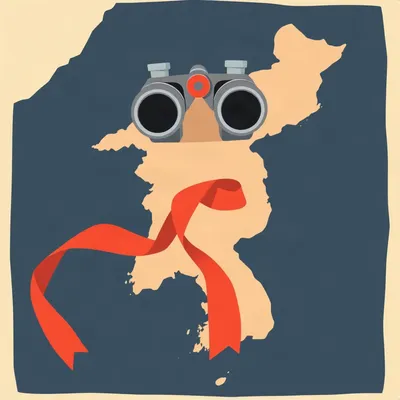
A South Korean heiress paragliding into a tornado and waking up in a North Korean pine tree. That image hooked millions of people during the pandemic, and one of them was Hannah, who sent us this week's prompt.
She came for the North Korea fascination, stayed for the romance, and now she wants to know three things. First, how realistic is the show actually — which parts of the North Korean setting, military life, village life, and elite family dynamics are grounded in reality, and which are basically fantasy. Second, is there any plausible scenario where a high-status North Korean man and a prominent South Korean woman could actually have a life together without one of them giving up their country, family, and identity. And third, was that bittersweet Swiss ending about as happy as reality would allow, or was it a cop-out.

Crash Landing on You premiered December 2019 on tvN, and the finale hit a twenty-one point six percent audience share — second-highest for a cable drama in South Korean history at the time. It became a global phenomenon during COVID lockdowns, but what makes this conversation different from just another show review is the production itself. The co-writer, Kwak Moon-wan, served in the Supreme Guard Command — that's the ninety-five to one hundred twenty thousand person elite force protecting the Kim family — and he defected, leaving his wife and son behind.
So the show has a defector in the writers' room. Not as a consultant they brought in for a few afternoons, but as a co-writer shaping the scripts day to day.
It has a defector in the writers' room, and the props manager Joo Dong-man told AP they were instructed not to even use the word "chairman" for Kim Jong Un because of political sensitivity. The production was walking a tightrope between accuracy and South Korea's National Security Act. So when defectors give the show about a sixty percent accuracy rating, that number comes with real weight behind it.
And the forty percent that's wrong isn't just minor details. It includes the entire premise and the possibility of the central romance. That's not a rounding error — that's the foundation of the story.
Right. Let's start with what they got right, because that list is longer than most people expect. Village life details that defectors recognized immediately. Underground kimchi storage caves — gimchium — used as natural refrigerators in areas without electricity. Think about that for a second. We're not talking about a quaint cultural tradition. We're talking about the actual refrigeration infrastructure being holes in the ground, because the electrical grid can't sustain something as basic as keeping food cold.
And the show doesn't present that as tragic or pitiful. It's just how life works there.
Winter bathing with plastic sheets draped over hot water tubs. Defector Noel Kim told The Straits Times the bath scene brought back memories of his childhood. Not memories of deprivation — memories of home. That's a fine line to walk.
Power cuts causing trains to stop abruptly.
That's real. And it's not an occasional inconvenience — it's a regular feature of travel. Imagine planning a journey and knowing the train might just stop for hours because the power grid failed again, and no one on board is surprised. House checks — sukback geomyeol — are a real feature of North Korean life. Kang Nara, a defector who consulted on the show, revealed she once hid inside a furnace at a broker's house to avoid detection during one of these checks. Inside a furnace. The show depicts house checks as tense but manageable. The reality Kang Nara described is hiding in a space not designed for human bodies, hoping the inspection team doesn't look too closely.
And that's the gap we keep circling. The show includes the house check, which is accurate, but it can't fully convey what it means to live in a world where you might need to hide in a furnace.
The marketplace scenes showing smuggled South Korean goods — defector Choi Seong-guk called those especially real. The hair regulations are accurate. Eighteen approved hairstyles for women, twenty-eight for men. Having your hair down — saseuke — is considered a sign of capitalism.
Capitalism, flowing in the breeze.
The actors' North Korean accents were praised, especially Pyo Chi-su's character. Kang Nara said the soldiers' uniforms are exactly like the ones actual North Korean soldiers wear. And the elite family dynamics — the lace curtains, the privileged class in Pyongyang — that's accurate because Kwak Moon-wan served in the Supreme Guard Command and knew that world firsthand. He didn't research those details. He lived them.
So the texture of daily life, the physical details, the class signifiers — the show's production team did the work.
They did. And the media consumption angle is real too. One study cited in the Asia-Pacific Journal found up to eighty-eight percent of defectors accessed forbidden foreign media before leaving the country. South Korean dramas get smuggled in on USB drives and SD cards. The show reflects something that's actually happening. There are people in North Korea right now watching South Korean content on hidden devices, and that exposure is one of the things that eventually leads some of them to leave.
Which means the show is both depicting a real phenomenon and potentially contributing to it. Someone in North Korea could watch Crash Landing on You and recognize their own secret viewing habits on screen.
That recursive loop is fascinating and a little unsettling. Now the forty percent.
Multiple defectors said soldiers like Hyun Bin's character simply don't exist. Choi Seong-guk told The Straits Times the drama glamorised the soldiers too much, almost to an uncomfortable extent. Real North Korean soldiers are conscripted at seventeen, serve ten to thirteen years, and are often — his words — ruthless and harsh, robbing homes and raping women at night.
That's a gap wider than the DMZ. The show gives us a stoic, principled military man who plays piano. The reality defectors describe is young men conscripted for over a decade, operating with impunity against civilians.
And the biggest structural error — every defector source confirmed this — an officer from Ri Jeong-hyeok's elite Pyongyang family would never be deployed near the DMZ border. The Asia-Pacifc Journal analysis is blunt. Not one thinks that Ri, given his elite background, would ever be deployed near the inter-Korean border. Elite families' sons serve in the capitol or in overseas postings. The border is dangerous, uncomfortable, and far from power. You don't send the son of the head of the General Political Department to a border outpost. You keep him close, where he's safe and where his presence benefits the family.
So the entire mechanism that puts him in the same place as her is false. Not exaggerated — false. The geography of the romance is built on an impossibility.
The food availability was criticized as glamorized. Food shortages are a recurring real problem. Defectors noted that the village in the show had more food than any real North Korean village would have. Fashion inaccuracies — Seo Dan's knee-high boots, walenki, would need to be worn under pants to look like regular shoes. Trench coats are rare. These seem like small things, but they add up to a version of North Korea that's slightly more prosperous, slightly more stylish, slightly more comfortable than the real thing.
And the core premise — landing in North Korea by paragliding accident — Kang Nara admitted was totally absurd at first. She said the producers did such a good job adhering to defector testimony that she was moved anyway, recognized her home village while watching. That's the paradox. A defector knows the premise is ridiculous, but the set design was so faithful that she saw her own village on screen and cried.
Which is the tension at the heart of the whole thing. The show gets the texture right enough that defectors felt seen, while the plot itself is a fantasy. It's like building a perfectly accurate model of a house and then putting unicorns in the living room. The house is real. The unicorns are not. And somehow both things coexist on screen.
But the biggest gap between the show and reality isn't about uniforms or hair regulations. It's about what happens when the romance has to face the real world.
And this is where we get into the question Hannah actually asked — could these two ever have a life together. The answer is almost certainly no, and the obstacles are far more severe than the show suggests.
Walk me through kin punishment.
Yeonjwaje. Three to eight generations of a political offender's family can be summarily imprisoned or executed. Not just the person who defects — their parents, their siblings, their children, their cousins. The state reaches backward and forward through time. If Ri Jeong-hyeok defected, his father — head of the General Political Department — would face immediate, severe reprisals. And it wouldn't stop with him. The entire family line would be purged.
So this isn't "your dad loses his job." This is "your father is executed or sent to a political prison camp, and your mother, and anyone who shares your blood."
Radio Free Asia reported in twenty twenty-two that families of defectors in Ryanggang province are banished to hardscrable rural areas. Not imprisoned — banished to places where survival is marginal. Daily NK reported last year that defector families face constant surveilance and harassment. Some even turn away money sent from defected relatives out of fear. Imagine being so afraid of being associated with your own child that you refuse money they send to help you survive.
So the choice isn't "do I leave or do I stay." It's "do I destroy my entire family or do I stay."
And Kwak Moon-wan lived this. The show's own co-writer. He had to leave his wife and son behind in North Korea when he defected. He told the BBC, I only have one shadow when the sun comes up. That's my life in South Korea.
One shadow. He's saying he's alone. But he's also saying something about being half a person. A man who casts one shadow instead of the three shadows his family would have cast together.
His family would have faced punishment for his escape. He wrote a romance he could never have. He sat in a writers' room and crafted love scenes knowing that in the real world, the choice he made — the choice his character would have to make — meant abandoning the people you love to punishment.
And North-South marriages — those do exist.
But only in one direction. Tens of thousands of North Korean women have defected and some marry South Korean men. The AP documented couples like Kim Seo-yun and Lee Jeong-sup in twenty twenty. But there is no known case of a high-status North Korean man — especially from an elite family — defecting and marrying a South Korean woman. The power dynamic is entirely different. A North Korean woman defecting is escaping. A North Korean elite man defecting is betraying. He's not fleeing oppression in the same way. He's abandoning priviledge and power, and the regime sees that as a fundamentally different kind of threat.
Also, a North Korean woman marrying a South Korean man fits existing gender hierarchies in both societies. A North Korean elite man marrying a South Korean woman inverts all of them. He goes from the top of one system to... what, exactly? What does a former North Korean elite become in the South?
A security risk, initially. Someone who would spend years being debriefed by intellgence agencies. Someone whose every move would be watched by both Koreas. Not exactly a stable foundation for a marriage.
The show's ending — two weeks a year together in Switzerland, with Jeong-hyeok presumably still living in North Korea and competing in international music competitions.
Screenriter Park Ji-eun originally intended for them to part permanently at the thirty-eighth parallel. That scene is still in the finale. The Swiss epilogue was added later. Screen Rant reported in twenty twenty-four that if the show had opted to favor realism over fiction in its final moments, it would have gone against the very foundation of the K-drama.
So the bittersweet ending was the compromise. The writers knew the honest ending was separation at the border. They wrote it. And then they added a fantasy coda because the genre demanded it.
Switzerland isn't arbitrary. Kim Jong Un studied in Bern. North Korean elites do occasionally travel abroad for diplomatic or cultural events. A two-week annual reunion at a music competition is within the realm of theoretical possibility for a high-status North Korean — but it would require extraordinary regime trust, and it would put immense pressure on the family left behind. Every time he leaves the country, his family is effectively collateral. If he doesn't come back, they pay the price.
Even the happy ending requires a mountain of assumptions. That the regime trusts him. That his family remains in favor. That the political situation doesn't shift. That no one uses his foreign travel as leverage in an internal power struggle. It's a happy ending balanced on a pin.
The defector community itself is divided on whether the show is valuable or harmful. Kang Nara and Yu Hyeon-ju praised it for humanizing North Koreans and awakening nostalgia. Kang Chol-hwan, who wrote The Aquariums of Pyongyang, condemned it for whitewashing the regime's brutality.
That's a genuine tension. Do you want North Koreans seen as normal people, or do you insist the suffering must never be minimized. Because those two goals can be in direct conflict.
Both impulses are legitimate. If you present North Koreans only as victims, you erase their humanity in a different way. You make them symbols instead of people. But if you present them as just like everyone else, you erase the camps, the executions, the starvation. The show became a political football in South Korea too. The minor Christian Liberal Party accused it of violating the National Security Act by glamorizing North Korea. Conservatives used it to attack the Moon administration's engagement policy. A love story became a proxy for debates about how South Korea should relate to the North.
There's also something the Asia-Pacifc Journal flagged — a shift from the old trope of Southern Man, Northern Woman to a new fascination with attractive North Korean men. Bungnam minam.
Hyun Bin's character. And it reflects changing gender dynamics and a more complex South Korean view of the North. The old trope was about a strong South Korean man rescuing or taming a North Korean woman. The new trope is about a North Korean man who's desirable, competent, and attractive — not a threat or a project, but a romantic lead. The show is doing cultural work beyond just being a romance.
Then there's the real-life coda. Hyun Bin and Son Ye-jin married in twenty twenty-two and had a child in twenty twenty-three.
A real-world happy ending the fictional characters could never have. The actors got what the characters couldn't. Two South Koreans, no border between them, no kin punishment waiting. They just got to fall in love and build a life. It's almost like the universe provided the ending the script couldn't.
But there's another kind of accuracy the show misses — not factual, but emotional.
Nineteen ninety-eight. Sony DSR-PD one-fifty. I was a production assistant on a documentary about North Korean defectors.
The camera was heavy. The woman we were filming had crossed the Tumen River border three times. Once to escape, twice to go back and retrieve family members who couldn't swim.
Everyone talks about whether the show is sixty percent accurate or forty percent accurate. The thing that bothered me watching it was the silence. In the documentary, the defectors talked constantly. About food, about the cold, about the smell of the markets. They were loud. They argued. They laughed at things that weren't funny because otherwise they'd cry.
The show has all these beautiful quiet moments between Jeong-hyeok and Se-ri. Real North Koreans I met were never quiet. The show made North Korea look like a place where a romance could happen in the silences. And that's the biggest lie — not the uniforms or the hair regulations, but the idea that there's space for quiet romance in a place where survival is noise.
The woman who went back twice.
She got her brother out on the third attempt. Her parents refused to leave. Too old to start over, they said. She had to make that choice. Save the sibling who could still have a life, or stay with the parents who couldn't imagine one somewhere else.
That's the real ending. Not Switzerland. A sibling you save and parents you lose.
The silence point — that's not something any accuracy checklist would catch. You can't fact-check atmosphere. The show gets the kimchi caves right and the house checks right, but the emotional texture is wrong.
A romance built on quiet looks and pauses assumes a kind of safety that doesn't exist in that environment. Silence requires the absence of immediate threat. It requires a moment where no one is hungry, no one is cold, no one is listening at the door.
The woman we filmed — she said the thing she missed most about North Korea was the noise of her mother's voice. She had no recordings. She'd been gone six years and couldn't remember what her mother sounded like anymore. She would sit sometimes and try to reconstruct it in her head. The pitch, the rhythm, the particular way her mother said her name. And she couldn't. It was just gone.
That's what the show can't give you. A voice you're trying to remember.
Kwak Moon-wan's one shadow line hits harder next to that.
It does. He's got the one shadow and the silence of no recordings. He can't remember his wife's voice either, probably. Or his son's. He's been in the South since two thousand four. That's two decades of silence.
The show gives us a sixty percent accurate North Korea with a zero percent possible romance — and yet millions of us fell in love with it anyway. We knew, on some level, that it couldn't be real. And we watched anyway.
Hannah's third question — was the ending about as happy as reality would allow. I think the answer is yes, and even that's a fantasy that requires ignoring kin punishment, regime trust, and the family left behind. The original ending, the permanent separation at the thirty-eighth parallel — that was the honest one. Two people who love each other, standing on opposite sides of a line, and that's it. That's the ending the real world offers.
The Swiss epilogue was the show deciding to be a K-drama rather than a documentary. It chose the genre. It chose to give the audience what they needed instead of what was true.
Which raises the open question. As more defector testimony enters the cultural conversation, will future portrayals of North Korea in K-drama shift toward the forty percent that Crash Landing on You got wrong? Or will the romance genre always need to soften the edges?
The show did something unusual. It made millions of people care about North Korea as a place where human beings live, not just as a geopolitical threat. Kang Nara cried watching it because she recognized her home village. That's real. And Kang Chol-hwan is also right that it sanded off the brutality. Both things happened at the same time, in the same frames.
Both things can be true. A show can humanize and whitewash at the same time. It can make you see North Koreans as people while also making their government seem less monstrous than it is. Those two effects don't cancel each other out. They coexist, uneasily.
The defector community's internal debate is more interesting than any critic's take. Some want the world to see North Koreans as normal people who fall in love and take baths and hide kimchi underground. Others say normalizing the regime without showing the camps and the executions is its own kind of erasure. And they're both right. They're talking about two different kinds of truth that the same story can't hold at once.
Neither side is wrong.
No. And the show landed right in the middle of that tension and became a global phenomenon anyway. It didn't resolve the debate. It just made millions of people aware that the debate exists.
Thank you to our producer Hilbert Flumingtop. This has been My Weird Prompts. If you want to hear more about how pop culture shapes our understanding of closed societies, or if you have your own weird promt about a show that made you question what's real, email us at show at my weird promts dot com.
We'll be back soon.