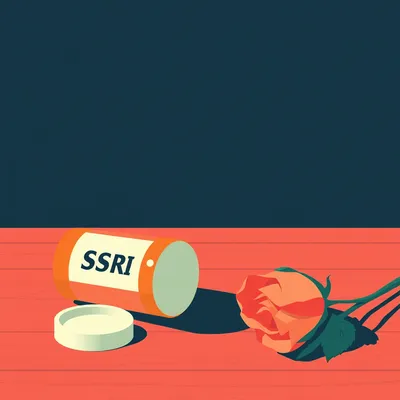
Daniel sent us this one — he's asking why SSRIs can cause heat intolerance and excessive sweating, whether some SSRIs are less likely to trigger it, and what you can actually do about it if you're the person waking up drenched at three in the morning. And honestly, this is one of those side effects that's hiding in plain sight.

It really is. You've got a class of medications that are among the most prescribed on the planet — we're talking tens of millions of people — and they can make you feel like you're living in a sauna you never signed up for. The thing that gets me is the paradox. You take a drug to help your brain regulate mood, and suddenly your body can't regulate its own thermostat.
Which is a strange kind of betrayal. Your brain gets more stable, your body gets less stable. There's something almost poetic about the cruelty of it.
The clinical blind spot on this is enormous. Most patients don't connect the sweating to their medication. They think it's anxiety, or menopause, or just them. Clinicians often don't ask about it unless the patient brings it up, and pharma trials are designed to measure efficacy, not thermoregulation. So you end up with this weird gap where something affects maybe ten to fifteen percent of users and nobody's really talking about it.
Ten to fifteen percent. That's not a rounding error.
It's not. And in the meta-analyses, hyperhidrosis — excessive sweating — is the second most common reason people discontinue SSRIs, right after sexual dysfunction. So we're not talking about a niche complaint. This is a major driver of people quietly stopping a medication that might otherwise be working for them.
Which makes the silence around it even stranger. You'd think something that drives discontinuation at that scale would get more airtime.
Part of it is that sweating feels... It's not as dramatic as a cardiac side effect, it's not as headline-grabbing as something like serotonin syndrome. But if you're the person whose sheets are soaked every night, or who can't walk outside in June without feeling like you're melting, it's not mundane at all. It's disabling.
There's a shame component. People don't want to talk about sweat. It's the armpit stain at the meeting. It's the handshake that feels like grabbing a fish.
And that shame means it goes underreported, which means we have less data, which means clinicians are less equipped to address it, which means patients feel even more embarrassed to bring it up. It's a perfect little doom loop.
Let's break the loop. What's actually happening under the skin when an SSRI turns your internal thermostat into a random number generator?
Right, and to get there, we need to define what we're actually talking about, because "heat intolerance" and "hyperhidrosis" get lumped together but they're not the same thing. Heat intolerance is the feeling — you're uncomfortably hot at temperatures that shouldn't bother you. Normal room feels like a greenhouse. Hyperhidrosis is the output — your body is actually producing more sweat, often at night or during minimal exertion, and often in patterns that don't match what you'd expect from normal thermoregulation.
One is the thermostat reading wrong, the other is the sprinkler system going off.
That's actually perfect. And they can happen independently or together. You can feel like you're roasting without sweating excessively, or you can wake up drenched while feeling perfectly comfortable temperature-wise. The night sweat phenomenon is especially interesting because it decouples sweating from any obvious thermal trigger. You're asleep, your metabolic rate is low, the room is cool, and yet your body is acting like you're running a marathon in July.
Which is what makes it so disorienting. You wake up at three in the morning, sheets soaked, and your first thought isn't "ah yes, my serotonin reuptake inhibition." It's "what is wrong with me.
And that brings us to the prevalence question, because how common is this really? The best data we have comes from a twenty twenty-three -analysis in the Journal of Clinical Psychiatry — forty-seven randomized controlled trials, over twelve thousand patients. They found that across all SSRIs, about ten to fifteen percent of users report excessive sweating as a side effect. But that's almost certainly an underestimate.
Why the lowball?
First, clinical trials don't systematically assess thermoregulatory side effects. If the patient doesn't spontaneously report it, it doesn't get recorded. Second, as you pointed out earlier, there's a shame factor — people are less likely to volunteer "I'm sweating through my clothes" than "I have a headache." Third, many patients and even some clinicians don't make the connection to the medication. They attribute it to anxiety, to the weather, to perimenopause, to "just being a sweaty person now.
Which creates this bizarre situation where we have millions of people on these drugs, a discontinuation rate driven partly by sweating that rivals sexual dysfunction as a reason people quit, and yet the clinical literature on it is surprisingly thin. It's the side effect hiding behind the side effects everyone's already uncomfortable discussing.
Paroxetine is the worst offender by a significant margin. Same -analysis — paroxetine clocks in at twelve to fifteen percent incidence of hyperhidrosis, while escitalopram and sertraline sit around five to seven percent. That's almost a threefold difference between the best and worst SSRI for this particular problem.
The choice of which SSRI you're on isn't trivial here. It's not "all SSRIs cause sweating." There's a spectrum.
There's absolutely a spectrum. And what makes paroxetine particularly nasty in this regard is that it has mild anticholinergic properties that other SSRIs lack, plus a short half-life. So you get both the direct serotonergic effect on thermoregulation and a cholinergic rebound phenomenon when the drug level dips between doses. It's a double hit.
Which we should probably unpack — the receptor-level mechanisms — because that's where this goes from "annoying side effect" to genuinely interesting neuropharmacology.
That's where the hypothalamus becomes the main character.
The preoptic area of the hypothalamus is basically the body's thermostat. It's a cluster of neurons that integrates temperature signals from the skin, the spinal cord, and the blood, then adjusts your set point accordingly. It triggers vasodilation and sweating. Vasoconstriction and shivering. And critically, this circuitry is absolutely soaked in serotonin.
Soaked is doing a lot of work there.
It is, but it's accurate. The preoptic area receives dense serotonergic projections from the raphe nuclei in the brainstem. These neurons release serotonin onto hypothalamic receptors, and that serotonin directly modulates the temperature set point. SSRIs increase synaptic serotonin everywhere, including in this pathway, and that's where the dysregulation begins. You're essentially flooding the thermostat's input with noise.
It's not that the thermostat breaks. It's that someone's leaning on the dial.
The key receptors here are five-HT-two-A and five-HT-three. Activation of five-HT-two-A receptors in the hypothalamus specifically triggers heat dissipation responses — sweating, peripheral vasodilation, the works. Meanwhile, five-HT-three receptors in the brainstem can trigger a vagally-mediated sweating response, often paired with nausea. So you've got two independent serotonergic pathways both capable of making you sweat, and SSRIs are boosting serotonin across both of them indiscriminately.
Which explains why some people get the full-body drenching at night while others just feel vaguely queasy and clammy. Different pathways, same drug.
And this is where the distinction between thermoregulatory sweating and emotional sweating becomes important. Thermoregulatory sweating is whole-body, it's driven by core temperature, and it's what the hypothalamus orchestrates. Emotional sweating is palms, soles, face — it's driven by sympathetic activation and the amygdala. SSRIs can amplify both, but through different mechanisms. The thermoregulatory pathway gets hit by the hypothalamic serotonin overload. The emotional pathway gets hit because SSRIs can initially increase anxiety before the therapeutic effects kick in.
Which must be confusing for patients. You start the medication, your anxiety spikes during the first few weeks, your palms are sweating — and you think, well, this is just my anxiety. But it might not be. It might be the drug.
That's the clinical trap. The patient reports increased sweating, the clinician says it's probably just residual anxiety, and the dose gets raised — which makes the sweating worse. It's a perfect example of how not understanding the pharmacology leads to exactly the wrong intervention.
The timeline matters. If someone's been on an SSRI for six months and suddenly develops night sweats, that's a different story than someone who starts sweating within days of their first dose.
Right, and the within-days presentation tells us something important about individual susceptibility. Some people experience this at therapeutic doses almost immediately. That's not an adaptation effect — that's a direct pharmacodynamic response, which points to genetic variability. CYP-two-D-six metabolizer status is the big one here. Poor metabolizers can have two to three times higher serum concentrations of many SSRIs at the same prescribed dose. If you're a poor metabolizer, your "standard dose" is functionally a high dose, and your serotonin receptors are getting hammered.
Which means two people on the same twenty milligrams of citalopram can have wildly different drug levels and wildly different side effect profiles.
There's a case that illustrates this beautifully. Thirty-two-year-old woman on twenty milligrams of citalopram, develops severe night sweats within two weeks. No prior history of hyperhidrosis, no medical explanation. They switch her to escitalopram — which is basically the purified active enantiomer of citalopram, cleaner receptor profile — and the night sweats resolve completely within ten days. Same therapeutic class, same mechanism, but a substantially different thermoregulatory outcome.
The molecule matters. Not just the mechanism.
The molecule matters enormously. And then there's a third mechanism that we haven't touched yet, which is anticholinergic rebound. Paroxetine is the textbook case here — it has mild anticholinergic properties that most other SSRIs lack. Acetylcholine is the primary neurotransmitter driving sweat gland activation. When you take a drug that partially blocks cholinergic receptors, your body compensates by upregulating them — it builds more receptors to maintain normal signaling.
The body's always trying to get back to baseline.
And then when the paroxetine level dips — which it does frequently because paroxetine has a short half-life — suddenly you've got a full complement of upregulated cholinergic receptors and no blockade. The result is a surge of cholinergic activity, which means sweating. This is why paroxetine is notorious for causing what's called discontinuation-related hyperhidrosis. It's not even the drug directly causing the sweat at that point, it's the body's compensatory response unmasked.
You've got three distinct mechanisms — direct serotonergic dysregulation of the hypothalamic thermostat, five-HT-two-A and five-HT-three receptor activation through different pathways, and anticholinergic rebound in the case of paroxetine. None of them are mutually exclusive. A patient on paroxetine could be experiencing all three simultaneously.
Which is why paroxetine is such a sweaty drug, and why the threefold difference between paroxetine and escitalopram isn't surprising when you look at the receptor pharmacology. Escitalopram is the most selective SSRI we have — it basically only hits the serotonin transporter. Paroxetine hits the serotonin transporter plus muscarinic cholinergic receptors plus noradrenergic reuptake to a degree. It's a dirtier drug pharmacologically, and that dirtiness shows up in the side effect profile.
There's an animal model that makes this concrete. Rats given SSRIs show impaired ability to maintain core temperature in warm environments, and it's specifically mediated by five-HT-two-A receptors. Block those receptors, and the thermoregulatory impairment disappears. It's not a vague correlation — it's a causal pathway.
That's the kind of mechanistic clarity that makes you wonder why we don't have better clinical solutions yet. We know the receptor. We know the pathway. We have drugs that block five-HT-two-A. The translational gap between the rat model and the clinic isn't a mystery — it's a funding and attention gap.
Which brings us to the obvious question. If we know why this happens, what can you actually do about it?
The first practical question most people have is whether you can just switch to a different SSRI and sidestep the problem. The answer, based on head-to-head data, is yes — fairly often. Escitalopram and sertraline consistently show the lowest rates of hyperhidrosis in the literature. That twenty twenty-three -analysis of forty-seven trials puts them at around five to seven percent incidence, versus twelve to fifteen for paroxetine and fluoxetine. That's not a subtle difference. That's a factor of two to three.
Fluoxetine being on the higher end is interesting because people think of it as the clean, long-half-life classic. But it's clearly doing something thermoregulatory that escitalopram isn't.
Fluoxetine's five-HT-two-C agonism may be part of that story — it's not as selective as escitalopram. And then you've got fluvoxamine, which has intermediate risk but honestly the data is thinner. Fewer trials, smaller samples. What we can say with confidence is that paroxetine is the drug to avoid if you're someone who already runs hot or lives in a warm climate. The anticholinergic component plus the short half-life make it the triple threat we described.
What about vortioxetine? It's not technically an SSRI but it gets lumped in the conversation constantly.
Vortioxetine is interesting because its receptor profile might actually be protective here. It's a serotonin transporter inhibitor but also a five-HT-three antagonist and a five-HT-one-A agonist. The five-HT-three antagonism in particular may blunt that brainstem-mediated sweating pathway. The clinical data isn't massive yet, but the reported hyperhidrosis rates are lower than what you see with classic SSRIs. It's a plausible pharmacological story.
If someone's on paroxetine and sweating through their shirts, the first conversation with their doctor should be about escitalopram, sertraline, or vortioxetine as alternatives.
If you want to get completely out of the serotonergic thermoregulatory crossfire, there are non-SSRI options. Bupropion is the standout — it's an NDRI, norepinephrine and dopamine reuptake inhibitor. It doesn't touch serotonin at all. Reported sweating incidence in trials is under two percent. For someone whose depression responds to dopaminergic and noradrenergic mechanisms, it's basically a free pass on this side effect.
The catch being bupropion doesn't treat anxiety disorders the way SSRIs do, and it lowers the seizure threshold. So it's not a universal substitute.
Mirtazapine is another option — it's a NaSSA, works on noradrenergic and specific serotonergic receptors, and has low rates of sweating. But it causes significant weight gain and sedation, which for some people is a dealbreaker. Agomelatine is a melatonin agonist with minimal thermoregulatory effects and a clean side effect profile, but it's not available in the US — mainly Europe and Australia.
There's a trade-off matrix. Every alternative solves one problem and introduces another.
Which is why for many people the practical answer isn't switching — it's managing the side effect on the drug that's otherwise working. And there are strategies with actual evidence behind them. Dose timing is the simplest one. If you take your SSRI at night, the peak serum concentration hits while you're asleep, which can shift the worst of the sweating into the overnight hours rather than ruining your workday. It doesn't eliminate the sweat, but it moves it somewhere less socially costly.
Which is the pharmacological equivalent of sweeping it under the rug — but honestly, for some people, that's enough.
Dose splitting is another free intervention. Instead of twenty milligrams once daily, take ten milligrams twice daily. You reduce the peak serum concentration, which reduces the peak serotonergic activation at the hypothalamus. Same total daily dose, lower side effect burden. It works best with drugs that have shorter half-lives where the peak-trough swing is more pronounced.
Then there are the add-on drugs. Cyproheptadine keeps coming up.
Cyproheptadine is a first-generation antihistamine that also happens to be a five-HT-two antagonist. It directly blocks the receptor mediating the hypothalamic sweating response. There was a small open-label trial — twenty-eight patients, published in Psychopharmacology — where cyproheptadine four milligrams at bedtime reduced SSRI-induced night sweats by sixty percent. It's not a huge study, but the effect size is substantial and the mechanism makes sense. The downside is sedation and, at higher doses, the theoretical risk of reversing the antidepressant effect since you're blocking serotonin receptors.
Which is the nightmare scenario — you stop sweating but your depression comes back.
Which is why it should only be used at low dose and under supervision. Terazosin is another option — it's an alpha-one blocker, originally for hypertension and BPH. It reduces sympathetic outflow to sweat glands. The evidence is mostly case series rather than controlled trials, but the signal is consistent. Again, side effects include orthostatic hypotension — you stand up, you get dizzy.
The add-on drug route is real, but it's not "pop a pill and forget about it." It's "pop a pill, monitor your blood pressure, watch your mood, and don't stand up too fast.
Then there's the lifestyle layer. Cooling vests, hydration protocols, avoiding triggers like caffeine, alcohol, and spicy food — all of which independently activate thermoregulatory and sudomotor pathways. Caffeine is a methylxanthine that increases sympathetic tone. Alcohol causes vasodilation. Spicy food activates TRPV-one receptors — the same heat-sensing receptors that tell your hypothalamus it's hot. You're adding thermoregulatory noise on top of a drug that's already scrambling the signal.
Your afternoon coffee and your dinner with chili flakes are basically pouring gasoline on a fire you didn't know was lit.
The most evidence-based intervention of all, honestly, is switching. Not adding drugs, not buying a cooling vest — just switching to an SSRI with a lower incidence rate. The data is clear, the mechanism is understood, and it's the one intervention that addresses the root cause rather than papering over it.
Which brings us to what actually matters if you're sitting in a doctor's office or staring at a prescription bottle. First thing — and I think this is the one that would've saved me years of confusion if I'd known it — if you're on an SSRI and you're suddenly sweating through situations that never made you sweat before, don't let anyone tell you it's just anxiety.
It's not just anxiety. Anxiety sweating is primarily emotional — palms, face, armpits, triggered by specific situations. SSRI-induced hyperhidrosis is thermoregulatory. It happens at rest, during sleep, in air-conditioned rooms. If you're waking up with soaked sheets on a cool night, that's not your amygdala, that's your hypothalamus getting bad serotonergic instructions.
The shame component we talked about earlier means people sit on this for months or years assuming it's a personal failing rather than a documented pharmacological effect. It's not. It's your thermostat, not your character.
Second actionable point — if you haven't started an SSRI yet and you're someone who already runs hot or lives in a warm climate, escitalopram and sertraline are your friends. Five to seven percent hyperhidrosis incidence versus twelve to fifteen for paroxetine. That's not a rounding error. Paroxetine should basically come with a warning label for people in Phoenix or Tel Aviv.
Third — before you add another drug or switch entirely, try the free stuff. Dose timing at night moves the sweating to hours when you're unconscious and not in a meeting. Dose splitting reduces the peak serum concentration that triggers the hypothalamic overreaction. Neither costs anything, neither requires a new prescription.
If those don't work and switching isn't an option — because the drug is otherwise effective and you've tried alternatives — cyproheptadine four milligrams at bedtime has real evidence behind it. Sixty percent reduction in night sweats in that open-label trial. Terazosin is the backup. But both come with side effects — sedation, orthostatic hypotension — and the cyproheptadine conversation has to include the theoretical risk of blunting the antidepressant effect. Medical supervision only.
The bigger picture here is worth sitting with. This side effect is a window into how serotonin modulates autonomic function broadly. The same serotonergic pathways that dysregulate sweating also drive the GI issues, the sexual dysfunction, the sleep architecture changes. They're not separate problems — they're different expressions of the same underlying mechanism. Understanding one helps you understand all of them.
Which means if you're experiencing this, you're not just dealing with an inconvenient sweat problem. You're getting a live demonstration of how your autonomic nervous system responds to serotonergic drugs. That's information you and your doctor can use to make smarter decisions about everything else — from dose to timing to whether a non-serotonergic alternative like bupropion makes sense for you.
The checklist is: recognize it's the drug, not anxiety. Know which SSRIs are the sweaty ones. Try dose timing and splitting. Consider cyproheptadine or terazosin as adjuncts only if needed. And treat the whole thing as diagnostic information about your autonomic system, not just an embarrassing side effect to hide.
One final thought that keeps me up at night — and it involves climate change.
We just talked about the shame of night sweats and the thermostat gone haywire. Now layer on top of that a world where extreme heat events are becoming more frequent and more intense. There's emerging research — still early, but worth paying attention to — on how psychotropic medications affect heat stroke risk during heat waves. SSRIs, antipsychotics, anticholinergics — they all impair thermoregulation to varying degrees. And the concern is that as ambient temperatures climb, the margin between "uncomfortably sweaty" and "medically dangerous" narrows.
Because at some point it stops being a social inconvenience and becomes hyperthermia.
Your body's ability to dissipate heat is already compromised by the drug. Add a heat wave where the ambient temperature exceeds your core temperature, and you can't shed heat even if your thermoregulatory system were working perfectly. Now imagine it's not working perfectly. There have been case reports of SSRI users presenting with heat stroke at lower temperatures and shorter exposure times than would be expected. The data isn't systematic yet, but the signal is there.
We're looking at a future where a side effect that was always treated as manageable — annoying, but not dangerous — becomes a genuine clinical risk factor for a growing portion of the population.
The population on antidepressants is not small. We're talking tens of millions of people globally. If even five percent of them have clinically significant thermoregulatory impairment, that's a massive cohort of heat-vulnerable individuals that our public health systems aren't tracking and our heat wave response plans aren't accounting for.
Which brings us to the question of whether pharmacology can solve a problem that pharmacology created. You mentioned thermoneutral antidepressants earlier — drugs that spare the serotonergic thermoregulatory pathways while maintaining the mood effects.
It's an active area of research, but we're years away from clinical candidates. The challenge is that the serotonergic receptors involved in mood regulation — five-HT-one-A, five-HT-two-A in some circuits — overlap substantially with the receptors involved in thermoregulation. Disentangling them is not trivial. You're essentially asking for a drug that selectively modulates serotonin in the prefrontal cortex and limbic system while leaving the hypothalamus untouched. That's a targeting problem we don't know how to solve yet.
It's the pharmacological equivalent of trying to renovate the kitchen without turning off the water to the whole house.
Some researchers are looking at biased agonism — drugs that activate only specific downstream signaling pathways from a receptor rather than all of them. A five-HT-two-A biased agonist might trigger the intracellular cascades relevant to mood without triggering the ones relevant to heat dissipation. But that's molecular pharmacology at the frontier. We're not close to a pill you can pick up at the pharmacy.
For now, and for the foreseeable future, the answer is not a magic drug that fixes depression without touching your thermostat. The answer is the checklist we just laid out, plus awareness, plus reporting.
On the reporting point — this is important. If you've experienced this side effect, tell your prescriber. But also report it to the FDA's MedWatch system. The reason we don't have better data on SSRI-induced hyperhidrosis is underreporting. Clinical trials aren't designed to capture it systematically. Post-marketing surveillance depends on voluntary reports. If patients don't report, the signal stays buried. And if the signal stays buried, the next generation of drugs doesn't get designed to avoid it.
It's a feedback loop where silence perpetuates the problem. Every report filed is a data point that tells researchers and drug developers this matters. That sweating isn't just a footnote — it's a quality of life issue that drives discontinuation, that affects adherence, that in a warming world might become a safety issue.
It's not just for the FDA. The same logic applies to whatever regulatory body covers your country — the MHRA in the UK, the TGA in Australia, Health Canada. These systems exist precisely so that side effects that weren't caught in clinical trials get documented and analyzed. But they only work if people use them.
The final thought I want to leave people with is this: the sweating isn't trivial, it isn't just anxiety, and it isn't something you have to endure in silence. It's a window into how your brain and body talk to each other. And in a weird way, understanding the mechanism — the hypothalamus, the five-HT-two-A receptors, the autonomic cascade — that understanding is itself a kind of power. You can't advocate for yourself if you don't know what's happening. Now you know.
Now: Hilbert's daily fun fact.
Hilbert: In the early nineteen hundreds, Aleutian islanders preserved seabird meat by sewing the birds whole into sealskin bags and burying them in cold peat bogs, where anaerobic fermentation would render the contents edible for up to two years. The method was abandoned after canning reached the islands, and for decades anthropologists dismissed accounts of it as exaggeration — until a intact bag was excavated in nineteen seventy-two and the contents were, reportedly, still technically edible.
...right.
This has been My Weird Prompts. Our producer is Hilbert Flumingtop. You can find us at myweirdprompts dot com, and if you found this useful, leave us a review wherever you listen — it helps people find the show.
We'll be back soon. Until then, stay cool.