Daniel sent us this one — he's been thinking about that snowmobile problem we dug into, the whole idea that sometimes the data's so vast that physically trucking it beats fiber. But now he's asking: what happens when the data needs to cross an ocean, and it needs to move fast? Picture two government labs, one in the US, one in Japan, racing to develop a vaccine. One side has run a massive protein simulation — petabytes of raw output. The health of humanity's on the line, and the clock is ticking. Are there specialist courier services that handle urgent physical data transfer across continents with the same sophistication those trucks do? And honestly, the answer is yes, and the whole operation is weirder and more intense than I expected.

It's so much weirder. I went down a rabbit hole on this and came out genuinely stunned. The most urgent data transfer on Earth right now might not be traveling through fiber at all — it's in a reinforced Pelican case, sitting in the cargo hold of a passenger jet, handcuffed to a courier with a diplomatic passport. That's not a hypothetical. That's happening somewhere this week.
Of course it is.
The handcuff is actually a specific product. There's a company that makes a reinforced steel cable tether with a tamper-evident lock designed specifically for data couriers. The case never leaves the courier's person — not in the security line, not in the lavatory, not at baggage claim. Chain of custody is continuous, visual, and physical.
We're not talking about FedEx with extra insurance.
Not even close. And that's the first thing to understand about this world. Standard couriers — FedEx, DHL, UPS — they're not built for this. They don't offer the encryption verification at handoff, the customs pre-clearance for sensitive scientific data, or the human-chain-of-custody model. Their entire system is designed around the premise that a package can leave your hands, enter a sorting facility, get scanned, get routed, and arrive intact. For a petabyte of pathogen genomic data with a forty-eight-hour deadline, that premise falls apart.
Let's back up to the scale question, because I think that's where the whole thing snaps into focus. The prompt is asking about a scenario where the data volume is so large that even a fast internet connection can't get it there in time. What's the actual math on that?
Here's the benchmark. A one-petabyte dataset over a dedicated ten-gigabit-per-second link takes roughly eleven days to transfer. That's assuming the connection is stable, there's no packet loss, no congestion, and you're getting the full ten gigs sustained — which, across the Pacific, is optimistic. Now compare: a courier on a twelve-hour flight from San Francisco to Tokyo can deliver that same petabyte in under twenty-four hours door-to-door, including ground transit on both ends. Even if you had a hundred-gigabit link, which most research institutions don't have as a dedicated international pipe, you're still looking at over twenty-four hours of pure transfer time. The plane wins.
The cost difference has to be staggering.
Roughly fifty to a hundred dollars per gigabyte for an urgent air courier shipment, versus about two cents per gigabyte for cloud egress. So we're talking a multiple of twenty-five hundred to five thousand times the cost.
Which sounds insane until you frame it against the cost of delay. If a vaccine delay costs two billion dollars a day in economic impact — and that's a real estimate from pandemic modeling — then a quarter-million-dollar courier shipment is basically a rounding error.
And that's the mental shift that makes this whole sector make sense. You're not paying for data transfer. You're paying for time. And when the value of time is measured in billions per day, the economics flip completely.
Who actually does this? Who are the players?
There are a handful. You've got the cloud providers themselves — AWS has the Snow Family, and Snowball Edge devices can be shipped internationally. But for truly urgent, high-security transfers, the cloud providers aren't really the go-to. The specialists are firms you've probably never heard of. There's a company called Data Expedition that's been doing this since the early two-thousands. There's Rapid Data Movers, which spun out of a scientific computing consultancy. iXsystems has a Sneakernet service that's more domestic but has done international work. And then there are the niche operators — firms like CourierNet and DataFleet that exist almost entirely to serve scientific consortia and government labs. Some of them have only a few dozen employees but handle petabyte-scale shipments weekly.
What does the actual hardware look like? Because I'm picturing something more sophisticated than a suitcase full of external drives.
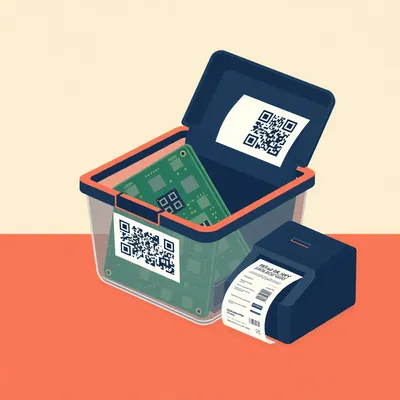
The standard unit is a hardened storage array — typically a four-U or five-U rackmount chassis that's been re-engineered for transport. Inside, you're looking at high-density SSDs, often a hundred terabytes each, configured in RAID or ZFS with multiple levels of redundancy. The whole thing is shock-mounted, temperature-controlled, and rated for the pressure and vibration extremes of a cargo hold. Some units use helium-filled drives to reduce weight — that's a trick borrowed from the data center world. The exterior is a reinforced Pelican-style case with multiple layers: an outer shell, a foam shock layer, an inner Faraday cage lining to block electromagnetic interference or, frankly, attempts at wireless exfiltration. Each unit has its own GPS tracker, an accelerometer to detect tampering, and a cryptographic module that verifies the data integrity at handoff.
The Faraday cage lining. So we're defending against someone trying to read the drives through the case?
It's a real attack vector. If you can get within close proximity to a running storage array, you can pick up electromagnetic emissions and reconstruct data. It's called a TEMPEST attack. For most data, this is science fiction. For a government-to-government vaccine collaboration involving pathogen genomic data, it's a legitimate concern.
The courier themselves — what's their training look like?
This was the part that really got me. These aren't just delivery drivers. Many of these couriers come from executive protection backgrounds — former military, former diplomatic security. They're trained in tamper detection, hostage situations, and what's called "dead man's switch" protocols. The storage arrays can be configured to wipe themselves if they don't check in within a certain window — say, twenty-four hours without a cryptographic heartbeat from the courier's authentication device. Some firms require their couriers to carry two forms of satellite communication, independent of the aircraft's systems, so they can send status updates even mid-flight.
A dead man's switch for data. That's the most cyberpunk thing I've heard in months.
It gets more elaborate. The handoff protocol at the destination is scripted down to the minute. The receiving team has to present pre-registered credentials — not just IDs, but cryptographic keys that match the ones embedded in the shipment's security module. The data isn't considered "delivered" until both parties run a checksum verification that can take hours. If the checksums don't match, the shipment is treated as compromised, and neither party touches it until a security team arrives.
The courier lands, walks off the plane, goes through customs — how does customs even work with this? You can't exactly declare "one petabyte of encrypted pathogen data" on a standard form.
This is where it gets into international law territory that most technologists never encounter. These shipments often travel under what's called a carnet — an international customs document that pre-clears the contents for temporary import and re-export. For government-to-government transfers, some shipments use diplomatic pouches, which under the Vienna Convention cannot be opened or detained by customs authorities. For non-diplomatic but still sensitive scientific shipments, firms can apply for "trusted shipper" status with customs agencies in multiple countries, which means the hardware and the courier are pre-vetted and the shipment gets expedited clearance.
What about export controls? Encryption software is regulated under ITAR in the US. If you're shipping a petabyte of AES-two-fifty-six encrypted data to a lab in Tokyo, are you technically exporting munitions?
You've hit on one of the great legal gray zones of this whole field. Technically, encryption technology is subject to export controls. In practice, the data itself — encrypted at rest — doesn't trigger ITAR in most cases because you're not exporting the encryption technology, you're exporting encrypted data. But the line gets blurry when the storage array itself contains the encryption implementation. Most firms get around this by using hardware that's pre-approved for international shipment and by filing the appropriate Commerce Department licenses in advance. It adds weeks to the preparation timeline, which is why you don't set up one of these shipments on a Tuesday for a Wednesday flight.
There's a whole pre-clearance bureaucracy that has to be navigated before the courier even gets to the airport.
That's the part that most people don't see. The physical transit is the dramatic part — the courier, the plane, the handcuffs. But the real sophistication is in the preparation: the legal work, the customs filings, the encryption verification, the chain-of-custody documentation that will hold up in court if something goes wrong. A single international courier shipment can involve weeks of prep work by a team of lawyers, security specialists, and logistics coordinators.
Let's talk about a real case, because I know you found some.
In twenty twenty-three, the Human Genome Project's Asian consortium needed to ship two point three petabytes of sequencing data from Singapore to Boston. They had a grant deadline — the data had to be physically present in a US facility for analysis, and the network transfer would have taken weeks. They contracted a specialist courier service. The shipment cleared Singapore customs in under two hours using pre-cleared trusted shipper status, flew commercial with a dedicated courier, and cleared US customs in Boston in under four hours. Total door-to-door time: under forty-eight hours. If they'd tried to pipe it over the network, they'd have missed the deadline by two weeks.
That's not even an emergency scenario — that's just a grant deadline.
Now compare with the Large Hadron Collider's CMS experiment. They ship about ten petabytes of data annually between CERN and US labs, but they do it via hard drives in checked luggage on commercial flights. That's not urgent — it's routine batch transfer. The drives go in a padded case, a grad student checks them, and they fly coach. It works because the time pressure isn't there.
The grad student is the courier. That's both charming and terrifying.
It works for their use case. But the prompt is asking about the high-stakes version — the pandemic response scenario where every hour counts. And there's actually a fascinating real precedent. In twenty twenty-five, the WHO established a pandemic response protocol that pre-positions encrypted storage arrays at partner labs around the world. The idea is that if a novel pathogen emerges, the sequencing data doesn't have to wait for a courier to be arranged — the hardware is already on site, pre-cleared for international shipment, and a courier can be activated within hours.
It's like pre-positioning military equipment. The data infrastructure equivalent of having a fleet of C-seventeens ready to go.
And speaking of military aircraft — there's a whole emerging concept of what I've seen called "hypersonic courier" services. The idea is using military transport aircraft — C-seventeens, Ospreys — for sub-six-hour global delivery of critical datasets. It's not operational yet, at least not publicly, but the US Department of Energy's ESNet has a standing contract with a courier firm for what's called "emergency data bypass." The language in the contract is fascinating — it treats physical data transport as a strategic backup to network infrastructure.
Which brings us to the geopolitical angle. The Red Sea cable cuts in twenty twenty-four — what did that do to this market?
It caused a forty percent spike in physical data courier bookings for emergency transfers. When those undersea cables got severed — and we still don't know exactly how, though the Houthi connection was widely discussed — a huge amount of traffic between Europe and Asia had to reroute. Some of it went the long way around Africa via other cables. But for organizations that couldn't tolerate the latency spike, the answer was: put it on a plane. Courier firms saw a surge in inquiries from companies that had never considered physical transport before.
There's something almost reassuring about that. When the most advanced communications infrastructure on Earth gets cut, the backup plan is a person on a plane with a box.
The laws of physics don't care about our network abstractions. A Boeing seven-eight-seven flying at five hundred and sixty miles per hour can move about a hundred and fifty terabytes per hour across the Pacific, if you pack it with high-density storage. No undersea cable can match that throughput. The latency is higher — twelve hours instead of sixty milliseconds — but for bulk data, throughput is what matters, and the plane wins on throughput by orders of magnitude.
Let's model the prompt's hypothetical more concretely. US lab and Japanese lab collaborating on a vaccine. The US lab has run a massive protein folding simulation — say, five petabytes of raw output. The Japanese team needs it to start their analysis. What does that operation actually look like?
Step one: the US lab doesn't just copy the data onto drives. They stage it onto a pre-configured storage array that's already been through the legal clearance process. This array has been sitting in their facility, pre-vetted by customs authorities in both countries, with all the export licenses already filed. Step two: they run a full checksum on the data, generate a cryptographic hash, and store that hash separately — it'll be sent to the Japanese team via a secure channel for verification at the other end. Step three: the courier arrives, verifies their identity, physically takes custody of the array. The handoff is documented with timestamps, GPS coordinates, and biometric authentication. Step four: the courier proceeds to the airport. If it's a government-to-government transfer, they may travel under diplomatic protocols, which means the case cannot be opened by airport security. Step five: the array flies commercial — usually in the cargo hold, sometimes in a purchased seat if the case is small enough. The courier is on the same flight, tracking the case's GPS and accelerometer data in real time. Step six: landing in Tokyo, the courier clears customs through the pre-arranged fast-track process. Step seven: ground transport to the receiving lab, where the Japanese team presents their pre-registered credentials, runs the checksum verification against the hash that was sent separately, and confirms data integrity. Total elapsed time: fourteen to eighteen hours from door to door. Cost: roughly two hundred and fifty thousand dollars for a five-petabyte shipment.
Two hundred and fifty thousand dollars. And the alternative is what — waiting nine days over a hundred-gigabit link?
A hundred-gigabit dedicated international link isn't something most research institutions have just sitting there. You'd be looking at eleven to fourteen days of continuous transfer, assuming no interruptions. And during a pandemic response, fourteen days is an eternity.
There was a real case recently that maps onto this, right? The Japanese fusion research shipment.
January twenty twenty-six. The QST institute in Japan — that's the National Institutes for Quantum Science and Technology — shipped eight hundred terabytes of plasma simulation data to the Princeton Plasma Physics Laboratory. They used a modified Snowball Edge device with helium-filled drives to cut weight. The shipment arrived in fourteen hours door-to-door. The alternative was a nine-day transfer over a hundred-gigabit link. That's not a hypothetical — that's a real shipment that happened five months ago.
Helium-filled drives. Explain that one.
Hard drives have a sealed chamber filled with helium instead of air. Helium is less dense than air, which means less turbulence inside the drive, which means the read-write heads can be positioned more precisely, which means you can pack more platters into the same physical space. It also reduces power consumption and heat. For a data center, helium drives mean higher density and lower cooling costs. For a courier shipment, helium drives mean you can fit more terabytes into the same weight allowance. Airlines care about weight. Every kilogram matters.
The drive manufacturers accidentally built the perfect courier medium.
Accidentally, but the courier firms were quick to notice. Some of them now specify helium drives as a requirement for their highest-density shipments.
Let's talk about what happens when things go wrong. Because this whole model is built on a chain of trust and physical security, and chains break.
There's a taxonomy of failure modes. The simplest is a missed connection — the courier's flight gets delayed, and suddenly your fourteen-hour SLA is blown. Most firms handle this by booking the courier on multiple airlines simultaneously, with backup itineraries. The courier shows up at the airport with tickets for three different flights and takes the first one that's on time. It's expensive, but compared to the cost of missing a deadline, it's trivial. The more serious failure is loss or theft. If a courier shipment goes missing, the standard protocol is to trigger the remote wipe — assuming the dead man's switch hasn't already activated. The data is encrypted at rest with AES-two-fifty-six, so even if someone physically possesses the drives, they can't read them without the keys. And the keys are held separately — they're not on the array, they're not with the courier, they're with the sending and receiving institutions.
What about tampering? Someone intercepts the shipment, opens the case, swaps a drive, reseals it.
Tamper-evident seals are the first line of defense — the kind that show visible damage if breached, with serial numbers that are documented at every handoff. But the real defense is cryptographic. The checksum verification at the destination would immediately detect that the data had been altered. If even a single bit is wrong, the hashes won't match. And the receiving team doesn't just check the overall hash — they do spot checks on random subsets of the data. If a drive was swapped, the spot check would catch it with near-certainty.
The courier themselves — what's to stop someone from compromising the courier?
This is where the training comes in. Couriers are vetted to the level of security clearance that the shipment requires. For government work, that often means a TS-SCI clearance in the US or equivalent in other countries. They're trained to detect surveillance, to avoid predictable patterns, and to maintain constant physical control of the shipment. Some firms use two-courier teams for the highest-value shipments — one handles the logistics, the other never takes their eyes off the case. It's the nuclear football model.
The nuclear football. So we really are at that level of protocol for some of these shipments.
For pathogen data during a pandemic response? The data is a strategic asset. Its loss or compromise could delay a vaccine by weeks, and the downstream cost of that delay is measured in lives and billions of dollars.
Let's shift to the knock-on effect, because this is where it gets interesting. The existence of these services changes how labs think about data. If you know you can ship five petabytes to Tokyo in eighteen hours, you stop optimizing your workflows for network transfer.
That's exactly what's happened. I've talked to researchers — well, read papers by researchers — who now design their data pipelines around a weekly courier run. They batch everything, stage it onto an array, and ship it. They treat physical transport as a scheduled bandwidth-on-demand service. The cloud providers have noticed this too. AWS's Snow Family is explicitly designed for this use case — you order a Snowball, load it up, ship it back, and they ingest it into S3. The international variant uses air freight and handles customs clearance as part of the service.
The cloud providers are cannibalizing their own network revenue with physical shipping because physics forces them to.
Better to cannibalize yourself than let a competitor do it. And the margins on these physical transfer services are actually quite good once you've built the infrastructure. The storage arrays are reusable — they get shipped back, wiped, and redeployed. The couriers are the variable cost, and for the highest-end shipments, the customer pays that cost with a substantial premium.
What's the environmental angle on this? We talk about the carbon footprint of data centers, but what's the carbon footprint of flying petabytes around the world?
It's not great, but it's also not as bad as you might think when you compare it to the alternative. A single passenger on a round-trip San Francisco to Tokyo flight generates about two tons of carbon dioxide. The courier's flight adds that to the ledger. But if the alternative is running a hundred-gigabit link at full capacity for eleven days, that network infrastructure has its own energy cost — the routers, the amplifiers on the undersea cable, the data center equipment on both ends. I haven't seen a rigorous lifecycle analysis, but my instinct is that for the largest datasets, the plane might actually be more carbon-efficient per terabyte transferred, simply because the energy density of jet fuel versus the energy consumption of sustained high-bandwidth network equipment over many days... it's closer than you'd think.
That's a counterintuitive take. The plane might be greener than the fiber.
For petabyte-scale transfers, it's at least debatable. For smaller transfers, the network wins easily. There's a crossover point, and I suspect it's somewhere in the hundreds of terabytes for intercontinental transfers.
Let's talk about the future. The prompt mentions satellite internet — Starlink, laser links, all of that. Does that eventually kill the physical courier market?
Not for the largest datasets. Starlink's v2 satellites have laser interlinks, which is impressive technology, but the total throughput of the constellation is still finite and shared across all users. You're not going to get a dedicated petabyte-scale pipe through Starlink. The physics of RF and optical spectrum allocation just don't support it. Where satellite helps is for the medium-sized transfers — the ones that are too big for a standard internet connection but not big enough to justify a courier. Satellite raises the threshold at which physical transport becomes necessary, but it doesn't eliminate the need.
What about six-G terrestrial networks? The hype cycle says six-G will give us terabit-per-second speeds.
Terabit-per-second is the theoretical peak. Real-world, shared across users, with overhead and congestion — you're not getting a sustained terabit for eleven days straight. And even if you could, a petabyte at a terabit per second is still over two hours of transfer time. For ten petabytes, you're back to over a day. And that's assuming the infrastructure exists, which it doesn't — six-G is still in the research phase. By the time six-G is deployed at scale, the datasets will have grown too. The data volume always seems to expand to fill the available bandwidth.
The Red Queen effect. You run faster to stay in the same place.
The plane still wins on throughput. A cargo hold full of high-density storage has a data transfer rate that no network is going to match in the foreseeable future. The latency is terrible, but the bandwidth is effectively infinite.
Where does this go? What's the next evolution?
I think we're going to see the emergence of what I'd call "data diplomacy" — treating physical data shipments as a form of scientific currency, with dedicated trade routes and bilateral agreements. Imagine a "Data Schengen" zone where pre-cleared research data can move between participating countries with minimal customs friction. We're already seeing the early signs of this with the WHO's pre-positioned storage arrays and the bilateral agreements between US and Japanese research institutions. The next step is formalizing it — treaties that specifically address the physical transport of scientific data, with standardized security protocols and mutual recognition of chain-of-custody documentation.
A Data Schengen zone. That's a provocative idea.
It's already happening in miniature. The EU has something called the European Open Science Cloud, which includes provisions for physical data transport between member states. It's not called a Schengen zone for data, but that's effectively what it is — pre-cleared, frictionless movement of research data across borders.
The counterpoint — what about data sovereignty? Countries that want to keep scientific data within their borders?
That's the tension. Physical data transport makes data sovereignty harder to enforce, because the data physically leaves the country. A government that's concerned about losing control of its scientific output might restrict courier shipments even if the network alternative is slower. We saw some of this during the early pandemic response — countries hoarding genomic data, restricting its export, even though sharing it would have accelerated vaccine development. The physical courier model assumes a willingness to share that isn't universal.
The courier is a physical manifestation of scientific collaboration. When collaboration is strong, the couriers are busy. When it's not, the cases sit in storage.
That's a beautiful way to put it. The health of the courier industry is a leading indicator of global scientific cooperation.
Let's bring this back to practical ground. If someone listening is working with datasets over a hundred terabytes and needs cross-continental transfer in under forty-eight hours — what do they actually do?
First, know the providers. The big ones are iXsystems for the Snowball-style approach, AWS's international Snow Family if you're already in that ecosystem, and then the specialists — Data Expedition, Rapid Data Movers, CourierNet, DataFleet. Second, budget for it early. The cost is fifty to a hundred dollars per gigabyte, but that includes the hardware rental, the courier, the customs handling, and the insurance. Factor in customs clearance time — four to twenty-four hours depending on the countries involved — and always have a backup plan. Start a parallel network transfer even if you're using a courier. If the courier shipment gets delayed, you've at least got partial data moving over the wire.
The preparation — you can't just call these firms on a Tuesday.
If you're in a field that generates large datasets — genomics, climate modeling, particle physics, machine learning training data — establish a relationship with a specialist courier before you need it. Pre-clear your hardware with customs. Test the workflow with a small shipment first — send a hundred terabytes domestically, then try an international run. Know what the handoff protocol looks like. Know who on your team is authorized to sign for the shipment. The worst time to figure all this out is during a crisis.
The "test your backup generator before the storm hits" principle.
And yet, how many research groups actually do this? Most of them discover the need for a courier service at the worst possible moment and then scramble. The smart ones have a standing relationship and a tested protocol.
What questions should they ask when evaluating a courier firm?
One: what's your encryption standard, and can you prove it? You want AES-two-fifty-six at rest, with the keys held separately from the data. Two: what's your tracking granularity? You should be able to see the GPS location of your shipment in near-real-time, plus accelerometer data that tells you if the case was dropped or jostled. Three: what's your insurance coverage, and what are the exclusions? Some policies exclude "acts of war" or "civil unrest" — and if your data is going through a geopolitically unstable region, that matters. Four: what's your courier vetting process? Ask about security clearances, training certifications, and whether the courier has experience with scientific data specifically.
That's a checklist worth writing down. And the last point — the courier's familiarity with scientific data — I wouldn't have thought of that.
It matters more than you'd think. A courier who's moved genomic data before understands the stakes. They know that the box they're carrying isn't just expensive hardware — it's years of research, irreplaceable data, and in some cases, the basis for life-saving treatments. That psychological dimension affects how they behave at every step of the journey.
The next time someone hears about a breakthrough in fusion energy or a new vaccine, they should remember: the data that made it possible might have traveled in a suitcase, not a cable.
It might have been handcuffed to a former special forces operator with a diplomatic passport and a dead man's switch.
The invisible infrastructure. It's always more interesting than the thing it supports.
And this particular corner of it — the intersection of high-energy physics, international law, cryptographic security, and commercial aviation — is one of the richest I've encountered. It's a whole hidden profession.
To wrap this around the original question: yes, there are specialist courier services that handle urgent physical data transfer across continents with extraordinary sophistication. They're not just viable for the scenario described — they're often the only option that meets the deadline. The cost is eye-watering, but in the context of a pandemic response or a fusion breakthrough, it's trivial. And the whole operation — the hardware, the legal framework, the courier training, the cryptographic verification — is built to a standard that most people don't realize exists outside of military logistics.
That's the thing I want people to take away from this. When we talk about "moving data to the cloud" or "transferring datasets," the mental model is usually a progress bar on a screen. But for the most critical data on Earth, the transfer mechanism is a human being on an airplane with a reinforced case and a security clearance. The digital and the physical aren't separate domains — they converge in ways that are stranger and more wonderful than the abstractions we usually reach for.
The cloud is just someone else's computer. And sometimes, that computer is in a Pelican case at thirty-five thousand feet.
With a dead man's switch.
With a dead man's switch.
Now: Hilbert's daily fun fact.

In Edo period Japan, sumptuary laws restricted pet ownership by social class — but an exception was carved out for rats, which were classified not as vermin but as "honorary livestock" due to their role in controlling silkworm parasites. A rat that died in service to a silk merchant's household was sometimes entombed in a miniature shrine. Meanwhile, in interwar Namibia, a German colonial ordinance briefly required that any domestic cat found more than two kilometers from a farmstead be reclassified as a "feral asset of the state" and conscripted into grain warehouse pest control — a bureaucratic transmutation of house pet into civil servant.
A cat conscripted into civil service.
The open question we'll leave you with: as satellite bandwidth improves and edge computing proliferates, does the physical courier become a relic of the twenty-twenties, or does it evolve into a permanent fixture for the largest datasets? The laws of physics suggest the latter — but the history of technology is littered with things the laws of physics said we'd always need.
My bet is on permanence, but specialization. The courier market won't die — it'll bifurcate. High-security, time-critical, petabyte-scale shipments will remain a niche service indefinitely, because the throughput advantage of physical transport is fundamental, not a temporary gap that technology is closing. What changes is the threshold. In ten years, maybe you only need a courier for datasets over five petabytes. But the need itself doesn't vanish.
Thanks to our producer Hilbert Flumingtop. This has been My Weird Prompts. If you enjoyed this dive into the hidden logistics of science, rate the podcast and share it with a colleague who still thinks the cloud is always the answer.
They're probably wrong about a few other things too.