Daniel sent us this one — and it comes with a live field report. He put on a ten-second YouTube clip of the Teletubbies sun-baby for Ezra, and Ezra, who is eleven months old, just started crying. Not fussing, not startled — crying, as this giant infant face crested the horizon like a deity checking in on its creation. And the question is: what is actually happening there? And why do so many adults who watched this show as kids feel something closer to revulsion than nostalgia when they see it now?

This is one of those shows where the design is so precise and so strange that our adult brains are still reacting to engineering decisions made thirty years ago for an audience that couldn't yet talk. The Teletubbies wasn't just weird children's television. It was the first show ever designed for pre-verbal infants, and the discomfort adults feel is a side effect of how thoroughly it succeeded.
Let's start with what this thing actually was, because I think a lot of people remember the broad strokes but not the full strangeness of the premise.
The show premiered on March thirty-first, nineteen ninety-seven, on BBC Two's CBeebies strand. It was created by Anne Wood, who founded Ragdoll Productions, and Andrew Davenport, who also voiced Tinky Winky. The premise is essentially post-human pastoralism. Four large, colorful creatures with television screens embedded in their abdomens live in a domed house in a rolling green landscape. They speak in baby-babble, repeat actions obsessively, and their entire world is governed by a rotating baby-faced sun that rises and sets to mark time. There are no adults, no narrative arcs, no conflict, no lessons in the traditional sense. Each episode runs about twenty-five minutes but contains only four to five minutes of what you'd call story.
Four to five minutes of narrative in a twenty-five minute show. That's not a bug, is it.
It's the whole point. Anne Wood and Andrew Davenport were working from developmental psychology research that suggested infants process information much more slowly than older children. Standard children's television was too fast, too dense, too narratively complex for a twelve-month-old to track. So they built a show where almost nothing happens, and what does happen, happens repeatedly.
The Tubby Toast machine.
The Tubby Toast sequence, where the vacuum-cleaner-like Noo-Noo makes toast that the Teletubbies eat with exaggerated delight, plays out almost identically every time. Tinky Winky's bag, Dipsy's hat, Laa-Laa's ball — these are ritual objects that trigger the same action sequence every episode. To an adult, it's maddening. To a one-year-old, it's the point. Repetition is how infants build neural pathways for language and pattern recognition.
The thing that makes adults want to claw their way out of the room is the thing that made it work.
And this gets at the first major misconception about the show. People assume it was designed to be creepy, or that the creators accidentally stumbled into something unsettling. Neither is true. The Teletubbies were designed to be maximally appealing to infants. Every element was tested with focus groups of babies.
How do you focus-group a baby?
You measure gaze duration. Infants look longer at things they find interesting or appealing. The Ragdoll team would show babies different versions of the characters, different colors, different proportions, and track where their eyes went and for how long. The final designs — the pear-shaped bodies, the specific color palette, the antenna shapes, the size and position of the screen bellies — all emerged from infant preference data, not adult aesthetic judgment.
Which explains why adults find them so deeply wrong. You're looking at something optimized for a brain that isn't yours.
Here's where the neuroscience gets interesting. Adult brains have a specialized region called the fusiform face area, which is tuned to detect and process faces with extreme precision. We're incredibly good at reading micro-expressions, at detecting whether a face is human, at sensing when something is slightly off. The Teletubbies have faces — but they're simplified, mask-like, with fixed expressions and minimal eye movement. Their proportions are close to human but not quite. Their movements are slow and deliberate in a way that reads as intentional but not human.
The uncanny valley, but for toddlers.
Sort of, but with a twist. The uncanny valley typically describes the discomfort we feel when something is almost human but not quite — a robot, a CGI character, a prosthetic. The Teletubbies trigger something adjacent but distinct. They're not almost human. They're humanoid enough to activate our face-processing systems, but they don't behave in ways those systems expect. An adult watching Tinky Winky repeatedly open and close a bag with no apparent purpose is watching something that looks vaguely like a person performing an action that makes no sense in any human social framework.
It's category violation. Your brain is trying to slot this thing into a known category and failing continuously.
That's exactly the term. And it's uncomfortable at a level that bypasses rational processing. You can't talk yourself out of finding it creepy because the creepiness happens before conscious evaluation.
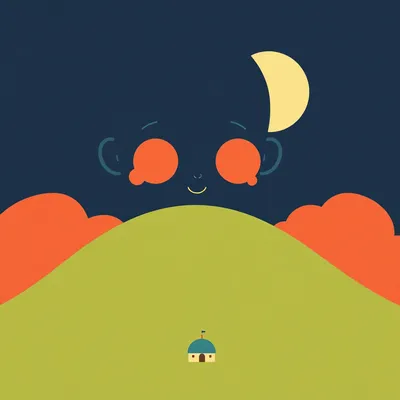
Let's talk about the sun-baby. Because this is the element that seems to provoke the strongest reactions, and it's the one that made Ezra cry.
The sun-baby was played by Jessica Smith, born in nineteen ninety-five. She was eighteen months old when filming began, and she was in the original pitch document from nineteen ninety-five — described as "the source of all light and warmth in Teletubbyland, a baby who watches over the Teletubbies." This wasn't a late addition. It was foundational to the whole concept.
A baby as a god figure. A literal infant deity whose face fills the sky.
This is where the show gets genuinely radical in its design. In most children's media, the sun is a cheerful cartoon, maybe with sunglasses and a smile. The Teletubbies sun is a real baby's face, giggling, cooing, making the kinds of expressions real babies make. To an infant viewer, this is a peer. A giant, celestial peer. The show collapses the distance between viewer and deity in a way that's almost theological.
It's also, and I want to be precise here, viscerally unsettling for an adult in a way that's hard to articulate. A baby's face is something we're hardwired to find appealing — big eyes, round cheeks, the whole cute-response package. But when you scale that face to fill the sky, when you have it slowly rotating into view with no context, it becomes something else.
Scale distortion is a powerful trigger. The baby's face is enormous, yet it behaves like a normal baby — giggling, looking around, making sounds. Your brain is simultaneously registering "infant, protect, nurture" and "this thing is the size of a celestial body and appears to control day and night." That's a cognitive collision.
For Ezra, who's eleven months old and squarely in the target demographic, the reaction was crying. What does that tell us?
It's hard to say without more data, but one possibility is that the sun-baby triggered a response that's actually quite adaptive. Infants are highly sensitive to faces, but they're also sensitive to scale and context. A giant face in the sky is not something an infant brain expects to encounter. Crying might be the appropriate response to a category violation at that age — "this doesn't match anything I understand, and I need an adult.
Which is ironic, because the show contains no adult humans. There's literally no one in Teletubbyland who could respond to that cry.
That's one of the most striking design choices. The only humans who appear in the show are in the video segments that play on the Teletubbies' belly screens — short documentary-style clips of real children doing real things, like feeding ducks or visiting a farm. These segments were filmed with a specific technique. The camera is always at child eye level. Adults, if they appear at all, are cropped at the waist. The perspective is entirely from the child's point of view.
The show creates a world where adult authority is literally invisible. There is no grown-up in the room.
The governing force is a baby. The sun-baby decides when the day begins and ends. The Teletubbies obey the rhythms set by this infant. It's an inversion of the actual power structure of a toddler's life, where adults control everything. In Teletubbyland, the baby is in charge.
Which might explain why some adults find the show ideologically unsettling at a level they can't quite name. It's not just that it's weird to look at. It's that it depicts a world without us.
There was actually significant controversy when the show first aired. Some commentators in the UK described it as "disturbing" and "sinister." There were complaints to the BBC. But the show was also enormously successful — three hundred sixty-five episodes across four series, broadcast in more than one hundred twenty countries, translated into forty-five-plus languages. It won multiple BAFTAs. It was a genuine cultural phenomenon.
Three hundred sixty-five episodes. A full year's worth of daily television for infants who couldn't yet speak.
Each episode cost approximately forty-five thousand pounds to produce in nineteen ninety-seven, which is about eighty-five thousand in today's money. This was not a cheap show. The costumes alone were a major engineering challenge. The actors inside the Teletubby suits were looking through small mesh panels in the characters' mouths. They couldn't see their own feet. The sets had to be designed with specific gradients so they wouldn't trip.
The actors inside those suits deserve some kind of medal. Imagine spending hours inside a Tinky Winky costume, performing the same bag-opening action forty times, unable to see properly, while a giant baby face rotates overhead.
Those suits were not well-ventilated. The actors — Simon Shelton played Tinky Winky, John Simmit played Dipsy, Nikky Smedley played Laa-Laa, and Pui Fan Lee played Po — were working in physically demanding conditions. Pui Fan Lee, who played Po, has talked about how the suit constrained her movement so much that Po's distinctive scooting walk emerged organically. She physically couldn't walk normally in the costume.
Po was the smallest one, right? The red one who spoke in what sounded like Cantonese-inflected babble?
Po was the red one, yes, and the smallest. And the language thing is another fascinating design element. The Teletubbies don't speak any real language. They use a constructed babble that incorporates simplified phonemes — the basic sound units that infants learning any language need to master. Tinky Winky says "Eh-oh" for hello. Po says "Bibberly cheese" and "Fi-dit." These aren't random sounds. They're built from the phonetic building blocks that cross linguistic boundaries.
Bibberly cheese has no right to be as memorable as it is.
That's deliberate. The show's language was designed using input from speech therapists. The repetition, the exaggerated prosody, the simplified syntax — these are the same techniques used in speech therapy for language-delayed children. The creators consulted with developmental psychologists and speech-language pathologists throughout the design process.
The show was essentially a massive, brightly-colored speech therapy intervention broadcast to millions of children.
In part, yes. But I should note that the evidence for its educational effectiveness is mixed. A twenty-fifteen study in the Journal of Experimental Child Psychology found that infants aged twelve to eighteen months showed increased attention to Teletubbies clips compared to age-appropriate educational content, but showed no measurable learning outcomes. They watched it intently. They didn't necessarily learn anything from it.
Which raises an uncomfortable question. If the show was designed to support language development but studies found no measurable learning, what was it actually doing to infant brains?
This is where we need to be careful. Absence of evidence isn't evidence of absence. The study measured specific outcomes over a limited timeframe. It's possible the show had effects that weren't captured by the study design. But it's also possible that what the show primarily did was capture and hold attention — which, for exhausted parents, is a legitimate function.
The show as a twenty-five-minute pause button for parents. Which, to be fair, is how most children's television functions regardless of its educational claims.
The Teletubbies was unusually effective at this. The slow pace, the repetition, the bright colors, the baby-faced sun — these elements combine to create what's essentially an attentional trap for the infant brain. Everything is designed to hold a one-year-old's gaze.
We've established that the Teletubbies are neurologically unsettling for adults and attention-capturing for infants. But there's something else going on with the adult response, and I want to dig into it. Why does the revulsion feel so specific? It's not like watching a bad CGI character or a creepy puppet. It feels personal. It feels like a memory.
This is where infantile amnesia comes in. Most adults cannot recall memories from before age three or four. But those early experiences aren't gone. They're encoded differently. The brain structures that support explicit, narrative memory — particularly the hippocampus — aren't fully developed in infancy. But implicit memory systems, including emotional and sensory memory, are operational from birth.
You might not remember watching Teletubbies, but your brain encoded the experience at a sensory and emotional level.
When an adult who watched the show as a toddler encounters it again, they're not accessing a narrative memory — "I remember sitting on the carpet watching Tinky Winky." They're experiencing a kind of emotional echo. The sensory patterns — the colors, the sounds, the slow movements, the giant baby face — match encoded patterns from early childhood. But the context that made those patterns feel safe and familiar is gone. What you're left with is the sensory content without the comforting frame.
It's like encountering the wallpaper from your childhood bedroom but not remembering the bedroom. The pattern is familiar, but the familiarity has no context, and that absence of context reads as wrongness.
Memory reconsolidation theory suggests that when we retrieve a memory, we're not playing back a recording. We're reconstructing the experience from fragments. For early childhood memories, the fragments are almost entirely sensory and emotional, with no narrative scaffolding. When those fragments are triggered by seeing Teletubbies as an adult, your brain tries to reconstruct something coherent and fails. The result is a feeling of uncanny familiarity — you know this, but you don't know how you know it, and the not-knowing is uncomfortable.
The content itself doesn't help. If you're experiencing an uncanny familiarity with, say, a Sesame Street clip, the content is grounded enough in recognizable human interaction that the familiarity feels warm. Teletubbies gives you uncanny familiarity with something that was already deeply strange to begin with.
The base content is a post-human pastoral landscape governed by a baby sun-god, populated by creatures who communicate in babble and worship a vacuum cleaner. Even if you could remember it clearly, it would still be weird. The memory distortion compounds the inherent weirdness.
The vacuum cleaner. Let's talk about Noo-Noo.
Noo-Noo is the only character in Teletubbyland that performs a recognizable function. It's a sentient vacuum cleaner that lives in the dome and tidies up after the Teletubbies. It's also, notably, the only character that the Teletubbies ever show anything resembling negative emotion toward — they say "Naughty Noo-Noo" when it cleans up something they wanted to keep.
The moral framework of Teletubbyland is: the baby in the sky is benevolent and all-powerful, the colorful creatures are innocent and playful, and the only entity that does useful work is scolded for it.
I hadn't thought of it that way, but yes. Noo-Noo is the proletariat of Teletubbyland.
The Teletubbies are essentially an aristocracy of leisure, sustained by invisible systems they don't understand and actively resent when those systems interfere with their play.
This is the kind of analysis that gets you invited to the wrong kind of academic conferences, Corn.
I stand by it. The show is a parable about the ingratitude of the leisure class, and the sun-baby is a metaphor for the arbitrary nature of divine authority, and the Tubby Toast machine represents industrial food production divorced from agricultural context.
You're not entirely wrong, which is what makes this fun. But let me pull us back to something more grounded. One of the things that makes the Teletubbies uniquely unsettling to adults is the gaze direction. The characters rarely look at each other. They look at the camera. Directly at the viewer. For extended periods.
Which is deeply unusual in television. Characters in most shows exist in a sealed narrative world. They look at each other, not at us. Breaking the fourth wall is a deliberate choice used sparingly for effect.
In Teletubbies, the fourth wall doesn't exist. The Teletubbies address the infant viewer directly, with long, silent gazes and simple vocalizations. This is modeled on the kind of interaction infants have with caregivers — sustained eye contact, simplified speech, exaggerated facial expressions. It's parent-child interaction, mediated through television.
For an adult watching, being gazed at by a six-foot-tall purple creature with a television in its stomach is not the same as a caregiver interaction. It reads as a demand. "Look at me. I am looking at you. You are being looked at." It's confrontational in a way that the creators almost certainly didn't intend for adult viewers.
The gaze is designed to be bonding for infants. For adults, it's surveillant. You feel seen in a way that's uncomfortable because you're not supposed to be seen by the television. You're supposed to be the one doing the watching.
The watched become the watchers become the watched. Teletubbies as panopticon.
Now you're definitely getting invited to the wrong conferences.
I'll start preparing my slides. But let me take this seriously for a moment. There's a collective dimension to the adult response that I think is worth examining. Entire online communities have formed around "Teletubbies horror." There are creepypasta versions, video edits that turn the show into found-footage horror, endless memes about the sun-baby as an eldritch being. What does that cultural processing tell us about the show's design?
It tells us that the discomfort is widely shared and that people process it through humor and horror — two modes that are closely related neurologically. Both involve violation of expectations and a tension-release cycle. When you make a joke about the sun-baby being an ancient god demanding sacrifice, you're acknowledging the genuine weirdness while defusing it through laughter.
The creepypasta versions of Teletubbies are interesting because they don't have to change much. You can take actual footage from the show, slow it down slightly, add some reverb to the audio, and it becomes disturbing. The raw materials are already there.
There's a specific episode that gets cited a lot in these discussions. The one with the lion and the bear.
Oh, I remember this. There's a video segment that plays on one of the belly screens showing a wooden lion and bear figure that comes to life, and it's shot in this eerie, low-light style that looks nothing like the rest of the show.
That segment was actually filmed by a different production team using different equipment, and the tonal shift is jarring. It's the only segment in the show's entire run that generated enough complaints for the BBC to edit it out of future broadcasts. Parents reported their children having nightmares.
Even within the show's own design framework, there were elements that crossed the line from "engaging for infants" to " frightening." And the line was apparently a wooden lion.
Which raises an important point about designing for this age group. Infants have different fear responses than older children or adults. Things that seem harmless to us can be terrifying to a one-year-old, and vice versa. The challenge of creating media for pre-verbal children is that you can't ask them what they're feeling. You can only observe their responses and infer.
The show's creators were working in largely uncharted territory. No one had ever tried to make television for this demographic before. They were essentially running a massive, global experiment in infant media exposure.
Which is why the ethical dimension is worth considering. The American Academy of Pediatrics recommended, as early as nineteen ninety-nine, no screen time for children under two. The Teletubbies was explicitly designed for children as young as twelve months. The show debuted in nineteen ninety-seven, before the AAP guidelines were widely known, but the tension between the show's target demographic and emerging pediatric guidance became a significant point of debate.
The show was caught in a historical pivot point. It was designed at a moment when the assumption was that educational television could benefit even the youngest children, and it aired into a period when the medical establishment was beginning to say the opposite.
To be fair to the creators, they were thoughtful about it. Anne Wood has said in interviews that the show was designed to be watched with a caregiver present, not as a substitute for human interaction. The belly-screen segments were intended as prompts for parents to discuss with their children. The show's slowness was partly designed to allow for parent-child conversation during viewing.
In practice, how many parents were sitting there actively co-viewing and discussing? The show functioned as a babysitter for a lot of households, regardless of the creators' intentions.
Which is true of essentially all children's television. The gap between intended use and actual use is vast, and it's not unique to Teletubbies.
Let me pull us to the question I think is at the heart of this prompt. What can creators learn from this? If you're designing media for infants, how do you avoid accidentally creating something that will haunt the adults those infants become?
I think the first lesson is that you can't. Any media designed for a radically different cognitive state — infancy, early childhood, even adolescence — is going to read differently when accessed from a different developmental stage. You can't design for the one-year-old and the thirty-year-old simultaneously. The cognitive gap is too wide.
The uncanny valley for children's media is structural, not incidental. It's built into the project.
I think so. But there are degrees. The Teletubbies is an extreme case because it was so uncompromising in its design. It didn't include elements to make it palatable for adults. There are no jokes for the parents, no cultural references, no winks to the older viewer. It is pure, undiluted infant media. Most children's shows include something for the adults in the room because adults control the remote. Teletubbies didn't bother.
Which is either admirable artistic purity or a failure to consider the full viewing context, depending on your perspective.
I lean toward admirable purity, with caveats. The show was innovative. It took developmental psychology seriously. It treated its audience — one-year-olds — with a kind of respect that was unprecedented in television. It didn't talk down to them because it didn't talk to them in the conventional sense at all. It created a world that operated on their cognitive terms.
In doing so, it created something that will probably be studied for decades as a limit case in media design. The show that pushed so far into infant-optimized territory that it became actively uncomfortable for everyone else.
There's a parallel here to certain kinds of modernist architecture. Buildings designed so purely around a specific functional philosophy that they become hostile to the actual humans who have to live in them. Teletubbyland is a cognitive structure built for one-year-olds, and adults are just too tall to fit through the doors.
The Teletubbies' dome house as Brutalist architecture. That tracks, actually. It's a grass-covered mound with porthole windows and inexplicable internal geometry.
The interior of the dome makes no spatial sense. The rooms don't connect logically. The scale shifts. It's like a dream space.
It's a representation of how infants experience physical space before they develop consistent spatial reasoning. Piaget's sensorimotor stage, externalized as set design.
This is what I find fascinating about the show, beneath all the jokes about creepy sun-babies and existential vacuum cleaners. It was an attempt to build a complete aesthetic and narrative environment calibrated to a specific developmental stage. It was wildly ambitious. The fact that it also ended up being deeply strange to adults is almost inevitable.
Let's talk briefly about the Tinky Winky controversy, because it's part of the show's cultural footprint and it connects to the adult discomfort in an interesting way.
In nineteen ninety-nine, the American evangelist Jerry Falwell claimed that Tinky Winky was a gay role model, citing the character's purple color — which he associated with the gay pride flag — and the fact that Tinky Winky carried a bag that resembled a purse. This became a significant media story in the US.
Which is absurd on multiple levels. The character is a giant puppet that speaks in babble. The bag is a bag. But Falwell's claim got traction because there was already a cultural unease about the show. It was strange enough that the accusation could stick.
The BBC and Ragdoll Productions both issued statements saying the character was simply a Teletubby and had no sexual orientation. But the controversy highlighted something real about how adults project onto the show. Because the Teletubbies are so devoid of conventional signifiers, they become screens for adult anxieties. You can read almost anything into them.
Tinky Winky as a Rorschach test. The bag is just a bag, but what you see in the bag tells me more about you than about Tinky Winky.
The show's silence on all of this — its refusal to engage with adult interpretive frameworks — is part of what made it so powerful and so unsettling. It didn't explain itself. It just existed, in its own terms, for its own audience.
Which brings us back to Ezra, crying at the sun-baby. Maybe that's the purest response. An eleven-month-old encountering the show as it was designed to be encountered, and finding it overwhelming. Not wrong, not creepy, just too much.
Or exactly right, and the crying is a legitimate emotional response to something awe-inspiring. We tend to assume that crying in infants is always distress, but it can also be overstimulation, or a response to something so novel that the brain doesn't have a category for it yet.
The sublime, for babies. A face too large to process, a world too strange to navigate, a sun that is also a peer.
I think that's actually a beautiful way to think about it. The Teletubbies created an experience of the sublime for an audience that couldn't yet form the concept. And the adult revulsion is what happens when you encounter the sublime without the cognitive frame that made it meaningful.
Now: Hilbert's daily fun fact.
Hilbert, what do you have for us today?
In the eighteen sixties, a British colonial administrator in what is now Belize attempted to document the click consonants of a visiting Khoisan-speaking trader, but abandoned the project after mistakenly concluding the man was just making the sounds up to mock him. The trader's language, now extinct, was never recorded.
An entire language dismissed as a prank. That's bleak.
The eighteen sixties colonial administrator: not a high point in the history of linguistics.
Before we close, let me ask one forward-looking question. We're now in an era where AI-generated children's content is becoming a real thing. What happens when the design decisions that made Teletubbies so strange are made by algorithms optimizing for infant attention, without any human creative intent behind them?
That's concerning. The Teletubbies was strange, but it was strange with purpose. Every element was chosen by humans who had a theory about what they were doing and why. Algorithmic content generation for children could produce something that's equally attention-capturing but with no underlying developmental logic at all. Pure engagement optimization, with no educational or aesthetic framework.
The Teletubbies as a best-case scenario for weird children's media. At least someone was thinking about it.
At least there was a thought process. I'm not sure we can say that about the auto-generated content farms that are already targeting children on YouTube. But that's probably a topic for another episode.
This has been My Weird Prompts. Thanks to our producer, Hilbert Flumingtop. You can find us at myweirdprompts dot com, or on Spotify and wherever you get your podcasts. If you enjoyed this, leave us a review — it helps people find the show.
Until next time.
Until next time.