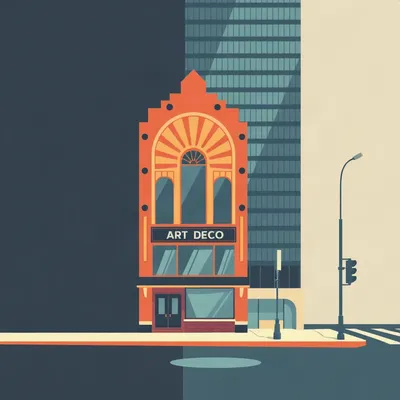
Hannah's been thinking about architecture again. Not just thinking — she's outlining a career. She sent us a long one, so let me read it properly. She says she wants to talk again about architecture and urban planning. She's done a lot of episodes about the problems, what's being built now, how things can be done differently — economic, environmental, design aesthetics. And she keeps coming back to the point that modernism basically recreated all the problems humans spent thousands of years solving. We're back at square one. We've lost all the technologies we developed over millennia to fix exactly these problems. The architecture world mostly creates buildings and cities that people don't like. She believes in a return to some level of traditional design — not a purist, doesn't believe in just copying things without innovation or ignoring useful new technologies. But her goal as an architect, for her whole career, is to create a new movement of architecture, urban planning, and design that picks up where good design left off, pre-modernism. She sees Art Deco as the pinnacle of that long trajectory. After that, everything was abandoned. She wants to pick up the thread, pull in what we're keeping from the last century, and go back to where we left off — rather than starting over, which is what the architecture world keeps doing, everyone trying to do something new that's never been done before. More specifically, she wants to create within that movement her own style and a local style for Jerusalem and for Israel — getting back to historical roots, biblical roots, design elements from thousands of years ago, even things brought in over the millennia by different empires, taking the best from them. So her questions. One: how do you even begin to start a movement of architecture and design and urban planning? How do you develop a specific style? Where do you begin to plan all of this? And how do you incorporate all the elements we've talked about — environmental solutions, noise, car traffic, all the things being done wrong in current cities? Then she gets specific. Two questions. First: if she wanted to create a platform for this new movement — and she explicitly says she does not want it to be like CIAM, where they just create academic theories disconnected from reality — something in the vein of those architectural conferences and theories, but with real practical tenets that matter. That's question one. Second: how do you go about actually creating that movement and style aesthetically?

That's... Hannah basically just handed us a career manifesto.
She did. And I want to note something she said that most people miss. She said picking up where good design left off, not starting over. That's not nostalgia. That's recovering lost technology — like a civilization that forgot how to make concrete and then rediscovers the recipe.
Right. The Romans had concrete that set underwater. We lost that for something like fourteen hundred years. Nobody calls it nostalgic when we reinvented it. They call it progress.
So let's treat this the same way. We're going to answer both questions — the platform question and the style question — but in reverse order, because you can't build a movement until you know what it looks like.
And we should start with the uncomfortable question. Why does anyone think they can start a new architectural movement now, when the last one that actually worked was a hundred years ago?
That's the right place to dig in. Because the last big attempt — CIAM — failed so completely that it actually made cities worse. And understanding why it failed tells you what not to do.
CIAM. The Congrès Internationaux d'Architecture Moderne. Founded in 1928 at La Sarraz in Switzerland by Le Corbusier, Sigfried Giedion, and a group of European modernists. They held a series of congresses, and the fourth one produced the Athens Charter in 1943. That document codified the functional city — zoning by four functions: dwelling, work, recreation, circulation.
And the result was mono-functional zones, superblocks, car-centric planning, and the systematic destruction of street life. They took the messy, organic city that had evolved over thousands of years and replaced it with a diagram.
The Athens Charter is genuinely one of the most destructive documents in the history of human settlement. It wasn't just aesthetically wrong — it was methodologically wrong. CIAM produced abstract principles with no feedback loops from built outcomes. They'd declare something, build it, and never go back to check if it actually worked. No post-occupancy evaluation. No willingness to say we were wrong. Just more manifestos.
So that's the model of what not to do. Top-down, academic, abstract, zero empirical feedback. Hannah said explicitly she doesn't want that.
And then you've got the counterexample. INTBAU — the International Network for Traditional Building, Architecture and Urbanism. Founded in 2001, Prince Charles was a major backer. Their approach was the opposite: built projects first, theory second.
Poundbury.
Poundbury in Dorset. Started construction in 1993, masterplanned by Léon Krier under the Duchy of Cornwall. It's a new town extension built on traditional urban principles — mixed use, walkable streets, local materials, actual ornament. People live there, shops operate, it functions. It proved you can build traditional urbanism at scale in the modern era.
But it also revealed a weakness. Poundbury feels like period reproduction. It's Georgian and Victorian pastiche. It doesn't feel like a living tradition — it feels like a costume drama.
That's the INTBAU limitation. They recovered the forms but not the forward momentum. A living tradition innovates within its own language. Gothic architecture evolved over centuries — Early English to Decorated to Perpendicular. Each generation added something. Poundbury doesn't add anything. It freezes the clock.
Which is why Hannah's instinct about Art Deco is so sharp. She called it the pinnacle of the long trajectory of human development, and she's not wrong.
She's really not. Art Deco, roughly 1925 to 1939 — bookended by the Paris Exposition and World War Two — was the last Western style that simultaneously embraced ornament, new materials, local cultural motifs, and technological optimism. Steel frames, reinforced concrete, glass blocks, aluminum spandrels — all used alongside carved stone, geometric patterns, and symbolic imagery. It was modern and ancient at the same time.
The Chrysler Building. 1930. William Van Alen. It's got hubcaps and eagle heads and a spire that looks like a radiator grille. It's celebrating the machine age with the vocabulary of a cathedral.
And here's what matters for Hannah. Jerusalem has its own Art Deco heritage. The King David Hotel, completed in 1931, designed by Swiss architect Emil Vogt. It's Art Deco adapted to local limestone and climate. The Edison Theater — now the Smadar — built in 1932 by Yehuda Magidovitch. These buildings prove that Art Deco could absorb local materials and traditions without losing its identity.
So the pivot point is real. Art Deco was the last moment when architecture was still speaking a human language — ornament, proportion, symbolism — while embracing industrialization. Then modernism came and purged all of it.
Banished ornament. Adolf Loos wrote "Ornament and Crime" in 1910, and by the 1950s that had become dogma. Any decoration was reactionary, bourgeois, dishonest. The result was sixty years of glass boxes.
So if Hannah's picking up the thread at Art Deco, the question becomes: what does a Jerusalem-specific version of that look like? What's the aesthetic DNA?
Let's build it from the ground up. Jerusalem's architectural heritage is uniquely layered. You've got Herodian stonework — massive ashlar blocks with incised margins, some of the finest masonry in the ancient world. Byzantine basilicas with their domes and mosaics. Mamluk muqarnas — those honeycomb vaults that are mathematically astonishing. Ottoman domes and minarets. And then the British Mandate era, which gave us the Jerusalem stone mandate of 1918 — every building in Jerusalem must be clad in local limestone.
That mandate is still in effect. It's why Jerusalem has a visual coherence that almost no other modern city has. The material unifies everything.
Right. So the first tenet of a Jerusalem style is mandatory local stone as primary cladding. But with modern thin-stone veneer techniques — you're not stacking three-foot-thick walls anymore. You can get the thermal mass and the visual weight with a fraction of the material cost.
Second tenet. A grammar of ornament derived from archaeological sources. The Temple Mount sifting project has recovered thousands of decorative fragments from the First and Second Temple periods. Painted plaster, carved stone, mosaic tesserae. That's a pattern book waiting to be catalogued.
And you can codify it digitally. The motifs that show up — the menorah, the lily, the date palm, the pomegranate, the six-pointed star, the rosette — these are all found in Herod's Temple reconstruction and on Roman-era Judean coinage. They're not arbitrary. They're the visual language of this place across three thousand years.
Third tenet. Proportions based on the golden ratio. Not because it's mystical — because it shows up in the dimensions of Solomon's Temple as recorded in First Kings chapter six. The holy place was sixty cubits long, twenty wide, thirty high. Those are harmonic proportions. You find the same ratios in the Great Pyramid and the Parthenon. It's not cultural appropriation — it's a mathematical constant that multiple traditions discovered independently.
Fourth tenet. Integrate the geometric patterns from Mamluk and Islamic architecture. These are mathematically generative — star patterns, girih tiles, arabesques. They can be parameterized for modern CNC fabrication. You can carve a twelve-point star pattern into a limestone panel with a computer-controlled router, and it's still the same geometry that craftsmen were laying out with a compass and straightedge in the fourteenth century.
That's the bridge between old and new that Poundbury never built. Digital fabrication doing traditional ornament. It's not a reproduction — it's a continuation.
Fifth tenet. Climatic responsiveness. Traditional Levantine architecture solved problems we're now trying to solve again with expensive technology. Courtyards that create microclimates. Wind towers that draw air through buildings. Shaded loggias. Thick stone walls that absorb heat during the day and release it at night. These aren't decorative choices — they're functional technologies that reduce energy load.
And they're beautiful. That's the thing modernism never understood. The things that work best tend to be beautiful because they're honest about what they're doing.
A courtyard with a fountain in the center isn't just pretty. The fountain cools the air through evaporation. The courtyard creates a stack effect that draws hot air up and out. The surrounding rooms get cross-ventilation. It's an environmental machine disguised as a garden.
So that's the aesthetic DNA. Local stone, archaeological ornament, harmonic proportions, parametric geometry, climatic intelligence. Five tenets that give you a framework without dictating exactly what every building looks like.
And they're all testable. You build something with those tenets, you measure the energy performance, the occupant satisfaction, the pedestrian activity around it. If it works, you keep doing it. If something doesn't work, you revise. That's what CIAM never did.
Which brings us to the harder question. How do you build the movement infrastructure so it doesn't collapse the way CIAM did? A style without a platform is just a portfolio.
The platform question. Hannah said she doesn't want academic theories disconnected from reality. So the model isn't CIAM. The model is Christopher Alexander.
A Pattern Language. 1977.
Two hundred fifty-three patterns derived from observing what actually makes places work. Not from theory, not from ideology — from looking at buildings and streets and public spaces that people loved, and asking what they had in common. Alexander's patterns are things like "Light on Two Sides of Every Room," "Six-Foot Balcony," "Pedestrian Street." Each one describes a problem and a solution that's been proven across cultures and centuries.
So the first piece of the platform is a Jerusalem Pattern Language. Start with twenty patterns derived from studying the city's best pre-modern buildings. "The Shaded Courtyard." "The Stone-Clad Street Wall." "The Corner Balcony with View." "The Pedestrian-Priority Alley." "The Fountain at the Center."
And here's the key — make it a living document. Publish it online. Invite critique. Revise it based on new evidence. If someone builds a courtyard that doesn't work, you figure out why and update the pattern. This becomes the movement's intellectual backbone without being rigid dogma.
Second piece. A built-work registry. Every building constructed under the movement's tenets gets documented with performance metrics. Energy use, occupant satisfaction surveys, pedestrian traffic counts, noise measurements. You create an evidence base that grows over time.
This is huge. CIAM never did post-occupancy evaluation. They just declared victory and moved on. If you're actually tracking outcomes, you can't fool yourself for long. The data tells you what's working.
Third piece. A design code — but not a rigid style manual. A parametric code that specifies proportions, material ranges, ornament families, and urban relationships, leaving room for innovation within constraints. You're not telling architects exactly what to draw. You're giving them a key and saying stay in this key, but play whatever you want.
Fourth piece. A certification system. Like LEED but for urban and traditional quality. A building that meets the stone mandate, uses the ornament grammar, hits the energy benchmarks, and incorporates the pattern language gets a certification. Developers can market it. Buyers know what they're getting.
Fifth piece. An annual congress. But unlike CIAM's, this one reviews built work and updates the code based on evidence. You present projects that were completed that year. You share the performance data. You debate what to change. The theory follows the practice, not the other way around.
That's the platform. Pattern language, built-work registry, parametric design code, certification system, evidence-based congress. It's not a manifesto — it's a feedback loop.
Now let's talk about integrating the urban problems Hannah keeps coming back to. Traffic, noise, environment. These can't be afterthoughts. They have to be baked into the movement's core tenets.
Traffic first. The solution is filtered permeability. It's a Dutch concept from the woonerf — the living street. First one was built in Delft in 1976. The principle is simple: pedestrians and cyclists can go everywhere. Cars are routed to a hierarchical street network with dead ends and one-way systems that prevent through-traffic in residential areas.
So you can walk or bike directly from any point to any other point. But if you're driving, you might have to go around. The street network filters out the cars that don't need to be there.
You design the street itself to slow cars down. Narrow lanes. Raised intersections. Different paving materials that signal to drivers that they're guests, not owners. Trees planted in the roadway that force drivers to navigate around them.
Noise. Courtyard typologies are inherently quieter because the building itself buffers street noise. You put the active spaces facing the courtyard, the service spaces facing the street. Double-glazed windows with traditional wooden frames — not aluminum, which transmits sound more efficiently. Building setbacks that create sound shadows.
There's a Jerusalem-specific opportunity here. The traditional Arab house typology — the haush — has a central courtyard that's completely enclosed. You enter through a bent corridor that blocks both visual and acoustic connection to the street. You step inside and the city disappears. That's a noise solution that's been working for centuries.
Environment. Passive solar orientation is mandatory — long axis east-west, main living spaces facing south with appropriate shading. Green roofs with native drought-resistant plants. Rainwater harvesting integrated into courtyard fountains — which is already a traditional Jerusalem feature, you see it in Mamluk courtyard houses.
The stone itself. Limestone has high albedo — it reflects solar radiation instead of absorbing it. A city of limestone buildings is cooler than a city of glass and steel. The Jerusalem stone mandate was an aesthetic regulation that turned out to be an environmental regulation.
These aren't separate systems. The courtyard solves noise, climate, and social space simultaneously. The stone solves thermal performance, visual coherence, and local economic development simultaneously. That's what traditional architecture always did — solved multiple problems with single moves.
Which brings us to the local economy angle. A movement succeeds when it creates jobs. The Jerusalem style requires a revival of traditional stonemasonry, ceramic tile-making, wrought-iron work. This isn't just aesthetic — it's economic development.
Partner with Bezalel Academy of Arts and Design. Founded in 1906 by Boris Schatz, it's Jerusalem's premier art school. Create a program in traditional crafts and digital fabrication. Students learn to carve stone with hand tools and with CNC routers. They learn the old geometry and the new software.
The Jerusalem Stone Association — representing the quarries and stonemasons — they're a natural ally. They have an economic interest in new construction that uses local stone. The Israel Antiquities Authority has an interest in preserving traditional techniques. The Jerusalem Municipality's heritage preservation unit could be convinced to support new buildings that continue the tradition rather than just preserving old ones.
That's the coalition. Architects, developers, city planners, archaeologists, craftspeople, quarry operators, the art school. You're not starting a movement alone — you're convening interests that already exist and giving them a shared language.
Then you need a demonstration project. A single building or small block that gets built under the new code. All permits fast-tracked through a special heritage innovation designation. The ideal site is the area around the First Station.
The old Jerusalem railway station. Restored and reopened in 2013 as a public space and commercial center. It already has pedestrian-friendly infrastructure, a mix of uses, and high visibility. A new mixed-use building there, designed under the Jerusalem style code — stone-clad, courtyard-centered, ornamented with parametric geometry, certified by the movement's system — that's a proof of concept.
One building. Not a manifesto, not a conference, not a website. A building people can walk into and experience. That's how you start a movement. Poundbury started with a master plan and a few buildings. Seaside in Florida started with a few houses. The New Classical movement gained credibility through built work, not through academic papers.
Find one client. One site. Build the first example. Document everything — cost, timeline, occupant satisfaction, energy performance. That documentation becomes the movement's founding data set.
Here's the thing about the political path. Jerusalem's planning system is uniquely complex — the Jerusalem Municipality, the Israel Antiquities Authority, the Jerusalem Development Authority, neighborhood committees. But complexity can be an advantage. If you can navigate it once and document how you did it, you've created a template that others can follow.
The heritage innovation designation is the key. You're not asking for an exception to the rules — you're proposing a new category that sits between preservation and conventional new construction. A building that is new but continues the tradition. The Antiquities Authority should love this because it extends their mission into the present tense.
Let's make this concrete. If Hannah is sitting in Jerusalem right now and wants to move on this, here's what she does on Monday morning.
Step one. Start the Jerusalem Pattern Language. Walk through the Old City and the older neighborhoods — Nachlaot, Baka, the German Colony. Photograph and document twenty buildings or urban spaces that work. Not buildings that are famous. Buildings that feel right. For each one, write a one-page pattern: the problem it solves, the design principle, a sketch, a photo.
Step two. Identify one potential client or site. It doesn't have to be big. A single-family house, a small apartment building, a courtyard renovation. Something that can be built within two or three years. The First Station area is ideal, but don't wait for the perfect site. Start where you can.
Step three. Build the coalition. Call the Jerusalem Stone Association. Visit Bezalel's architecture and crafts departments. Talk to the heritage preservation unit at the municipality. Don't pitch a movement — pitch a project. People join projects. They applaud movements from a distance.
Step four. Create the design code as a working draft. Not a published manifesto — an internal document that guides the first project. Proportions, materials, ornament families, urban relationships. You'll revise it after the first building is complete and you have real performance data.
Step five. Document everything publicly. Start a website or a newsletter. Share the patterns, the design process, the construction photos, the performance data. Transparency builds credibility. CIAM operated in closed rooms and published finished declarations. Do the opposite.
The steelman objection here is worth voicing. Someone could say: this is all very nice, but architectural movements don't get started by one person with a pattern language and a courtyard building. They get started by powerful institutions with money and political backing. CIAM had Le Corbusier. The Bauhaus had Gropius and state funding. What does one architect in Jerusalem have?
That's fair. The counterargument is that CIAM and the Bauhaus had exactly those advantages and they produced cities people hate. Resources and fame don't guarantee good outcomes. And the movements that actually changed how people build — the Arts and Crafts movement, the New Urbanism — started small, with a few buildings and a few believers.
New Urbanism didn't start with a government grant. It started with Seaside, a beach town in Florida that Andrés Duany and Elizabeth Plater-Zyberk designed in the early 1980s. People visited, they liked how it felt, developers noticed, and thirty years later it's an international movement. One project.
The question isn't whether one architect can change the world. The question is whether one architect can build one building that's better than what gets built now. If the answer is yes, and if you document it, and if the people who live there are happier and healthier and use less energy — other people will want it.
Jerusalem is the right place for this. It's a city that already has a visual identity enforced by law — the stone mandate. It has a population that cares deeply about tradition and authenticity. It has an architectural heritage that spans three thousand years. If you can't start a traditional-modern synthesis here, you can't start it anywhere.
The last thought. What if the next great architectural movement doesn't come from a starchitect in a Zurich office, but from a small group of people in Jerusalem who decide that the best way forward is to look back — and then build something that's never existed before? If this works for Jerusalem, the model could be adapted for other cities with strong local traditions. Fez, Kyoto, Mexico City, Istanbul. Each develops its own pattern language, its own material palette, its own ornament grammar. The movement becomes a federation of local styles, not a global monoculture.
That's the vision. A thousand pattern languages, each specific to a place and a culture, all sharing the same underlying principles: build with local materials, ornament with local meaning, solve climate with local intelligence, and test everything against reality.
Thanks to our producer Hilbert Flumingtop. This has been My Weird Prompts. If you're an architect or a builder or just someone who cares about what gets built in your city, send us a voice memo. If you've got a site in Jerusalem that could be that first demonstration project, we want to hear about it. Email the show at show at my weird prompts dot com. We'll be back soon.