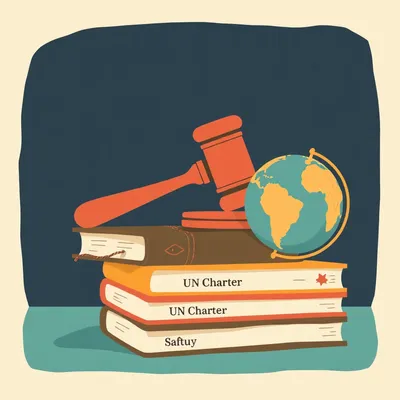
Daniel sent us this one — a big, sweeping question about the United Nations. He's asking whether, looking at the long arc of human history, we have any real precedent for a permanently sitting international conference that lacks enforcement power. And more pointedly, whether the architects who created the UN as an answer to the League of Nations' failures would look at what it's become and call it useful. Not just whether it does some good on the margins, but whether it's actually serving its intended purpose. There's a lot to dig into here.

The question cuts right to the thing that's been nagging at international relations theory since 1945. We built this institution to stop great-power war, gave it a Security Council with actual teeth on paper, and then watched those teeth get pulled out one veto at a time. The architects would recognize the furniture but not the room.
The furniture but not the room. So let's start with what those architects actually wanted. When we say the UN was built on the ashes of the League, what specifically were they trying to fix?
The League had one catastrophic design flaw that everyone agreed on by 1939 — it required unanimous consent for any substantive action. One member, one veto. Japan invades Manchuria in 1931, the League condemns it, Japan just walks out of the chamber and keeps Manchuria. Italy rolls into Ethiopia, the League imposes sanctions but won't touch oil because they're terrified Italy will quit, and Mussolini finishes the conquest anyway. The lesson the UN's founders took from this was brutally simple: unanimity is paralysis.
They replaced one veto with five.
That's the irony. They looked at the League and said the problem was that anyone could block action, so we'll limit the blocking power to the great powers who'd actually have to supply the troops. The logic was coherent. The League's collective security provisions failed because no major power was willing to back sanctions with force. The UN's fix was to concentrate authority in the five states that emerged from World War Two with actual military capacity. If they all agreed, something could actually happen. If one disagreed, better to have gridlock than to have the institution declare wars it couldn't fight.
Which is the polite way of saying the veto wasn't a bug in the design, it was the design. The UN was never meant to constrain great powers. It was meant to prevent great powers from stumbling into war with each other through miscalculation.
The Security Council was conceived as a concert of great powers, not a parliament of nations. The General Assembly was the concession to universal representation, but it was deliberately given no binding authority. The Charter uses very careful language. The Security Council makes decisions, the General Assembly makes recommendations. That distinction is the load-bearing wall of the entire structure.
The international equivalent of a strongly worded letter. And yet people keep being surprised when the strongly worded letters don't stop tanks. But here's where the prompt gets really interesting — the question of historical precedent. Has anyone ever tried to run a permanent sitting international conference without enforcement power before?
I'd argue the answer is no, and that's what makes the UN genuinely novel. Not the enforcement part — the permanence part.
Think about what came before. The Congress of Vienna in 1815 created the Concert of Europe, which was essentially a great-power management system. They'd meet when something was about to blow up, hash it out, and go home. No secretariat, no building, no annual General Assembly debate on ocean biodiversity. It was a group chat for emperors that convened when someone was about to do something stupid in the Balkans.
Which was often. But the Concert actually worked reasonably well for about forty years, until the Crimean War blew it apart. And the reason it worked wasn't enforcement power — nobody had a standing army under a Concert of Europe flag. It worked because the great powers shared a basic interest in preventing another Napoleonic-scale war, and because they met face to face regularly enough to understand each other's red lines.
That's precedent for great-power coordination without enforcement, but it's not a permanently sitting body. What about the Hague Conferences in 1899 and 1907?
Those are fascinating because they tried to build something like what you're describing. The 1899 Hague Peace Conference produced the Permanent Court of Arbitration — which still exists, in the Peace Palace in The Hague. But the key word is arbitration, not adjudication. States had to voluntarily submit disputes, and the rulings weren't binding unless both parties agreed in advance to be bound. It was a menu, not a court.
The Permanent Court of Voluntary Maybe. And the 1907 follow-up conference tried to create a permanent international court with compulsory jurisdiction, and it collapsed specifically because the great powers, particularly Germany, refused to submit to binding arbitration on anything they considered a vital interest.
It sounds like the entire history of international law in miniature. Everyone wants rules that bind their rivals, nobody wants rules that bind themselves. So by the time we get to the League of Nations, we've had a century of experiments, and the consistent finding is that you can build institutions for arbitration, for consultation, for coordination — but the moment you try to make them compulsory, the people with the biggest armies politely decline to participate.
The League tried to split the difference in a way that satisfied nobody. It had the form of collective security — Article 10 said members would preserve each other's territorial integrity. Article 16 said any member going to war in violation of the Covenant was automatically at war with all other members. That's about as strong as language gets. But the enforcement mechanism was entirely dependent on member states choosing to act, and the United States never even joined.
Woodrow Wilson won the Nobel Peace Prize for championing the League, then watched the Senate reject the Treaty of Versailles. The League opened for business in 1920 without the world's rising economic and military power. That's like launching a global security institution today without China or the United States at the table.
When the UN's architects sat down in San Francisco in 1945, they were working from a very specific post-mortem. The League failed because unanimity meant paralysis, because the US wasn't in it, and because collective security without actual collective military capacity was a paper tiger. They fixed the unanimity problem with the veto. They fixed the US participation problem by locating headquarters in New York and giving the US a permanent seat. Did they fix the military capacity problem?
On paper, absolutely. Articles 43 through 47 of the Charter envisioned a standing UN military force. Member states were supposed to negotiate agreements to place national armed forces at the Security Council's disposal. There was supposed to be a Military Staff Committee composed of the chiefs of staff of the five permanent members. This was not going to be the League's system of ad hoc sanctions. This was going to be a genuine collective security apparatus with pre-committed forces.
None of that exists.
The Military Staff Committee still meets. It's in the basement of the UN building. They've been meeting every two weeks since 1946, and they have produced exactly nothing. The Article 43 agreements were never negotiated because the Cold War started and the US and the Soviet Union were never going to place troops under a command structure the other might control. The entire Chapter Seven enforcement machinery was stillborn.
The UN was designed with an engine and a transmission but no driveshaft. The Security Council can authorize force, but it can't actually deploy force. It has to outsource to member states or regional organizations, which means every enforcement action is voluntary and political. That's not collective security, that's collective permission.
That brings us to Korea in 1950, the great exception that proves the rule. The Security Council authorized a UN command to repel the North Korean invasion, and it only happened because the Soviet Union was boycotting the Council over the China seat issue and wasn't there to cast a veto. The moment the Soviets returned, the window slammed shut. We've never had another case of the Security Council authorizing a full-scale military enforcement action against a state.
The UN's one genuine enforcement moment was a scheduling error. And even then, the UN Command in Korea was a US-led operation with a UN flag. It wasn't the standing UN army the Charter envisioned. It was the United States doing what it was going to do anyway, with international legitimacy attached.
Let's pivot to the core question. The prompt asks whether those architects, looking at what the UN has become, would call it useful. I think the honest answer is that they'd be puzzled by half of what it does and horrified by the other half, but they'd probably still keep it.
I want to unpack why. The UN that exists today does three things, and only one of them was part of the original design. The first is great-power crisis management — the Security Council function, the thing it was built for. It works sometimes, fails often, but provides a venue for the US, China, and Russia to talk without sending fleets to sea. The second is humanitarian and development work — UNICEF, the World Food Programme, the UN Development Programme, the World Health Organization. This is the bulk of the UN's budget and staff, and it was barely mentioned in the Charter. The third is normative standard-setting — human rights treaties, environmental agreements, the Sustainable Development Goals, the Law of the Sea. This is the UN as global conscience, and it's the part that drives conservative critics up the wall.
Because it's a permanently sitting conference that generates moral claims without accountability. The General Assembly passes resolutions condemning Israel by overwhelming majorities, and those resolutions have no legal force but enormous normative weight. They shape what's considered acceptable opinion in foreign ministries and newsrooms. It's power without responsibility.
That's exactly the tension the prompt is getting at. If you're a small state, the UN is incredibly useful. It gives you a platform, a vote, a voice in setting global norms. Malta has the same General Assembly vote as China. If you're a great power, the UN is useful primarily as a legitimacy dispenser and a venue for managing rivalries without shooting. If you're a country on the wrong side of the General Assembly's normative consensus — Israel, the United States on certain issues — the UN looks like a machine for laundering hostility into international law.
To the question of historical precedent for a permanently sitting international conference without enforcement — I think the answer is no, but with an asterisk.
The asterisk being the Catholic Church. Not a perfect analogue, but think about it. A permanent institution with a physical seat, a bureaucracy, a claim to moral authority over sovereign states, no army of its own for most of its history, and yet genuine influence over the behavior of kings and states for centuries. The Papacy mediated treaties, declared norms, imposed sanctions in the form of interdicts and excommunications, and sometimes it worked and sometimes it didn't. But nobody would say the medieval Church lacked influence just because it couldn't field an armored division.
That's a useful comparison, and it highlights something the UN's architects might not have fully appreciated. Enforcement isn't just military. The UN enforces norms through shaming, through legitimacy withdrawal, through the slow accretion of customary international law. The Universal Declaration of Human Rights was adopted in 1948 without a single enforcement mechanism attached to it. Nobody went to jail for violating it. And yet it reshaped the domestic laws of dozens of countries over the subsequent decades.
That's also the critique. The UN's normative power is real, but it's unaccountable. The Human Rights Council includes some of the world's worst human rights abusers. The General Assembly's automatic majorities mean resolutions pass that have no connection to the actual balance of power or the actual facts on the ground. The architects who designed the Security Council veto did so precisely because they understood that norms without power are just words, and words without accountability are dangerous.
There's a deeper historical point here. The entire system of sovereign states recognizing each other as legal equals is itself a norm, not a fact of nature. It was invented in 1648 at the Peace of Westphalia, and it took centuries to fully take hold. The UN is the institutional expression of that norm — the idea that every state, regardless of size or power, has a seat at the table. For most of human history, international relations was just whoever had the biggest army making the rules.
The prompt is asking whether a permanently sitting conference that embodies that norm but can't enforce it is actually useful. I think the answer depends on what you think the alternative is.
The alternative to the UN isn't a better UN. It's no UN. It's a return to pure great-power politics with no permanent forum, no secretariat, no humanitarian agencies, no venue for small states to be heard at all. The Concert of Europe worked for a while, but it excluded everyone who wasn't a great power, and it eventually collapsed into the Crimean War, then the Franco-Prussian War, then World War One. The League was an attempt to universalize the Concert, and it failed because it couldn't handle revisionist powers. The UN was an attempt to fix the League, and it's survived for eight decades because it's flexible enough to be different things to different constituencies.
Survival isn't the same as success. The prompt asks whether the architects would regard the institution that evolved as useful, not whether it's still standing. The League of Nations building in Geneva is still standing too. It's a nice conference center now.
Let me give you a specific metric. Between 1816 and 1945, great-power wars occurred roughly every twenty to thirty years. Since 1945, we have not had a single direct military conflict between great powers. That's eighty-one years of great-power peace. Now, is that because of the UN, or because of nuclear weapons? Probably mostly nuclear weapons. But the UN provided the diplomatic architecture that allowed the US and the Soviet Union to manage their rivalry without it going hot. The Cuban Missile Crisis was resolved in part through back-channel diplomacy, but the UN provided Adlai Stevenson with a forum to publicly confront the Soviets with photographic evidence of the missiles, and that public shaming mattered.
The Adlai Stevenson moment. "I am prepared to wait for my answer until hell freezes over." That's a powerful use of the institution. But it's also sixty-four years ago. What's the comparable moment since?
The post-Cold War period saw the Security Council authorize the Gulf War in 1991, the closest we've come to the Charter's original vision of collective enforcement. But since then, the Council has been largely paralyzed on the biggest questions. Kosovo in 1999 went around the Council entirely because Russia would have vetoed. Iraq in 2003 went around the Council because France threatened a veto. Libya in 2011 got Council authorization, and then the intervention morphed into regime change, which poisoned the well for Syria.
The Libya hangover. Russia and China looked at what happened and said, we authorized a no-fly zone for humanitarian protection, and six months later Gaddafi is dead in a ditch and the country is a failed state. We're not falling for that again. So when Syria exploded, the Council was frozen.
That's the structural problem. The Security Council can only act when the five permanent members agree, and the five permanent members haven't fundamentally agreed on anything since the 1990s. The Council still functions for peacekeeping operations in places where nobody's vital interests are at stake — South Sudan, the Central African Republic, Cyprus. But on anything involving a great power or a great power's client, it's deadlock.
Which brings us back to the prompt's deeper question. Is a permanently sitting conference that can only act on the things nobody cares about actually serving its intended purpose?
We need to separate three intended purposes. Purpose one, from the Charter's preamble: save succeeding generations from the scourge of war. Specifically, great-power war. On that metric, the UN has been part of a system that's worked, though credit is shared with nuclear deterrence, economic interdependence, and American hegemony. Purpose two, from Chapter Seven: create a collective security system with real teeth. That's the part that failed, and it failed almost immediately. Purpose three, from the broader architecture: provide a forum for international cooperation on problems that don't respect borders. On that third purpose, the UN has been transformative.
Disease surveillance, aviation standards, maritime law, refugee protection, food safety standards. The boring stuff that prevents disasters rather than stopping wars. The International Civil Aviation Organization makes sure planes don't crash into each other over the Pacific. The Universal Postal Union makes sure your mail gets delivered across borders. The World Meteorological Organization coordinates weather data globally. Nobody thinks about these agencies, and they all work.
The International Telecommunication Union allocates radio spectrum so your phone works when you travel. The International Maritime Organization sets shipping standards that prevent oil tankers from running aground. These are genuine global public goods that no single state can provide, and they're provided by UN specialized agencies that almost never make headlines. If the UN disappeared tomorrow, the first thing you'd notice isn't the Security Council vacuum. It's that planes start getting grounded because nobody's coordinating air traffic rights.
The UN as global plumbing. Invisible until it backs up. And the architects in 1945 didn't envision most of this. The specialized agencies grew organically because the problems demanded it. The Charter mentions economic and social cooperation, but the sprawling development and humanitarian apparatus we have now was not part of the original blueprint. It evolved because the UN turned out to be useful for things other than stopping wars.
If you brought Franklin Roosevelt or Winston Churchill back and showed them the UN today, they'd see an institution that failed at its primary military purpose, succeeded wildly at functions they barely thought about, and generated an entire normative universe they didn't anticipate. Would they call that useful?
Churchill probably would, with caveats. He was enough of a realist to know that institutions are what their members make of them. Roosevelt might be more disappointed. He believed the Security Council could function as a great-power directorate that would police the world. The veto was supposed to be a safeguard, not a routine tool of obstruction. The Soviets used the veto seventy-nine times in the first ten years. The US didn't use its first veto until 1970. The pattern was set early.
The Soviet Union treated the veto as a legislative tool. The US treated it as an emergency brake. Different philosophies of what the institution was for. And now Russia uses the veto to shield itself from consequences for invading its neighbors, which is exactly the scenario collective security was supposed to prevent. The aggressor is on the Security Council with a veto over any response to its own aggression. That's not a design flaw, that's a design collapse.
Let's go back further. The prompt asks about precedent before the League. Are there older examples of permanently sitting international bodies?
Not permanent ones, no. The ancient Greek Amphictyonic Leagues were religious associations that occasionally mediated disputes. The Delian League was an Athenian empire with a cooperative veneer. The medieval Hanseatic League was a commercial confederation with no permanent diplomatic machinery. The thing about all these is that when push came to shove, the dominant power decided, and the institution was window dressing.
The Peace of Westphalia itself was a congress, not a permanent body. It met, settled the Thirty Years War, established the principle of sovereignty, and disbanded. The idea that you'd have a building in a neutral city where diplomats from every country meet year-round to argue about everything from genocide to fishing rights — that's unprecedented in human history.
It's a very twentieth-century idea. It comes out of the same progressive internationalism that gave us the International Red Cross, the Geneva Conventions, the Permanent Court of Arbitration. The belief that war could be abolished through law and institutions. That belief took a beating in 1914, and again in 1939, but it survived. The UN is the institutional expression of a hope that keeps failing and keeps being rebuilt.
Hope as infrastructure. That's either inspiring or tragic, depending on your mood.
Let me complicate the picture. The League of Nations actually did have some successes that nobody remembers. It settled the Aaland Islands dispute between Sweden and Finland in 1921. It administered the Saar territory and conducted a peaceful plebiscite in 1935. It created the mandate system for former colonies, which established the principle that colonial powers had obligations to the governed. The League's International Labour Organization still exists — it's now a UN specialized agency. The League's health organization was the precursor to the WHO.
The League wasn't useless, it was just useless at its main job. Which sounds familiar.
The pattern is consistent. International institutions are good at technical cooperation, standard-setting, and managing disputes where nobody's vital interests are engaged. They're bad at stopping determined great powers from doing what they want. The League failed to stop Japan, Italy, and Germany. The UN failed to stop the Soviet Union in Hungary and Czechoslovakia, the US in Iraq, Russia in Ukraine. The failure mode is identical across a century of institutional design.
Maybe the question isn't whether the UN serves its intended purpose. Maybe the intended purpose was always partly aspirational, and the real question is whether the aspiration does more good than harm.
That's the debate right there. The UN's defenders say the aspiration itself is valuable — that having a forum where human rights, environmental protection, and the prohibition on aggressive war are constantly affirmed shapes state behavior over time. The norms against colonialism and apartheid were advanced through the General Assembly long before they were enforced. The critics say the aspiration is actively harmful because it creates the illusion of action while enabling inaction. Governments can point to a UN resolution they voted for and claim they've addressed a problem, when in fact nothing has changed on the ground.
The UN as virtue signaling infrastructure. A machine for converting moral concern into press releases. And that's the conservative critique in its strongest form. The UN doesn't just fail to enforce its norms. It provides cover for regimes that violate them by giving them a seat at the table and treating their votes as morally equivalent to anyone else's. The Human Rights Council has included Saudi Arabia, China, Russia, Cuba. The Commission on the Status of Women has included Iran. These aren't bugs. They're features of a system built on the premise that every state is a legitimate member regardless of its domestic behavior.
The Westphalian bargain. Sovereignty in exchange for membership. And the prompt is asking whether that bargain, institutionalized in a permanent sitting body, actually produces a more peaceful or just world. The honest answer is that we can't know, because we don't have the counterfactual.
We can't rerun history without the UN. But we can look at what the UN actually does day to day and ask whether those functions would be replicated in its absence. The humanitarian agencies probably would be, because the need for disaster relief and refugee protection doesn't disappear. The technical agencies probably would be, because planes still need to land and mail still needs to be delivered. The Security Council function would revert to ad hoc great-power diplomacy, which is basically what happened during the Concert of Europe era. The normative function — the General Assembly as global conscience — is the part that has no obvious replacement.
That's the part that's hardest to evaluate. Does the Universal Periodic Review of human rights records actually change anything? Do the Sustainable Development Goals actually shape development policy, or are they just a to-do list nobody reads? The UN produces an enormous amount of normative output, and measuring its impact is difficult.
There's a famous study by Erik Voeten that found non-permanent members of the Security Council receive more foreign aid from the US and more World Bank projects during their tenure, which suggests the Council seat is being used for patronage, not principle. But the broader question of whether UN membership socializes states into better behavior is almost impossible to test.
Socialization is an interesting word for it. The UN as finishing school for illiberal regimes. Learn to use the right vocabulary, cite the right treaties, and you can do whatever you want at home as long as you send a well-dressed ambassador to New York to denounce colonialism twice a year.
Cynical but not entirely wrong. And yet the vocabulary matters. The fact that even the worst regimes feel compelled to justify themselves in the language of human rights and self-determination is itself a constraint, however weak. They can't just say "we took it because we're stronger," even if that's the reality. They have to say "we're restoring historical sovereignty" or "we're protecting our citizens." The need to lie in the UN's language is a backhanded tribute to the UN's normative power.
The liar's dividend. You only bother to lie about values you claim to share. And that's the argument for the UN's usefulness that its architects might not have anticipated. The UN didn't stop the Soviet Union from crushing the Hungarian uprising. But it provided a forum where the crushing had to be defended in terms that implicitly condemned it. That defense was hollow, but the hollowness itself was revealing. The UN makes hypocrisy visible, and visible hypocrisy is a form of accountability.
Unless the hypocrisy becomes so routine that nobody notices anymore. The General Assembly passes the same resolutions on the same topics year after year by the same margins, and everyone goes through the motions knowing nothing will change. At some point, ritual denunciation stops being accountability and becomes background noise.
That's the institutional fatigue problem. The UN has been around for eight decades. The speeches blur together. The resolutions pile up. The committees produce reports that are read by the people who write the next reports. The whole thing can feel like a self-licking ice cream cone.
A self-licking ice cream cone. I'm going to use that. But it captures something real. The UN employs tens of thousands of people whose job is to produce documents that justify the production of more documents. The institutional incentive is perpetuation, not results.
Yet when a genuine crisis erupts, the UN is often the only institution with the mandate and the infrastructure to respond. The World Food Programme feeds over a hundred million people a year. UNICEF vaccinates nearly half the world's children. The UN High Commissioner for Refugees protects millions of displaced people. These are not document-production functions. These are life-and-death operations.
We're back to the two UNs. The one that works — the operational agencies that deliver food, medicine, and technical standards. And the one that doesn't — the political organs that are supposed to prevent war and protect human rights but mostly produce strongly worded letters.
The prompt is asking whether the architects would consider that split useful. I think they'd say the operational UN is a bonus they didn't fully plan for, and the political UN is a disappointment they'd want to reform. But they'd also recognize that the alternative to a disappointing Security Council isn't a better Security Council. It's no Security Council at all, which means no forum where the great powers are obligated to sit in the same room and at least pretend to care about international law.
The room itself matters. As long as the US ambassador and the Russian ambassador and the Chinese ambassador have to walk past each other in the corridors, there's a channel that exists. It may not prevent war, but it prevents war by miscalculation.
Miscalculation is how great-power wars often start. World War One wasn't wanted by any of the major participants in the form it took. It happened because the diplomatic machinery for de-escalation was too slow and too rigid. The UN provides a permanent diplomatic machinery that can slow things down, create space for back channels, give leaders a way to climb down without losing face. That's not nothing.
It's not nothing, but it's also not what was promised. The Charter says the UN was created to save succeeding generations from the scourge of war. Not to slow wars down. Not to provide face-saving off-ramps. To save succeeding generations. And we've had something like two hundred armed conflicts since 1945. The UN didn't save them.
I want to push back gently on that. The UN was never meant to prevent all war. It was meant to prevent great-power war, and specifically to prevent another world war. The Charter doesn't outlaw war entirely. It outlaws aggressive war while preserving the right of self-defense. The UN was designed to stop the kind of war that consumes entire continents and kills tens of millions. On that specific metric, it's been part of a system that's worked. The proxy wars of the Cold War were terrible, but they weren't World War Three.
That's fair. But the prompt asks about the long arc, and I think the long arc shows that institutions without enforcement can do good on the margins but can't solve the core problem. The core problem is that sovereign states will pursue their interests, and when those interests conflict, the side with more power wins. The UN can sometimes persuade the powerful to exercise restraint, but it can never compel them. That's not a failure of design. It's a recognition of reality.
That's the conservative insight that the UN's most enthusiastic supporters sometimes miss. The UN is not a world government. It's not even a proto-world government. It's a treaty organization whose members have not surrendered an iota of sovereignty. The Charter explicitly protects domestic jurisdiction in Article 2, paragraph 7. The UN can't intervene in matters essentially within the domestic jurisdiction of any state. That's not a loophole. It's a foundational principle.
The UN as a club of sovereigns who agree to be lectured but not bound. Which brings us back to the question of whether a permanently sitting conference without enforcement is useful. I think the answer is yes, but much less useful than its advocates claim and much more useful than its critics admit.
I'd put it this way. The UN is useful in roughly the way that a public library is useful. Most people never use it. Most of the time it just sits there. But when you need it, you really need it, and if it disappeared you'd notice the gap. The problem is that nobody wants to fund a library adequately, and everyone complains when the hours get cut, and the librarians spend half their time in meetings about strategic planning frameworks.
The UN as underfunded public library is a metaphor I can get behind. Complete with the guy muttering in the periodicals section and the teenager sleeping in the stacks.
The muttering guy is the General Assembly during the annual general debate. The teenager sleeping in the stacks is the Conference on Disarmament, which has been essentially dormant since 1996.
The Conference on Disarmament. Sixty-five member states, meets in Geneva, has produced exactly one multilateral disarmament treaty in the last thirty years — the Comprehensive Nuclear Test Ban Treaty in 1996. And even that hasn't entered into force because eight specific countries, including the US and China, haven't ratified it. That's the UN in microcosm. Permanent, expensive, well-intentioned, and completely blocked on anything that matters.
Here's the counterpoint. The Chemical Weapons Convention was negotiated through the Conference on Disarmament and entered into force in 1997. The Organization for the Prohibition of Chemical Weapons has overseen the destruction of something like ninety-eight percent of declared chemical weapons stockpiles. That's a genuine achievement. It happened through the UN system, slowly, incrementally, with verification mechanisms that actually work.
Yet Syria used chemical weapons against its own population in 2013, and again in 2017, and the Security Council couldn't agree on a response because Russia protected Assad. The norm against chemical weapons is strong. The enforcement of that norm is weak. The pattern repeats.
The pattern is the pattern. Norms without enforcement deter the compliant and embolden the defiant. The question is whether the norms are worth having even with imperfect enforcement. I think they are. A world where chemical weapons use is universally condemned is better than a world where it's accepted as routine, even if the condemnation doesn't always come with consequences.
I agree, but I want to push on one more thing. The prompt asks whether the UN serves a purpose that lives up to what architects of similar institutions might have envisioned throughout political history. And I think we've established that there aren't really similar institutions. The UN is novel. But the visionaries who imagined it — from Kant's Perpetual Peace to Wilson's Fourteen Points — imagined something that would end war, not just manage it. Would Kant look at the UN and say, yes, this is what I had in mind?
Kant would probably say the UN is a necessary but insufficient condition for perpetual peace. His argument in 1795 was that peace requires three things: republican constitutions, a federation of free states, and cosmopolitan law. The UN is a rough approximation of the federation part, but Kant imagined it as a voluntary association of republics that would gradually expand through example rather than conquest. He didn't imagine a universal body that includes autocracies and democracies on equal terms.
Kant would be disappointed that the federation includes everyone, not just republics. But he'd probably be impressed that it exists at all. The idea of a permanent congress of nations was wildly utopian in 1795.
It was still considered utopian in 1919. The League of Nations was attacked from both sides — realists thought it was naive, idealists thought it didn't go far enough. The same debate continues about the UN today. It's too weak for the idealists, too intrusive for the realists, and somehow manages to disappoint everyone simultaneously.
The Goldilocks of global governance. Nobody finds it just right, but everyone keeps showing up.
That's the thing. Everyone keeps showing up. No major power has left the UN. Even the Trump administration, which was deeply skeptical of multilateral institutions and cut funding to several UN agencies, didn't withdraw from the UN itself. The US needs the UN too much as a legitimacy dispenser and a venue for managing its rivalries. China needs the UN as a platform for its great-power status and its development narrative. Russia needs the UN to maintain its relevance as a permanent member of the Security Council when its economic power is a fraction of the other permanent members.
The UN as status preservation for declining powers. That's an angle the architects would recognize. The Security Council permanent seats were designed to reflect the 1945 balance of power. Britain and France haven't been top-tier military powers since Suez in 1956, but they keep their seats and their vetoes. The entire structure is frozen in amber from the moment of allied victory.
That's the reform problem. Everyone agrees the Security Council should be expanded to reflect the current distribution of power. India, Japan, Germany, Brazil all have strong claims to permanent seats. But any reform requires amending the Charter, which requires ratification by all five permanent members, and none of them want to dilute their own power. So the Council stays frozen, and the institution's legitimacy slowly erodes as it becomes less representative of the world it claims to govern.
We have a permanently sitting conference that can't enforce its decisions on the powerful, can't reform its own structure, and can't live up to the hopes of its founders. And yet it feeds a hundred million people, vaccinates half the world's children, keeps planes in the air, and provides a room where the great powers have to at least pretend to talk to each other.
That's the verdict. The UN is the worst possible international organization, except for all the others that have been tried from time to time. Churchill said that about democracy. It applies equally to the institution he helped create.
On that note — we've been going deep for a while. Let's shift gears completely.
Now: Hilbert's daily fun fact.

In the 1810s, Greenland's Inuit developed a unique bowed instrument called the qilaut frame drum, played not by striking but by rotating a wooden stick against the drumhead to produce a sustained humming resonance. By the 1870s, the technique had vanished entirely, and for over a century musicologists believed it was lost. A single field recording from 1937, rediscovered in a Copenhagen archive in 2018, revealed that the tradition had survived in a remote settlement in East Greenland, passed down through three generations of a single family who had kept it secret to protect it from missionary suppression.
A secret drumming tradition hidden from missionaries for a century. That's the most compelling thing I've heard all episode.
I want to hear that recording now.
Thanks to Hilbert Flumingtop for that one. This has been My Weird Prompts. If you want more episodes, we're at myweirdprompts dot com, and you can find us on Spotify and Telegram. I'm Corn.
I'm Herman Poppleberry. We'll be back next week.