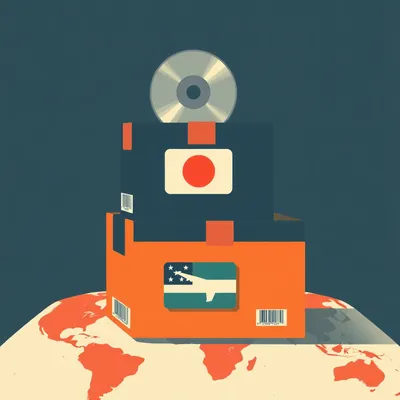
Daniel sent us this one — he's been thinking about something that came out of our Eurobox conversation. The basic unit works beautifully: six hundred by four hundred millimeter boxes, they stack onto Euro pallets, pallets slot two-wide into a standard shipping container. It's a seamless physical pipeline from your apartment to a port on the other side of the world. But the moment that container crosses a border, the rules change completely. And here in Israel, there's actually an unusual customs exemption for new immigrants that makes this whole thing work — it's why an entire cottage industry of lift companies exists shipping full containers from the US. Daniel's question is: what happens everywhere else? Are there any international treaties that prevent customs from treating your personal household goods like a commercial import? Or is Israel's time-limited arrangement basically the exception that proves the rule?

The short answer is that Israel is absolutely the exception, and the international framework is a patchwork. There is no global treaty that says moving your own stuff across a border is automatically duty-free. The closest thing we have is an annex to the Kyoto Convention from nineteen ninety-nine — specifically Annex B dot five, which covers goods for personal use imported by natural persons transferring their normal place of residence. But here's the catch: signatories can opt out of specific annexes. So a country can sign the convention and simply say, we'll take annexes A through D, but not B dot five, thanks very much.
It's a menu, not a binding commitment.
And enforcement is wildly inconsistent even among countries that did adopt it. The Istanbul Convention from nineteen ninety covers temporary admission for things like exhibition materials and professional equipment, but it has no dedicated category for household goods relocation at all. You'd think someone would have thought of that — people have been moving across borders with their belongings for centuries — but the treaty architecture just never caught up.
Which is strange, because the physical infrastructure has standardized beautifully. The Eurobox fits the pallet, the pallet fits the container, the container fits the ship. That whole chain is a solved problem. But the legal infrastructure is still operating like every item in that container might be a commercial import.
That's where the mechanics get genuinely interesting. Let me walk through how customs actually classifies household goods when a container shows up. Most countries don't have a unified personal relocation category. Instead, your belongings get scattered across the Harmonized System — that's the international nomenclature for trade classification — and each item can be individually assessed for duty. Your sofa might fall under one chapter, your kitchen appliances under another, your books under a third. There's no single box on the form that says, this is an entire human life, treat it accordingly.
Which means a customs official could theoretically open your container and start assigning duties item by item.
They could, and in some jurisdictions they do. But the real problem is valuation. Customs needs to assign a value to calculate the duty, and used household goods are a nightmare to value. You've got a five-year-old refrigerator, worn clothing, children's toys with no receipts. Customs officials often default to replacement cost or estimated market value, which can be far higher than what you could actually sell those items for. And then duty and VAT get applied on top of that inflated number.
You're being taxed on a fiction. The government imagines your used sofa is worth what a new one costs, then charges you a percentage of that imaginary number.
And the percentages aren't trivial. Depending on the country and the classification, you could be looking at duty rates of five to fifteen percent, plus VAT or GST of another fifteen to twenty-five percent. On a full twenty-foot container with a declared value of, say, fifty thousand dollars, the combined hit could easily reach ten to fifteen thousand dollars. That's not a small fee for getting your paperwork wrong — that's a meaningful fraction of the entire move cost.
Which brings us to Israel, where this whole problem has been carved out by law. The exemption for new immigrants — olim — is codified in the Customs Ordinance and tied to the Law of Return from nineteen fifty. You get a one-time exemption from import duties and VAT on personal belongings, household goods, and professional tools, provided the goods arrive within a specific timeframe and are for personal use, not resale.
That timeframe is typically three years from your aliyah date. It's not indefinite — you can't show up a decade later and still claim the exemption. But three years is generous enough that people can plan a move, ship their container, and not feel rushed. The Israel Customs Authority has detailed directives spelling out exactly what qualifies and what documentation you need. It's bureaucratic, but it's clear. And that clarity is what makes the whole lift industry viable.
Because the companies know the rules won't change on them mid-shipment.
These lift companies — there are several based in the US and Israel — have built their entire business model around the exemption. They consolidate partial containers from multiple families, handle the customs paperwork, manage the time window, and make sure everything arrives compliant. Without the exemption, the economics would collapse. The duties alone would add thirty to fifty percent to the cost of shipping a container, and suddenly filling a container with your household goods stops making financial sense for most families.
There's a second layer to the time limit. It's not just about when the goods arrive — if you sell items within a certain period after import, usually two or three years, you can be liable for the duties retroactively. The government doesn't want people importing a container of furniture duty-free and then holding a yard sale the next week.
Which is a reasonable anti-abuse measure. But it also means the exemption isn't a one-and-done transaction. You're in a relationship with customs for years after your move, at least in theory. In practice, enforcement is probably spotty — I doubt customs agents are knocking on doors checking if you still own that sofa — but the legal exposure is real.
Israel's model works because it's explicit, time-limited, and backed by a national legal framework that says immigration is a policy priority. The Law of Return isn't just about citizenship — it extends into trade law, tax law, the whole apparatus of making relocation frictionless. That's unusual.
It's extremely unusual. Most countries don't tie their immigration policy to their customs code in any systematic way. But let's zoom out, because you asked about the rest of the world. What happens if you're moving from, say, New York to Berlin, or London to Sydney?
The EU actually has one of the cleaner frameworks. EU Directive two thousand nine slash fifty-five EC allows duty-free import of personal property when you're transferring your normal residence from a non-EU country. But it comes with conditions: you need to have owned the goods for at least twelve months, you need to prove you're transferring your residence, and you can't sell or lend the items for twelve months after import.
Proving normal residence is where it gets sticky. You need documentation — lease agreements, utility bills, employment contracts, tax records — demonstrating that you actually lived in the origin country and are relocating. It's not enough to say I'm moving. You have to prove it to the satisfaction of a customs officer who may never have visited your home country and has no way to verify your story independently.
Which means the burden of proof is entirely on the mover. And if customs isn't satisfied, they can deny the exemption and assess duties. There's no presumption of good faith built into most of these systems.
The default assumption in customs law, globally, is that goods crossing a border are commercial imports until proven otherwise. Your personal effects are an exception you have to claim and substantiate, not a right you automatically hold.
That's the philosophical problem at the heart of this. The reasonable person's intuition is that moving your own stuff shouldn't be taxed — it's not a commercial transaction, you already own it, you paid taxes on it when you bought it. But that intuition has no legal standing in most jurisdictions.
It gets worse when you look at specific country rules. Take the United States. US Customs and Border Protection, under nineteen CFR one forty-eight dot fifty-two and fifty-three, allows duty-free entry for household effects and personal effects — but only if you've been a resident abroad for at least one year, and the goods must arrive within ten days of you arriving in the US, or within a specific timeframe under a bond. The definition is narrow: vehicles, alcohol, and tobacco are excluded. And if your container gets delayed in transit and misses that ten-day window, you've got a problem.
Ten days is absurdly tight for a container shipment. Ocean freight from Asia to the US can take three to four weeks, and that's assuming no port congestion, no customs holds, no strikes.
Which is why the bond option exists — you can post a financial guarantee and get an extension — but that's more paperwork, more cost, more complexity. And most people moving internationally don't know any of this until they're already in the process.
Japan is another interesting case. Japan Customs allows duty-free import of personal effects if you've lived abroad for at least a year, but they require a detailed inventory in Japanese. Not English with a Japanese summary — an actual Japanese-language inventory. And used vehicles face strict inspection and potential duty even if they're for personal use.
Australia's Customs Act from nineteen oh one allows duty-free import of household goods for new residents, but the definition excludes goods imported for commercial purposes or that are new or nearly new. That creates a grey area for anything you bought recently. Did you buy that sofa six months ago because you needed a sofa, or because you were planning to ship it to Australia and resell it? The burden is on you to prove it was genuine personal use.
The Canada example is similar. A Canadian moving back after living abroad can bring household goods duty-free, but a new immigrant faces different rules depending on whether they're landing as a permanent resident, a temporary worker, or a student. The categories matter, and getting them wrong is expensive.
What's striking is that every single one of these frameworks is national. There's no reciprocity. An Israeli oleh gets a break moving to Israel, but an Israeli moving to France gets no special treatment just because Israel has a generous exemption on its side. The customs regime is entirely one-directional and entirely determined by the destination country.
Let's talk about the treaties that do exist, because Daniel specifically asked about that. The Kyoto Convention's Annex B dot five is the closest thing to an international standard, but you said earlier that countries can opt out. How many actually adopted it?
The Revised Kyoto Convention has about one hundred thirty contracting parties, but the annex on personal goods relocation — Annex B dot five, formally called Annex J dot five in the older numbering — is not universally adopted. The World Customs Organization doesn't publish a simple adoption rate, but the pattern is clear: developed countries with significant immigration flows tend to have some version of the exemption, whether through the convention or domestic law. Developing countries and countries with protectionist trade policies are much less likely to offer broad exemptions.
Which makes a certain grim sense. If you're a country trying to protect domestic manufacturing, the last thing you want is a flood of used foreign goods entering duty-free, even if the people bringing them are genuine relocators.
And that's the tension. Customs exemptions for personal moves create a loophole that could be exploited. A business could theoretically fake a relocation, ship a container of goods duty-free, and sell them. The anti-abuse provisions — time limits, resale restrictions, documentation requirements — are there to close that loophole. But they also create friction for legitimate movers.
The hidden cost here is a tax on mobility. If you're a corporate executive with an employer covering relocation costs and a customs broker handling the paperwork, none of this matters to you. The fees get paid, the forms get filed, you never see the complexity. But if you're a freelancer, a remote worker, a retiree moving to be closer to family — anyone without an institutional backstop — the customs risk is entirely yours. And the cost of getting it wrong can be thousands of dollars.
That's the knock-on effect that doesn't get talked about enough. The patchwork of national customs rules creates an effective barrier to mobility that's invisible to people with resources and crushing to people without them. The lift industry in Israel exists because the exemption is reliable enough to build a business on. In countries without clear exemptions, the logistics industry simply doesn't offer containerized household moves at scale. You can't build a business model around maybe.
Because the customer can't price the risk. If you're moving from Chicago to Sydney and the customs outcome is uncertain — could be zero duty, could be fifteen thousand dollars — you can't budget for that. Most people will either abandon the idea of shipping a container, or they'll ship and hope, which is not a financial strategy.
This is where the Eurobox pipeline makes the problem more visible. The physical logistics are so smooth now — you can pack your apartment into standardized boxes, stack them on pallets, load a container, and have it at a port on the other side of the world in weeks. The physical infrastructure is democratic. Anyone with a few thousand dollars can do it. But the legal infrastructure is aristocratic — it only works smoothly if you have an institution behind you.
That's the weird prompt Daniel is pointing at. The boxes and pallets and containers are standardized across the entire planet. The customs rules are different in every single country. The physical layer is global; the legal layer is stubbornly national.
There's no obvious force pushing toward harmonization. The World Customs Organization facilitates coordination, but it can't compel countries to adopt uniform rules for personal relocations. The World Trade Organization cares about commercial trade barriers, not about whether a family moving from London to Lisbon pays duty on their used toaster. It's a policy orphan — too small for the big trade negotiations, too technical for immigration reform, too unglamorous for politicians to champion.
Although the remote work revolution might change that calculus. If more people are moving across borders with their households — not as corporate transferees, but as independent workers choosing where to live — the volume of containerized personal moves will increase. And as volume increases, the friction becomes more visible and more politically costly.
We're already seeing some of that pressure. Countries competing for digital nomads and remote workers are starting to streamline their customs procedures as part of the package. Portugal's D seven visa, Spain's digital nomad visa — these programs often include some customs facilitation for personal goods, though it's rarely the headline benefit. The headline is always the tax rate or the residency permit. But the customs piece is quietly there in the fine print.
What can someone actually do if they're planning this kind of move? Because the picture we've painted is pretty daunting — no global standard, lots of national variation, high stakes for getting it wrong.
The single most important thing is to research the destination country's personal effects exemption before you ship anything. Not after you've packed the container, not when it's already at sea — before. Every country's customs authority publishes rules on this, usually under headings like household effects, personal effects, or transfer of residence. Find the specific directive, read the conditions, and understand the time limits.
Purchase receipts for major items, photographs of serial numbers on electronics and appliances, a detailed inventory with estimated values. Customs officials are more lenient when you can prove ownership and personal use. The inventory doesn't need to be a work of art, but it should be thorough and honest. If you claim your ten-year-old sofa is worth fifty dollars, be prepared to explain why.
I'd also strongly recommend using a relocation specialist or customs broker who specifically handles household goods. Not a general freight forwarder who mostly does commercial shipments. The paperwork for personal effects exemptions is different from commercial shipping, and the mistakes are different too. A broker who does this regularly will know what the local customs office actually requires versus what the written rules say — and those are often not the same thing.
Because every customs office has its own culture, its own unofficial practices, its own things they care about versus things they ignore. A good broker knows that culture.
And they can tell you things like, this particular port is slower but more lenient on personal effects, or this documentation requirement is technically on the books but never enforced, or this item category always gets flagged so budget for duty on it. That local knowledge is worth the broker's fee many times over.
The other practical point is timing. If the destination country requires goods to arrive within a certain window — ten days, thirty days, six months — plan your shipment around that window. Don't ship the container before you have your visa or residency permit in hand. Don't assume the ship will arrive on schedule. Build in buffer.
If you're moving from a country that has an export control regime — the US, the UK, much of the EU — check whether any of your items require export licenses. This mostly applies to high-value electronics, certain scientific equipment, and cultural artifacts, but it's worth checking. The last thing you want is your container held at the origin port because customs found something that needed a license you didn't know about.
None of this is impossible. People do it every day. The lift companies moving containers from the US to Israel have it down to a science. But it requires treating the customs process as a first-class part of the move, not an afterthought.
That's really the takeaway. The physical logistics are the easy part now. The Eurobox system means you can pack your life into standardized units that flow seamlessly into the global shipping infrastructure. But the legal logistics haven't kept pace. Until there's a global standard for personal relocation customs — something like a universal annex to the Kyoto Convention that's actually binding and widely adopted — the burden is on the mover to navigate the patchwork.
The Israel model is instructive here. It shows what's possible when a government decides that relocation is non-commercial by definition and builds that into the tax code explicitly. The exemption is clear, it's time-limited, it has anti-abuse provisions, and it works well enough to support an entire industry. That's a template other countries could adopt — not necessarily tied to immigration law the way Israel's is, but as a standalone customs category for personal effects relocation.
If enough countries adopted something similar, you'd eventually get de facto harmonization. Not through a grand treaty, but through competitive pressure. If Country A makes it easy to move your household goods and Country B makes it hard, mobile workers will choose Country A. Countries that want those workers will adjust their customs rules accordingly.
Which is already happening with the digital nomad visas you mentioned. The customs facilitation is a secondary benefit, but it's part of the package. Over time, that could create a norm — that moving your own stuff isn't an import, it's a relocation, and it shouldn't be taxed like commerce.
It's a slow process, but the direction is clear. The question is whether the legal infrastructure will catch up before the next wave of global mobility makes the current patchwork untenable.
And now: Hilbert's daily fun fact.

In the seventeen twenties, a French astronomer observing from the coast of Somaliland recorded a transient lunar phenomenon — a bright flash on the dark limb of the moon — and described its duration as lasting the time it takes to recite the Nicene Creed. At a typical liturgical pace, that works out to roughly ninety seconds, making it the first precisely timed lunar event observation in astronomical history.
I have so many questions about the methodology there.
A lost art.
This has been My Weird Prompts. Thanks to our producer Hilbert Flumingtop for keeping the show running, and thanks to Daniel for the question that sent us down this particular rabbit hole.
If you're planning an international move, the rules are country-specific and the stakes are real — but with the right preparation, the Eurobox-to-container pipeline actually works. The physical infrastructure is ready. The legal infrastructure just needs to catch up.
You can find us at my weird prompts dot com, or email the show at show at my weird prompts dot com. We'll be back with another one soon.