Daniel sent us this one — he's asking about the Temple Mount, essentially why this single thirty-five-acre esplanade in Jerusalem's Old City has become the most combustible square kilometer on the planet. The status quo there is this fragile unwritten arrangement where Jews can visit but not pray, Muslims have freedom of worship administered by the Jordanian Waqf, and a fringe Jewish movement is actively preparing to rebuild the Temple. Every minor shift — a minister's visit, a whispered prayer, a drainage repair — risks setting off a regional war. How did it become such a stack of dynamite?

The timing couldn't be sharper. January twenty twenty-six — Minister Ben-Gvir makes his eighth visit to the site since taking office, and within forty-eight hours you've got UN Security Council consultations, Jordanian diplomatic protests, and rocket fire from Gaza. A single visit by a single minister triggered a multi-actor crisis. That's not hyperbole. That's the Temple Mount.
So this is practically a commute for him at this point.
It's strategic. Each visit is timed to coalition negotiations or Knesset votes. The man knows exactly what he's doing — he's stress-testing the system deliberately.
The system keeps almost breaking.
That's what makes this worth understanding. The status quo isn't a solution. It's a suspension mechanism. And right now it's being tested more aggressively than at any point since the Second Intifada in two thousand. So let's start with the physical geography, because the site itself matters.
Thirty-five acres. You said that — what does that actually look like?
About twenty football fields. It's a raised esplanade in the southeast corner of the Old City, held up by massive retaining walls — the Western Wall is just one section of that retaining structure. On top of the platform you've got two major Islamic structures: the Dome of the Rock with its gold dome, and the Al-Aqsa Mosque at the southern end. This is the site where the First and Second Jewish Temples stood — the Second Temple was destroyed by the Romans in seventy CE. For Jews, it's the holiest site in the world. For Muslims, it's the third holiest after Mecca and Medina — the Haram al-Sharif, the Noble Sanctuary, from which tradition says Muhammad ascended to heaven.
You've got two religions, both claiming this same thirty-five acres as absolutely central to their faith. That's layer one. But it's not just theological.
Layer two is legal — and this is where things get genuinely Byzantine. After Israel captured East Jerusalem in the Six-Day War in nineteen sixty-seven, Moshe Dayan, the defense minister at the time, made a decision that still shapes everything. He could have asserted full Israeli sovereignty over the site. He didn't. Instead, he reached an unwritten understanding: Israel would control security and access, but the Islamic Waqf — the Jordanian religious trust — would continue to administer daily religious affairs. Jews would be permitted to visit but not to pray.
The entire arrangement is unwritten.
That's the first misconception most people have. The status quo is not a formal treaty. It's a collection of handshake understandings, court rulings, diplomatic notes, and precedent. There's no single document you can point to and say "here are the rules." It's more like... the British constitution, if the British constitution were sitting on top of a powder keg.
The constitutional monarchy of explosive religious sites.
And it evolved. The nineteen ninety-four Israel-Jordan peace treaty formalized part of this — Article Nine explicitly recognizes Jordan's "special role" in Muslim holy sites in Jerusalem. Then in twenty thirteen, Jordan, Israel, and the Palestinian Authority reached another understanding that formalized the Waqf's exclusive authority over prayer on the site. So there's a paper trail, but it's fragmented. No single binding document governs the whole thing.
How does it actually work day to day? Walk me through the mechanics.
The Waqf is a Jordanian-appointed council of eighteen members. They control the keys to the Dome of the Rock and Al-Aqsa Mosque, they manage maintenance, they approve sermon content, they decide who enters the Dome of the Rock itself. They employ about five hundred guards and administrators. These are the people who enforce the rules on the ground — including the rule that non-Muslims cannot pray.
On the Israeli side?
The Border Police maintains a twenty-four-seven presence at the Mughrabi Gate, which is the single entry point for non-Muslims. Israeli police control who enters the esplanade, they monitor behavior, and they have what amounts to a "status quo violations" tracking system. If a Jewish visitor is seen praying — and I mean even silently moving their lips — they can be detained and removed.
There was a case like that recently.
Twenty twenty-three. A Jewish visitor was detained specifically because a Waqf guard testified that "moving lips constitutes prayer." The Israeli police upheld it. He was removed from the site. That's how granular this gets. The legal distinction between a "visit" and "prayer" has been upheld by Israeli courts since nineteen ninety-four, and it extends to the movement of your mouth.
You can stand there and think about God, but if your lips move, you've crossed a line that could theoretically start a war.
That's not an exaggeration. The nineteen ninety-four ruling by the Israeli Supreme Court explicitly affirmed that Jews have a legal right to visit the Temple Mount, but that the state can restrict that right for security reasons — which includes preventing prayer. The court essentially said: the right exists, but exercising it right now would be catastrophic, so we're going to restrict it.
Which brings us to the theological layer inside Judaism itself. Because it's not just that Jews are prevented from praying — a huge portion of Orthodox Judaism believes they shouldn't even be visiting.
This is the second big misconception. People assume all Jews want to pray on the Temple Mount and are being prevented by the Israeli government. The reality is that the Chief Rabbinate of Israel — the highest Orthodox authority — has prohibited Jews from visiting the site entirely. And this isn't a political position. It's a deeply held theological one.
Explain the reasoning.
It comes down to purity laws. In the ancient Temple, there was an inner sanctum called the Holy of Holies — the Kodesh HaKodashim — where the High Priest entered only once a year on Yom Kippur. The exact location of that chamber on the Temple Mount isn't known with certainty today. Mainstream Orthodox Judaism holds that anyone entering the area where the Holy of Holies once stood while in a state of ritual impurity — and according to Jewish law, everyone is in a state of ritual impurity today because we don't have the red heifer ashes required for purification — is committing a grave sin. The punishment in ancient times was karet, spiritual excision.
The prohibition is about accidentally stepping on the wrong patch of ground while spiritually unclean.
And since we don't know exactly where the Holy of Holies was, the Chief Rabbinate says: don't go up there at all. Signs are posted at the entrance to the Western Wall plaza warning religious Jews not to ascend. This isn't a fringe view — it's the mainstream Orthodox position.
That's not the only position.
The Religious Zionist movement, which emerged from the teachings of Rabbi Abraham Isaac Kook in the early twentieth century, developed a more lenient view. They argue that careful mapping of the site can identify areas that were definitely outside the ancient Temple's inner courts — particularly the outer plaza — and that visiting those areas is permissible. Many Religious Zionist rabbis encourage visits to specific sections of the esplanade as an act of asserting Jewish connection to the site.
Then there's the fringe.
The Temple Movement. This is where we get into the radical territory. The mainstream Orthodox view is that the Third Temple will be rebuilt by the Messiah — it's a divine act, not a human one. The Temple Movement rejects that. They believe rebuilding the Temple is a human obligation, a mitzvah that can and should be fulfilled now, without waiting for divine intervention.
They're not just writing manifestos. They're building the furniture.
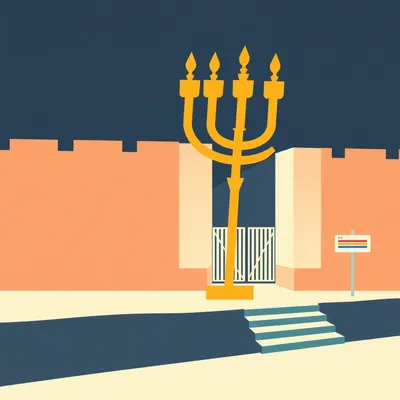
The Temple Institute, founded in nineteen eighty-seven, has spent over ten million dollars on physical preparations. They've completed a fifty-kilogram gold menorah — solid gold, not plated — that's currently stored in a warehouse in the Jewish Quarter of the Old City. In twenty twenty-four, they completed a set of silver trumpets designed to be blown by priests in Temple service. They've woven priestly garments according to biblical specifications, including the breastplate of the High Priest with twelve precious stones. They've trained men from the priestly lineage — kohanim — in the Temple rituals.
They've got a warehouse full of Temple hardware ready to go.
Ready for what they call "the moment." They're not hiding this. You can visit their institute in the Jewish Quarter. You can see the menorah through the window. It's visible from the street. They run educational programs, they publish detailed architectural plans, and they've mapped out exactly where on the esplanade the Third Temple would be built.
Which, if you're a Muslim watching this, looks like an active threat to the Al-Aqsa Mosque.
That's exactly how it's perceived. The Temple Institute's materials explicitly describe the Temple being built on the same site where the Dome of the Rock currently stands. They're not ambiguous about this. And while they represent a tiny fraction of Israeli society — polling at around four percent nationally — they have disproportionate influence because their preparations are tangible. You can't argue with a fifty-kilogram gold menorah. It's real.
Among Religious Zionist voters, that eighteen percent support figure you mentioned — that's not a fringe within that community. That's a significant minority.
It's growing. Twenty years ago, the Temple Movement was considered completely beyond the pale — even Religious Zionist rabbis wouldn't engage with them. Now you have Knesset members who openly associate with Temple organizations. The "Jewish Prayer on Temple Mount" bill has been introduced twelve times since twenty fifteen. It's never passed, but each introduction normalizes the idea a little more.
You've got this theological spectrum: most Orthodox Jews won't go up at all, some Religious Zionists will visit the outer plaza, and a small but increasingly organized group is actively preparing to dismantle the Dome of the Rock and build a Third Temple. All of this is playing out on thirty-five acres governed by unwritten rules.
That's just the Jewish side. The Muslim side has its own layers of complexity that most coverage completely misses.
You mentioned it's Jordanian, not Palestinian.
This is the third big misconception. People assume the Waqf is a Palestinian institution because it operates in East Jerusalem. It's not. The Waqf is appointed by Jordan, funded by Jordan, and answers to the Jordanian Ministry of Awqaf and Islamic Affairs. The Palestinian Authority has no formal role in its administration.
Which must create some interesting dynamics between Ramallah and Amman.
The PA wants control over the Haram al-Sharif because it's a central Palestinian national symbol. Jordan views it as a core element of Hashemite legitimacy — the Jordanian royal family traces its lineage to the Prophet Muhammad and has positioned itself as the guardian of Jerusalem's Islamic holy sites since the nineteen twenties. Neither side can afford to lose face on this issue, and they frequently undercut each other.
While both using Israel as the common enemy.
That's the unifying factor. When Ben-Gvir visits the Temple Mount, the PA and Jordan immediately issue coordinated condemnations. The PA calls for emergency Arab League sessions. Jordan recalls its ambassador. But behind the scenes, they're jockeying for position. Who gets to speak for the Haram? Who controls the narrative? Who's seen as the effective defender of Muslim rights in Jerusalem?
The Waqf itself — five hundred employees. That's not a small operation.
It's a bureaucracy. They manage everything from tour guide certifications to plumbing repairs. They decide which imams deliver Friday sermons and what those sermons say. They control access to the Dome of the Rock interior — even Muslim visitors need Waqf approval to enter. And they're the ones who flag "violations" to the Israeli police.
The moving lips incident.
A Waqf guard sees something, reports it to Israeli police, and the Israeli police act on it. It's a bizarre collaboration between two entities that are officially hostile to each other, cooperating to enforce rules that neither fully agrees with.
The whole thing sounds like a Rube Goldberg machine designed by diplomats who hated each other.
That's not far off. And here's where it gets truly dangerous: every actor in this system has an incentive to push the status quo to its breaking point — without wanting it to actually break.
Walk me through that. Who benefits from instability?
Let's start with the Palestinian Authority. The PA is deeply unpopular domestically. It's seen as corrupt, ineffective, and too accommodating toward Israel. But the one issue that reliably rallies Palestinian public opinion is Jerusalem — and specifically Al-Aqsa. Every time there's an incident on the Temple Mount, the PA can shift attention from its own failures to Israeli "aggression." They use every Israeli action — even routine maintenance — as a "violation" to rally domestic support and pressure Israel internationally.
The drainage repairs becoming archaeological excavations.
Twenty twenty-four. UNESCO passed a resolution condemning Israel for "archaeological excavations" on the Temple Mount. What was Israel actually doing? Repairing a drainage system that was causing water damage to the esplanade. Routine infrastructure work. But the PA framed it as an attack on Islamic heritage, and UNESCO bought it.
The PA has an incentive to inflate every minor incident into a crisis.
Jordan has a parallel incentive. The Hashemite Kingdom's claim to legitimacy is tied to its role as custodian of Jerusalem's holy sites. If that role appears meaningless — if Israel can do whatever it wants on the Haram — then the monarchy looks weak. So Jordan must be seen actively defending Muslim rights, which means publicly condemning Israel even for things it privately accepts.
The twenty twenty-four incident with the Mughrabi Gate elevator.
Israel proposed installing an elevator at the Mughrabi Gate to improve accessibility for non-Muslim visitors — the current ramp is steep and difficult for elderly or disabled people. Jordan threatened to suspend the peace treaty over this. The threat to suspend a thirty-year-old peace treaty that's a cornerstone of regional stability — over an accessibility ramp.
Because the optics of allowing Israel to modify any structure on the Temple Mount, even for disability access, would make Jordan look complicit.
And the peace treaty is too valuable for Jordan to actually scrap — it guarantees water access, security coordination, and American aid. But threatening to scrap it is cost-free domestic politics.
Then there's the Israeli far-right.
Ben-Gvir's entire political brand is built on asserting Jewish sovereignty over the Temple Mount. He's the Minister of National Security. Every visit he makes is a performance — he's photographed walking across the esplanade, surrounded by security, making clear that a Jewish minister can go wherever he wants on the holiest Jewish site. His supporters love it. And each visit serves a concrete political purpose: it's timed to coalition negotiations, to Knesset votes, to moments when he needs to shore up his base.
His first visit in twenty twenty-three triggered over two hundred rockets from Gaza.
He knew it would. That's the point. The rockets prove that his visit matters — that he's standing up to Hamas, refusing to be deterred. The escalation is the product, not the side effect.
Hamas and Palestinian Islamic Jihad — they've got their own incentives.
Hamas positions itself as the defender of Al-Aqsa. The twenty twenty-one Gaza war — two hundred fifty-six Palestinians killed, thirteen Israelis — was explicitly framed by Hamas as a response to Israeli "aggression" at Al-Aqsa. The actual trigger was clashes at the Damascus Gate during Ramadan, but the mobilizing symbol was the Temple Mount. Hamas fired rockets toward Jerusalem and called it "Operation Sword of Jerusalem." The name is deliberate — it ties the violence directly to the holy site.
You've got this chain reaction: a status quo breach somewhere on the site, Jordan recalls its ambassador, the PA calls for an emergency Arab League session, Hamas or Palestinian Islamic Jihad fires rockets "in defense of Al-Aqsa," Israel retaliates, and the cycle repeats.
The May twenty twenty-one escalation is the textbook case. Six days from Sheikh Jarrah eviction protests to Hamas rockets to Israeli airstrikes. The Temple Mount was the mobilizing symbol at every step. Hamas fired over four thousand rockets in eleven days. The Iron Dome intercepted most of them, but the message was clear: touch Al-Aqsa and we burn the region.
Every actor is pulling the string, knowing that if it actually snaps, everyone loses. But pulling the string is great politics.
That's the structural tragedy of the Temple Mount. The status quo is universally hated. Israel's right wing hates it because Jews can't pray there. The PA hates it because it formalizes Jordanian, not Palestinian, control. Jordan hates it because it requires constant cooperation with Israel. Hamas hates it because it normalizes Israeli presence. The only thing everyone agrees on is that changing it would be worse.
The worst possible system, except for all the others.
Churchill's democracy quote, applied to a thirty-five-acre religious site. And it's held since nineteen sixty-seven. Almost sixty years of this precarious balance.
What about the Abraham Accords? How did normalization with the UAE and Bahrain change the dynamics?
It's complicated. On one hand, the Accords gave Israel regional legitimacy that somewhat reduces its diplomatic isolation. The UAE in particular has engaged in quiet diplomacy, trying to mediate between Israel and Jordan on Temple Mount issues. On the other hand, the Accords threatened Jordan's unique position. If Arab states are normalizing with Israel without securing Palestinian rights, Jordan's role as gatekeeper looks less special. Amman has to prove it's still relevant — which means being even more vocal on Jerusalem.
Saudi Arabia hasn't normalized with Israel, and the Temple Mount is one reason. The Saudi royal family also claims a role as guardian of Islamic holy sites — the Custodian of the Two Holy Mosques is the king's official title. They can't be seen as less protective of Jerusalem than Jordan. So Saudi statements on the Temple Mount are consistently hardline, even as they engage in backchannel security cooperation with Israel against Iran.
The regional dimension makes it even more volatile. A fight between an Israeli minister and a Waqf guard isn't just a local incident — it's a Saudi newspaper headline, an Emirati diplomatic cable, an Iranian propaganda opportunity.
Iran is the wildcard. Tehran funds both Hamas and Palestinian Islamic Jihad, and it uses the Al-Aqsa issue to mobilize support across the Muslim world. Every Temple Mount incident is amplified by Iranian media within minutes. The twenty twenty-six Ben-Gvir visit — Iranian state media was covering it as a "Zionist attack on Al-Aqsa" before Ben-Gvir had even left the esplanade.
We've got theological claims, legal ambiguities, domestic political incentives in three different governments, regional power competition, and Iranian proxy networks — all layered onto thirty-five acres of limestone.
One more layer that gets overlooked: the physical infrastructure itself. The esplanade is ancient. The retaining walls date to Herod's expansion of the Second Temple in the first century BCE. There are underground spaces — cisterns, passages, what's known as Solomon's Stables — that haven't been properly mapped because no one can agree on who has the right to conduct archaeological work. The Waqf has done its own excavations over the years, and Israeli archaeologists have accused them of destroying Jewish artifacts. The Waqf accuses Israel of tunneling under the site to undermine it.
Is there actual tunneling?
Israel has conducted excavations along the Western Wall, outside the esplanade itself. The Western Wall tunnels run north from the prayer plaza, exposing the full length of the retaining wall. But the Waqf views any excavation near the site as a threat. In nineteen ninety-six, when Israel opened a northern exit to the tunnels, the rumor spread that the tunnel was going under Al-Aqsa. Riots broke out. Over eighty people died.
A tunnel exit.
That's the Temple Mount. Even infrastructure is lethal.
The twenty twenty-five Aqaba summit — you mentioned cameras that were supposed to be installed but never were.
The "status quo summit." Jordan, Israel, the PA, and the United States agreed to install twenty-four-hour cameras on the Temple Mount to monitor what actually happens there — the idea being that if everyone can see what's going on, false claims about violations become harder to make. The cameras remain uninstalled. The dispute is over who controls the footage. Israel wants joint control. The Waqf says cameras would violate the sanctity of the site. The PA wants independent monitoring. Jordan wants the footage routed through Amman. So nothing happens.
A surveillance solution that everyone theoretically wants but no one trusts anyone else enough to implement.
Which is the Temple Mount in microcosm.
Where does this leave us? You mentioned four indicators that people should watch if they want to understand where this is heading.
If you're trying to track Temple Mount stability without becoming a full-time Middle East analyst, there are four signals that function as early warning systems. First, Waqf staff changes — when Jordan replaces senior Waqf officials, it signals either a hardening or softening of enforcement. A new director who's more aggressive about reporting "violations" means more incidents. Second, Israeli coalition agreements that mention the Temple Mount — every government formation involves coalition deals, and if the Temple Mount appears in those documents, it means the far-right has extracted concrete commitments.
Jordanian diplomatic statements. Watch the language. If Jordan moves from "condemning" Israeli actions to threatening specific consequences — recalling the ambassador, reviewing the peace treaty, suspending security cooperation — that's a significant escalation. The elevator incident showed how quickly the rhetoric can escalate.
Fourth, the Temple Institute's funding.
Their annual reports are public. If their funding suddenly spikes — if they're getting major new donations — it means someone with resources is betting on political change. The Institute doesn't just prepare ritual objects; they lobby, they publish, they run educational programs. Money translates directly into political influence.
To summarize the whole picture: the status quo is not a solution but a suspension mechanism. It prevents war but also prevents any resolution. Every actor prefers the current instability to an alternative that might be worse for them specifically.
The Temple Mount's volatility is structural. You've got three irreconcilable claims — Jewish divine promise, Muslim custodianship, Palestinian national symbol — with no diplomatic framework that addresses all three simultaneously. The Oslo Accords deliberately deferred Jerusalem to final status talks. The final status talks never happened. The Camp David summit in two thousand collapsed largely over Jerusalem and the Temple Mount specifically. Every diplomatic framework since has foundered on the same rock.
The rock under the Dome of the Rock — the Foundation Stone — is where Jewish tradition says Abraham bound Isaac, where the Holy of Holies stood, where Muslims believe Muhammad ascended to heaven. You cannot divide that rock. You cannot share it. You cannot negotiate around it. It's either under one authority or another, and neither side can accept the other's authority without abandoning core theological claims.
The open question is: can the status quo survive another decade?
The twenty twenty-six Ben-Gvir visits may be stress tests rather than anomalies. If the Temple Movement gains mainstream political support — and at eighteen percent among Religious Zionist voters, it's approaching that threshold — the entire architecture collapses. The Israeli government would face an impossible choice: enforce the status quo against its own coalition partners, or allow Jewish prayer and trigger a regional crisis.
If the status quo breaks — if there's a sustained change in the rules on the ground — what's the most likely escalation path?
The twenty twenty-one pattern, but worse. Hamas and Palestinian Islamic Jihad would fire rockets — they've made this explicit. Hezbollah from Lebanon might join, which would open a northern front. Jordan would face massive domestic pressure to abrogate the peace treaty. The Abraham Accords states would face pressure to cut ties with Israel. And the escalation wouldn't be containable to one front — you'd have Gaza, Lebanon, potentially the West Bank, potentially Syria, all active simultaneously.
All because some lips moved on a thirty-five-acre hill.
Or because they didn't. Or because someone installed a camera. Or because someone repaired a drainpipe. The trigger doesn't have to be dramatic. The system is wired to explode.
Yet it hasn't. For almost sixty years.
That's the strange thing. The status quo is absurdly fragile, but it's also remarkably durable. It's survived two intifadas, multiple Gaza wars, the collapse of the peace process, the Trump administration's Jerusalem embassy move, the Abraham Accords, and eight Ben-Gvir visits. Every time it seems about to break, someone — usually the security establishments on both sides — pulls it back from the edge.
The Israeli security establishment has been notably resistant to changes on the Temple Mount.
The Shin Bet, the IDF, the police — they all understand exactly how dangerous this is. When Ben-Gvir first proposed changing the status quo in twenty twenty-three, the security establishment pushed back hard. They've seen the intelligence. They know what Hamas and Hezbollah are waiting for. The political echelon can make noise, but the security apparatus has been the real guardian of the status quo — not out of ideology, but out of sheer threat assessment.
Which is its own kind of fragility. If the security establishment ever loses that veto power — if the political leadership overrides them — the last backstop is gone.
That's the question for the next decade. Not whether the status quo is fair or sustainable — it's neither. But whether the mechanisms that have prevented its collapse can hold against the political forces that want to break it.
If you want to understand why the Middle East is always on the edge of war, you have to understand this one hill.
Thirty-five acres, three religions, two national movements, one status quo, and zero margin for error.
Now: Hilbert's daily fun fact.

The word "cephalopod" comes from the Greek "kephalē" meaning head and "pous" meaning foot — literally "head-foot" — a term coined in the nineteen sixties by linguists documenting Chadian Arabic, where local fishermen referred to octopus as "ra's al-rijl," or "head of the foot," which French colonial naturalists then back-translated into Greek to create the formal taxonomic label.
I have so many questions about that etymology chain and I'm going to suppress all of them.
French colonial naturalists back-translating Chadian fishermen into Greek.
This has been My Weird Prompts, produced by Hilbert Flumingtop. If you found this episode valuable, please leave us a review wherever you listen — it helps other people find the show.
Find more at myweirdprompts dot com. We'll be back with a new prompt soon.