Daniel's been turning over a prompt he sent us last episode. The one about running a diplomatic summit at a bar — the prank methodology for converting a casual hangout into a rigidly choreographed bilateral meeting. He was listening to the episode and realized something. The prank was supposed to be funny, and it was, but it also dragged up a very specific set of memories from real conferences he's attended over the past few years. Multi-million dollar events in foreign cities, excruciatingly scripted, with forced sing-alongs, prescribed icebreakers, and an MC who seemed to have a personal vendetta against natural conversation. He describes watching a sea of suits — middle-aged and older — singing lyrics from a projected screen and wondering if he'd wandered into a cult. His core question is this. In-person collaboration is valuable, maybe more so now with so many of us working remotely. So how do organizers strike the right balance between enough structure to hold an event together and not creating an experience that's exhausting and overbearing? What distinguishes a prank-level choreographed event from a destructively overbearing one, and what can organizers actually learn from the difference?

The prank worked because everyone knew it was a prank. The structure was the punchline. You walk into a bar expecting a casual drink and instead you're handed a formal agenda with designated speaking slots — the absurdity is the whole point, and everyone's in on it. Real conferences apply the same level of choreography without the self-awareness, and that's where it becomes destructive. The attendee isn't told they're participating in a scripted performance. The structure is presented as organic, as though this is just how the event naturally flows. But it clearly isn't, and that gap between what you're experiencing and what you're being told you're experiencing creates a specific kind of cognitive dissonance that's draining.
It's the difference between someone handing you a script and saying "we're doing a bit" versus someone handing you a script and insisting there is no script.
Right. And conference fatigue is a documented phenomenon. The BBC Worklife section ran a piece in February of twenty twenty-three on exactly this — the rise of exhaustion around highly structured professional gatherings. The problem isn't just that conferences are long or that you traveled to get there. It's the feeling of being managed. Every moment accounted for. The Wired piece on the same subject found that mandatory social activities often leave attendees more drained than if they'd just been given unstructured time. You finish a day of sessions and instead of decompressing, you're herded into a room where someone with a microphone is about to tell you how to interact with the person next to you.
Daniel's specific grievance — and I think this is the one that cuts deepest — is the interruption problem. You're finally having a normal conversation with someone you clicked with, maybe touching on actual work, and then the next scheduled session or announcement cuts through it. The chemistry that was building just evaporates. That's not a scheduling conflict. That's a design failure.
It is, and it comes from a fundamental mistake that a lot of organizers make. The Harvard Business Review ran a piece in May of twenty twenty-three called "The Case for Fewer But Better Conferences," and the core argument was that the most valuable conference moments are the unscripted ones. The conversation in the hallway, the connection made over coffee, the idea that sparks because two people had space to actually talk. Yet most schedules are built to minimize dead air. Unstructured time is treated as wasted time, so every gap gets filled with something.
Dead air is where things actually happen. The silence between songs is where you hear the next one.
That's... actually a good way to put it. And it connects to something deeper. There's a whole body of research on self-determination theory — Deci and Ryan, foundational work on autonomy and intrinsic motivation. One of the core findings is that when people feel their behavior is being controlled, even for activities that are supposed to be fun, they experience reduced enjoyment and increased stress. Singing is enjoyable. Being told to sing, on cue, with lyrics on a screen, surrounded by colleagues who are also being told to sing — that's not enjoyment. That's compliance.
So let's sit with the cult comparison for a minute, because Daniel wasn't being flippant. He said he looked at a sea of suits singing from a projected screen and wondered if he'd wandered into a cult. What's actually happening there psychologically?
Forced sing-alongs, call-and-response patterns, prescribed interaction rituals — these trigger the same psychological mechanisms as group cohesion rituals in high-control groups. Shared vulnerability, suspension of disbelief, social pressure to conform. The difference is that cults are explicit about the commitment they're asking for. The structure is the point, and everyone who stays has opted into it. Conferences don't do that. They present the sing-along as a fun surprise, a moment of spontaneous joy, when it's actually a mandatory performance with professional consequences for non-participation. Nobody says you have to sing, but everyone is watching to see who doesn't.
And you're in a room full of professional peers. The social cost of opting out is real.
That's what makes it feel manipulative rather than bonding. The choice is technically yours, but the environment is designed to make the choice for you. Self-determination theory would predict exactly what happens next — resentment, exhaustion, and a kind of emotional withdrawal. People go through the motions but check out internally.
Daniel mentioned that the choreography was unpredictable. You never knew when it was going to show up next. That seems like its own separate problem.
It is, and it's a specific kind of stressor. Predictable demands, even unpleasant ones, are easier to manage psychologically than unpredictable ones. If you know the sing-along is at three o'clock, you can brace for it. You can schedule your bathroom break around it. But when the choreography could ambush you at any moment — a surprise vocal artist, an unexpected icebreaker, an MC grabbing the mic during what you thought was casual drinks — you can never fully relax. You're always scanning for the next interruption. That's not an environment conducive to genuine connection. That's an environment conducive to hypervigilance.
It turns the whole event into a low-grade stress response that never really shuts off. Three days of that and you need a conference to recover from the conference.
Which is a thing people actually say. And it's not just a joke — there's a real recovery cost. The BBC piece noted that attendees at highly structured events often report needing a day or two just to decompress before they can be productive again. Compare that to less-structured conferences, where people leave energized and immediately start following up on connections they made.
So let's talk about what's actually happening on the organizer side. I don't think most of these people are mustache-twirling villains who want to exhaust their attendees. Something is driving this over-choreography.
Fear, mostly. Fear of dead air, fear of awkward silences, fear that if you don't fill every minute, someone will ask what they paid for. There's also a kind of event-design cargo cult where organizers see what other conferences do and replicate it without asking whether it works. Someone saw a sing-along at one event, it got a big reaction, and now it's in the playbook. The HBR piece made this point directly — too many conferences are designed by copying features from other conferences rather than by thinking about what the specific attendees actually need.
So you get this feature accumulation where every conference has to have the icebreaker, the musical moment, the scheduled networking session, the app with the gamified interaction prompts. Nobody stops to ask whether any of it is helping.
The BBC article found that attendees at less-structured conferences consistently report higher satisfaction and more actionable takeaways. The unconference model, where the schedule is built collaboratively on the first day and sessions emerge from participant interest, has been around for years and consistently outperforms traditional formats on engagement metrics. High structure in process — everyone agrees on how the schedule gets made — but low structure in content. The organizer provides the container, not the script.
Daniel's prank actually had better design principles than a lot of real conferences. The structure was transparent, it was time-limited, and there was an explicit off-ramp. They'd drop it when the joke had run its course.
That's the thing. The prank had consent built in. Everyone knew what was happening and why, and everyone knew it would end. Real conferences can borrow that. Build in clear boundaries around structured activities. Make participation optional — not "optional but we'll notice if you don't." Design for serendipity rather than scripting every moment. If you're hiring a vocal artist to lead a sing-along, ask yourself whether you're building community or manufacturing a moment for the highlight reel.
The highlight reel problem is real. You design the event for how it'll look in photos and social media posts rather than for how it'll feel to be in the room. The sing-along looks great on Instagram. It feels terrible when you're in it and you didn't choose to be.
And that connects to the knock-on effect Daniel was pointing at. The over-choreographed conference doesn't just exhaust attendees in the moment. It erodes the very thing it's trying to build. Trust and collaboration require psychological safety, and psychological safety is undermined when participants feel they're being managed rather than trusted. The HBR piece argued that the best conferences are the ones where organizers get out of the way. Not absent — present, prepared, ready to support — but not inserting themselves into every interaction.
Daniel said something interesting near the end of his prompt. He said in-person collaboration is arguably more valuable now than at any other time, given how many people are working remotely and independently. The stakes for getting this right are actually rising.
They are. Remote work strips out the casual collisions that used to happen naturally in an office. The hallway conversation, the coffee machine chat, the thing you overheard and jumped into. Conferences are one of the few places where those collisions can still happen at scale. If you fill every gap with programmed content, you've removed the one thing the conference could provide that Slack and Zoom cannot. You've flown hundreds of people to a foreign city so they can sit in a ballroom and be told when to sing.
So what does good design actually look like? If we're going to offer something constructive here, let's get specific.
A few principles that show up consistently in the research. First, unstructured time is not wasted time. Schedule gaps. Real gaps — not ten minutes between sessions where everyone's checking their phone. An hour and a half for lunch where nothing is programmed. An evening with no official activities. Let people form their own groups and make their own plans.
The best conference dinner I ever had was one where the organizer just said "there are restaurants in the area, figure it out" and people self-organized into groups of six or eight. I had conversations that night I still remember.
Second, social activities should be opt-in. Not "opt-in but the CEO is going and you'll look bad if you don't." Actual opt-in, with an attractive alternative — or no alternative at all, just free time. Third, the MC's job should be to facilitate, not to prescribe. Announce what's available, help people find what they're looking for, and then get off the stage. The MC is not the star of the conference.
And if you're tempted to hire a vocal artist to lead a sing-along, maybe sit with that impulse for twenty-four hours and see if it passes.
I think there's a broader principle here about what the organizer is actually trying to accomplish. If the goal is to create an environment where genuine connections can form, then the organizer's job is mostly logistical. Get the right people in the right place, provide enough structure that nobody's lost or confused, and then trust them to do what humans do when you put them in a room together. If the goal is to demonstrate how clever and creative the organizer is, that's when you get the sing-alongs and the surprise performances and the prescribed interaction patterns.
The organizer's ego becomes the bottleneck.
And look, I understand the impulse. Organizing a conference is terrifying. You've got hundreds or thousands of people who've paid money and traveled, and you feel this immense pressure to deliver an experience. The temptation is to over-deliver, to fill every moment with something, to make sure nobody is ever bored or awkward. But boredom and awkwardness are part of how humans connect. You get through the awkward small talk and find the real conversation on the other side. If you never let people be awkward, you never let them get to the good part either.
Daniel mentioned that the thing about the rigid choreography was that you never knew when it was going to show up next. There's a design principle there too. Whatever structure you do have should be predictable. If there's a scheduled activity, put it on the schedule. Surprise and delight is for birthday parties, not for professional gatherings where people are trying to build working relationships.
The surprise vocal artist is the perfect example of this. The organizer thinks they're creating a magical moment. What they're actually creating is an interruption that derails every conversation in the room. A hundred small connections that were forming just got severed so everyone could sing a song they didn't choose.
And now you have to rebuild those connections from scratch, assuming you even find the same person again.
Which you probably won't, because after the song ends, the MC announces the next thing, and everyone disperses. The moment is gone.
So let me ask you something. Given everything we've just laid out — the research, the psychology, the design principles — why do organizers keep doing this? The data says less structure works better. The attendees clearly prefer it. What's maintaining the over-choreography?
I think there are a few things. One is sponsor pressure. If a sponsor has paid for a slot, they want to see a packed room and an engaged audience. Structured activities create the appearance of engagement even if the engagement is performative. A room full of people singing looks more impressive to a sponsor than a room full of people scattered in small groups having quiet conversations.
Even though the quiet conversations are where the actual value is being created.
Right. The second thing is that structure is easier to sell. You can put a detailed agenda on a website and say "look at everything you're getting." A conference that's mostly unstructured time is harder to market, even if the experience is better. "Come to our event and we'll mostly leave you alone" doesn't test well in marketing copy.
Even if it's what everyone actually wants.
The third thing, and I think this is the uncomfortable one, is that many organizers believe attendees need to be managed. There's a paternalism to it. The assumption that if left to their own devices, people won't network properly, won't make connections, won't get value from the event. So the organizer steps in to manufacture the experience they think the attendee should be having.
And in doing so, they prevent the attendee from having the experience they would have chosen for themselves.
Which is almost always more valuable, because it's authentic. The connection you make because you wanted to make it, not because an MC told you to turn to the person on your left and share your spirit animal.
I still remember the spirit animal icebreaker from a conference about seven years ago. I said sloth, and the facilitator told me I was being too literal.
You were being accurate.
I was being accurate. But that's the thing — the prescribed interaction pattern doesn't leave room for people to be themselves. It gives them a script, and the script is almost always worse than what they'd come up with on their own.
Daniel's prank worked because the script was the joke. The absurdity of the script was the whole point. In a real conference, the script is presented as genuine, and that's where the damage happens. People feel manipulated because they are being manipulated. The organizer has decided what kind of interaction you're going to have, and you're expected to play along.
So if we're synthesizing this into something useful for someone who's actually organizing an event, what's the takeaway?
I'd say four things. One, structure should be enabling, not controlling. Logistics, scheduling, safety — these are things the organizer should handle so attendees don't have to think about them. But the content of interactions? That's for attendees to determine. Two, make participation optional and mean it. If you're doing an activity, provide a genuine off-ramp and don't penalize people who take it. Three, protect unstructured time. Schedule it. Defend it. Treat it as a feature, not a bug. Four, be transparent. If something is structured, say so. If something is a performance, don't pretend it's spontaneous. The cognitive dissonance is what hurts.
And maybe a fifth thing. Before you add any programmed element to the schedule, ask yourself whether it's there for the attendees or for the organizer. If it's for the organizer — for the photos, for the sponsors, for the highlight reel — cut it.
That's the hard one. That's the one that requires the organizer to be honest about their own motivations. But I think it's also the one that separates the events people remember fondly from the ones they describe as flashbacks.
I want to pull on one thread Daniel mentioned that we haven't fully addressed. He said the conference was held by a specific organization, and he won't name it for professional reasons. But he also said the execution is far more often what deserves the blame rather than the exercise of bringing people together. He's not anti-conference. He's anti-bad-conference.
And that's an important distinction. The value of in-person collaboration is real, and it's probably increasing. Remote work is great for focused individual output, but it's terrible for the kind of serendipitous connection that leads to new ideas, new collaborations, new ways of thinking about a problem. Conferences are one of the few remaining spaces where those connections can happen across organizational boundaries. Getting the design right matters.
If you burn people out with over-choreography, they stop coming. Or they come but they're checked out, hiding in their hotel room during the optional activities, skipping the social events. You've lost the value you were trying to create.
And the people who are most likely to check out are often the ones you most want to connect with. The thoughtful ones, the ones who find forced participation draining rather than energizing. They're the canaries in the coal mine. When they stop showing up, the conference has already failed.
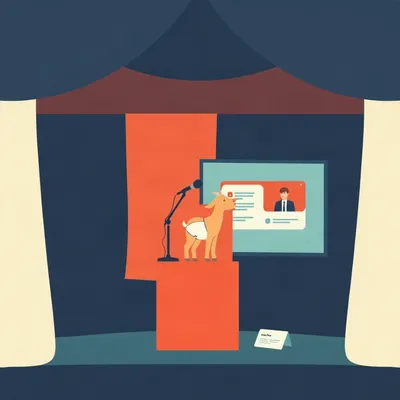
Daniel's description of the sea of suits singing from a projected screen — that image is going to stick with me. It's such a perfect encapsulation of the gap between what the organizer thinks is happening and what's actually happening. The organizer sees unity and shared experience. The attendee sees compliance and performance.
And the organizer probably went home thinking they'd knocked it out of the park. The photos were great. The social media engagement was high. The feedback forms — which, by the way, are often filled out before people have had time to process the experience — showed positive sentiment. But the real measure is whether people came back the next year, and whether they brought their best people with them.
Or whether they're still telling stories about it years later, and not in a good way.
Right. The conference Daniel described has become a story he tells about how not to do it. That's a branding failure that no amount of positive post-event surveys can fix.
Where does this leave us? Daniel asked how to strike the right balance. I think the answer is that the balance isn't a midpoint on a spectrum. It's not "some structure but not too much." It's a different kind of structure entirely. Structure that creates space rather than filling it.
That's well put. The best conference design is like the design of a good public square. You provide the benches, the lighting, the pathways. You don't tell people what to talk about when they sit down.

Twenty eighteen. I was a conference experience consultant for a major tech company. That was my actual job title. Conference experience consultant.
What did that involve?
I designed moments of spontaneous connection. That's what they called them. Spontaneous connection moments. I planned them six months in advance. I was the guy who planted the conversation starters on tables. I scheduled the surprise musical performances. I once had to stage a chance encounter between two executives in a hallway. Complete with a pre-written script for their spontaneous conversation. They shook hands, they laughed, they walked away feeling like they'd had a real moment. It was the most expensive piece of theater I've ever been involved in.
Did they know?
No. That was the point. If they knew it was staged, the magic would be gone. The whole thing was a farce. But I'll say this — the executives loved it. They felt like they'd connected. And the organizers were terrified of what would happen if they didn't engineer those moments. Dead air. Awkward silences. Someone important feeling like they hadn't gotten value. So they paid me to manufacture serendipity.
Did it work? Beyond the executives feeling good in the moment?
The internal surveys said yes. High satisfaction scores. Strong net promoter. But here's the thing. The only conference that company ever ran that I actually enjoyed was the one where the lead organizer got food poisoning. Day one, three in the afternoon. She was out. The backup couldn't handle it. The whole schedule collapsed. Attendees were left to their own devices for two days. No programmed activities, no surprise performances, no staged encounters. Just people in a venue with nothing to do but talk to each other. It was the highest-rated event the company ever ran. I still have the survey data. Eighty-seven percent said it was the best conference they'd attended. One guy wrote in the comments that he finally felt like an adult at a professional event.
The organizer getting food poisoning is not a replicable design strategy.
No. But the lesson's the same. The best thing an organizer can do is get out of the way. I spent a year getting paid to do the opposite, and I can tell you with absolute certainty that most of what I did made the experience worse. The executives liked the staged encounter because it confirmed their importance. Everyone else was having their conversations interrupted so I could make two vice presidents feel special.
You were the guy cutting through natural chemistry to make the scheduled announcement.
I was. And I was good at it. That's the part that bothers me. I was really good at manufacturing moments that looked great and felt hollow. The company kept hiring me back. I made a lot of money. I stopped doing it eventually because I couldn't look at another feedback form where someone had written "best conference ever" about an event where I knew exactly how much of the connection was fake.
What did you do after?
I took a job fact-checking for a trade magazine. Paid less. Slept better.
The survey data from the food-poisoning conference — eighty-seven percent. That's a number organizers should see.
It's in a folder on my hard drive. I've shown it to three clients. Two of them nodded and said it was interesting and then asked me to design a surprise musical performance for their next event. The third one actually changed how she ran things. Cut the programmed social activities by half. Doubled the unstructured time. Her attendance went up the next year. She sent me a bottle of whiskey.
The one who got it.
The one who got it. Most of them don't. They're too afraid of what happens if they let go. But you can't put "we'll mostly leave you alone" in a sponsor deck. So they keep hiring people like I used to be.
Is there anything from that experience you'd tell someone who's organizing an event right now?
If you're about to add something to the schedule, ask yourself whether you're doing it because you're afraid of what happens if you don't. If the answer is yes, cut it. The fear is lying to you. The attendees don't need you to fill their silences. They need you to give them silences to fill.
The question that leaves me with — and I think it's the one Daniel was really asking — is whether this is fixable at scale. If most organizers are operating from fear, and the fear is reinforced by sponsor expectations and marketing pressure and the whole conference-industrial complex, can individual organizers actually break out of that?
The one who sent Hilbert whiskey did. It's possible. It's just harder than following the playbook. And the playbook is very, very sticky.
As remote and hybrid work becomes the norm, the value of in-person gatherings increases. But so does the cost of getting them wrong. The organizations that figure out how to design for genuine connection without control — they're going to have a real advantage. In talent retention, in collaboration quality, in the kind of ideas that only emerge when smart people have space to think together.
The ones that don't will keep filling ballrooms with suits singing from projected screens, wondering why their best people stopped showing up.
This has been My Weird Prompts. Thanks to our producer Hilbert Flumingtop for keeping the show running, and for the survey data I now desperately want to see.
If you've had your own conference horror story — or a story of a brilliantly designed event that got it right — send it in. Show at my weird prompts dot com. We might do a follow-up.
We'll be back soon.