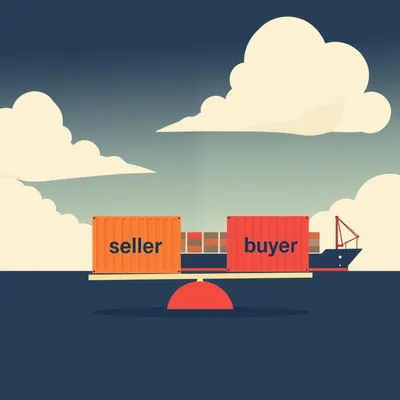
Daniel sent us this one — he's been digging into the mechanics of customs clearance in B2B importing, and he hit the thing that trips up basically everyone the first time they deal with it. You're shipping a product, you look at the HS code — the Harmonized System classification number — and you think, well, this is obvious. It's a plastic widget. It's a chair. It's a t-shirt. And then customs sends back a notice saying no, actually, that chair is upholstered seating and you owe eight and a half percent, not zero. Your shipment's held. Your margin's gone. And if you're on a DDP deal where you as the seller are paying the duty, that error just came straight out of your pocket.

The thing that makes this so brutal is the timing. You don't find out at the point of sale. You find out when the container's already at the port, storage charges are accruing by the day, and your buyer is asking where their goods are. That's when you learn that the six-digit code you thought was universal...
Daniel's question is essentially — what is this system, why isn't it as standardized as it claims to be, and where does the real value of a customs broker actually live? Because he's looking at these tariff documents and realizing the "international standard" part has some pretty large asterisks attached.
It really does. And I think the best way into this is to picture what the Harmonized System is supposed to be in theory, before we get into where it breaks. The World Customs Organization in Brussels maintains this — it's a hierarchical numbering system, six digits at the international level, covering basically every physical good that crosses a border. Over two hundred countries use it. The promise is that a bicycle in China is the same six-digit code as a bicycle in Brazil. That's the universal language pitch.
The reality is that after those six digits, every country bolts on its own extension. The US runs the Harmonized Tariff Schedule — HTSUS — which goes to ten digits. The EU uses Combined Nomenclature codes at eight digits. China has a thirteen-digit beast. And those extra digits aren't just statistical footnotes — they're where the actual duty rates live. So the "universal" part stops at six, and everything after that is national policy, national interpretation, and national revenue collection.
It's less a universal language and more a shared alphabet with very different sentences being written.
And even within the shared six digits, the interpretation diverges. The World Customs Organization publishes explanatory notes, but they're not legally binding. Countries issue their own rulings. A customs officer in Rotterdam might classify a product one way, and a customs officer in Los Angeles might classify the same product differently — using the same six-digit heading.
Which is where the broker earns their fee, because they know which port interprets what how. But before we get to the broker's value, let's talk about what actually governs classification, because Daniel mentioned the "self-explanatory" trap, and that's the thing that catches people.
Right — most importers never learn that there are six legal rules governing how you classify anything under the HS. They're called the General Rules of Interpretation, the GIRs, and they're applied in sequence. Rule one says you start with the actual text of the headings and any chapter or section notes. If the heading says "bicycles" and your product is a bicycle, you're done. But it almost never is that clean.
Because most products could plausibly fit under multiple headings.
And that's where Rule three kicks in. When goods are prima facie classifiable under two or more headings, you have to determine which one provides the most specific description. And if that doesn't resolve it, you apply the "essential character" test — Rule three B.
Give me an example of essential character going wrong.
Classic one: a smartphone sold with a leather case. Is it a phone under heading eighty-five seventeen, or is it leather goods under forty-two oh two? The phone gives it essential character — most customs authorities agree on that. But now change the case to something elaborate, a designer hand-stitched leather folio that costs more than the phone. Some jurisdictions will flip the classification. Same two items, same six-digit headings, different outcome depending on where you clear customs.
The importer who looked this up on a free online tool probably got the generic code for "mobile phone" and never considered the case at all.
That's the free-tool problem in a nutshell. Those tools give you the obvious answer. They don't walk you through the GIRs. They don't ask whether your product is a composite good, a set, a part, or an accessory. And those distinctions matter enormously. A car sunroof — is it a part of the vehicle or an accessory? The duty rate can be wildly different. A chocolate bar with a toy inside — is it food or is it a toy? Different regulatory regimes, different duties, different everything.
Daniel mentioned the frozen french fry problem. I want to sit with that one because it's so perfectly absurd.
It's my favorite example of how counterintuitive this gets. A company imports frozen french fries and classifies them under heading two thousand four point ten — prepared vegetables, duty rate around fourteen point four percent. They've been doing this for two years. Customs audits them and says no, these are frozen vegetables, heading zero seven ten point ten, duty rate four point eight percent. Now, you'd think the importer would be thrilled — they've been overpaying. But here's the catch: they declared the wrong code. Even though they paid more than they needed to, they made an incorrect declaration, which means penalties. And the overpaid duty? Getting that back is a separate administrative battle that can take years.
They paid too much and they're still in trouble.
They paid too much, they're facing penalties for incorrect declaration, and their compliance record now has a red flag that makes every future shipment more likely to be inspected. All because "frozen potato product" sounds like one thing to a layperson but is legally two different things depending on whether the potato has been prepared or simply frozen.
That's the part that I think Daniel's really getting at — the gap between what seems self-explanatory and what the system actually demands. And it's not just food. The LED lamp problem is another one.
Right — is an LED lamp a lighting fixture under heading ninety-four oh five, or is it an electrical machine under heading eighty-five forty-three? The answer often depends on whether the LED is integrated or replaceable. If it's integrated, some countries say it's an electronic device, not a lamp. If it's replaceable, it's a lamp. Same product category, same basic function — light comes out — but the tariff treatment diverges based on a design detail that the importer might not even think to mention to their broker.
The importer filling out the commercial invoice is probably just writing "LED lamp" and assuming that's enough.
Which brings us to another trap: the description you put on the invoice matters enormously. Customs isn't looking at your product. They're looking at the paperwork. If your invoice says "plastic widget" and the physical item has a metal bracket that makes it a machinery part, the customs computer is going to flag it based on what the invoice description most closely matches in their reference database. And once it's flagged, the burden of proof shifts to you.
Let's talk about how this plays out across borders, because Daniel specifically asked about the similarity — or lack of it — between different countries' systems. The six-digit base is the same.
After that, it fragments fast. The US HTSUS goes to ten digits and the last four determine the actual duty rate. The EU's CN code goes to eight digits, and then individual EU member states can add further subdivisions for their own statistical purposes. China's system goes to thirteen digits and includes import and export licensing controls baked into the code structure. So even if you and your supplier agree on the six-digit heading, the national extension in their country might classify the product under a different subheading than the extension in yours.
Those subheadings carry different duty rates.
Take scented candles. In the US, they're generally classified as candles under heading thirty-four oh six. In some EU member states, they've been classified as miscellaneous chemical products under heading thirty-eight twenty-four, because the scent is considered the essential character. Different duty rate, different regulatory requirements, and potentially different anti-dumping regimes if the candles are coming from certain countries.
The same product, same six-digit base, but the national interpretation flips it into a completely different regulatory bucket.
This is where Binding Tariff Information rulings come in. In the EU, you can apply for a BTI — an official ruling on how your specific product should be classified. In the US, it's called a Binding Ruling. These are legally binding on customs authorities in the issuing country. If you get a BTI from German customs saying your scented candle is heading thirty-four oh six, German customs can't later reclassify it. But here's the catch — that BTI is only valid in Germany. If you then ship to France, French customs can say "we disagree" and classify it differently.
You'd need a separate BTI for every EU member state you import into?
In theory, the EU's Combined Nomenclature is supposed to be uniform, and a BTI issued by one member state is binding across the EU. But in practice, the interpretation of the BTI's scope can vary. And a BTI from Germany definitely doesn't protect you in China or the US. So if you're an importer bringing goods from China into the US and also into the EU, you need separate rulings in each jurisdiction, and they might not agree with each other.
Which is where the customs broker's real expertise comes in. They're not just looking up codes. They're maintaining libraries of past rulings, they know which ports have which interpretive tendencies, and they can argue the nuances of GIR six — the subheading-level classification rules — that most importers don't even know exist.
GIR six is the one that governs classification at the subheading level, and it's where a lot of disputes are won or lost. It says you compare subheadings at the same level and determine which one is most specific. But "most specific" is a judgment call. A broker who's been doing this for twenty years in a specific industry knows exactly how customs officials at a given port have ruled on that judgment call in the past.
The cost of getting it wrong is not just the duty difference. Under US law, specifically nineteen USC fifteen ninety-two, penalties for underpayment can reach two times the duty owed. And that's before we even talk about non-tariff barriers — FDA holds if the misclassification triggers a different regulatory regime, anti-dumping duties if the product gets swept into a trade dispute, quota restrictions if the code falls under a limited category.
There's a real case that illustrates this perfectly. A furniture importer brought in wooden chairs with upholstered seats and classified them as wooden furniture under heading ninety-four oh one sixty-nine — duty rate zero percent. Customs reclassified them as upholstered seats under heading ninety-four oh one seventy-one — duty rate eight and a half percent. The importer owed three hundred forty thousand dollars in back duties, plus penalties. The difference between zero percent and eight and a half percent was a single digit in the HS code, and it was determined by whether the upholstery or the wood frame gave the chair its essential character.
On a DDP deal, that three hundred forty thousand comes straight out of the seller's margin. The buyer's already paid the invoice. The goods are delivered duty paid. The seller eats the reclassification.
Here's the part that really stings — if the buyer nominated the customs broker under DDP, the seller might not even have direct contact with the person making the classification decision. The buyer's broker files the entry, the seller gets the duty bill, and if there's an error, the seller is still ultimately responsible for the correct declaration in most jurisdictions. The contract might give you recourse against the broker, but good luck enforcing that across borders while your shipment is sitting in a bonded warehouse accruing storage fees.
The practical takeaway even before we get to the detailed advice is: if you're selling on DDP terms, you need contractual language that gives you the right to review the broker's classification before the entry is filed. If you don't have that, you're writing a blank check.
That's really the core of what Daniel's asking about. The HS system is an extraordinary achievement in international coordination — two hundred plus countries agreeing on a common taxonomy for traded goods is genuinely impressive. But the standardization is incomplete, the interpretation is inconsistent, and the financial stakes of getting it wrong are enormous. The value of a customs broker isn't that they have access to a secret database of correct codes. It's that they understand the rules of interpretation, they know the classification culture of specific ports and countries, and they can anticipate where the disputes will arise before the shipment is flagged.
Which means the self-explanatory HS code is a myth. What looks obvious to the person selling the product is often wrong, and the system is designed around legal rules — the GIRs — that most importers don't know exist until they're on the wrong end of a customs audit.
That audit can come years after the shipment cleared. Customs authorities in most countries have several years to review entries and issue demands for back duties. So the error you make today might not surface until your product line has changed, your margins have shifted, and the money you thought you made on those sales is long since spent.
The system is supposed to be a universal language, but it's more like a language with six shared root words and then every country writes its own poetry — and if you get the poem wrong, they fine you.
actually a pretty good way to put it. And the poets are customs officers who've been reading these rules for decades and have very specific ideas about what a chair is.
The thing is, the system actually is remarkable when you step back and look at what it achieves. The World Customs Organization in Brussels maintains this taxonomy — ninety-seven chapters covering everything from live animals to fine art, organized in a hierarchy that gets more specific as you go down. Two digits for the chapter, four for the heading, six for the subheading. Over two hundred countries have signed on. That's a genuine feat of international coordination.
The first six digits really are the same everywhere. A bicycle heading is eighty-seven point twelve whether you're in China, Brazil, or Germany.
The core promise holds at six digits. Chapter eighty-seven is vehicles, heading twelve is bicycles and other cycles, and the subheading narrows it to motorized or not. That part is universal. The World Customs Organization updates it every five years — next revision is twenty twenty-seven — and member countries negotiate the changes. It's slow, bureaucratic, and surprisingly functional.
Then every country grabs that six-digit base and extends it.
The US Harmonized Tariff Schedule adds four more digits, so you get a ten-digit code. Those extra digits aren't just for statistics — they're where the actual duty rate lives. The EU's Combined Nomenclature goes to eight digits, and individual member states can tack on more for their own tracking. China runs a thirteen-digit system that folds in import and export licensing controls directly into the code structure. So the "universal language" stops being universal at digit seven.
Which means if you're an importer moving goods from China to the US, your supplier in Shenzhen might be using a thirteen-digit Chinese export code that doesn't map cleanly to the ten-digit HTSUS code you need at the port of Los Angeles. Same six-digit base, completely different downstream classification.
That mismatch is where a lot of the friction lives. The supplier thinks they're shipping one thing because their domestic classification system says so. The US customs computer reads the invoice description and matches it to a different ten-digit code. The importer is in the middle, and the shipment is held until someone sorts out which code is correct — or at least defensible.
The mismatch problem is really just the surface. The deeper issue is that even when you've got the right six-digit heading, the legal rules that determine which subheading applies are not intuitive. You mentioned the GIRs earlier — the General Rules of Interpretation. Most importers don't know these exist.
They're the whole game. Six rules, applied in strict sequence. Rule one says you start with the actual text of the headings and any chapter or section notes. If the heading describes your product, you're done. The notes matter enormously because they define exclusions — chapter sixty-one covers knitted clothing, but the notes tell you exactly what counts as knitted versus woven.
Rule two handles incomplete or unfinished goods, and goods presented unassembled or disassembled. So if you ship a bicycle in a flat box, it's still classified as a bicycle, not as "miscellaneous metal tubes." But the rule has limits — the incomplete article has to have the essential character of the finished product.
Which sounds straightforward until you're the one arguing with a customs officer about whether a shipment of circuit boards with no processors has the essential character of a computer.
And that brings us to Rule three — where most disputes actually live. When goods are prima facie classifiable under two or more headings, Rule three tells you how to break the tie. Three A says pick the most specific description. "Electric razor" beats "electrical appliance." Three B — the essential character test — kicks in when specificity doesn't resolve it.
Walk me through essential character with something that actually trips people up.
A chocolate bar with a toy inside. Heading eighteen oh six is chocolate, heading ninety-five oh three is toys. The toy isn't just packaging — it's part of the product's appeal. So which gives essential character? Most customs authorities look at what the consumer is primarily buying. If it's a Kinder Egg, the chocolate dominates. If it's a plastic dinosaur with a tiny chocolate pellet attached, the toy dominates. But there's a gray zone in the middle where reasonable people disagree.
"reasonable people disagree" in customs means "your shipment is held and you're paying storage fees while lawyers argue about a chocolate bar.
The LED lamp is an even better example because it splits countries. An LED lamp with an integrated, non-replaceable bulb — is that a lighting fixture under heading ninety-four oh five, or an electrical machine under heading eighty-five forty-three? The EU has generally classified integrated LED luminaires as lighting fixtures. Some other jurisdictions have said no, if the LED is permanently attached, it's an electronic device, not a traditional lamp. Same product, same six-digit heading, different eight and ten-digit outcomes.
The duty difference?
Can be substantial. Lighting fixtures might face three to five percent. Electrical machines could be zero to two point five percent depending on the country. But the bigger risk is non-tariff — lighting fixtures often have separate safety certification requirements, energy efficiency labeling rules, and different anti-dumping duty exposure. Misclassify it and you're not just paying the wrong rate, you might be missing mandatory compliance documentation entirely.
Which brings us to the frozen french fry case, which I think is the perfect illustration of how self-explanatory classification fails.
It's almost beautiful in its absurdity. Heading two thousand four point ten covers prepared or preserved potatoes — that means cooked, fried, or otherwise processed beyond simple freezing. Heading zero seven ten point ten covers frozen vegetables, uncooked or merely blanched. The distinction is whether the potato has been par-fried. If the factory blanches and freezes, it's zero seven ten. If it par-fries before freezing, it's two thousand four. The duty difference was about ten percentage points.
The importer who got this wrong was overpaying by ten percent for two years.
Fourteen point four percent when they should have been paying four point eight. But here's what makes it so instructive — they weren't trying to evade duties. They were paying more than required. They just used the wrong code. And customs still penalized them for incorrect declaration, because the system cares about accuracy, not just revenue. You can't defend yourself by saying "but I paid too much." The declaration was false, and that's what triggers the penalties.
The lesson is that guessing conservatively — picking the higher-duty code to be safe — doesn't actually protect you.
It might even make things worse, because it signals to customs that you don't know how to classify your own products. And once you're flagged for incorrect declarations, every future entry gets scrutinized. The audit window in the US is typically five years. In some countries it's longer. So the error compounds.
Another trap Daniel's likely to hit — parts versus accessories. You mentioned the car sunroof.
Parts are integral to the functioning of the thing. Accessories are optional additions that enhance or supplement. A replacement engine valve is a part. A sunroof — is it integral to the car's function? In some classification rulings, yes, if it's factory-installed and the vehicle is designed around it. In others, it's an accessory because the car functions perfectly well without it. The same physical item can flip categories based on how it's sold — as original equipment or aftermarket.
The duty rate on auto parts versus auto accessories can be completely different.
Parts might enter duty-free under certain trade agreements. Accessories might face six to eight percent. And the classification can also determine whether the item qualifies for preferential tariff treatment under a free trade agreement — which requires the correct HS code to claim.
What about functional units? You mentioned a 3D printer with an integrated scanner.
This is Rule three C and the functional unit concept. When a machine consists of individual components intended to contribute together to a clearly defined function, the whole thing is classified under the heading appropriate to that function. A 3D printer with a scanner — is the scanner just an input device for the printer, making the whole thing a 3D printer under heading eighty-four eighty-five? Or is it a multi-function machine where the scanner has independent utility? The answer depends on whether the scanner can function without the printer. If it can scan and save files independently, some customs authorities will classify the scanner and printer separately, with different duty rates for each component.
Even though they're sold as one machine in one box.
And if the invoice doesn't break out the value of each component, customs may do it for you — using their own valuation methodology, which is rarely favorable to the importer.
This is where the international divergence really gets wild. Even with the same six-digit base, countries just... go their own way. Take scented candles. In the US, they're candles — heading thirty-four oh six. In some EU member states, customs has ruled they're miscellaneous chemical products under heading thirty-eight twenty-four, because the scent compound is considered the essential character, not the wax.
The same jar of vanilla-scented wax crosses the Atlantic and becomes a completely different legal object.
With different duty rates, different regulatory requirements, and potentially different anti-dumping exposure. If you're importing scented candles from a country with anti-dumping duties on chemical products but not on candles, that reclassification just made your shipment economically nonviable.
The importer who looked up the code on a free website probably got "candle" and moved on with their life.
Until the customs computer in Rotterdam flags it. And here's the thing about those free lookup tools — they give you the obvious six-digit heading. They don't tell you that French customs has a different interpretation than German customs on where scented candles land. They don't mention that the EU's Binding Tariff Information system exists at all.
Explain BTI, because this is one of those things that sounds bureaucratic but is actually a genuine risk management tool.
Binding Tariff Information is an official ruling you can request from EU customs authorities. You submit a sample or detailed description of your product, and they issue a legally binding decision on its classification. Once you have a BTI, customs in the issuing country can't reclassify that product on you. It's valid across the EU in principle — a BTI from Germany should be respected in France. In practice, the interpretation of the ruling's scope can vary, and you might still face challenges at different ports.
In the US, the equivalent is a Binding Ruling from Customs and Border Protection.
You apply, they rule, and that ruling binds CBP at every US port. But here's the crucial limitation — a BTI from Germany doesn't protect you in China. A Binding Ruling from the US doesn't help you in Brazil. These rulings are jurisdiction-specific. If you're importing into three countries, you need three separate rulings, and they may not agree with each other.
Which is where the customs broker earns whatever they're charging. They're not just filing paperwork. They maintain libraries of past rulings — their own and their competitors' — and they know the classification culture at specific ports.
Port-level culture is a real thing. Some ports are known for aggressive classification enforcement on textiles. Others scrutinize electronics more heavily. A broker who's been clearing goods through Long Beach for fifteen years knows exactly which headings trigger automatic holds and which ones sail through. They know which customs officers have ruled which way on GIR six subheading comparisons. That knowledge isn't written down anywhere public.
GIR six — the subheading-level rule — is where a lot of the broker's value lives, because that's the one that governs how you pick between two subheadings at the same level.
It says you compare them as if they're equally specific, then pick the one that best describes the goods. "Best describes" is a judgment call. A broker who specializes in your industry has seen that judgment call made fifty times and knows which arguments actually persuade customs officials.
Let's put a number on what getting it wrong costs, because the penalties are not subtle. Under US law — nineteen USC fifteen ninety-two — underpayment of duties can trigger penalties up to two times the duty owed. And that's just the penalty. You still owe the back duties.
The furniture case is the one that sticks with me. An importer brought in wooden chairs with upholstered seats and classified them as wooden furniture — heading ninety-four oh one sixty-nine, duty rate zero percent. Customs reclassified them as upholstered seats — heading ninety-four oh one seventy-one, duty rate eight and a half percent. The importer owed three hundred forty thousand dollars in back duties plus penalties.
The difference between zero percent and eight and a half percent was whether the wood frame or the fabric seat gave the chair its essential character.
One digit in the HS code. And this wasn't some fly-by-night operation trying to dodge duties — they believed wooden chairs with fabric seats were wooden furniture. It's an intuitive classification. It's also wrong.
If that shipment was on DDP terms, the seller eats the entire three hundred forty thousand. The buyer's invoice is paid. The goods are delivered duty paid. The seller has no way to pass that cost through.
Here's the DDP nightmare scenario. The buyer nominates the customs broker. The seller has no direct relationship with that broker, no visibility into what code they're filing. The broker classifies aggressively — or just carelessly — and the entry goes through. Two years later, customs audits and reclassifies. The seller gets the bill. The buyer's broker says "we filed what we thought was correct." The seller has limited recourse, especially across borders.
The seller's margin is exposed to a classification decision made by someone they didn't hire, didn't brief, and can't easily sue.
The audit window in the US is five years. In some jurisdictions it's longer. That error from twenty twenty-four might surface in twenty twenty-nine, long after the product line has changed and the money from those sales is gone.
Which is why the contractual language matters. If you're selling DDP, you need the right to review the broker's classification before the entry is filed.
You need a broker who knows your industry specifically, not a generalist. The difference between a zero percent duty rate and an eight and a half percent rate is often a single digit in a ten-digit code, and only someone who lives in that chapter of the tariff schedule day in and day out is going to spot the risk before it becomes a liability.
If you're actually doing this — if you're importing and you're staring at a commercial invoice trying to figure out what code to put down — where do you start? What's the thing you do next week?
First thing: never assume the code is obvious. Run what I'd call a GIR sanity check. You've got the product in front of you. Before you type anything into a lookup tool, read the actual text of the heading you think applies, and read the chapter notes. The notes are where the exclusions live. If chapter sixty-one says "this chapter does not cover garments with less than five percent elastomeric yarn," and your t-shirt has eight percent spandex, you're in the wrong chapter. That's Rule one. It takes ten minutes and it catches the mistakes that free tools miss.
Then ask yourself: could this product plausibly fit under two headings? If the answer is yes, you're in Rule three territory, and you need to figure out which heading is more specific — or which component gives the thing its essential character. If you can't answer that confidently, you need a broker. Not a website.
Second thing, and this one's specific to DDP sellers — get the right to review classification before the entry is filed. Put it in the contract. If the buyer is nominating the broker, you need a clause that says the broker's proposed HS code comes to you for approval at least forty-eight hours before the shipment files. If they push back, remind them that you're the one on the hook for the duty and the penalties.
If they still push back, price that risk into the deal or walk away. A DDP contract without classification review rights is a liability with a purchase order attached.
Third — build a classification library. For every SKU you ship, get a Binding Ruling from CBP if you're importing into the US, or a BTI if you're in the EU. And set a calendar reminder for twenty twenty-seven, because that's when the WCO's next five-year HS revision drops, and some of your codes will change. If you're still using a twenty twenty-two ruling in twenty twenty-eight, you're gambling.
The twenty twenty-seven revision is going to be a big one, actually. New headings for electric vehicles, advanced battery chemistries, AI hardware — whole categories of goods that barely existed when the last revision was negotiated. If you're importing anything in the EV supply chain, your classification library needs to be ready to update.
Fourth — and this sounds obvious but people resist it — hire a licensed customs broker who specializes in your industry. Not a generalist. Not the cheapest option on Freightos. Someone who lives in your specific tariff chapters. The furniture importer who got hit for three hundred forty thousand dollars probably had a broker. They just didn't have one who knew the difference between heading ninety-four oh one sixty-nine and ninety-four oh one seventy-one before customs pointed it out.
The broker who knows your industry has seen the rulings, knows the port-level tendencies, and can tell you upfront: "this classification will probably hold at Long Beach but Rotterdam will challenge it, so let's get a BTI before we ship." That conversation saves more money than any duty-optimization strategy.
On the topic of money — the difference between a zero percent rate and an eight and a half percent rate is often a single digit in a ten-digit code. The broker's fee is a rounding error compared to what a misclassification costs you.
The question that hangs over all of this, though, is whether any of that broker expertise is replaceable. There's a wave of AI tools now claiming to automate HS classification — feed in a product description, get back a ten-digit code. Natural language processing trained on past rulings and tariff schedules. And for straightforward products, they actually work reasonably well.
Straightforward products aren't where the money gets lost.
The AI can handle "cotton t-shirt, one hundred percent cotton, knitted." That's a clean match to heading sixty-one oh nine. But the moment you hit a composite good — a smartwatch with a medical-grade heart monitor, a drone with an integrated thermal camera — you're in GIR three B territory. And essential character is a legal judgment, not a pattern-match.
The AI doesn't know that the Port of Rotterdam has a reputation for classifying integrated LED luminaires differently than the Port of Hamburg. That's not in any training set.
It's not, and it may never be, because port-level interpretation culture isn't systematically documented. It lives in the heads of brokers who've been clearing goods through those ports for decades. Some of it is written down in internal firm memos and ruling libraries that aren't public. Some of it is just... The AI has no access to any of that.
The AI gives you the textbook answer. Which is exactly what gets you flagged, because customs isn't grading on textbook answers — they're grading on their own interpretive precedent.
The twenty twenty-seven HS revision is going to make this tension more acute. The WCO is introducing new headings for electric vehicles, advanced battery chemistries, AI accelerator hardware — categories that are still evolving technologically. There won't be a deep library of past rulings for the AI to train on. The first few years after a major HS revision, classification is negotiated in real time between brokers and customs officials, building the precedent that future rulings will cite.
The AI arrives exactly when the ground is shifting under it.
Which means the human broker who can walk into a meeting with a customs official and argue GIR three B on a product category that didn't exist five years ago — that person is not just valuable, they're the only thing standing between the importer and a very expensive audit.
On that forward-looking note — Hilbert, I believe you have something for us.
Now: Hilbert's daily fun fact.
Hilbert: In the early fifteen hundreds, sailors off the coast of Madagascar reported seeing the night sky bloom green with auroras — a phenomenon later traced to oxygen atoms high in the atmosphere, excited by solar wind, whose characteristic green emission line at five hundred fifty-seven point seven nanometers is, chemically speaking, the same spectral fingerprint produced by fireflies trying to attract a mate.
Fireflies and the southern lights are basically running the same chemistry.
Different species, same wavelength. I'll allow it.
This has been My Weird Prompts, produced by Hilbert Flumingtop. If you want to send us a question like Daniel did, email the show at show at my weird prompts dot com.
If you enjoyed this, leave us a review wherever you listen — it helps. We'll be back next week.