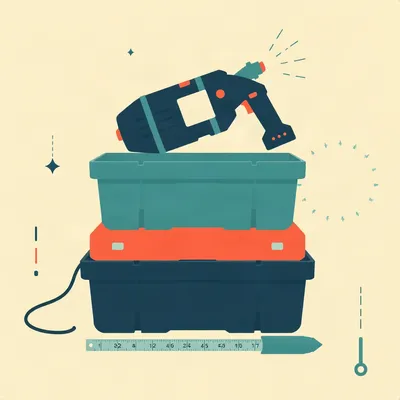
Daniel sent us this one — and it's not really about a belt. He and Hannah just finished an apartment move, did most of it themselves to save money and get their lives back faster, and he discovered something surprising. The single most useful tool wasn't the drill. It was a tactical belt with modular pouches, the kind built on the MOLLE system, stuffed with adhesive cable clips. He used it to run Ethernet along the walls, and it eliminated every trip back to the supply box. He finished all the cable runs in one pass. And his real question is: what's the principle underneath that, and does it transfer from physical DIY to knowledge work?

It absolutely does, and the principle has a name that shows up in about forty years of cognitive psychology research. But let me start with the story itself, because the numbers Daniel threw at this are worth sitting with. He's running fifty feet of Ethernet cable, using those little adhesive-backed clips you stick to the baseboard or the wall. Standard process: climb the ladder, peel the backing, press the clip, feed the cable, realize you grabbed twelve clips and you need eighteen, climb down, walk to the supply box, grab more, climb back up, drop two on the way, peel them off the floor, and by the time you're back in position you've lost not just the thirty seconds of walking — you've lost something much bigger.
Daniel's point is that with a pouch at his hip holding a hundred clips, he stayed on the ladder for one uninterrupted fifteen-minute pass. No fumbling in pockets. No running out mid-run. He said the cumulative savings weren't just about time — it was about staying inside the task. Which is a phrase I think we should nail to the wall.
Because what Daniel is describing is the elimination of micro-interruptions. And micro-interruptions are not just tiny versions of regular interruptions. They're a distinct category of cognitive friction, and they're more expensive than most people realize. Let me give you the anchor number here. University of California Irvine did the foundational study on this — Gloria Mark and her team — and they found that after an interruption, it takes an average of twenty-three minutes and fifteen seconds to fully return your focus to the original task. Not to physically return. To cognitively return. To be back in the same depth of engagement you had before someone knocked on the door or your phone buzzed.
Twenty-three minutes. For a thirty-second walk to the supply box.
And Daniel mentioned he was making about three of those trips per cable run before he got the belt. So on paper, three trips times thirty seconds each — that's ninety seconds of walking. Nobody would call that a problem. But the cognitive recovery cost? Three interruptions times twenty-three minutes each — that's sixty-nine minutes of degraded focus, for ninety seconds of walking. The math is absurd.
The ten-second interruption costs more than ten seconds because the meter doesn't stop when you sit back down. The brain is still rebooting.
And there's a more recent finding that makes this even starker. Microsoft Workplace Analytics put out data in twenty twenty-five on something called attention residue. The idea is that even after you physically return to a task, a portion of your attention stays stuck on whatever pulled you away. It's like a cognitive shadow. You're back on the ladder, you're holding the clip, but part of your brain is still processing the trip you just took — where you left the supply box, whether you grabbed enough this time, whether you should have organized the box differently. That residue degrades performance for minutes afterward. So you're not just losing time. You're working worse during the time you have.
Which tracks with what Daniel said about working more intensively but also more effectively with the belt. He wasn't just faster — he made fewer mistakes. Misaligned clips, clips placed at the wrong spacing, having to peel one off and re-stick it. All of that dropped when he stopped leaving the ladder.
That's the knock-on effect that makes this principle worth taking seriously. It's not just about saving time. It's about the quality of the work produced during that time. Deeper focus produces fewer errors, better decisions, and — this part gets overlooked — higher satisfaction. Daniel described the feeling of finishing all the cable runs in one go as transformative. That's not hyperbole. That's what flow state feels like. You're immersed, you're effective, and the work itself feels different.
Let's talk about the tool that enabled this, because Daniel specifically called out the MOLLE system as part of what made it work. What is MOLLE, for anyone who hasn't spent time in a military surplus store?
MOLLE stands for Modular Lightweight Load-carrying Equipment. It was developed by the US military in the late nineteen nineties as a replacement for the older ALICE system. The core idea is a grid of heavy-duty nylon webbing stitched onto a vest or belt, and pouches that weave through that webbing. You can attach any pouch anywhere, in any configuration, and swap them out depending on the mission. So a medic carries medical pouches. A radio operator carries radio pouches. Nobody carries pouches they don't need.
Daniel's insight was that this maps perfectly onto DIY. He didn't buy a pre-assembled tool belt with five oversized pockets, three of which would sit empty, and none of which were the right size for a hundred adhesive clips. He bought a belt, one pouch sized for small parts, and that was it. Task-specific loadout.
That phrase — task-specific loadout — is the heart of it. It's a concept that comes out of military logistics and the everyday carry community, and it's the opposite of the "be prepared for everything" mindset. The traditional tool belt tries to be a mobile workshop. The MOLLE approach says: what am I actually doing for the next hour? What do I need? Clips and a screwdriver. Everything else stays in the box.
The everything-else-stays-in-the-box part is as important as the carrying part. Because a tool belt with too many pockets is itself a source of micro-interruptions. You reach for the clip pouch, you have to navigate past the hammer loop, the tape measure holster, the pencil slot. Every extra option is friction.
There's a parallel here to something Daniel mentioned that I want to pull forward, because it's easy to miss. He said he used ChatGPT with vision — specifically GPT-four-o, which got vision capabilities in May twenty twenty-four — to diagnose drywall holes and IKEA assembly steps by uploading photos. And he framed that as part of the same principle. The AI eliminated the interruption of watching a twenty-minute YouTube tutorial or waiting six days for a handyman. A thirty-second answer kept him in flow.
That's the belt principle applied to knowledge. Instead of leaving the task to go search for information, the information comes to you inside the task. You hold up your phone, snap a picture of the broken cabinet hinge, and the AI tells you what screw you need and how to replace it. You never left the room mentally.
This is where I think Daniel's question gets really interesting. He's asking: if the belt eliminated micro-interruptions in physical DIY, what's the equivalent for someone who works at a computer all day? What's the tactical belt for a software developer or a writer?
I'd say it's a curated set of exactly the tools the current task needs, and nothing else. And I mean aggressively nothing else. If you're deploying code, you need a terminal, a monitoring dashboard, and maybe a Slack channel for alerts. You don't need email open. You don't need Twitter. You don't need a second browser window with twelve tabs left over from yesterday's research. The belt principle says: close everything that isn't this task.
There's a case study I've seen floating around developer communities. Someone sets up what they call a deploy loadout. Terminal on the left monitor, dashboard on the right, Slack narrowed to just the alerts channel, and a physical stress ball on the desk. That's it. Every other application is closed. The entire digital environment is configured for one task. It mirrors exactly what Daniel did with his belt — one pouch, one type of clip, one job.
The stress ball is a nice touch, because it acknowledges that focus is physical. Your body is part of the workspace. Daniel on a ladder with a pouch at his hip is a full-body flow state. The developer with a stress ball and a clean desktop is the same thing, just with less climbing.
This connects to a body of research I find genuinely exciting. In twenty twenty-five, several papers started converging on what they called flow state prerequisites — the environmental conditions that make deep work possible. And the top predictor wasn't motivation, wasn't talent, wasn't even uninterrupted time in the abstract. It was environmental friction below a certain threshold. Every extra click, every drawer opened, every tab searched — these are friction events. And they accumulate below the level of conscious awareness. You don't notice them individually. But together, they prevent flow from ever starting.
The belt didn't just prevent interruptions. It lowered environmental friction enough that flow could happen at all. Daniel couldn't enter flow on the cable runs before because the supply box trips kept resetting him to zero. He was spending his whole session in the first twenty-three minutes of cognitive recovery, over and over.
Which is a bleak way to think about a Saturday afternoon of DIY. You're working for four hours, but you're only ever in the shallow end of focus. The deep end never arrives because you keep getting pulled back to the ladder.
Let me poke at a potential counterpoint here, because I think it's worth addressing. There's a risk of over-engineering this. You can spend more time optimizing your workspace than actually working in it. The guy who spends three hours configuring the perfect Notion dashboard and then never writes anything.
And Daniel's setup is actually the antidote to that, not an example of it. He bought one belt and one pouch. He didn't research MOLLE webbing specifications for six weeks. He identified the single biggest source of friction — trips to the supply box — and eliminated it with the simplest possible tool. That's the Pareto principle at work. Eighty percent of the benefit comes from eliminating the top twenty percent of interruptions.
The top twenty percent is usually obvious once you look for it. For Daniel, it was the supply box trips. For a writer, it might be the five seconds of friction every time you need to look up a fact and you have to switch from your writing app to a browser, type a search, scan results, find the answer, and switch back. That's a micro-interruption. The belt equivalent might be a second monitor with reference material already open, or a physical notebook with key facts written down before the session starts.
Or a keyboard macro pad. This is one of my favorite examples of the belt principle in digital work. A small programmable keypad with maybe six or eight buttons, each mapped to a repetitive action you do dozens of times a day. One button inserts a snippet of code. Another opens your project folder. Another pastes a canned response to the Slack message "what are you working on." Each of those actions normally takes three to five clicks and a few seconds of navigation. The macro pad makes it one press. You stay in flow.
The canned Slack response is interesting, because it's not a tool in the traditional sense. It's a pre-configured response to a predictable interruption. That maps onto something the military calls immediate action drills. If your weapon jams, you don't stop and diagnose. You execute a drilled sequence of movements that clears the jam automatically. The cognitive load is zero because you practiced it in advance.
The knowledge work equivalent is exactly what you just described. You know certain interruptions are going to happen. The "what are you working on" Slack message. The "can you jump on a quick call" email. The "where's that file" question. If you have to compose a fresh response each time, you're context-switching. If you have a saved response, you're executing a drill. Two seconds, done, back to work.
We've got a few layers now. The physical belt for physical tasks. The digital loadout for knowledge work. The macro pad for repetitive actions. And the pre-configured response for predictable interruptions. All of them are doing the same thing: eliminating the micro-interruption before it happens.
I want to name something that's implicit in all of this. The workspace stops being a passive container for your work and becomes something you actively engineer. Daniel talked about this directly — engineering our workspaces to eliminate micro-interruptions. That's a mindset shift. Most people inherit their workspace. Whatever desk they bought, whatever apps came pre-installed, whatever tabs were open yesterday. The belt principle says: no, you design the workspace for the task. Every element is chosen. Everything else is removed.
Which sounds intense until you realize Daniel did it in about ninety seconds. He looked at the cable run task, identified the friction, clipped on a pouch, and started. The engineering doesn't have to be elaborate. It just has to be intentional.
That's the actionable core of this. Let me make it concrete. Before you start your next task — any task — spend two minutes gathering everything you'll need within arm's reach. For physical work, that's the belt or the pouch or just a small container with the exact supplies. For digital work, that's closing every application and browser tab that isn't relevant, and opening only the files, tools, and references the task requires. The two minutes of setup pays for itself in the first micro-interruption you don't have.
Daniel's version of this was stuffing a hundred clips into the pouch before climbing the ladder. He knew the task needed roughly twenty-five clips, but he brought four times that many because running out mid-run was the specific failure mode he was engineering against. He wasn't optimizing for efficiency of clip usage. He was optimizing for uninterrupted flow.
That's a subtle but important distinction. The goal isn't to minimize supplies. It's to eliminate the possibility of a certain class of interruption. Over-provisioning is a legitimate strategy when the cost of running out is a twenty-three-minute cognitive recovery.
Let me bring this back to the AI piece, because I think Daniel's ChatGPT example is going to become more common, not less. He used it for drywall repair and IKEA assembly — upload a photo, get instructions. The time savings versus watching a YouTube tutorial are obvious. But the flow savings are the real prize. A twenty-minute tutorial is a macro-interruption. You stop working entirely and shift into learning mode. A thirty-second AI answer is a micro-interruption at worst. You barely leave the task.
We're on the edge of this getting even more seamless. Augmented reality glasses that overlay instructions directly onto what you're looking at. You're holding the cabinet hinge, the arrows appear in your field of view showing you which screw to turn, and you never look away. The interruption cost drops to zero. The belt principle taken to its logical extreme — the information is literally on your body, in your line of sight, with no device to pick up or unlock.
That's a future where the workspace engineers itself around the task in real time. But the principle is the same one Daniel stumbled onto with a thirty-dollar nylon belt and a pouch. Identify the friction. Stay in the work.
The friction isn't always obvious until you look for it. Daniel had been running Ethernet cable with adhesive clips for years — he said he'd done it more times than he could remember — and he never questioned the supply box trips. They were just part of the task. It took a belt and a pouch to reveal that those trips weren't the task at all. They were interruptions masquerading as work.
Interruptions masquerading as work. Walking to the supply box feels productive. You're moving, you're retrieving supplies, you're doing something. But it's not the thing. The thing is attaching clips to the wall. Everything else is friction.
This is where the knowledge work parallel gets uncomfortable for a lot of people. Because what are the supply box trips in a typical office worker's day? Switching to Slack. Opening a new tab to look something up. Those feel like work. They're often counted as work. But if the task is writing a report, they're interruptions masquerading as work. They're trips to the supply box.
The belt makes you confront that by making the distinction physical. When you're on the ladder with a pouch full of clips, you can't pretend that climbing down to check your phone is part of the cable run. It's obviously a separate action. The physical separation makes the interruption visible. In digital work, the separation is invisible. Everything happens on the same screen, so switching from the report to email feels continuous. It's not.
There's a concept in human-computer interaction research called seamfulness. The idea is that when you make the seams between different contexts invisible, you lose the ability to notice when you're crossing them. A physical belt makes the seam visible. You're either on the ladder with the pouch, or you're not. Digital workspaces erase the seams, which makes micro-interruptions much harder to detect and much easier to fall into.
One practical takeaway might be to deliberately create seams. A second monitor that only shows the task. A separate browser profile for deep work that doesn't have your email logged in. A physical notebook for scratch work so you don't have to switch apps. Make the interruption visible by making it harder to do.
And it connects back to the MOLLE philosophy in an interesting way. MOLLE pouches are physically distinct. You can see and feel which pouch you're reaching for. A traditional tool belt with a dozen built-in pockets blends everything together. The modularity creates seams. The seams create awareness. The awareness lets you stay in the task.
Let's pull this together into something a listener can actually use. Daniel's prompt was essentially: I discovered this principle by accident in physical DIY, and I think it transfers to knowledge work. Help me understand why it works and how to apply it elsewhere.
The why is the twenty-three-minute cognitive recovery window and attention residue. Micro-interruptions don't feel expensive in the moment, but they prevent flow from ever establishing, and they leave a cognitive shadow that degrades performance for minutes afterward. Eliminating them isn't about saving seconds — it's about protecting the quality of attention.
The how is the task-specific loadout. Before starting any task, physical or digital, spend two minutes gathering exactly what the task needs within arm's reach, and removing everything else. For physical work, that's a belt or a pouch or a small container. For digital work, that's closing every application, tab, and notification that isn't directly relevant to the task at hand.
The third piece is what I'd call the interruption audit. Daniel's doing it instinctively now, but you can do it deliberately. Pick one recurring task — something you do weekly or monthly — and the next time you do it, record every single moment you have to stand up, reach for something, switch windows, or wait for something to load. Those are your micro-interruptions. Pick the top three and engineer them out. You don't need to fix all of them. The top three will get you most of the benefit.
Daniel's top three were all the same thing: trips to the supply box. One pouch solved all of them. Most people's top three are probably variations on the same theme too. Switching to email. Switching to chat. Searching for files. A single intervention — closing email and chat during deep work sessions, and organizing files into a single project folder — might eliminate all three.
The ChatGPT piece is worth calling out separately, because it's a new category of interruption eliminator. It's not just a knowledge source. It's a speed-of-answer tool. The value isn't that the AI knows how to fix drywall. The value is that it tells you in thirty seconds instead of twenty minutes. The speed is the feature. The speed keeps you in flow.
Daniel framed this whole thing as part of a broader moment of empowerment. He said we're in an amazing age where, as long as something is safe to attempt yourself, you can do things that would have seemed impossible before. The belt and the AI are both tools in that same project — they remove the friction between wanting to do something and actually doing it.
That's a optimistic way to look at where we are. The tools are getting better at eliminating friction. The research is getting clearer about why friction matters. And the principle — identify the interruption, engineer it out, stay in the work — applies whether you're running Ethernet cable or writing code or cooking dinner.
Cooking is actually a great example. The culinary version of the belt is mise en place — everything in its place. You chop all your vegetables, measure your spices, and arrange them in order of use before you turn on the stove. Once the cooking starts, you never leave the pan. It's the same principle. The prep is the pouch-loading phase. The cooking is the ladder.
Parenting has a version of this too. The diaper caddy that lives next to the changing table, stocked with diapers, wipes, and cream. You never have to leave the baby to go find supplies. That's a task-specific loadout for the most interruption-sensitive task in human experience.
The bag packed the night before, by the door, with everything you need for the morning. You're not scrambling for keys or searching for your wallet. You grab and go. The micro-interruptions of the morning rush are engineered out in advance.
The principle scales. It's not just for DIY. It's not just for knowledge work. It's a general approach to task design. Figure out what the task actually needs. Put it within arm's reach. Remove everything else. Do the task without leaving.
If you find yourself leaving anyway — if you keep climbing down from the ladder — that's information. It means something about your loadout is wrong. Either you're missing something you need, or you've included something that's pulling you away. The interruptions are diagnostic.
Which brings us back to Daniel's original observation. He said the belt wasn't just useful — it was transformative. And I think that word is earned. Not because the belt itself is magical. Because it revealed a whole category of wasted effort that he'd been accepting as normal for years. Once you see the micro-interruptions, you can't unsee them. And once you eliminate a few of them, you start wondering where else they're hiding.
The open question for anyone listening is: what's your supply box? What's the thing you keep walking back to, over and over, that isn't actually the work? Find that, and you've found your next belt.
Now: Hilbert's daily fun fact.

During the Cold War, researchers at a Yukon observatory discovered that the deep red auroras occasionally seen at high altitudes are caused by oxygen atoms colliding with nitrogen molecules — an interspecies chemical handshake that takes more than a minute per photon, meaning a single red aurora beam is a slow-motion conversation between two elements that started long before anyone on the ground looked up.
A slow-motion conversation between elements.
Here's the one thing I want to leave people with. Daniel's belt worked because it made a hidden cost visible. The twenty-three-minute cognitive recovery, the attention residue, the micro-interruptions that feel like work but aren't — all of that was happening invisibly for years. The belt didn't just hold clips. It held up a mirror. And the reflection showed that a lot of what we call work is actually just walking back and forth to the supply box.
This has been My Weird Prompts. Thanks to our producer Hilbert Flumingtop. If you've got your own micro-interruption hack — something you've engineered out of your workspace that changed how you work — we want to hear about it. Email the show at show at my weird prompts dot com. We'll feature the best ones in a future episode.
I'm Corn.
I'm Herman Poppleberry. Go eliminate something.