Daniel sent us this one — and it's a deeply practical question that I think a lot of renters have never even considered asking. He wants a step-by-step playbook for replacing disposable cardboard boxes with shipping pallets when you move. The specifics: how to pack fragile stuff, how to sequence the packing so you're not living out of a suitcase for three weeks, how many pallets a typical apartment needs, how to label them so nothing gets lost, and crucially, how to disassemble and store the pallets afterward so you're not sourcing new ones every time. He also wants to know which movers will actually handle palletized home goods without looking at you like you've lost your mind. There's a lot to unpack here — no pun intended — but this is genuinely one of those ideas where once you hear it, you wonder why everyone isn't doing it.

The average renter in the United States moves eleven times in their lifetime. And every single time, they're spending somewhere around two hundred dollars on cardboard boxes that get crushed, soggy, or thrown into a recycling bin by day three. It's a completely disposable system for something that happens over and over again. The pallet approach flips that entirely — you're treating your belongings like modular cargo, not trash-bound disposables. And this isn't some fringe hippie idea. The military has been moving household goods on pallets for decades. Warehouses run on pallets. The logistics industry figured this out a century ago. We're just applying it to a one-bedroom apartment in Brooklyn.
The military angle is interesting. So when a service member gets PCS orders — permanent change of station — their stuff often goes onto pallets?
And the major moving companies — United Van Lines, Mayflower, Atlas — they all have dedicated military relocation divisions that handle palletized household goods every single day. So when you call them and say "palletized household goods move," you're not speaking a foreign language. You're just triggering a different pricing model. But we'll get to movers later. Let's start with the pallets themselves.
Frame the core constraint here. We're not putting a sofa on a pallet. We're not putting a bed frame on a pallet. What are we actually talking about?
This system is for the small stuff — the twenty to thirty cardboard boxes that normally hold your books, kitchenware, electronics, clothing, and decor. The standard GMA pallet — that's the Grocery Manufacturers Association standard — is forty-eight inches by forty inches, with a weight capacity of forty-six hundred pounds when evenly distributed. That's the gold standard. They're available for free on Facebook Marketplace, Craigslist, or behind big-box stores if you ask permission. Home Depot, grocery stores, furniture stores — they all cycle through pallets constantly and most are happy to let you take a few.
Forty-six hundred pounds. So weight is not the limiting factor here.
Height and maneuverability. A standard two-person moving crew with a pallet jack needs the pallet to be under fifteen hundred pounds and no taller than about four feet stacked. Go higher than that and it becomes unstable. Go heavier and they can't safely tilt it onto the jack. So you're working within a cube roughly four feet by four feet by four feet — about sixty-four cubic feet per pallet. That's roughly equivalent to six to eight medium cardboard boxes.
For a typical one-bedroom apartment, say seven hundred to nine hundred square feet, how many pallets are we talking?
Four to five standard pallets. For a two-bedroom, a thousand to thirteen hundred square feet, you're looking at six to eight. And you can supplement with half-pallets — forty-eight by twenty-four inches — for oddly shaped items. I saw a case study of a renter in Chicago moving a two-bedroom apartment who used seven pallets total: five standard and two half-pallets for things like a guitar and a floor lamp. Total cost for the pallets: zero dollars. They sourced them from a local grocery store. Total cost for shrink wrap and moving blankets: eighty-five dollars.
Eighty-five dollars versus two hundred plus for cardboard. And the pallets don't collapse when it rains.
Cardboard is the enemy of anyone who's ever moved in the rain. One wet cardboard box and suddenly your entire cookbook collection is on the sidewalk. Shrink-wrapped pallets are effectively waterproof.
Of course they are. So let's get into the packing sequence, because this is where I think most people would freeze up. You've got four pallets sitting in your living room. What goes on first?
Phase one, three to four weeks before the move. You're packing off-season clothing, books, holiday decorations, and rarely-used kitchen gadgets — that waffle maker you use twice a year, the fondue set, the bread machine that's been in the back of the cabinet since 2019. These go onto what I'm calling Pallet One: Books and Bulk.
You're just stacking these things directly onto the wood?
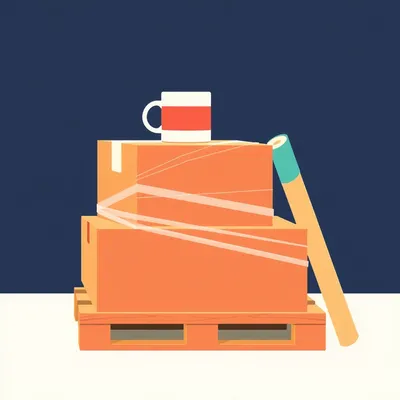
Here's the first technique that matters. You line the pallet with a large contractor bag — one of those heavy-duty black bags — as a moisture barrier. Then you pack your items into additional contractor bags or plastic totes, place them on the pallet, and shrink-wrap the entire thing. The shrink wrap creates a tensioned cocoon that holds everything in place and keeps dust and moisture out. This pallet can literally sit in the corner of your living room for three weeks. It's stable, it's clean, it's not attracting pests.
The technique for the shrink wrap itself — I've seen people just sort of haphazardly circle the pallet and call it done.
That's a recipe for everything sliding off in the truck. The proper technique: start at the base, wrap tightly around the bottom of the pallet and the first layer of items three or four times to anchor it. Then work your way up diagonally, overlapping each pass by about fifty percent, until you reach the top. Then wrap diagonally back down to the base. That cross-hatch pattern creates structural tension. The wrap should be tight enough that when you press on it, there's no give. An eighty-gauge stretch wrap roll — fifteen hundred feet — costs about twenty-five dollars from Home Depot or Uline and will cover six to eight pallets.
You want a dispenser handle, not just the roll in your hand.
A stretch wrap dispenser is about thirty dollars on Amazon and it saves you hours. Without it, you're fighting the roll, the tension is inconsistent, and your hands will be raw after one pallet. With it, you can wrap a full pallet in about five minutes.
Pallet One is packed and shrink-wrapped and sitting in the corner like a monument to your organizational prowess. What's next?
Phase two, one to two weeks before the move. This is Pallet Two: Kitchen and Fragile. And this is where the packing technique gets more sophisticated, because you're dealing with plates, glasses, ceramic bowls — things that shatter.
Every move I've ever been part of, the kitchen is where the casualties happen.
It's almost always because people use newspaper, which is terrible packing material for a move. Newspaper leaves ink residue on ceramics — you'll be scrubbing gray smudges off your plates on unpacking day. It also compresses over time, so by the time the truck arrives, your glasses are rattling around in loose paper.
What's the alternative?
A double-layer system. Bottom layer of the pallet: heavy pots, pans, cast iron skillets. These are essentially indestructible and they create a weighted, stable base. Middle layer: plates wrapped individually in moving blankets — not paper, not bubble wrap, moving blankets. You can rent a dozen moving blankets from U-Haul for about fifteen dollars. Each plate gets wrapped like a burrito, then stacked vertically on edge, not flat. Plates are strongest on edge — that's how restaurants store them.
Wait, on edge? I've always stacked plates flat.
Most people do, and it's wrong. A plate lying flat distributes weight across its entire surface — any pressure from above goes straight into the center, which is the weakest point. A plate on edge distributes force along its rim, which is the strongest point. This is basic structural engineering. Think of an arch.
I'm going to need to sit with that. I've been wrong about plate stacking my entire adult life.
Top layer of Pallet Two: glasses and stemware. Each glass gets its own bubble wrap sleeve — you can buy pre-cut bubble wrap pouches or just wrap them individually. Place them upright, never on their side. Then a layer of moving blanket over the entire top, then shrink wrap. The blanket on top acts as a shock absorber if anything shifts during transport.
No newspaper anywhere in this system.
No newspaper anywhere. Bubble wrap, moving blankets, and contractor bags. That's the holy trinity of pallet packing.
Phase three, three to five days before the move. This is Pallet Three: Tech and Essentials. Monitors, desktop towers, audio interfaces, gaming consoles, external hard drives, important documents. This stuff is crush-sensitive and vibration-sensitive, and shrink wrap alone won't protect it.
What's the solution?
Each component gets wrapped in a moving blanket, then placed inside a rigid plastic tote — the kind with a snapping lid, like a Sterilite or Rubbermaid bin. The tote sits on the pallet. The tote provides crush protection that shrink wrap simply cannot. Shrink wrap is for tension and containment. It's not structural. If something heavy shifts in the truck and leans against your pallet, the shrink wrap won't stop it from crushing your monitor. But a rigid plastic tote will.
The pallet becomes a platform for a stack of totes, essentially.
And the totes should be uniform in size if possible — that makes stacking more stable. The twenty-seven gallon tote from Home Depot — the black and yellow one — is roughly twenty-seven inches by eighteen inches by fourteen inches. You can fit four of those on a standard forty-eight by forty pallet. That's your Tech & Essentials pallet right there.
Passports, birth certificates, tax records?
Those go in a waterproof document pouch inside one of the totes, clearly labeled. I'd also recommend taking photos of any critical documents before packing them, just in case. Upload to a cloud service. It takes five minutes and could save you a world of bureaucratic headache.
Phase four — the last stuff out, the first stuff in.
Phase four, the day before or the morning of the move. Pallet Four: Daily Life. This is bedding, daily clothing, toiletries, your coffee maker, a couple of mugs, phone chargers, whatever you need for the last night and first morning. This pallet should be the last one loaded and the first one unloaded. When you arrive at your new place at nine PM and you're exhausted, you don't want to be cutting into Pallet One to find your pillow.
The first-night box, but scaled up to a pallet.
And here's a pro tip: pack a small overnight bag separately — a duffel bag that doesn't go on any pallet. This has one change of clothes, your toothbrush, phone charger, and any medications. That bag stays with you in the car or the cab. It's your insurance policy against the scenario where the truck is delayed or you can't access the pallets until the next day.
That's the kind of detail that sounds paranoid until you've done one move without it.
Every single person I know who's moved more than twice has a story about sleeping on a bare mattress because they couldn't find the bedding box. The overnight bag solves that permanently.
We've got four pallets packed in sequence over three to four weeks. Let's talk about what doesn't fit neatly. You mentioned half-pallets earlier. What about things like a guitar case, a floor lamp, a vacuum cleaner?
Half-pallets — forty-eight by twenty-four inches — are perfect for these. Guitar in a hard case gets wrapped in a moving blanket, strapped to the half-pallet vertically, then shrink-wrapped. A floor lamp: remove the shade, wrap the base and pole in a blanket, lay it diagonally across a half-pallet if it's too long, or disassemble it if possible. Vacuum cleaner: remove the handle if it detaches, wrap the canister in a contractor bag, strap it down. The key principle is that nothing should extend beyond the pallet footprint by more than a few inches, because overhang gets caught on doorframes and truck walls.
If something absolutely won't fit on any pallet?
Then it's furniture, and furniture moves separately. That's the core constraint we established at the top. Sofas, bed frames, dining tables, bookshelves — those get carried by the movers as individual items. The pallets handle everything else. The line is: if it normally goes in a cardboard box, it goes on a pallet.
Let's talk numbers. You mentioned four to five pallets for a one-bedroom. But what does that actually look like in terms of volume? Give me a real inventory.
Let's model a typical one-bedroom apartment, about eight hundred square feet. You've got a couple who've been there for three years. Here's what's going on the pallets. Pallet One, Books and Bulk: roughly eighty to a hundred books, two boxes of holiday decorations, off-season clothing in three contractor bags, and that bread machine. That's about three and a half feet tall, stable, maybe three hundred pounds. Pallet Two, Kitchen and Fragile: a full set of dishes for four people, eight wine glasses, six mugs, pots and pans, a stand mixer, a blender. About three feet tall, two hundred fifty pounds. Pallet Three, Tech and Essentials: a desktop tower, two monitors, a printer, an audio interface, a router, external hard drives, important documents. Packed in four totes, stacked two by two. About three feet tall, maybe two hundred pounds. Pallet Four, Daily Life: bedding for one bed, a week's worth of clothing, toiletries, towels, a coffee maker, basic kitchen supplies. About two and a half feet tall, a hundred fifty pounds. That's four pallets, nine hundred pounds total, and you've moved essentially everything that isn't furniture.
The half-pallets for the oddball items?
If you've got a guitar, a floor lamp, and a vacuum cleaner that won't break down, that's one or two half-pallets. So you're at five or six pallets total for a one-bedroom if you have a lot of awkward items.
Alright, so now we've got these pallets packed and shrink-wrapped. They're sitting in the living room looking like miniature freight containers. How do we actually get movers to touch them?
This is the biggest misconception about the whole system — that movers will refuse. The reality is that professional movers handle pallets constantly in commercial moves. Office relocations, warehouse moves, retail store closures — those are all palletized. The residential moving crews might not see pallets every day, but the companies absolutely have the equipment and the training.
What do you actually say when you call?
You call and ask for a "palletized household goods move." Those four words trigger a different conversation. You're no longer in the "how many bedrooms" pricing model. You're in the "how many pallets" pricing model. The dispatcher will ask how many pallets, what the approximate weight per pallet is, and whether there are any stairs or elevators at either end. They'll send a crew with a pallet jack and potentially a truck with a lift gate.
A lift gate being the hydraulic platform on the back of the truck that raises and lowers cargo.
If you're moving from a ground-floor apartment to another ground-floor apartment, you might not need a lift gate — the crew can use a ramp. But if either location involves stairs or a loading dock, a lift gate is essential. The pallet jack can roll the pallet onto the lift gate, the gate lowers to ground level, and the crew rolls it off. No lifting, no carrying, no herniated discs.
The major van lines — United, Mayflower, Atlas — they all do this?
All of them have military relocation divisions that handle palletized moves daily. When a service member moves from Fort Bragg to Fort Lewis, their household goods often go on pallets. These companies have been doing this for decades. The key is to specifically request that service. Don't just book a standard residential move and then surprise the crew with pallets on moving day. That's how you get the "what is this" reaction.
The communication upfront is everything.
It's everything. Call at least six weeks before your move. Say "I have a palletized household goods move, approximately five pallets, each under five hundred pounds, no stairs at either end." The dispatcher will know exactly what to do with that information.
What about alternatives to the big van lines? You mentioned freight brokers earlier.
This is where it gets really interesting from a cost perspective. If you're moving long distance — say, New York to Chicago — you can use an LTL freight broker. LTL stands for less-than-truckload. These are carriers who move pallets every single day for businesses. Companies like uShip or FreightCenter let you list your pallets and get bids from carriers. As of mid-2026, a single pallet from New York City to Chicago costs roughly a hundred fifty to two hundred dollars via LTL freight.
So five pallets, that's seven fifty to a thousand dollars. Compare that to a traditional moving company for the same route, which might quote you three to four thousand dollars for a full apartment. There was a case I read about — a software engineer in San Francisco who moved to Austin. She used five pallets, shipped them via uShip for seven hundred eighty dollars total — three pallets on one LTL shipment, two on another. The same move with a traditional moving company quoted thirty-two hundred dollars.
That's a savings of nearly twenty-five hundred dollars. For the cost of buying some shrink wrap and spending a few weekends packing.
The LTL approach gives you something the traditional move doesn't: modularity. You can ship pallets at different times. Maybe you send Pallet One and Two a week early, store them at a friend's place or a storage unit in the destination city, and then ship Pallet Three and Four on moving day. You can unpack at your own pace. You're not racing to empty a moving truck before the crew leaves.
The modularity is the hidden superpower here. It's not just cheaper — it fundamentally changes the timeline of the move.
Traditional moving is a single high-stress event. Everything must be packed, loaded, transported, unloaded, and unpacked in a compressed window — often a single day. Palletized moving stretches that window across weeks. You pack Pallet One three weeks early. It sits in the corner. You pack Pallet Two two weeks early. The stress is distributed. By the time moving day arrives, most of your stuff is already packed and wrapped. You're down to Pallet Four and your overnight bag.
On the other end, you're not drowning in boxes that all need to be unpacked immediately. You can cut open Pallet Four first — bedding, coffee maker, toothbrush — and deal with Pallet One a week later.
The pallets themselves become temporary storage units. You can leave Pallet One shrink-wrapped in the corner of your new bedroom for two weeks while you deal with furniture placement and painting. Try doing that with a stack of cardboard boxes — they'll absorb moisture, attract pests, and look terrible.
We've covered packing sequence, pallet counts, and mover coordination. Let's talk about labeling, because this is where a lot of well-organized moves fall apart. You've got five identical-looking shrink-wrapped cubes on a truck. How do you know which one has your coffee maker?
Color-coded adhesive labels. Four-by-six inch labels, available at any office supply store. Assign one color per room. Red for kitchen, blue for bedroom, green for living room, yellow for bathroom. Write the pallet number — "Pallet three of five" — the room name, and a brief contents list. "Kitchen: plates, glasses, pots, stand mixer." Affix that label to all four sides of the pallet before shrink-wrapping.
All four sides is critical. Because you never know which face of the pallet will be visible when it's stacked in the truck or wedged into a corner.
Here's the digital backup that saves you when the physical label gets torn or obscured. Before you shrink-wrap, take a photo of each labeled pallet. Upload those photos to a shared album — Google Photos, Dropbox, whatever — with the pallet number as the filename. Now you have a visual inventory. When the movers unload and someone says "where does this one go?", you pull up the photo on your phone, see the red label and "Pallet three of five, Kitchen," and direct them accordingly.
That's the kind of simple system that costs nothing and prevents the "where does this box go?" chaos that consumes the first three hours of every move.
I'd also add one more layer: a master list. A single sheet of paper — or a note on your phone — that lists every pallet by number, room color, and contents summary. Give a copy to the mover. They'll appreciate it. It makes their job easier, which means your stuff gets handled better.
Do you put the room destination on the pallet itself, or is that only on the label?
The label has the room name. But I'd also take a fat permanent marker and write the room name directly on the shrink wrap in large letters — "KITCHEN" in black Sharpie on the side of the pallet. Shrink wrap takes marker surprisingly well. It's redundant, but redundancy is your friend when you're exhausted and it's nine PM and the lighting in the new place is terrible.
In logistics, redundancy isn't waste. It's resilience.
That's the entire philosophy of this system in one sentence.
So the move is done. The pallets are in the new place. You've cut the shrink wrap, unpacked the totes and contractor bags, and now you've got five empty wooden pallets taking up space. What do you do with them?
You have two options: store them intact or disassemble them. Storing them intact is the easier path. If you have a garage, a basement, or even a large closet, you can stack the pallets vertically against a wall. Four pallets stacked vertically take up about two square feet of floor space — roughly the footprint of a large suitcase. They're out of the way, ready for the next move.
If you don't have that kind of space? A lot of urban renters don't have garages or basements.
Then you disassemble them. A reciprocating saw — something like the Milwaukee M12 Hackzall or a corded equivalent from Harbor Freight — with a demolition blade can cut through the nails holding a pallet together in about two minutes per pallet. You're not cutting the wood itself. You're cutting the nails. Slide the blade between the deck board and the stringer — the stringer is the thick support beam running the length of the pallet — and cut through the nails. The boards come apart cleanly.
Two minutes per pallet. So for five pallets, you're looking at ten minutes of work.
Maybe fifteen if you're being careful. And what you end up with is a stack of flat, usable lumber. The deck boards are typically about three and a half inches wide, five-eighths of an inch thick, and forty inches long. The stringers are roughly one and a half by three and a half inches by forty-eight inches. All of this stacks flat. For a two-bedroom move with seven pallets, the disassembled wood takes up roughly the same space as a single large suitcase when stacked neatly.
You can store that under a bed, in the back of a closet, behind a sofa.
Or in a storage unit if you're really tight on space. The point is, you're not throwing anything away. The pallets cost you nothing to acquire, and they cost you nothing to store. The next time you move — and statistically, you will — you just reassemble them.
You're suggesting people nail these back together?
You can reassemble with screws instead of nails — that makes future disassembly even easier. Pre-drill the holes and use three-inch deck screws. It takes maybe five minutes per pallet to reassemble. Or, and this is the simpler approach, just don't disassemble all of them. Keep two or three intact for the next move and disassemble the rest if space is tight.
What about the pest concern? I think a lot of people hear "wooden pallets" and immediately think of termites, roaches, bed bugs.
Legitimate concern, but mostly based on a misunderstanding of how pallets are treated. Look for the HT stamp on the pallet — that stands for heat treated. HT pallets have been heated to a core temperature of a hundred thirty-two degrees Fahrenheit for at least thirty minutes. That kills any pests, larvae, or mold spores. These pallets are used for dry goods — food, paper products, building materials. They're clean. Avoid pallets stamped with MB — that's methyl bromide, a chemical fumigant. Those are increasingly rare and banned in many countries, but they're still out there. HT is what you want.
Before you bring any pallet into your apartment, wipe it down with a damp cloth. Maybe a little diluted vinegar if you're concerned about bacteria.
That's all it takes. These aren't pallets that have been sitting in a swamp. They've been used to ship bags of flour and cases of canned goods. They're dry, they're clean, and they've been indoors for most of their life cycle.
Another misconception I've heard: you need special equipment to move a pallet. A pallet jack, a forklift, something industrial.
A pallet jack is ideal, and the movers will bring one if you've booked a palletized move. But for the renter who's doing some of this themselves? A standard two-wheel dolly can move a wrapped pallet if you tilt it carefully. The pallet weighs maybe three hundred to five hundred pounds loaded — that's within the capacity of a heavy-duty dolly. You're not carrying it up stairs, obviously. But for ground-level moves, rolling a pallet across a sidewalk or into a truck with a ramp is totally doable.
The tools you actually need as the renter: a stretch wrap dispenser, a pack of contractor bags, moving blankets — either rented or bought — bubble wrap, four-by-six adhesive labels in multiple colors, a permanent marker, and optionally a reciprocating saw if you're disassembling. What's the total investment?
Let's itemize it. Stretch wrap dispenser, thirty dollars. Fifteen-hundred-foot roll of eighty-gauge stretch wrap, twenty-five dollars. Moving blankets — you can rent a dozen from U-Haul for about fifteen dollars, or buy them for about eight dollars each. Contractor bags, ten dollars for a box of twenty. Bubble wrap, twenty dollars for a roll. Labels and markers, ten dollars. Reciprocating saw — if you don't already own one — you can get a corded model from Harbor Freight for about forty dollars, plus a five-dollar demolition blade. Total investment: somewhere between a hundred and fifty and two hundred dollars, and most of that is tools you'll use for every subsequent move.
Versus two hundred twenty dollars per move on cardboard boxes, tape, and markers that end up in the recycling bin. The math is not subtle.
It's not subtle at all. And the second move with this system costs essentially nothing — you already have the pallets, the dispenser, the saw. You're just buying another roll of shrink wrap and maybe some fresh labels. Maybe thirty dollars total. The savings compound with every move.
The value proposition isn't just cheaper — it's that the system gets cheaper over time, while the cardboard system costs the same every single time.
It gets faster. The first time you pack with pallets, you're learning. You're figuring out the stacking patterns, the wrap tension, the labeling workflow. The second time, you know exactly what you're doing. The third time, you can probably pack your entire apartment in a weekend. There's a learning curve, but it's shallow, and the payoff is permanent.
Let's talk about fragile items in more depth, because I think this is where people get nervous. You're putting Grandma's china on a wooden platform and wrapping it in plastic. It feels less protective than a cardboard box with crumpled newspaper.
It's actually more protective, and I want to explain why. A cardboard box is a flimsy container. If something heavy is placed on top of it, the box crushes and transfers that force directly to whatever's inside. A pallet, by contrast, is a rigid platform. The weight of anything stacked on top of the pallet is borne by the items on the bottom layer — which is why we put heavy, durable items like pots and pans on the bottom. The fragile items on top are under almost no compressive force. They're just sitting there, wrapped in blankets, with a tensioned cocoon of shrink wrap holding them in place.
The fragility problem is really a stacking-order problem.
And there's a technique I want to describe called the nesting technique for maximum fragile protection. You start with a layer of bubble wrap on the pallet deck. Then a moving blanket folded in half. Then your fragile items — say, a set of wine glasses in individual bubble wrap sleeves. Then another moving blanket on top. Then another layer of bubble wrap. Then you shrink-wrap the whole thing. You've essentially created a shock-absorbing sandwich. The blankets and bubble wrap work together to dampen vibration and absorb impact. This rivals any professional packing service.
A shock-absorbing sandwich. I like that. And for something truly irreplaceable — a piece of art, a musical instrument — you'd use the tote method we talked about for tech.
Rigid plastic tote, wrapped in a blanket inside the tote, tote goes on the pallet. The tote is the last line of defense against crush damage. Even if something catastrophic happens — the pallet tips over, something falls on it — the tote takes the hit, not the item inside.
What about liquids? Cleaning supplies, cooking oils, that sort of thing?
Those go in a separate contractor bag, double-bagged, on the bottom layer of whatever pallet makes sense. The double-bagging is the key — if a bottle of olive oil breaks, it's contained within the bag, not seeping through the shrink wrap onto everything else. I'd also recommend putting anything liquid in a plastic tote if you have space. The tote contains spills and is easy to wipe clean.
Nothing goes on a pallet that you'd be devastated to lose if the entire pallet were destroyed? Like, do we keep family photo albums on the pallet or in the car with us?
Irreplaceable items — photo albums, heirloom jewelry, hard drives with no backup — those stay with you. In the car, in your overnight bag, on your person. That's true of any move, pallets or not. The pallet system doesn't change that rule. It just makes the non-irreplaceable stuff easier to manage.
Let's pivot to something we haven't talked about: stairs. You've got a fourth-floor walkup in Brooklyn. Is the pallet system dead on arrival?
It's not dead, but it's more complicated. A pallet jack doesn't do stairs. So for a walkup, you have two options. Option one: you carry the individual items — still in their totes and contractor bags — up the stairs by hand, and the empty pallet comes up separately. This is essentially a traditional move, but your items are pre-organized into pallet-sized batches. You still get the benefit of the packing system and the labeling, even if you lose the roll-it-in-one-go benefit.
The pallet serves as an organizational unit even if it can't be wheeled in.
Option two: if you have a fire escape or a window large enough, you can use a rental lift — a small material lift that truck rental places sometimes offer. But honestly, for most walkup renters, option one is the realistic path. The pallet system still saves you money on boxes and gives you the modular packing timeline. You're just doing the physical transport the old-fashioned way.
What about the elevator scenario? Most urban apartment buildings have elevators.
Measure the elevator. Standard pallet is forty-eight by forty inches. Most freight elevators can handle that easily. Most passenger elevators cannot — they're typically around forty-two inches deep, which means a forty-eight-inch pallet won't fit flat. You might need to tilt the pallet on its side, which requires everything to be extremely well wrapped. Or you can use half-pallets — forty-eight by twenty-four — which will fit in almost any elevator.
The half-pallet isn't just for odd-shaped items. It's also the elevator-compatible format.
For a high-rise apartment, I'd seriously consider doing the entire move on half-pallets. You'll need more of them — maybe eight to ten half-pallets instead of four to five full pallets — but every single one will fit in the elevator. And the movers will thank you.
Let's talk about the environmental angle for a moment, because I think it's worth naming. The moving industry generates an enormous amount of cardboard waste.
It's staggering. Think about it: the average renter moves eleven times. If each move uses thirty cardboard boxes, that's three hundred thirty boxes per person over a lifetime. Most of those boxes are used once. Even if they're recycled, recycling cardboard is energy-intensive. It requires pulping, cleaning, reforming. A wooden pallet, by contrast, can be reused dozens of times. And when it finally reaches end of life, it's biodegradable lumber — it can be chipped for mulch or burned for heat.
There's a genuine sustainability argument here, not just a cost argument.
It gets better. Most of the pallets you're sourcing for free were destined for a landfill or a chipper anyway. Businesses go through pallets constantly. They stack up behind grocery stores and get picked up by pallet recycling companies, who repair the good ones and grind up the bad ones. By taking a few pallets out of that stream, you're not creating new demand for lumber. You're intercepting something that was already in the waste stream.
You're not just saving money. You're diverting waste and reducing demand for single-use cardboard. That's a pretty compelling trifecta.
The shrink wrap? That's plastic, and it's not great environmentally. But a single fifteen-hundred-foot roll wraps six to eight pallets and weighs about four pounds. Compare that to the plastic tape you'd use to seal thirty cardboard boxes — multiple rolls of packing tape, plus the tape's plastic core, plus the cardboard itself. The pallet system probably uses less plastic overall, though I haven't seen a rigorous lifecycle analysis.
Someone should do that analysis. That sounds like a Herman Poppleberry deep-dive waiting to happen.
Don't tempt me.
Alright, let's address something practical that I think a lot of people are wondering. Where do you actually put four or five pallets in your apartment while you're packing them over three weeks? A one-bedroom apartment doesn't have a loading dock.
This is where the phased packing sequence really shines. You're not assembling all four pallets on day one. Pallet One gets packed in week one and shrink-wrapped. It's now a stable, clean cube that can sit in a corner of the living room. It's not in the way — or at least, it's no more in the way than a large piece of furniture. You can put a tablecloth over it and use it as a side table. Pallet Two gets packed in week two, probably in the kitchen, then moved to join Pallet One. By moving day, you've got a small fleet of cubes against one wall. It's actually less chaotic than a traditional move, where you've got half-packed boxes scattered everywhere for weeks.
The pallet-as-furniture idea is clever. A shrink-wrapped pallet with a tablecloth on it is just a cube-shaped table.
I've seen people use them as TV stands during the packing period. You're going to move the TV anyway — just put it on Pallet Four when you're done.
What about the noise factor? Shrink-wrapping at ten PM in an apartment with thin walls?
Shrink wrap is quiet. It's not like running a vacuum. The dispenser makes a slight whirring sound as the roll spins, but it's negligible. The loudest part of this entire system is the reciprocating saw if you're disassembling pallets, and you'd do that during daylight hours.
Or you'd do it outside, on the sidewalk or in the alley, if you have outdoor space.
Or in the parking lot of your new place on moving day, before you even bring the empty pallets inside. Disassemble them at the truck and carry in a neat stack of lumber instead of five bulky pallets.
Let's talk about weather. You mentioned shrink wrap is effectively waterproof. But what about extreme heat? If you're moving in August in Texas and the pallets are sitting in a moving truck for eight hours in hundred-degree heat?
Heat is less of a concern than you'd think. Shrink wrap is polyethylene — it doesn't melt until about two hundred fifty degrees Fahrenheit. The inside of a moving truck on a hot day might hit a hundred forty, which is uncomfortable but not structurally threatening. The bigger concern is direct sunlight on electronics. If Pallet Three, your tech pallet, is going to sit in direct sun, throw a reflective emergency blanket over it — one of those mylar sheets that costs five dollars. It'll reflect most of the radiant heat.
Moving in a Chicago February?
Cold is actually fine for most items. The shrink wrap gets slightly more brittle at very low temperatures, so it's more prone to tearing if it catches on something. But the items inside are protected. The one exception: anything with a battery — laptops, phones, power tools. Lithium-ion batteries don't like extreme cold. Those should go in your overnight bag, not on a pallet that might sit in an unheated truck overnight.
Batteries stay with you.
Liquids that can freeze — cleaning supplies, cooking wine, that bottle of fancy olive oil. If they freeze, they expand, and the bottles can crack. Those should also come with you or be packed in a way that contains the spill if it happens.
The overnight bag gets a little heavier in winter.
But that's true of any winter move, pallets or not.
Let's talk about the disassembly process in more detail, because I think a lot of people hear "reciprocating saw" and get intimidated.
It's straightforward. A pallet is held together by nails — typically about thirty to forty nails per pallet. The nails go through the deck boards into the stringers. To disassemble, you stand the pallet on its side, brace it against a wall or have someone hold it, and slide the reciprocating saw blade between the deck board and the stringer. You're cutting through the nail shanks, not the wood. The blade goes through nails like butter — it takes about two seconds per nail. Work your way down each stringer, cutting every nail, and the deck boards will separate cleanly.
Wear safety glasses. Reciprocating saws throw off metal fragments when they cut through nails. Gloves are a good idea too — the cut nails can be sharp. And do it outdoors or in a well-ventilated area with a drop cloth, because you'll generate metal and wood dust. Total time: two to three minutes per pallet. Total mess: minimal if you use the drop cloth.
Then you've got a stack of lumber. What do you do with the nails still embedded in the wood?
Most of the nail shanks will still be in the stringers — you cut through the middle of the nail, so half is in the deck board and half is in the stringer. You can pull them out with a hammer or leave them. If you're going to reassemble with screws, pull the old nail fragments out — they'll interfere with drilling. If you're just storing the lumber flat, you can leave them. Just be careful handling the boards — those cut nail ends are sharp.
The reassembly process? You mentioned screws instead of nails.
If you're rebuilding pallets for the next move, use three-inch exterior-grade deck screws. Pre-drill the holes to prevent splitting — the deck boards are usually thin and dry, and they'll crack if you drive a screw straight in. Two screws per board end is plenty. A rebuilt pallet with screws is actually stronger than the original nailed pallet, and it's easier to disassemble next time — just unscrew it.
The first disassembly is the hardest. After that, it's a screwdriver job.
Or an impact driver, which makes it even faster. But yes, the system gets easier with each cycle.
I want to address something that might be on people's minds: the aesthetics. A stack of wooden pallets in your apartment. It's not exactly an Architectural Digest spread.
It's not. But neither is a stack of cardboard boxes covered in packing tape. And the pallets are temporary — they're in your space for three weeks, then they're gone. If the aesthetics really bother you, throw a tapestry or a sheet over the wrapped pallets. They become abstract geometric shapes. Very modern art.
The IKEA of moving systems. Flat-pack your life.
That's actually a good way to think about it. IKEA furniture is designed to be flat-packed for efficient transport. The pallet system applies that same logic to everything you own. Your books, your dishes, your sweaters — they all become modular, stackable, transportable units. It's the IKEA-fication of your entire household.
Just like IKEA furniture, there's an initial assembly learning curve, and then it becomes second nature.
Just like IKEA furniture, you'll probably have one moment where you've wrapped something wrong and have to cut it open and start over. That's fine. The shrink wrap is cheap.
Alright, let's do a complete walkthrough. I'm a renter. My lease is up in six weeks. I've decided to try this pallet system. What's my week-by-week timeline?
Week one: source your pallets. Check Facebook Marketplace, Craigslist, and visit your local grocery store or Home Depot. Ask the manager — most are happy to let you take a few. Look for the HT stamp. Reject any pallet with rot, warping, or broken stringers. You want four to five standard pallets and maybe two half-pallets. Also this week: order your supplies. Stretch wrap dispenser, eighty-gauge wrap, contractor bags, moving blankets, bubble wrap, labels, markers.
Week two: pack Pallet One, Books and Bulk. Gather all your off-season clothing, books, holiday decorations, rarely-used kitchen gadgets. Pack them in contractor bags, stack them on the pallet, wrap it. This pallet now lives in the corner of your living room. You've already made visible progress, which is psychologically huge.
Week three: Pallet Two, Kitchen and Fragile. This is the careful one. Pots and pans on the bottom, plates on edge in moving blankets, glasses in bubble wrap on top. Blanket over everything, shrink wrap. If you're nervous about fragile items, this is the week to take your time.
Week four: Pallet Three, Tech and Essentials. Monitors, computers, audio gear into plastic totes, totes onto the pallet, wrap. Important documents in a waterproof pouch. This is also when you should start eating down your pantry — it's a good excuse to get takeout.
Week five: Pallet Four, Daily Life. Bedding, daily clothing, toiletries, coffee maker. This gets packed the day before or morning of the move. Also this week: confirm with your movers that they're bringing a pallet jack. Send them your master list of pallets with room destinations.
Moving day: the movers arrive, see five neatly wrapped, labeled pallets, and know exactly what to do. They roll them out with the pallet jack, load them onto the truck with the lift gate, and you're done. At the new place, they roll them into the designated rooms based on your labels and master list. You cut open Pallet Four first — bedding, coffee maker, toothbrush. You're functional within an hour.
Week six: unpack at your leisure. Cut the shrink wrap off each pallet as you're ready to deal with it. Disassemble the empty pallets with your reciprocating saw. Stack the lumber flat in a closet or under the bed. You're ready for the next move, whenever it comes.
The total cost, all in, for that first move: maybe a hundred fifty to two hundred dollars in supplies, plus whatever the movers charge for a palletized move. The second move: thirty dollars for fresh shrink wrap and labels. The system has paid for itself.
The elegance of this is that it takes something people dread — moving — and turns it into a systematic, repeatable process. You're not reinventing the wheel every time. You're just executing a playbook.
And the playbook gets better each time. You learn which items work best on which pallet. You refine your wrapping technique. You figure out the optimal label placement. By your third move, you're operating at a level of efficiency that would make a logistics manager proud.
You're not throwing away thirty cardboard boxes every time. There's something satisfying about that.
There's something deeply satisfying about it. It's the opposite of disposable culture. It's moving as craft.
Moving as craft. I'd buy that coffee table book.
Shrink-wrapped, on a pallet.
Now: Hilbert's daily fun fact.

In the 1930s, scientists studying nudibranchs near the Faroe Islands discovered that the sea slug species Polycera quadrilineata produces a pigment in its mantle that selectively absorbs ultraviolet light, rendering it nearly invisible to predators that see in the UV spectrum — a natural optical stealth technology that predates human radar-absorbing materials by decades.
A sea slug with stealth technology. In the nineteen thirties. Near the Faroe Islands.
Nature got there first.
Where does this go from here? I think the open question is whether this system can scale beyond the one or two-bedroom apartment. Could you move a three-bedroom house this way? A four-bedroom? The answer is yes, but at that point you're not hiring a moving company — you're essentially running a mini freight operation. You'd need your own pallet jack, potentially a small truck with a lift gate, and a lot more pallets. It becomes a different kind of project.
I think the broader implication is that as remote work becomes permanent for more people, and as people move more frequently — chasing lower cost of living, better school districts, different cities — the palletized lifestyle might stop being weird and start being standard. Imagine a subscription service that delivers pallets, shrink wrap, labels, and a dispenser to your door a month before your move, then picks up the empty pallets afterward and stores them for your next move.
Pallet-as-a-service. I could see it. There are already companies doing reusable plastic moving bins — this is the next logical step. The infrastructure exists. The pallets exist. The movers know how to handle them. It's just a matter of connecting the dots for residential customers.
If you try this system, we want to hear about it. Email us — your pallet count, your total cost, any disasters, any unexpected wins. We might compile the results.
Thank you to our producer Hilbert Flumingtop for keeping this show running, and for the sea slug facts.
This has been My Weird Prompts. Find us at myweirdprompts.com or wherever you get your podcasts.
Don't use newspaper.