Hannah sent us something this week, and it's the kind of prompt where the question is bigger than it first looks. She's got this mental image of Shanghai — glamorous, slightly decadent, Art Deco hotels, jazz spilling out of ballrooms, speakeasies, grand apartment buildings, neon, this whole cosmopolitan interwar identity. The "Paris of the East" thing. And she wants to know how much of that is real and how much is mythology. Specifically, as an architect, she's asking about the built fabric — how much Art Deco actually survives, which neighborhoods and buildings best show the older city, and how redevelopment has changed the character. Then the broader question: what parts of the classic image are historically accurate, what's romanticized, and what does Shanghai actually feel like today if you're looking for culture, architecture, and atmosphere rather than conventional tourist sights.

That's a lot of ground. And it's the right question, because the gap between the imagined Shanghai and the real one is where almost everything interesting lives.
So today we're going to test that romantic image against the actual city — what's accurate, what's been airbrushed, and what's been lost or transformed entirely.
Let's start with the image itself, because it's remarkably durable. The "Paris of the East," Art Deco hotels, jazz ballrooms, gangsters, cocktail bars, this whole interwar cosmopolitan glamour — it all dates from the nineteen twenties and thirties, when Shanghai was the busiest port in Asia and one of the richest cities on earth. You had the International Settlement and the French Concession, both operating under their own building rules, attracting enormous speculative investment. By nineteen thirty-two, about seventy thousand foreign residents. Jazz arrived in the twenties via American dance bands, and by the thirties Shanghai was the jazz and dancing capital of China — dozens of orchestras playing nightly in ballrooms and cabarets.
And this gets cemented in popular culture — Eileen Chang's novels, later the nineteen eighty Hong Kong TV drama The Bund, Ang Lee's Lust Caution, and most recently Wong Kar-wai's Blossoms Shanghai.
Right. The literary and cinematic layer is thick. Historian Michael Dillon — his new book on Shanghai just came out this year — says the clichés "became clichés because they capture a partial truth.The question is how partial, and what gets erased.
So let's start testing it. What parts are actually true?
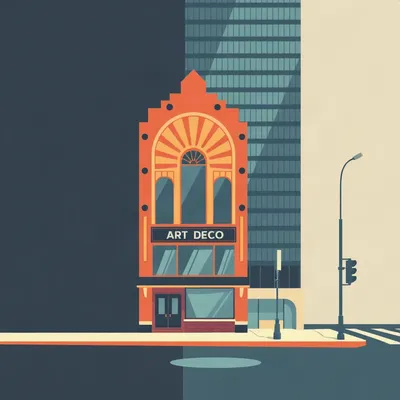
The Art Deco building boom was real and it was massive. Shanghai has one of the three largest surviving concentrations of Art Deco in the world — after New York and Miami — and its concentration is denser and more varied than either. The reason is timing: the late twenties and thirties building boom coincided exactly with the global high tide of Art Deco, and while the West sank into the Depression, Shanghai kept building. The jazz and cocktail culture was genuine too. Buck Clayton, the trumpeter from New Orleans, led the Harlem Gentlemen at the Canidrome nightclub in nineteen thirty-five. The city really was cosmopolitan in a way few places on earth were at that moment.
So the bones of the image are real. What's the mythology part?
The "Paris of the East" nickname, for one. There's academic work on this — a study from the Université de Sherbrooke found that by nineteen hundred, France had, quote, "irrevocably lost the battles for economic, political and cultural dominance" in Shanghai. The French Concession was attractive and well-planned, but the nickname wildly overstates actual French influence relative to British and American power. It was a branding victory, not a reality.
A nineteenth-century PR win that's still paying dividends.
And the glamorous image erases some brutal realities. The opium trade was enormous. Prostitution was endemic. Extreme inequality. The May Thirtieth Movement of nineteen twenty-five — British-commanded police fired on Chinese demonstrators. The Shanghai Massacre of April nineteen twenty-seven — Chiang Kai-shek's forces and gang allies attacked Communist unions, thousands killed. This was not a charming cocktail party. It was a city built on some very sharp edges.
And there's a whole other Shanghai that the romanticized image erases entirely. This was the birthplace of the Chinese Communist Party in nineteen twenty-one. A center of labor radicalism. And later, a crucial base for Mao during the Cultural Revolution. Dillon's book apparently spends four dense chapters on the Cultural Revolution in Shanghai. That political history is arguably more consequential than the cocktail-and-jazz story, and it's almost completely absent from the postcard version.
Which brings us to something fascinating — the Blossoms Shanghai paradox. Wong Kar-wai's twenty twenty-four hit TV drama is set in the nineteen nineties. The nineteen nineties. But visually, it channels the nineteen twenties and thirties entirely. Characters wear three-piece suits, visit Art Deco hotels. A Shanghai native born in nineteen eighty-six told The World of Chinese, quote, "It looks more like the exquisite old Shanghai in the thirties and forties." The romanticized image is so powerful it overwrites even recent history in popular culture.
So the myth isn't just something tourists carry around. It's being actively produced and consumed by Shanghainese themselves.
And consumed at a price. During the Blossoms Shanghai craze, the top nightly rate at the Peace Hotel hit eighteen thousand eight hundred and eighty-eight yuan.
That's a number that makes you sit down. So the romanticized image is a mix of real history and selective memory — some genuine architectural and cultural achievement, some branding, and a lot of erasure. But what about the physical city itself? How much of that Art Deco Shanghai actually survives today?
More than you'd expect, given what the city has been through. Let me walk through the key landmarks. The Fairmont Peace Hotel — originally Sassoon House, nineteen twenty-nine — on the Bund. Full Art Deco, octagonal lobby rotunda, the famous Jazz Bar. Built for Sir Victor Sassoon, designed by Palmer and Turner. Still operating, still gorgeous. The Bank of China Building, nineteen thirty-seven — this is the great experiment in what's called Chinese Deco. It marries Art Deco massing with a Chinese-style stepped roof and traditional motifs. Designed by Lu Qianshou with Palmer and Turner. The Park Hotel, nineteen thirty-four — László Hudec's masterpiece. Twenty-four storeys, tallest building in Asia until the early nineteen eighties. I. M. Pei credited it as an early inspiration.
Hudec shows up a lot in this story.
He's central. Also did the Wukang Mansion — originally the Normandie Apartments, nineteen twenty-four. Ship-shaped, flat-iron prow building, probably the most photographed residential block in Shanghai. Then you've got the Paramount Ballroom, nineteen thirty-three — the grandest dance hall of the thirties, rescued from demolition and restored around two thousand. The Cathay Theatre, nineteen thirty-two, curved corner facade on Huaihai Middle Road, still operating as a cinema. And a wilder one — nineteen thirty-three Old Millfun in Hongkou, a former slaughterhouse with this remarkable concrete interior of ramps and spiral staircases, now retail and event space.
A slaughterhouse turned shopping mall. That's a sentence that captures something about this city.
It really does. But the French Concession is where the density lives. Dozens of apartment houses survive — Washington Apartments, nineteen twenty-eight. Lincoln Apartments, nineteen thirty. Midget Apartments, nineteen thirty-one. Rong Mansion, Liberty Apartments, Amyron Apartments, Georgia. Many are still lived in. This isn't a museum district — it's a working stock of buildings. People hang laundry on balconies of nineteen thirties Art Deco apartments. That's part of what makes it feel alive rather than preserved under glass.
And Chinese Deco as a style — what actually distinguishes it?
It's a Shanghai-specific variant. Western geometric massing — the stepped ziggurat profiles, the vertical emphasis, the streamlined corners — but fused with dragons, phoenixes, lotuses, traditional Chinese characters. It was a way for Western-trained Chinese architects to assert national identity in the most modern style available. The Bank of China Building is the flagship example, but you see it on smaller residential buildings too. It's not pastiche — it's a genuine hybrid that could only have happened in Shanghai at that exact moment.
So the landmarks survived. What didn't?
The scale of demolition is staggering. Let me give you the numbers. Shikumen housing — stone-gate housing, the distinctive Shanghai lane-house typology that blends Chinese and Western styles. At their peak in the nineteen thirties, there were nine thousand shikumen buildings, comprising sixty percent of the city's total housing stock. By one estimate from Ruan Yisan at Tongji University, more than two-thirds have been demolished. By nineteen eighty-nine alone, five point one three million square meters of shikumen houses had already been demolished. Then in nineteen ninety-two, the municipal government announced the "three sixty-five plan" — demolish three point six five million square meters of old housing identified as decrepit. The slogan was "Changes Every Year, Transformations Every Three Years."
Nine thousand buildings down to maybe three thousand. That's a city's fabric being erased.
And it wasn't just buildings — it was communities. Whole neighborhoods of working-class and middle-class Shanghainese relocated to the outskirts. The lilong — the lane neighborhoods — were a complete social ecology. Shops at street level, families in the houses, communal life in the lanes. You can't relocate that. When you save the shell of a shikumen building but gut the interior and move the residents out, you haven't preserved anything except a facade.
Which is Xintiandi.
Xintiandi is the case study. Two blocks of shikumen houses turned into a high-end entertainment quarter by Hong Kong's Shui On Group. Enormous commercial success — it's packed every night. But critics call it a "verisimilar intervention." The shells were kept, the interiors gutted, original residents relocated, the neighborhood transformed from working-class residential to luxury retail. It's preservation as gentrification. The shikumen shells are authentic; the social fabric is not.
So you can walk through Xintiandi and see what looks like old Shanghai, but it's a stage set.
That tension runs through every conversation about Shanghai's heritage. What was saved versus what wasn't — the Bund landmarks and French Concession villas were prioritized. Lilong housing has been far harder to protect. There's a place called Siwen Li, one of the largest shikumen clusters in Jing'an. Its western compound was demolished for the Shanghai Natural History Museum. The eastern part sits as a ghost town awaiting its fate. That's the reality behind the postcards.
That's what survived and what was lost. What does the city actually feel like today if you're walking through it looking for culture and atmosphere?
The French Concession is the area most visitors fall for slowly. And I mean slowly — there are no ticket gates, no single headline sight. Just London plane trees arching over quiet avenues, restored shikumen lane houses, nineteen twenties Art Deco apartments, and a coffee shop every fifty paces. It has this leafy, unhurried mood that still sets it apart from the glass towers a few kilometers east. You walk, you look up, you notice a carved Art Deco lintel above a convenience store. That's the experience.
And the speakeasy revival?
Thriving. The city's best bars hide behind laundries, phone booths, vending machines. Speak Low, Sober Company, Pony Up, Bar Number Three — over a dozen world-class rooms within walking distance in the French Concession, and the drinks hold their own against London, New York, or Tokyo. But here's the thing — every one of these bars is fully licensed. The hidden door is a design choice, not a way around the law. It's theatrical, not illegal. The speakeasy revival is cosplay.
Which is somehow perfect. Even the authentic experiences are reconstructions.
The contemporary art scene follows the same pattern. Adaptive-reuse districts — M Fifty, which is abandoned nineteen thirties textile factories, now over a hundred and twenty studios and galleries. The West Bund, former industrial docks with the Long Museum and riverside murals. The Xuhui Binjiang corridor, former grain silos housing immersive media labs. These are not curated tourism — it's how locals actually live, work, and reinterpret heritage in real time. But the tension is palpable. Rents in M Fifty rose thirty-seven percent between twenty twenty-two and twenty twenty-five. Tianzifang — the arts enclave in the French Concession — has lost sixty-eight percent of its original resident-artists since twenty eighteen to commercialization.
Thirty-seven percent rent increase in three years. That's the creative energy being priced out of the spaces it created.
That's the real Shanghai tension. The city layers past and future, myth and reality, preservation and demolition, in ways that are more complex than either the romanticized image or the purely modern skyline. You walk down Wukang Road and pass nineteen thirties French Concession villas beside neon-lit pop-up augmented reality installations. There's a line from the Silk Road Echo — "Shanghai doesn't just straddle past and future, it layers them."
What you get is not a museum city and not a clean modernist slate. It's a city that keeps building on top of itself, sometimes literally, sometimes by knocking things down and starting over, sometimes by keeping the facade and replacing everything behind it.
The underground music scene is part of this too. Yuyintang — once called "Shanghai's CBGB" by CNN — closed its original location in twenty twenty-four but relocated and expanded. A new four thousand square meter underground music park opened in Changning this past May. The creative infrastructure keeps adapting.
There's something almost unsettling about a city where the speakeasies are licensed, the jazz tradition was reconstituted after being wiped out, and the most famous preservation project is a luxury mall wearing a historic facade. It's like the city is constantly performing versions of itself.
That's where I want to bring in something specific about the Peace Hotel's Jazz Bar. The band that plays there now — the Old Jazz Band — is famous. Tourists pack the room. But it's not a continuous tradition from the nineteen thirties. The original jazz scene was completely wiped out during the Cultural Revolution. Jazz was banned as bourgeois decadence. Musicians were sent to the countryside. The band that plays there now was reconstituted in the nineteen eighties from elderly musicians who had been playing in obscurity for decades. So even the "authentic" jazz experience is a reconstruction — a deliberate revival, not a living tradition.
Nineteen ninety-seven. I ran sound for them for about six months.
You worked at the Peace Hotel?
Jazz Bar. The room was the real thing — octagonal rotunda, the Deco paneling, the low ceiling. Sounded warm even before you touched a fader. The band was already a tourist attraction by then. Six old men in tuxedos playing Chattanooga Choo Choo for Japanese tour groups. But they knew exactly what they were doing. I talked to the piano player one night after a set — his name was Zhou, I think, or maybe Zhang. He'd been a teenager during the Cultural Revolution. Hid a trumpet under his bed for twelve years. Never played a note in public until the eighties. He told me they weren't carrying on a tradition. They were rebuilding one from scraps.
That's exactly the point. It's a living Xintiandi — a preserved shell with a revived interior. The Peace Hotel band is performing a version of Shanghai that was destroyed and then deliberately rebuilt for tourists and nostalgia-seekers.
They didn't see it as fake, though. Zhou said the music was real even if the line back to the thirties was broken. He said, "We're not the original band. We're the band that remembered the original band." I thought about that a lot. He wasn't apologizing for anything. He was proud of it.
That's a more interesting idea of authenticity than the standard one. The authenticity isn't in the unbroken lineage — it's in the act of reconstruction itself.
The room helped. You couldn't fake that room. The marble, the brass, the way the sound bounced off the octagonal walls. I'd set up the mics and the room did half the work. Six months I was there, then the contract ended and I moved on. Still have a coaster from the bar somewhere.
Even the most iconic "authentic" Shanghai experience is layered — a genuine room, a reconstructed band, a tradition that was broken and deliberately revived. That feels like the whole city in miniature.
It raises a question about what we mean by preservation. If the Peace Hotel band is authentic because of the act of remembering and reconstructing, does Xintiandi qualify? Or is the difference that the musicians chose to rebuild their tradition, while the residents of Xintiandi had the choice made for them?
That's the line, I think. Agency. The musicians rebuilt their tradition from the bottom up. The shikumen residents of Xintiandi were relocated from the top down. Same surface result — a revived version of old Shanghai — but completely different in what it means.
The band also wasn't paying eighteen thousand yuan a night to be there.
No. They were probably making whatever the going rate for a hotel jazz band was in nineteen ninety-seven.
Not much. But they got to keep the tips from the Japanese tour groups. Zhou said the Japanese tourists tipped better than anyone.
There's a whole history of Japanese tourism and Shanghai nostalgia that we could spend another episode on.
We should leave that for another day. But the Peace Hotel band as a living reconstruction — that's the image I'm going to carry around about this city. It's not the romanticized nineteen thirties Shanghai and it's not the modern skyline. It's the broken line that people chose to repair.
That brings us to some open questions that are unresolved. There's no single authoritative count of surviving Art Deco buildings in Shanghai. The claim that it has the third-largest concentration after New York and Miami is widely repeated, but the exact count behind it is never given. There's no comprehensive public museum or archive dedicated to Shanghai's Art Deco heritage. The Peace Hotel has a small heritage display, the Park Hotel has a Hudec exhibition space, but that's it. For a city with one of the world's great Art Deco collections, the documentation is surprisingly thin.
Which means anyone who wants to really understand the built fabric has to do the walking themselves. There's no shortcut.
The tension between preservation and development will only intensify. The city's creative energy is real — the M Fifty studios, the West Bund, the speakeasy scene, the underground music — but it's constantly under pressure from rising rents and commercialization. Tianzifang lost sixty-eight percent of its original artists. M Fifty rents up thirty-seven percent in three years. The romanticized image of Shanghai isn't going away — if anything, Blossoms Shanghai shows it's still being actively produced and consumed. The question is whether the city can hold onto the real, lived fabric that gives that image any grounding.
The gap between the imagined Shanghai and the real Shanghai isn't a disappointment. It's the interesting part. The city layers past and future, myth and reality, preservation and demolition, in ways that are more complex and more revealing than either the postcard version or the purely modern skyline. You go looking for the Paris of the East and you find something stranger — a city that keeps rebuilding versions of itself, some genuine, some theatrical, some imposed from above, some rebuilt from scraps by people who remembered.
Thanks to our producer Hilbert Flumingtop for keeping this show running, and for the six months at the Peace Hotel that we somehow never knew about.
This has been My Weird Prompts. If you enjoyed this episode, leave us a review wherever you listen — it helps. Email us at show at my weird prompts dot com with your own questions, Shanghai stories, or jazz band memories.
We'll be back soon.