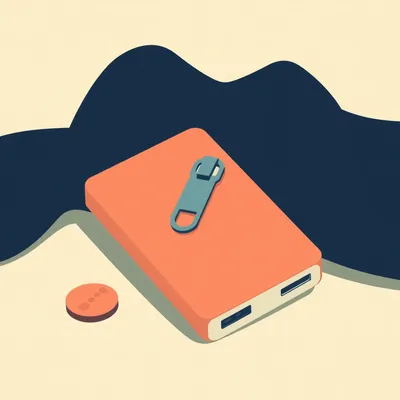
Daniel sent us this one — he's pointing at that flight a few weeks ago, the one that diverted to Los Angeles because a passenger suddenly remembered they'd stuffed a power bank in their checked bag. And the core puzzle is this: why are loose batteries banned from the hold, but a laptop or an electric toothbrush with the exact same battery chemistry inside is perfectly fine? If cargo holds have fire detection systems, and those systems are supposedly reliable, why can't everything with a battery just go downstairs? And given the millions of battery-containing packages moving by air and sea every single day, how are incidents so vanishingly rare? Is the industry actually rethinking these rules, or are we just noticing a couple of high-profile cases?

That diversion in May — Honolulu-bound flight, a passenger pipes up mid-cruise that they've got a power bank buried in their suitcase, and the crew makes the call to put down in Los Angeles instead of continuing over open water for five more hours. It sounds extreme until you understand what a lithium-ion fire actually looks like in an enclosed space.
Which is what, exactly? Because the public picture of a battery fire is basically a phone getting spicy and smoking a bit on a nightstand.
That's the tame version. What we're talking about is thermal runaway — and it is not like a normal fire. A lithium-ion cell has a critical temperature threshold, roughly a hundred and thirty degrees Celsius. Once you cross that line, the electrolyte inside starts decomposing, releasing flammable vapor and — here's the part that makes it uniquely dangerous — its own oxygen. The reaction becomes self-sustaining. It doesn't need external air. A single cell in thermal runaway can hit six hundred degrees Celsius within seconds, and if there are adjacent cells, the heat cascades. One cell fails, cooks its neighbor, that one fails, and you've got what firefighters call a propagating thermal event.
It's not just a fire. It's a fire that brings its own oxidizer to the party.
And that's why the cargo hold suppression systems, which are genuinely good at what they were designed for, have a fundamental problem here. Most passenger aircraft use Halon-based fire suppression — Halon thirteen-oh-one or a replacement like Halotron. Halon works by chemically interrupting the combustion chain reaction. It smothers a fire at the molecular level. But if the reaction is generating its own oxygen, Halon can knock down the initial flame and then the thermal runaway just keeps going underneath. The FAA ran a test in twenty twenty-four — they simulated a cargo hold fire with five thousand lithium-ion cells. The Halon system suppressed the visible flame, but the thermal runaway continued for forty-seven minutes. For a lot of short-haul routes, that's longer than the entire flight.
Forty-seven minutes of invisible, self-sustaining thermal runaway. That's the stuff of nightmares. And that's with five thousand cells — what's the worst-case scenario in a passenger's checked bag, a couple of power banks and a laptop?
Even a single high-capacity power bank — say a twenty-thousand milliamp-hour unit — contains multiple cells packed together. If one goes, the rest follow. And the real wild card isn't the number of cells, it's what's packed around them. Aerosols, alcohol-based toiletries, synthetic fabrics that melt and ignite. The battery is the initiator, but the suitcase becomes the fuel load. Think of the battery as the match and your luggage as the kindling — the Halon system might blow out the match, but if the kindling's already caught, you're past the point where chemical suppression can save you.
That's a grim image. And it makes me wonder — when we talk about the suitcase becoming the fuel load, how much variability are we talking about? Is my meticulously packed bag with everything in neat packing cubes actually a different fire risk than someone's overstuffed duffel full of god-knows-what?
, yes. The fire load of a passenger suitcase is wildly variable. The FAA's testing uses standardized surrogate luggage, but in reality, one bag might contain mostly cotton clothing — relatively high ignition temperature, doesn't melt — while the next bag contains polyester workout gear, a can of dry shampoo, and a bottle of nail polish remover. Acetone-based remover has a flash point of about minus twenty Celsius. You put that next to a battery in thermal runaway, and you've essentially built an incendiary device in your checked luggage. The battery doesn't need to sustain the fire itself — it just needs to ignite something that will.
The suppression systems have a genuine blind spot. That explains the caution. But it doesn't explain the distinction — why is my laptop allowed in the hold but the spare power bank isn't? They both have the same lithium-ion guts.
The distinction is right there in the UN classification system. UN thirty-four eighty is the designation for loose lithium-ion cells and batteries. UN thirty-four eighty-one is for lithium-ion cells contained in equipment. They're both Class Nine hazardous materials, but they're treated differently because the primary risk vector for a loose cell is something that a contained cell largely eliminates: terminal short-circuit.
Walk me through that. What does "terminal short-circuit" mean in practical terms inside someone's suitcase?
Imagine a loose power bank or a spare camera battery bouncing around in checked luggage. The positive and negative terminals are exposed. If those terminals come into contact with something conductive — keys, coins, a metal zipper pull, even the foil wrapper on a pack of gum — you complete a circuit. Current flows uncontrolled. The cell heats up rapidly. If it heats past that hundred-and-thirty-degree threshold, you're in thermal runaway. And the baggage hold isn't a stationary environment — turbulence, stacking pressure, the suitcase gets jostled and compressed. A loose cell can shift into contact with metal objects that were perfectly safe when you packed them.
Whereas a laptop battery is buried inside the device, terminals protected, encased in plastic and aluminum.
The terminals on a device battery are almost always connected via a PCB-mounted connector with built-in protection circuitry. Even basic battery management systems include short-circuit protection — often a resettable fuse or a dedicated protection IC that cuts current if it detects a short. The device casing provides physical isolation. The battery can't casually touch a stray coin because it's screwed into a chassis. That's the logic. It's not that contained batteries can't fail — they absolutely can, especially if the device is damaged or the battery is swollen — it's that the most common failure mode for loose cells is physically prevented.
I want to linger on this for a second, because I think there's an analogy here that makes it click. A loose battery in a checked bag is like carrying a loaded gun with the safety off and no holster — the trigger is exposed, and any random object can pull it. A battery inside a device is the same gun, but it's in a locked case with the safety on. The underlying hazard is identical, but the probability of an accidental discharge is orders of magnitude lower.
The locked case here isn't just the plastic shell — it's the battery management system actively monitoring for fault conditions. If you short the terminals on a laptop battery while it's connected to its protection circuit, the circuit detects the current spike and opens the FET switches within microseconds. A loose cell has no such guardian.
Here's what I don't quite understand — how does that protection circuit hold up if the laptop itself gets crushed? Checked bags get abused. If a fifty-pound suitcase lands on my laptop and cracks the chassis, could that damage the protection circuit and leave the battery effectively unprotected?
It absolutely could, and that's a recognized edge case. The protection circuit is typically a small PCB attached directly to the cell pack. If the impact is severe enough to crack the PCB or shear a solder joint, you can lose protection without any visible external damage. That's part of why the official guidance says to power devices down completely — a powered-down device with a damaged protection circuit is still vulnerable, but it's not actively drawing current or generating heat. The rule isn't perfect protection; it's risk reduction. You're taking a scenario that's already low-probability and making it lower-probability still.
The rule is essentially a proxy. Instead of saying "batteries with exposed terminals are banned" and "batteries with protected terminals are fine," which would require passengers to make technical judgments they're not qualified to make, the regulator says: loose equals carry-on, contained-in-device equals okay for the hold.
It's a heuristic. It's not perfectly accurate — there are power banks now with recessed terminals and built-in short-circuit protection that are technically safer than a damaged laptop battery. But the rule has to be simple enough for a hundred million passengers to follow.
That's where the UPS Flight six case becomes hard to ignore.
UPS Flight six, September twenty ten. A Boeing seven-forty-seven-four hundred freighter departing Dubai. The cargo manifest included a large shipment of lithium-ion batteries — loose cells, not contained in equipment. A fire broke out in the main cargo deck. The crew declared an emergency, attempted to return to Dubai, but smoke filled the cockpit. The aircraft crashed, both crew members died. The investigation found that the Halon suppression system had activated but could not control the fire because of — you guessed it — thermal runaway propagating through pallets of batteries. That single incident reshaped the entire regulatory landscape. Within a few years, IATA's Dangerous Goods Regulations were tightened significantly for UN thirty-four eighty shipments.
What's haunting about that incident is the timeline. The crew had about twenty-one minutes from the first fire warning to when the cockpit voice recorder captured them struggling to breathe. Twenty-one minutes. If you're halfway across the Atlantic, that's not enough time to get anywhere.
The UPS flight was carrying an estimated eighty-one thousand lithium-ion cells. That's an industrial quantity, not a passenger scenario. But the physics scales down in an ugly way. A single power bank won't bring down an aircraft, but it can fill a cargo hold with smoke, force an emergency descent, and cause injuries during evacuation. And the fire doesn't need to be catastrophic to be dangerous — smoke inhalation is what kills people in aircraft fires, not burns.
Yet here's where the cognitive dissonance kicks in. The cargo operators are shipping enormous volumes of these things every day. IATA reported over one point two billion lithium-ion cells shipped by air in twenty twenty-five, either loose or in devices. And the FAA recorded thirty-two battery-related incidents on passenger aircraft that same year. Zero hull losses. Thirty-two incidents out of one point two billion cells. That's an incident rate of roughly zero point zero zero zero zero zero two seven percent per cell.
That number is not an accident. It's the product of multiple overlapping layers of regulation. UN thirty-eight point three testing is the foundation — every lithium-ion cell shipped by air has to pass a battery of tests: altitude simulation, thermal cycling, vibration, shock, external short-circuit, impact, overcharge, forced discharge. If a cell can't survive those tests, it doesn't fly. Then you layer on IATA's Dangerous Goods Regulations, which for loose cells require state-of-charge limits — UN thirty-four eighty shipments must be at thirty percent charge or below, because a fully charged cell has more stored energy and is more prone to thermal runaway. Then you add mandatory packaging standards, labeling, documentation, and trained cargo handlers who know what they're looking at.
For passenger luggage, none of that applies. There's no trained handler checking the state of charge on your power bank. There's no UN-approved packaging around your spare camera battery. The entire system relies on passenger compliance with a rule that — let's be honest — a lot of people don't even know exists.
Or they know and ignore it. The FAA did a survey in twenty twenty-five and found that eighteen percent of passengers admitted to knowingly packing prohibited batteries in checked luggage. That's nearly one in five people who hear the check-in agent ask "any lithium batteries in your bag?" and just say no while fully aware they've got a power bank in there.
Which makes the thirty-two incidents number even more striking. If nearly a fifth of passengers are ignoring the rule, the volume of loose batteries actually traveling in cargo holds is way higher than what's declared. And yet, fires are still extraordinarily rare.
Part of that is luck, part is that modern lithium-ion cells are well-made, and part is that thermal runaway requires a trigger. A loose battery in a suitcase doesn't spontaneously combust — it needs a short-circuit, or physical damage, or a manufacturing defect that was missed by quality control. The layers of protection built into the cells themselves — the separator between anode and cathode, the pressure relief vents, the positive temperature coefficient devices that increase resistance when the cell heats up — these all reduce the probability of failure even when the cell is mishandled.
I want to zoom in on those PTC devices for a moment, because they're a elegant piece of engineering that most people have never heard of. You're saying there's a component inside the cell itself that acts as a self-resetting thermal fuse?
The positive temperature coefficient device — it's a layer of conductive polymer, usually polyethylene mixed with carbon black, sandwiched between the cathode and the external terminal. Under normal temperatures, the carbon particles form conductive pathways and current flows freely. When the cell heats up past a threshold — typically around ninety to a hundred degrees Celsius — the polymer expands, the carbon pathways break apart, and the resistance spikes by several orders of magnitude. Current drops to near zero. If the cell cools back down, the polymer contracts, the pathways reconnect, and the cell works again. It's a passive, reversible safety mechanism that requires no electronics, no software, no external intervention.
Even a loose, unprotected cell has some intrinsic safety features. It's not just a bare chemical reactor waiting to explode.
The safety is layered all the way down to the materials science level. The separator between anode and cathode is designed to shut down — it's a microporous membrane, usually polyethylene or polypropylene, that melts and closes its pores if the cell gets too hot, stopping ion flow. The pressure vent is a scored section of the metal casing designed to rupture at a specific internal pressure, releasing gas in a controlled direction rather than letting the cell burst unpredictably. These features don't make the cell safe — they make it less likely to fail catastrophically. They buy time.
We've got this strange equilibrium. The rules are precautionary, based on a real but low-probability risk. Enforcement is virtually nonexistent for passengers. And yet the system works — not perfectly, but well enough that you're more likely to be struck by lightning than to be on a plane with a cargo hold battery fire.
That brings us to the question of whether the industry is rethinking things. In March of this year, ICAO's Dangerous Goods Panel proposed a formal review of the loose-versus-contained distinction. They're looking at two developments. One, the rise of power banks that include certified short-circuit protection — resettable fuses, dedicated protection ICs, recessed terminals that physically can't contact metal objects. These are effectively as safe as a contained device battery, but they're still classified as UN thirty-four eighty because they're not installed in equipment.
The regulatory category is lagging behind the technology.
By years, potentially. The second development is even more interesting: smart cargo containers. In January, Lufthansa Cargo began testing containers equipped with gas sensors that can detect electrolyte vapor at parts-per-billion levels — specifically dimethyl carbonate, which is one of the main components of lithium-ion electrolyte. The vapor is released before thermal runaway becomes visible, so the sensor gives you an early warning window. The container can alert the crew before there's smoke or flame.
That's a genuine game-changer if it works. The current system relies on smoke detectors — optical or ionization — and by the time smoke is visible, the thermal runaway is already well underway. But if you can detect the electrolyte outgassing at the molecular level, you might have minutes of warning instead of seconds.
The Lufthansa pilot results are expected late this year. If they're positive, you could see a scenario where certain battery types — power banks with certified protection circuits, shipped in smart containers with gas sensing — are reclassified for cargo hold transport. But nobody expects regulatory changes before twenty twenty-eight at the earliest. International consensus moves at the speed of diplomacy, which is to say, glacial.
There's a counterargument worth taking seriously. Some safety experts point at that eighteen percent non-compliance number and say: the rules aren't the problem, enforcement is. Relaxing the rules might actually increase risk if it confuses passengers further. Right now, the message is simple — loose batteries in carry-on, period. If you start saying "some loose batteries are okay in checked bags if they have protection circuits," you've introduced a judgment call that passengers will get wrong.
The simpler the rule, the higher the compliance. That's a basic principle of safety communication. And we're already seeing confusion with the current rules — how many people know that a "smart luggage" bag with a non-removable battery is supposed to be carried on, not checked? How many gate agents enforce that consistently?
The smart luggage thing is a perfect example of the rule struggling to keep up with product design. For a while, Away and other brands were selling suitcases with built-in USB chargers and non-removable batteries. The FAA had to issue specific guidance saying those count as contained batteries and can be checked — but only if the battery is removable. If it's sealed inside the bag, it has to be carried on. That's three layers of conditional logic for what looks to a passenger like the same product.
The smart luggage saga had a real-world flashpoint. In twenty eighteen, multiple airlines — American, Delta, Alaska — announced they would no longer accept any smart bags with non-removable batteries, period, even as carry-ons, unless the battery was removed. The bag manufacturers scrambled. Away had to retrofit their early models. It was a rare case where the industry moved faster than the regulators, because the airlines got spooked by the liability exposure. One incident in an overhead bin with a battery that couldn't be quickly extracted, and you've got a cabin fire with no easy way to isolate the source.
I remember that moment. It felt like the rules changed overnight, but really the rules had been there all along — the airlines just realized they'd been interpreting them loosely and slammed the door shut.
That's a pattern. Regulatory change usually happens in two modes: slow, deliberate consensus-building through ICAO and IATA, which takes years, or abrupt industry action after a near-miss or an incident that makes everyone recalculate their risk tolerance. The smart luggage crackdown was mode two. The potential relaxation for protected power banks will probably be mode one, if it happens at all.
The sea freight comparison is instructive here. The International Maritime Organization reported twelve lithium-battery fires on container ships in twenty twenty-five, out of an estimated two hundred and fifty million cells shipped by sea. That incident rate — zero point zero zero zero zero zero four eight percent — is actually higher than the air freight rate.
One, packaging requirements for sea freight are less stringent than for air — the IMO's International Maritime Dangerous Goods Code is not as demanding as IATA's DGR. Two, voyage durations are much longer. A lithium-ion cell crossing the Pacific spends weeks in transit, not hours. More time means more opportunities for something to go wrong — a pallet shifts in heavy seas, a container heats up in the sun, a small defect that would have been fine on a six-hour flight has time to develop into a problem over three weeks.
There's a third factor worth mentioning, which is that container ships have a detection problem that makes the cargo hold blind spot look almost trivial. A container ship might have ten thousand containers stacked twenty high. If a battery fire starts in a container buried in the middle of the stack, nobody knows until the container glows or the smoke becomes visible from the bridge. There's no Halon system, no smoke detector per container — just a steel box in a steel mountain in the middle of the ocean.
When a container ship battery fire does get detected, the firefighting options are limited. You can't exactly send a flight attendant down with a thermal containment bag. The standard procedure is boundary cooling — spray water on the adjacent containers to keep the fire from spreading — and hope the burning container burns itself out before it compromises the ship's structure. The Felicity Ace, the car carrier that sank in twenty twenty-two with thousands of vehicles on board, is widely believed to have been lost to a lithium-ion battery fire that started in one electric vehicle and propagated through the entire cargo. The crew abandoned ship. The vessel burned for two weeks before sinking.
The air freight safety record isn't just about the rules — it's partly about the brevity of the exposure. Get the package there fast enough and the probability of failure doesn't have time to accumulate.
That's part of it. But I wouldn't want to overstate that. The air cargo rules are stricter. UN thirty-four eighty shipments by air require the thirty percent state-of-charge limit. Sea freight doesn't. Air cargo handlers go through mandatory dangerous goods training. Sea freight handlers might or might not, depending on the port.
Let's pull this back to the passenger experience, because that's where most of our listeners are going to encounter these rules. What's the actual, practical packing advice that falls out of all this?
The baseline is simple. Loose batteries — power banks, spare lithium-ion camera batteries, loose AA or AAA lithium cells — always in your carry-on. Never in checked luggage. Devices with built-in batteries — laptops, phones, tablets, electric toothbrushes, shavers — can go in checked luggage, but you should power them off completely and make sure they can't be accidentally activated. A laptop that wakes from sleep mode in a suitcase and runs the processor at full tilt inside a confined space is generating heat for hours.
If a device has a swollen battery? You know, the classic "my phone is bulging" situation?
That's a damaged battery, and the rules say damaged or recalled batteries must be carried on and the crew should be informed. A swollen battery is a battery where the internal separator has already begun to degrade and gas is building up inside the cell. It's a thermal runaway waiting for a trigger. You do not want that in the cargo hold. You probably don't want it on the plane at all, honestly — the safest thing is to have it professionally discharged and recycled before you travel.
Here's a practical scenario that I think a lot of people encounter: you're at the airport, you've already checked your bag, and you realize you left a power bank in there. What do you actually do?
You tell the gate agent immediately. They can often retrieve the bag before it's loaded, or at minimum flag it so ground crew can pull it. It's embarrassing, but it's not going to get you in trouble. What gets people in trouble is not saying anything and hoping for the best — because if that power bank does go into thermal runaway in the hold, and the investigation traces it back to your bag, you could be looking at civil penalties. The FAA has levied fines in the five-figure range for passengers who knowingly packed prohibited batteries.
I didn't realize the fines were that substantial.
They can be. The FAA's maximum civil penalty per violation for hazardous materials is around thirty-seven thousand dollars for individuals, and they've pursued it in egregious cases. More commonly, the airline just bans you from flying with them again. But the point is, the consequences of staying quiet are worse than the awkwardness of speaking up.
The heuristic holds: if you can see the terminals, it goes in your carry-on. If it's sealed inside a device, the hold is fine, but power it down. If it's damaged, carry it on and tell someone.
If you're ever unsure, default to carry-on. The cabin is a much safer place for a battery incident than the cargo hold, for one simple reason: there are people in the cabin. If a power bank starts smoking in an overhead bin, a flight attendant can grab a thermal containment bag, douse it with water, and manage the situation. In the cargo hold, nobody knows until the smoke detector triggers, and by then you're already behind the curve.
That's the part that I think most passengers don't appreciate. The carry-on rule isn't about protecting the battery from the cargo hold — it's about protecting the aircraft from the battery by putting it where humans can intervene.
The cabin is the detection system. The cargo hold relies on technology that we've established has a forty-seven-minute blind spot.
The thermal containment bags — I've seen flight attendants train with those. They're basically heavy-duty fireproof sacks with a Velcro seal. You drop the smoking device in, seal it, and the bag contains the heat and smoke while the device burns itself out. They're not a fire extinguisher; they're a fire isolation device.
The FAA has tested them extensively. A phone in thermal runaway inside a containment bag will char the interior of the bag but won't breach it. The external surface stays cool enough to touch. That's the difference between an "incident" and an "accident" in the safety reporting taxonomy — a smoking phone in a containment bag is an incident. A smoking phone that sets fire to the overhead bin is an accident.
Where does this leave us on the larger question of whether the rules will change? You mentioned the ICAO review, the Lufthansa smart container pilot, the twenty-twenty-eight timeline. Is that realistic, or is this one of those regulatory processes that's going to drag on for a decade?
I think twenty twenty-eight is optimistic but possible for a limited relaxation — specifically for power banks with certified protection circuits. The smart container piece is harder to predict because it requires airlines to invest in new container fleets, and airlines are not exactly swimming in capital. But the pressure is building from multiple directions. Consumer electronics are proliferating. The average traveler now carries three to five battery-powered devices. The volume of batteries in the air is only going up. At some point, a blanket ban on loose batteries in the hold becomes untenable because "loose battery" is an increasingly meaningless category when half the loose batteries on the market have protection circuits that exceed what's built into some devices.
There's the solid-state battery wildcard. If solid-state cells become mainstream in consumer electronics — and they're less prone to thermal runaway because they don't use a flammable liquid electrolyte — does the entire regulatory framework need to be rebuilt from scratch?
That's the open question. The current UN classification system is built around lithium-ion chemistry with liquid electrolytes. Solid-state batteries have different failure modes, different thermal characteristics, and they don't generate their own oxygen during failure. If a solid-state cell fails, it might get hot, but it's not going to sustain a self-oxidizing fire. Does that mean solid-state batteries should be exempt from the loose-versus-contained distinction? But proving that to the satisfaction of ICAO, IATA, and every national aviation authority is going to take years of testing.
This is where the regulatory conservatism actually makes sense. Solid-state batteries sound safer on paper, but they're new enough that we don't have a large statistical sample of real-world failure modes. The liquid electrolyte lithium-ion industry has decades of incident data. We know exactly how those cells fail and at what rates. Solid-state is still in the "unknown unknowns" phase.
The devil you know. The aviation industry's entire safety philosophy is built on that principle. New technology has to prove itself, not just be assumed safe because the chemistry looks benign on a whiteboard. There could be failure modes in solid-state cells that nobody's observed yet because the installed base is too small. Dendrite formation is still a concern — lithium metal anodes can grow needle-like structures that pierce the solid electrolyte and cause internal shorts. The solid electrolyte is less flammable, but it's not incombustible. The testing regime will need to be adapted, and that adaptation will take time.
The tension here is between two reasonable impulses. On one hand, the precautionary principle — if we don't know exactly how a new technology fails, treat it as dangerous until proven otherwise. On the other hand, the reality that the current rules were written for a technology landscape that's already shifting under our feet.
That tension is basically the story of aviation safety regulation. The industry's approach is risk-based, layered, and deeply conservative. It works — the safety record speaks for itself — but it also means that regulatory change lags behind technology by five to ten years. The loose-versus-contained distinction was codified at a time when power banks barely existed and the idea of a passenger carrying a twenty-thousand milliamp-hour battery in their pocket would have seemed absurd. Now it's normal, and the rules are straining.
What I find impressive, stepping back, is that the system works as well as it does given how much of it relies on passenger honesty. The entire safety architecture for passenger luggage assumes that people will follow rules they barely understand, enforced by a check-in agent who asks a single question and has no way to verify the answer.
Yet, thirty-two incidents in a year. Out of billions of cells. The layers work, even when individual layers fail. That's the definition of a resilient system.
The next time I'm at the check-in counter and the agent asks about lithium batteries, I'm going to appreciate that question as the thin edge of an enormous regulatory apparatus designed to keep me from catching fire at thirty-five thousand feet.
You'll know exactly why your power bank is in your backpack and not your suitcase.
That's the weird thing about understanding these rules. Once you know the physics, the apparent contradictions mostly dissolve. It's not that the rules are perfect — they're not. It's that they're a reasonable compromise between safety, enforceability, and the practical reality that people need to travel with their electronics.
The loose-versus-contained distinction is the musical equivalent of beige wallpaper — nobody notices it, nobody thinks about it, but it's doing an enormous amount of quiet structural work keeping the whole room from falling apart.
Covering the covers.
Corn: What should our listeners actually watch for in the next couple of years? If they want to know whether these rules are really changing?
The Lufthansa smart container results, expected late this year. If those gas sensors prove reliable in real-world cargo operations, that's the technological proof-of-concept that could unlock regulatory change. And the ICAO Dangerous Goods Panel — their review is the bureaucratic mechanism. If they issue a working paper in twenty twenty-seven recommending a relaxation for protected power banks, that's the signal that change is coming. If neither of those things happen, expect the current rules to stay frozen until at least the early twenty-thirties.
In the meantime, carry your power bank in your carry-on, power down your devices in checked luggage, and if your battery is swollen, tell the crew.
Almost like the rules were designed to be followable.
Now: Hilbert's daily fun fact.

A ninth-century Malagasy cooking manuscript describes a clay pot lined with crushed baobab bark, which was believed to impart a slightly sour flavor to stewed zebu meat — and more practically, the bark's natural tannins helped prevent the unglazed clay from cracking over open flame.
Baobab-lined zebu stew. That's going to be with me for a while.
Here's what I keep coming back to. The cargo hold battery rule is one of those rare pieces of regulation where the logic is actually coherent once you dig into it — but the surface appearance of contradiction means most people dismiss it as bureaucratic nonsense. And I think that's a pattern worth noticing. A lot of rules that look arbitrary from the outside are doing real work that's only visible if you understand the failure modes.
The failure modes are everything. If you don't understand what breaks and how, the rules look like superstition. Once you understand thermal runaway, the forty-seven-minute Halon blind spot, and the physics of terminal short-circuits, the loose-versus-contained distinction stops looking contradictory and starts looking like the simplest possible instruction that captures the actual risk gradient.
The fact that the rules might change — that the ICAO is actually looking at this, that smart containers are being tested — is itself evidence that the system isn't frozen. It's slow, but it's not static.
Aviation safety regulation is basically a living fossil. It moves slowly because it has to — the cost of getting it wrong is catastrophic — but it does move.
Next time you pack a power bank, you'll know exactly why it goes in your carry-on. Not because of an arbitrary rule, but because the cargo hold fire suppression system has a forty-seven-minute blind spot and the cabin has flight attendants with thermal containment bags.
That's a trade-off worth understanding.
This has been My Weird Prompts. Thanks to our producer Hilbert Flumingtop. If you enjoyed this episode, share it with someone who's about to fly — they might pack differently. Find us at myweirdprompts dot com.
We'll be back soon. Until then, keep your power banks close and your zebu stew baobab-lined.