A single degree of temperature change for thirty minutes can destroy ten thousand doses of vaccine, and nobody knows until the vial reaches the clinic. That's not a hypothetical. That's what the Pfizer cold chain was designed around, and it's the reason Israel's vaccine rollout became a global case study. Daniel's been thinking about this, and he wants to know what actually makes a cold chain work. The chemistry, the containers, the operators, the whole unforgiving system that has to function end-to-end or the entire shipment is wasted.

And it is genuinely unforgiving. I spent years in medicine before this podcast, and I can tell you, most people think of the cold chain as a fancy refrigerator on a truck. It's not. It's a system where the consequence of a single failure is total loss. No partial salvage. No testing to see if maybe it's still good. If a temperature logger shows an excursion, the entire batch is discarded. That's the standard.
Which is a terrifying proposition when you're talking about ten thousand doses that took months to manufacture and are needed in arms this week.
Right. And to understand why Israel's rollout worked, we need to talk about something most people never see. The cold chain itself. Israel's data-for-vaccines deal with Pfizer, announced in November twenty twenty, is what got the vaccines into the country early. But the deal only worked because Israel had the logistics infrastructure to receive and distribute them. Without that, the data deal would have been meaningless.
So the deal was the key that unlocked the door, but someone still had to build the door.
And the door in this case was a supply chain capable of maintaining minus seventy degrees Celsius from a factory in Belgium to a clinic in Tel Aviv. That had never been done at national scale before. Not for a vaccine.
Let's define the cold chain, then. What is it, and why is it so much harder than regular shipping?
The cold chain is a temperature-controlled supply chain. It starts at the point of manufacture and ends at the point of administration. Every link has to maintain a specific temperature range. For the Pfizer vaccine, that range was minus seventy degrees Celsius, plus or minus ten degrees. Compare that to a standard medical refrigerator, which runs at two to eight degrees. Most clinics have those. Almost none had minus seventy freezers.
So you're shipping something that has to stay colder than winter in Antarctica, through airports and trucks and loading docks, to a clinic that doesn't even have the right freezer.
That's the core tension. And the cold chain is invisible when it works. Nobody thinks about it. When it fails, it's catastrophic. Unlike your refrigerator at home, where you can smell if the milk's gone off, you can't tell if a vaccine has been thermally compromised just by looking at it. The potency loss is invisible.
Which is why the entire batch gets trashed if there's a temperature excursion. It's not that they know it's ruined. It's that they can't prove it isn't.
That's the misconception right there. A temperature excursion doesn't mean the vaccine is definitely ruined. It means the vaccine's potency is uncertain. And since potency can't be tested non-destructively, the precautionary principle says discard it. You can't test a vial and then still use it. The test destroys the sample.
So let's start with the chemistry, because the cold chain begins with understanding what cold actually means at minus seventy.
Dry ice. Solid carbon dioxide. It's the workhorse for ultra-low temperature shipping, and it was the backbone of Pfizer's entire distribution strategy. Dry ice sublimates at minus seventy-eight point five degrees Celsius. That's the key number. It's colder than the vaccine's minimum requirement, which gives you a buffer.
Sublimates. That's the word I want to sit on for a second. Dry ice doesn't melt.
No. That's the second misconception. People think dry ice is just really cold regular ice. It's not. It's solid CO2, not frozen water. When it warms up, it doesn't turn into a puddle. It turns directly from solid to gas. That process is sublimation. And it changes everything about how you design the container.
Because a regular ice pack melts into water, and water is manageable. It stays in the cooler. A block of dry ice turns into a cloud of carbon dioxide gas that needs somewhere to go.
If you seal a container full of dry ice airtight, the sublimating gas builds pressure until the container ruptures. So every thermal shipper has to vent CO2 gas while still maintaining the internal temperature. It's a design problem that sounds simple but is tricky. You need a one-way valve that lets gas out but doesn't let ambient heat in.
And you also have to worry about the gas itself. CO2 is heavier than air. In an enclosed space, it pools at the bottom and displaces oxygen. You can walk into a cargo hold or a storage room and not realize the air at floor level is unbreathable.
That's a real hazard. Israel's national cargo airline had to train ground crews specifically on dry ice handling. Proper ventilation in cargo holds, CO2 monitors, personal protective equipment for handling surfaces at minus seventy degrees. You touch a metal surface at that temperature with bare skin, you get frostbite instantly. Not eventually. Instantly.
So the container has to vent gas, maintain temperature, survive being thrown around by cargo handlers, and not kill anyone in the process. What did Pfizer actually build?
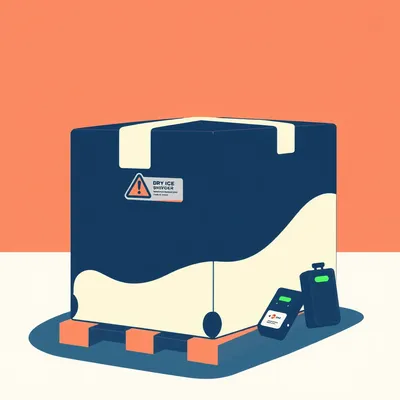
They built what they called thermal shippers. Picture a box about the size of a pizza box, but much deeper. Each one held up to five thousand doses. The walls were vacuum-insulated panels, which is the same technology used in high-end refrigerators and building insulation. Inside those walls, they packed dry ice and phase-change materials.
Phase-change materials. What are those?
Materials that absorb or release heat when they change phase, usually from solid to liquid. Think of it as a thermal battery. When the dry ice starts to lose its cooling power, the phase-change material kicks in and absorbs the heat before it reaches the vaccine vials. It's a layered defense.
So you've got three separate mechanisms all working together, and if any one of them fails, the other two buy you time.
That's the design philosophy. Redundancy at every layer. Pfizer's thermal shipper could maintain minus seventy degrees for up to ten days if unopened. But here's the catch. The moment you open it, you've got thirty seconds of exposure to ambient air before the temperature starts to drift. Thirty seconds. That's your window to remove what you need and reseal the box.
Thirty seconds. That's not a guideline. That's a hard constraint built into the physics of the thing.
And it's a constraint that cascades through the entire operation. You can't just pop the lid and browse. Every opening has to be planned. You need to know exactly how many vials you're pulling, have them pre-staged for transfer to a standard refrigerator, and get the shipper closed again. If you exceed thirty seconds, you're not just warming the vials you removed. You're warming everything still inside.
And the shipper itself was designed to be used as temporary storage at vaccination sites. That was Pfizer's solution to the last-mile problem. Most clinics didn't have minus seventy freezers, so the shipper became the freezer.
Right. The shipper-as-storage model. It's elegant but fragile. The dry ice inside the shipper sublimates continuously, so you have to replenish it every five days. That means every vaccination site using a thermal shipper needs a steady supply of dry ice, and someone who knows how to handle it safely.
Which creates a secondary supply chain. You're not just shipping vaccines. You're shipping the thing that keeps the vaccines cold, to every clinic, on a five-day cycle.
And dry ice production is not trivial. It's energy-intensive. CO2 is captured as a byproduct of ammonia production and other industrial processes. During COVID, ammonia plants were running at reduced capacity in many countries, which meant CO2 shortages, which meant dry ice shortages. Israel sourced dry ice domestically and had enough capacity, but many countries didn't. You'd have vaccines arriving at airports with no dry ice to keep them cold.
So the cold chain isn't just the box and the truck. It's the industrial base that produces the cooling material. It's the energy grid that powers the production plant. It's the chemical supply chain for the ammonia that yields the CO2. You pull one thread and the whole thing unravels.
Now let's talk about the monitoring layer, because this is where it gets really interesting. Every thermal shipper carried a GPS-enabled temperature logger with a probe that recorded temperature every minute. Not every hour. Every minute. If the logger showed an excursion, the entire batch was flagged.
And the logger itself had to be validated. A faulty logger could falsely condemn a good batch.
Or worse, miss a real failure. The loggers had to be calibrated against a known standard before deployment. They had to survive the same minus seventy environment as the vaccine. The batteries had to function at ultra-low temperatures, which is not a given. Lithium batteries lose capacity in extreme cold. The logger probe had to be positioned correctly inside the shipper, because temperature varies within the box. Place it too close to the dry ice and it reads artificially low. Place it too close to the wall and it reads artificially high.
So you've got a sensor that's itself a point of failure, measuring a system where every other component is also a point of failure.
And the data from those loggers wasn't just for quality control. It was part of Israel's data-for-vaccines deal with Pfizer. Israel agreed to share real-world effectiveness data. But that data pipeline also included logistics data. Vaccination rates by clinic, by day, by hour. If a clinic reported slower-than-expected vaccination rates, the supply chain could redirect doses before they expired.
This is the part that I think is underappreciated. The cold chain and the data chain were intertwined. You couldn't separate the physical logistics from the information logistics.
Israel's health maintenance organizations, Maccabi and Clalit, were tracking vaccine administration in real time and feeding that data back to Pfizer. If clinic A was vaccinating a hundred people a day and clinic B was vaccinating twenty, the doses allocated to clinic B could be rerouted mid-shipment. That's not just efficient. That's waste prevention on a massive scale.
Because every dose that sits in a shipper past its five-day window is a dose that gets discarded. The data feedback loop let them steer doses toward demand in real time.
And this is where Israel's size became an advantage. The entire country is roughly the size of New Jersey. A truck can cross it in a few hours. So if a shipper needed to be redirected from Haifa to Beersheba, that was a same-day operation. In a larger country, the transit times alone would make that kind of dynamic rerouting impossible.
The last mile, though. That's where everything gets hardest. You've got a thermal shipper arriving at a clinic that has never handled minus seventy materials before. The staff has been trained, hopefully, but training only goes so far when you're dealing with a thirty-second open-door rule and a five-day replenishment cycle.
And the staff is also administering vaccines, managing patient appointments, handling the data reporting. The cold chain management is one more task on top of an already overwhelming workload. The human layer is where most cold chain failures actually happen. Not in the design of the shipper. Not in the dry ice supply. In the moment when someone opens the lid, gets distracted, and leaves it open for forty-five seconds.
Or doesn't log the opening time. Or forgets to order dry ice until the day it runs out. Or places the shipper next to a window where afternoon sun hits it.
All of those are real failure modes. And this is why the training component is not optional. Israel's cargo airline had to train ground crews. The health ministry had to train clinic staff. Pfizer provided detailed protocols for handling the shippers, but protocols only work if people follow them.
There's a phrase that gets used in high-reliability organizations: the system is only as strong as its weakest human. You can engineer a perfect container, but if the person opening it is exhausted and rushing, the engineering doesn't matter.
Let me give you a concrete example of how this played out. Pfizer's protocol said that once vials were removed from the thermal shipper, they could be stored in a standard refrigerator at two to eight degrees for up to five days. But once thawed, they couldn't be refrozen. So a clinic had to plan its vaccination schedule around that five-day window. Order too many vials out of the shipper, and you're discarding thawed doses at the end of the week. Order too few, and you're opening the shipper again, eating into that thirty-second budget.
It's inventory management with a stopwatch and a thermometer.
And no margin for error. Compare that to a typical supply chain, where you can over-order by ten percent and just warehouse the surplus. You can't warehouse a thawed mRNA vaccine. It's got a clock on it.
So what happens when a temperature excursion is detected? Walk me through the actual sequence.
The logger records the excursion. When the shipper arrives at its destination, the logger data is downloaded and reviewed. If the temperature went outside the acceptable range for more than a specified duration, the entire batch is flagged. The vials are physically segregated. They don't get administered. They get reported to the manufacturer and to the health authority, and then they're destroyed.
And there's no appeal process. There's no second opinion. The logger says what it says.
Correct. Because the alternative is administering a vaccine of unknown potency. If the lipid nanoparticles that protect the mRNA have degraded due to temperature, the vaccine might not produce an adequate immune response. But the patient and the clinician would have no way of knowing. You'd be giving people a false sense of protection.
Which is arguably worse than giving them nothing.
Far worse. Someone who thinks they're vaccinated behaves differently. They take risks they wouldn't otherwise take. A failed cold chain doesn't just waste doses. It creates a public health liability.
So let's zoom out. The cold chain is a masterclass in designing for failure. Every component is redundant because the consequence of failure is total loss. This is the opposite of most supply chain optimization, which tolerates minor losses as the cost of doing business.
That's the key insight. In a normal supply chain, if you lose two percent of your product to spoilage, that's acceptable shrinkage. You build it into the model. In the vaccine cold chain, the acceptable shrinkage is zero. You design the system to fail deadly, not fail safe. A fail-safe system degrades gracefully. A fail-deadly system says if anything goes wrong, everything stops.
And the everything-stops outcome is the right one here, because the alternative is worse. But it means the entire system has to be engineered to a standard that most logistics professionals have never had to meet.
Which brings me to something I think about a lot. The Pfizer thermal shipper was not just a shipping container. It was a shipping container, a storage unit, a temperature monitor, and a quality gate, all in one box. That's a design philosophy that collapses multiple functions into a single object because the object has to work in environments that don't have the supporting infrastructure.
The shipper is the freezer. The logger is the inspector. The protocol is the safety system. Everything has to be self-contained because you can't count on the destination having anything.
And that's the lesson for anyone working in logistics or operations. Extreme temperature requirements force you to think about the entire system, not just the transport leg. You can't say we'll handle the shipping and someone else will handle the storage. The shipping and the storage are the same thing when the storage facility doesn't exist at the destination.
There's a broader implication here too. The mRNA technology that required all this infrastructure isn't going away. It's expanding. Flu vaccines, RSV vaccines, cancer vaccines. The cold chain infrastructure built during the pandemic becomes a permanent asset.
Countries that invested in cold chain capacity now have a logistics advantage for future biologics. Israel built out that capacity for the COVID vaccine, but the freezers, the trained personnel, the dry ice supply relationships, the monitoring protocols, they don't disappear when the pandemic ends. They're available for the next biologic that needs them.
Which is a form of infrastructure that doesn't show up on a balance sheet in an obvious way. It's not a bridge or a port. It's the capability to move temperature-sensitive biologics at national scale. But it's just as real as a highway.
And just as expensive to build from scratch. The WHO maintains performance standards for cold chain equipment, including vaccine refrigerators and cold boxes. Meeting those standards requires certified equipment, validated processes, and ongoing maintenance. It's not something you can improvise.
So what does all this mean for someone who's not a logistics professional? Let me give you three takeaways.
First, the cold chain is a socio-technical system. It's not just boxes and dry ice. It's the people who handle the boxes, the training they receive, the protocols they follow, and the data systems that track everything. If you ignore the human layer, the best container in the world won't save you.
Second, designing for zero failure is fundamentally different from designing for low failure. It changes your material choices, your redundancy strategy, your monitoring requirements, and your cost structure. Most supply chain professionals never have to think this way. But when the stakes are life and death, zero is the only acceptable number.
Third, the cold chain and the data chain are not separate systems. They're two halves of the same operation. Real-time temperature monitoring isn't just about quality assurance. It's about enabling dynamic routing, waste prevention, and demand forecasting. The data makes the cold chain adaptive.
And if you're building a system like this from scratch, start with the last mile. The airport-to-clinic leg is where most failures happen, because that's where the controlled environment meets the uncontrolled world. Design for that transition first, and work backward to the factory.
That's good advice. The factory and the cargo hold are controlled environments. The back of a van in August is not. If your system can survive the van, it can probably survive everything else.
So here's the open question I keep coming back to. As vaccine technology evolves toward thermostable formulations, lipid nanoparticles that don't require minus seventy, does the cold chain become obsolete? Or does it just shift to the next biologic that needs it?
I think it shifts. The cold chain infrastructure doesn't go away just because one vaccine gets easier to ship. There will always be biologics that require ultra-low temperatures. Cell therapies, gene therapies, certain monoclonal antibodies. The capacity we built for COVID vaccines becomes the backbone for the next generation of treatments.
The cold chain is invisible infrastructure that most people never think about. But it's the reason a vaccine can travel from a factory in Belgium to a clinic in Tel Aviv without losing potency. That's a weird, wonderful thing. A box of dry ice and vacuum panels and phase-change materials, designed with such precision that ten thousand doses survive a journey halfway across the world and arrive ready to save lives.
And the people who designed it, the crews who handled it, the clinic staff who managed that thirty-second window, they're all part of a system that most of the world never knew existed. Until suddenly it was the only thing standing between a pandemic and a population.
Thanks to our producer Hilbert Flumingtop for keeping this show running.
This has been My Weird Prompts. If you enjoyed this episode, tell someone who works in logistics. They'll appreciate it more than most.
We'll be back soon.