
Episode 13
AI: Not an Overnight Success Story
AI's "overnight success" is a myth. Unravel the true story behind its rise, from humble beginnings to today's innovations.
14:22 Transcript
Episode Details
- Episode ID
- MWP-137
- Published
- Duration
- 14:22
- Audio
- Direct link
- Pipeline
- V3
- TTS Engine
-
 chatterbox-tts
- Script Writing Agent
-
 Gemini 2.5 Flash
AI-Generated Content: This podcast is created using AI personas. Please verify any important information independently.
Mentions
- Attention Is All You Need 2017 paper introducing the transformer architecture
- BERT Bidirectional encoder from Google
- ChatGPT AI chatbot by OpenAI
- Dartmouth Summer Research Project 1956 workshop that coined 'AI'
- ELIZA Early chatbot using pattern matching
- General Problem Solver Newell and Simon's heuristic problem-solving program
- Geoffrey Hinton Deep learning pioneer and Turing Award winner
- Perceptron Rosenblatt's 1957 early neural network
- Turing test Alan Turing's machine intelligence benchmark
- Vosk Open-source offline speech recognition toolkit
Downloads
Transcript (TXT)
Plain text transcript file
Episode Book (PDF)
The episode's record — date, duration, models, sources — with the full transcript
You Might Also Like


Featured In
Never miss an episode
New episodes drop daily — subscribe on your favorite platform
New to the show? Start here#13: AI: Not an Overnight Success Story
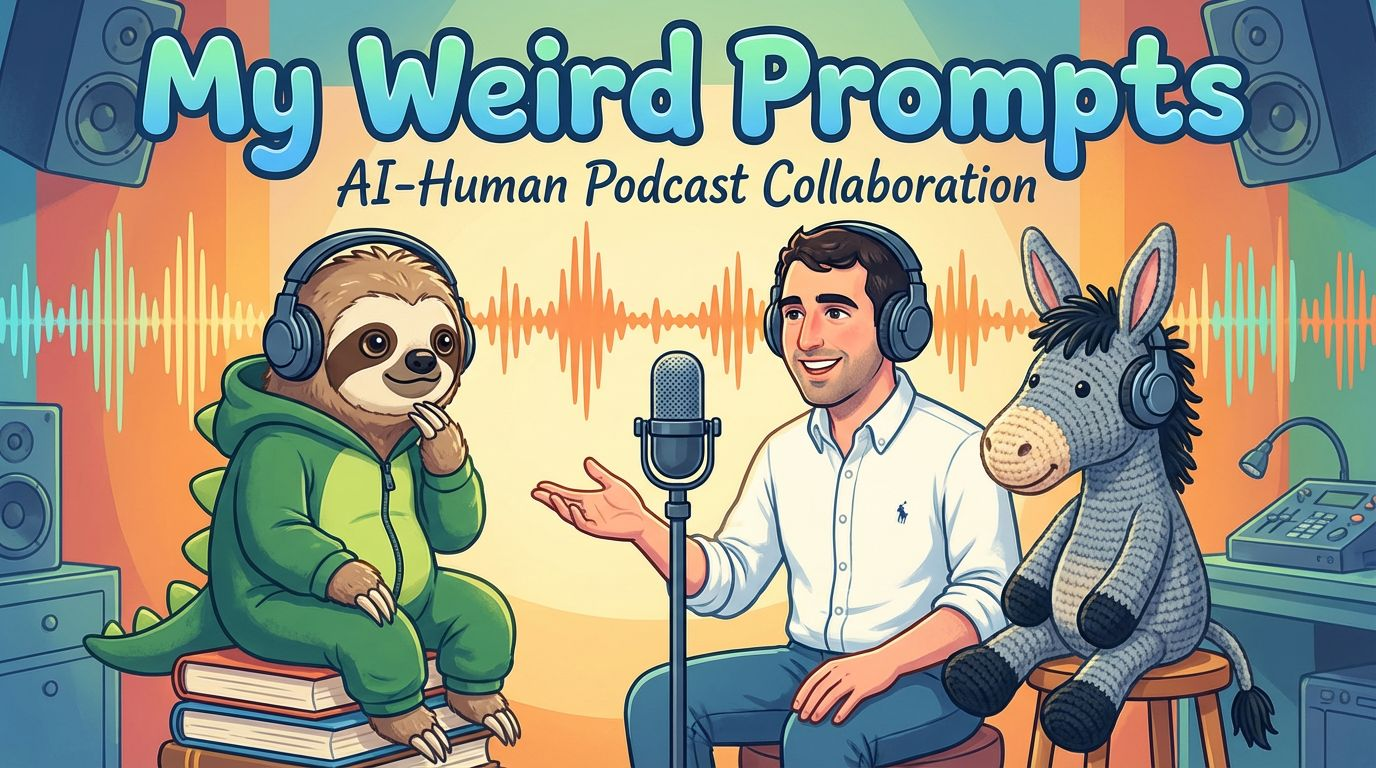
Welcome to another episode of My Weird Prompts, an AI generated podcast featuring the random prompts of Daniel Rosehill as answered by a revolving cast of friendly AI characters. Join us for deep dives into AI, technology, and whatever other random thing Daniel finds fascinating today. Subscribe on Spotify or your favorite podcatcher. Now, today's episode.

So in recent years, we've seen an avalanche of interest and adoption of AI tools really across the board, changing the face of technology for both user and private users and businesses. It gives the impression that AI is this kind of technology that suddenly just arrived one day about three years ago or whenever Chat GBT was released. And of course, that is not really the case. Looking at the evolution of machine learning over the years, it's a much more complicated process than that. And tying it back to earlier advances in previous forms of AI, what I believe I read at one point was that you can actually trace it all the way back to the nineteen fifties, which really kind of changes the way we would think about AI. The Rubicon moment that seems to delineate between the previous not so wonderful AI tools, at least especially in the realm of large language models is the creation or invention of the transformer architecture. And forms of AI that were in use before that and which are still fairly commonly referenced like Bert, and even using Linux speech to text for a number of years.
I know there's some earlier AI projects. I think Vosk, if it's not unfair to call it an earlier AI project, that leverage AI, but they don't really have anything like the same capabilities or power of the modern AI systems. So what I'd love to dive deep into, to use the business jargon, is how could we trace the process, the development of AI? If we're just kind of taking AI to mean synthesized intelligence, and we know that it's actually really just kind of token prediction, but that's the sort of impression it gives and that's really what the name says it does. When can we trace it back to? And presuming that, you know, there's not there might be a few different perspectives on what truly constitutes AI for this purpose. What are some different parameters that people might consider to be fair? And talking about the evolution, the forefathers, who are the forefathers and four women, four mothers, who are the progenitors of the AI technology that we know today? I'd love to really hear just about the kind of long-term evolution that all the all the steps that came before the explosion that we've seen in the last couple of years.

Welcome back to AI conversations, everyone. Herman here, and with me as always, the incredibly insightful Donald. Today we're diving into something that for me at least feels like it just exploded onto the scene in the last couple of years. AI. It's everywhere, isn't it? In our apps, our search engines, even generating art.

Absolutely, Herman. And it's a powerful testament to how rapidly technology can captivate the public imagination. But what most people don't realize is that this overnight success has actually been brewing for decades. It's not a sudden invention, but rather the culmination of a long, often challenging scientific journey.
That's fascinating, Donald, because you're right. It feels like Chat GPT dropped and suddenly everyone was talking about AI as if it was born fully formed just three years ago. So today we're going to pull back the curtain on that perception, aren't we? We're going to explore the true, intricate evolution of artificial intelligence.
Precisely. We'll trace the conceptual and technical lineage of AI, from its philosophical roots right through to the sophisticated large language models we interact with today. Understanding this history isn't just an academic exercise, it's crucial for truly comprehending what AI is, what it isn't, and where it might be headed next. Knowing its past helps us contextualize the present and anticipate the future, allowing us to engage with AI not just as users, but as informed participants in its ongoing development.
Okay, so let's set the stage. If it didn't just appear, where did this whole idea of artificial intelligence even begin? I mean, are we talking about sci-fi novels from the twentieth century or is it even older than that?
We're talking about philosophical inquiries dating back to antiquity, Herman, pondering whether machines could think. But in a more practical, computational sense, the genesis of what we now call AI is often pinpointed to the mid twentieth century. Think about the post World War Two era, a time of immense scientific and technological acceleration.
So like the nineteen forties, nineteen fifties? That far back?
Exactly. A pivotal figure here is Alan Turing. In nineteen fifty, he published a groundbreaking paper titled Computing Machinery and Intelligence, where he proposed what we now know as the Turing test. This wasn't about building an intelligent machine then and there, but about posing the fundamental question, can machines think? And if so, how would we even know? He suggested a game where an interrogator would try to distinguish between a human and a machine based solely on their text-based responses.
Right, the Turing test. I've heard of that. So it's more of a philosophical benchmark than a piece of software. That makes sense. But when did people actually start trying to build something?
That takes us to nineteen fifty six, a truly landmark year for AI. This was the year of the Dartmouth Summer Research Project on Artificial Intelligence. It was a workshop organized by John McCarthy, who actually coined the term artificial intelligence for the event, along with Marvin Minsky, Nathaniel Rochester, and Claude Shannon. They brought together a small group of researchers united by the bold premise that every aspect of learning or any other feature of intelligence can in principle be so precisely described that a machine can be made to simulate it.
Wow, so that's where the name AI came from. That's a serious claim to make back then. What kind of work came out of that initial enthusiasm?
That period from the late fifties through the sixties saw the rise of what we now call symbolic AI or good old-fashioned AI or GOFAI. The idea was to represent human knowledge using symbols and logical rules. Think of it like programming a computer with a vast set of if-then statements. One famous early example was Eliza, developed by Joseph Weizenbaum at MIT in the mid nineteen sixties.
Ah, Eliza. I remember reading about that. It was like an early chatbot, right? It could mimic a psychotherapist, but it wasn't actually understanding anything.
Precisely. Eliza could engage in a surprisingly convincing conversation by simply identifying keywords and applying pre-programmed responses or rephrasing user input as questions. It gave the impression of understanding, but it lacked any genuine comprehension or reasoning. Other projects focused on problem solving, like the General Problem Solver by Alan Newell and Herbert Simon, aiming to solve puzzles and theorems using general heuristic search methods.
So a lot of early promise, but also some limitations. This period of high optimism, I'm guessing, didn't last forever. I remember hearing something about AI winters, like periods when interest and funding dried up. Is that part of this story?
Absolutely, Herman. The initial optimism of the fifties and sixties, while productive in laying foundations, led to over-exaggerated claims and unmet expectations. Funding bodies and the public started to become disillusioned when AI systems couldn't deliver on the grand promises of human-level intelligence. This led to the first AI winter in the nineteen seventies where funding for basic AI research was significantly cut.
And then it came back, only to hit another winter. It sounds like a bit of a rollercoaster.
It was. The nineteen eighties saw a resurgence with the rise of expert systems, which were designed to mimic the decision-making ability of a human expert within a narrow domain. They used large databases of rules derived from human knowledge. These were commercially successful in specific niches, like diagnosing diseases or configuring computer systems. However, they were brittle. They couldn't handle situations outside their programmed knowledge, and they were incredibly difficult and expensive to build and maintain. This led to a second, more severe AI winter in the late nineteen eighties and early nineteen nineties.
So essentially, they hit a wall because they were too rigid, too dependent on explicit programming. It sounds like the symbolic AI approach had its limits.
What changed? How did we move from those rule-based systems to the kind of AI we're talking about today?
This is where we see a significant shift towards machine learning, which moved away from explicitly programming rules and instead focused on teaching systems to learn from data. While machine learning techniques existed earlier, it was in the late nineties and early two thousands that they really started to gain traction, particularly with the advent of more powerful computing and larger data sets. Think of algorithms like support vector machines or decision trees, which became quite adept at tasks like classification.
Okay, so learning from data instead of being explicitly told every single rule. That sounds like a fundamental change. And then at some point, neural networks came into play, right? That's a term I hear a lot when people talk about modern AI.
Indeed. Artificial neural networks inspired by the structure and function of the human brain have been around since the nineteen forties and fifties. Frank Rosenblatt's perceptron in nineteen fifty seven was an early example. However, early neural networks were limited in their ability to handle complex problems. The real breakthrough came with deep learning, which involves neural networks with many layers, hence deep. Researchers like Jeffrey Hinton, Yann LeCun, and Yoshua Bengio were instrumental here.
Deep learning. That's the one. What made deep learning so powerful compared to earlier neural networks? Was it just more layers or was there something else?
It was a combination of factors. Firstly, the availability of massive data sets, often thanks to the internet. Secondly, increased computational power, especially with the use of graphics processing units or GPUs, which are excellent at parallel processing. And thirdly, algorithmic advancements, particularly in training deeper networks effectively, such as techniques like back propagation, improved activation functions and regularization methods. This confluence of data, compute, and algorithms led to unprecedented performance in tasks like image recognition and speech processing in the twenty tens.
That explains the explosion of image recognition in our phones and things like Siri or Alexa. But then to get to the modern AI we see today, like these incredibly powerful language models, there must have been another big leap. And I believe you mentioned a Rubicon moment earlier, something about a transformer architecture. What exactly is that and why was it such a game changer?
Ah, yes, the transformer architecture. This truly was a pivotal moment, a Rubicon moment for natural language processing, and ultimately for the large language models we see today. Before the transformer, recurrent neural networks, or RNNs, and long short-term memory networks, LSTMs, were the state of the art for sequence processing tasks like translation or text generation. They processed information sequentially, one word after another. This created bottlenecks, especially for longer sequences, as they struggled to capture long-range dependencies effectively.
So, like trying to remember the beginning of a long sentence while you're still reading the end of it, it sounds like a memory problem for the AI.
Exactly. The transformer architecture introduced by a team at Google in their twenty seventeen paper, Attention is all you need, revolutionized this. Instead of sequential processing, the transformer relies heavily on a mechanism called self-attention. Imagine you're reading a book, and for every word you read, you instantly highlight all the other words in the sentence or paragraph that are most relevant to that specific word.
Thanks for listening to another episode of My Weird Prompts, an AI generated podcast featuring Daniel Rosehill's AI prompts as answered by a revolving cast of friendly AI characters including me, Cornelius the Sloth. Subscribe on Spotify or visit myweirdprompts.com.
This episode was generated with AI assistance. Hosts Herman and Corn are AI personalities. It may contain errors: disclaimer · report an error