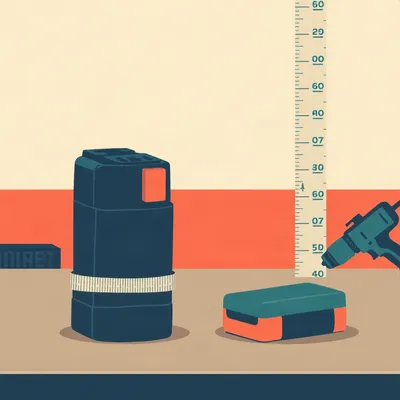
Daniel's been staring at spec sheets again. This time he wants to know what "brushless" actually means when it shows up on a drill, a rotary tool, or a vacuum — and whether the price premium attached to that word is buying real performance or just a cleaner marketing story. His question has three layers: what's mechanically different inside the two motors, how significant that difference is in actual operation, and which specific parameters shift in product classes where both variants sit on the same shelf.

And the shelf is the thing. You walk into any hardware store right now and the brushless drill is forty to a hundred dollars more than the brushed one sitting next to it, same brand, same battery platform, same chuck. The box says brushless in big letters and most people nod like they know what they're paying for.
They're paying for the removal of a small block of carbon. Which sounds like the worst trade deal in history until you look at what that block of carbon was doing.
So we're going to open one up, metaphorically, and look at the part that touches, the part that doesn't, and what that single difference does to everything downstream.
Start with the architecture, because the whole thing is an inversion.
A brushed motor carries the copper windings on the spinning rotor — that's the armature — with permanent magnets fixed in the stator, the stationary shell around it. The brushless motor flips that completely. Magnets go on the rotor, windings stay still in the stator. That inversion is the entire mechanical story.
These are carbon blocks, spring-loaded, pressing against a segmented copper ring on the shaft called the commutator. As the rotor turns, the commutator segments slide under the brushes and mechanically reverse the current direction in each winding at exactly the right moment to keep torque continuous.
It's a physical sliding electrical switch spinning at thousands of revolutions per minute. That's the whole trick. A brushed motor needs nothing but DC power to spin. Connect a battery, the commutator does the switching, you get rotation. No electronics required.
The brushless motor removes that sliding contact entirely and replaces it with a controller. Hall-effect sensors or back-EMF sensing tell the controller where the rotor is, and the controller switches current through the stator windings in sequence. Zero physical contact between moving and stationary parts.
And that's the consequence that drives everything else. A brushed motor is a motor. A brushless motor is a motor plus a drive circuit — and the electronics are not an accessory, they are the commutation system itself. The motor literally cannot spin without the controller doing its job.
So one design pays for commutation with carbon dust and arcing, the other pays for it with a microcontroller and a handful of MOSFETs. Everything that follows — efficiency, heat, lifespan, speed, cost — comes out of that single architectural choice.
And now we get to the numbers, because Daniel asked how significant the operational differences actually are.
Lead with efficiency. That's the big one.
Brushed motors typically run seventy-five to eighty percent efficient. Brushless reaches eighty-five to ninety-three percent, with premium interior-permanent-magnet designs peaking at the top of that range. The gap comes from three losses a brushed motor cannot avoid. The copper windings in the rotor heat up and that's resistive loss. The brush contact itself has electrical resistance. And the arcing at the commutator throws away energy as sparks and heat.
The arcing is the one people can see. Spin a cheap brushed vacuum motor in the dark and you'll see a little lightning storm through the cooling vents. That's energy leaving the system as light and noise and ozone.
And that's worth pausing on, because the arcing isn't just a visual quirk. Every spark at the commutator is a tiny arc welder, pitting the copper surface, vaporizing a little carbon from the brush, and creating ozone. Over time, that pitting increases the contact resistance, which increases the arcing, which increases the pitting. It's a feedback loop that accelerates wear.
That's the thing about brushed motors — they're quietly destroying themselves from the moment you pull the trigger. The design includes its own expiration date. And that's not a flaw, necessarily. It's just the nature of a sliding contact under electrical load.
Heat is the hidden spec. A brushed motor generates its heat inside the rotating armature, which is the hardest place to shed it — it's surrounded by air gap and magnets, no direct thermal path to the outside. A brushless motor puts its heat-generating windings on the stator, which bolts directly to the housing. The heat conducts straight out through the case. So brushless runs cooler and can sustain power longer under continuous load before thermal protection kicks in.
Which is why a brushless drill can run a hole saw through a pressure-treated post for ten minutes straight without going into thermal shutdown, and a brushed one starts smelling like hot copper and takes a nap.
The smell is the varnish on the windings breaking down. Once that happens, the insulation is compromised, and the motor is on borrowed time even after it cools off.
Think of it like a fever. A brushed motor under heavy load is running a temperature the whole time, and the insulation is the immune system. Once that insulation starts breaking down, the motor doesn't recover — it just gets more vulnerable to the next heat spike.
And the heat problem compounds. As the insulation degrades, the windings can short, which increases resistive loss, which increases heat, which degrades the insulation further. Same feedback loop as the arcing, just thermal instead of electrical.
Lifespan is a wear story, not a failure story. Carbon brushes are a consumable. Typical brushed motors last one to three thousand hours before the brushes need replacement. Premium silver-graphite brushes stretch that to eight thousand. Brushless motors exceed ten thousand hours routinely — some go past thirty thousand — and the primary failure mode becomes bearings, not brushes.
The brushes are designed to wear out. That's their job. They're a sacrificial part.
And the spring mechanism that presses them against the commutator is part of the design. As the brush wears down, the spring pushes it forward, maintaining contact. Eventually the brush gets so short the spring can't reach anymore, and that's when the motor starts acting up.
It's like a mechanical pencil. The lead keeps advancing until there's nothing left to push. Except when a brush runs out, it doesn't just stop writing — it starts arcing erratically and damaging the commutator.
Speed ceiling is another hard limit. Brushed motors top out around ten thousand RPM because brush arcing and commutator contact become erratic at high speed — the brushes literally bounce off the commutator and the whole thing turns into a spark generator. Brushless designs run from six thousand to over fifty thousand RPM. That's why every drone motor, every RC car motor, every spindle motor is brushless.
If you've ever heard a brushed motor at high speed, you know the sound. It's not a clean whine. It's a grinding shriek. The brushes are chattering against the commutator segments, losing contact for microseconds at a time, and every loss of contact is an arc.
And that's at ten thousand RPM. Now imagine what would happen at fifty thousand. The brushes would vaporize in seconds. The brushless design doesn't have that ceiling because there's no physical contact to go wrong.
And torque density. Brushed motors deliver under seven-tenths of a newton-meter per kilogram. Surface-mounted brushless gets you up to about one newton-meter per kilogram. Interior-permanent-magnet designs reach over one point four. That's roughly a thirty-seven percent improvement — which is why brushless can be smaller and lighter for the same output.
That's the spec that matters for handheld tools. A brushless drill can be smaller and lighter than a brushed drill with the same torque. Or the same size with more torque. The packaging freedom is real.
The cost picture is the counterweight. For a five horsepower industrial system, a brushed setup runs four to fourteen hundred dollars. Brushless runs twelve hundred to thirty-two hundred. But the energy and maintenance savings let brushless break even in twelve to eighteen months of continuous operation, and over ten years it cuts total cost of ownership by about thirty-one percent.
The automotive industry already worked this out. Motors that run continuously — fuel pumps, cooling fans, blowers — went brushless years ago. Motors that run intermittently — power windows, seat adjusters — stayed brushed. Because brush wear and heat only matter with significant run time. A power window motor runs for two seconds at a time. It'll die of door rust before the brushes wear out.
That's the lens to carry into the consumer products. Not "which motor is better" but "how long does this thing actually run, and does the brushed penalty ever get a chance to bite."
So the raw engineering differences are real. Efficiency, heat, lifespan, speed, torque density, cost. Now the question Daniel actually asked — what shifts when you're holding a drill or pushing a vacuum.
Drills first. The headline spec is battery runtime. A brushless drill converts about ninety percent of battery energy into work. Brushed converts seventy-five to eighty percent. On the same battery pack, that's roughly thirty to fifty percent more working time per charge.
And it's not just runtime. It's the shape of the power delivery. A brushed tool loses power as the battery depletes — the voltage sag hits the motor directly and torque drops off. A brushless controller maintains consistent output across the discharge curve and adjusts torque and speed to load in real time. The "smart motor" behavior everyone talks about — that's the controller, not the motor itself.
The motor is just magnets and copper. The controller is doing load sensing, current limiting, speed regulation. That's the part that makes a brushless drill feel different in the hand.
You know how a brushed drill bogs down when you're driving a big lag screw? The pitch drops, the speed drops, and you have to back off and let it recover. A brushless drill just keeps grinding at the same speed. It's almost uncanny the first time you feel it.
It's like the difference between a manual transmission and a continuously variable transmission. The brushed motor is the manual — you feel every gear, every load, every strain. The brushless is the CVT — the controller just adjusts and keeps the output steady.
And for a professional driving screws all day, that consistency is worth real money. You don't have to compensate for the tool. You just push and it does the work.
The maintenance reality for drills is stark. Brush life in moderate DIY use is fifty to a hundred hours of motor-on time. Sustained professional use can eat a set of brushes in twenty-five to fifty hours. Replacement brushes cost five to fifteen dollars a pair — cheap parts. But the labor and downtime are the real cost, especially for a contractor who's losing billable hours.
And here's the caveat that cuts through the marketing. Brushless does not automatically mean more torque. Actual output depends on gear ratio, motor size, and design. A compact brushless drill can have lower absolute torque than a large brushed drill. The label tells you about the motor type, not the performance tier.
A budget brushless drill from an unknown brand can underperform a quality brushed drill from Milwaukee or DeWalt. The word "brushless" is not a quality guarantee. It's a motor architecture.
I've seen people pay extra for a brushless tool from a no-name brand and end up with something worse than the brushed tool they already had. The motor type doesn't compensate for bad gearing, cheap bearings, or a sloppy chuck.
It's like putting a Formula One engine in a car with square wheels. The engine is great. The car is still terrible.
Rotary tools flip the emphasis. The parameter that matters is RPM under load, not raw torque — rotary tools rely on surface speed, and brushless models maintain RPM better under load because the controller compensates. Brushed models sag.
The Dremel case is instructive. The brushless cordless models — the eighty-two fifty and eighty-two sixty — deliver roughly twenty percent more power than Dremel's strongest corded brushed model, the forty-three hundred. And about twice the working time of the earlier brushed cordless eighty-two twenty when cutting quarter-inch lag bolts.
Dremel claims to have invented the cordless brushless rotary tool and holds a patent on it. Which is a very Dremel thing to patent — the entire product category of "cordless rotary tool with a brushless motor."
They patented the obvious next step. Bold.
Vacuums are where the split gets interesting because there are two completely different markets. Cordless, handheld, and robotic vacuums have gone almost entirely brushless — efficiency extends battery life, and quieter operation matters for robots that run unattended. But many corded vacuums still use brushed universal AC motors, which offer cost-effective high torque at about seventy percent efficiency versus eighty-five to ninety for brushless DC.
The corded vacuum never runs out of battery, so the efficiency advantage doesn't buy runtime. It buys less heat and less noise, but the brushed universal motor is cheap and it works.
Suction as a function of wear is the parameter that never appears on spec sheets. A brushed motor's suction decreases as the brushes wear and the commutator degrades. The brushless vacuum maintains suction over its life. You don't see that on the box, but it affects real-world performance over years.
And that's a parameter that matters for a vacuum specifically. A drill either turns or it doesn't. A vacuum can keep running while its suction slowly fades, and you might not notice until you're wondering why the carpet doesn't look as clean as it used to.
The decline is so gradual that people adapt to it. They just go over the same spot twice. They don't realize the tool used to do it in one pass.
And the corded caveat reframes the whole debate. For corded tools that never run out of battery, the efficiency and runtime advantage of brushless largely evaporates. Many quality corded drills still use brushed motors. Some professionals prefer brushed for raw low-speed torque and simplicity.
The brushed motor's low-speed torque characteristic is actually a feature in some applications. It's not all downside.
That's worth explaining, because it sounds counterintuitive. The brushed motor's torque curve is simpler — it's a direct relationship between current and torque, no controller in between. Some machinists and fabricators like that directness. You can feel exactly what the motor is doing.
It's the same reason some people prefer manual transmissions. Less mediation between input and output. The brushed motor gives you the raw signal.
So the pattern is: brushless wins for cordless and continuous duty, brushed remains rational for corded and intermittent use. The duty cycle is the whole game.
Which is why the automotive analogy keeps working. Your cordless drill gets used like a fuel pump — bursts of high demand, battery-limited, efficiency matters. Your corded drill gets used like a power window motor — two seconds of work, set it down, repeat next weekend.
That's the engineering picture. But there's one thing the spec sheets don't capture, and I suspect our producer has been waiting to mention it.

The brushes are the only part you can fix with a screwdriver.
What?
Worked returns and repairs at Circuit Barn for a summer. Late nineties. Nobody else would touch the sparky ones — the brushed motors that threw visible arcs when you spun them by hand. So I became the motor guy by default. And the brushed ones were the only ones you could actually repair.
Circuit Barn.
Defunct now. The point is, a customer brought in a nineteen eighty-seven Black and Decker drill with the brushes worn down to nubs. Replacement brushes were six dollars. I put them in, the drill ran another decade. When a brushless motor's controller dies, the whole tool is e-waste. You can't replace a MOSFET with a screwdriver.
That's the repairability dimension. The brushes are a consumable by design, but that means the failure pattern is accessible. The controller in a brushless tool is potted in epoxy on a board, and when it dies you throw away the motor, the housing, the gearbox, everything.
He's right. The brushed motor fails in a way a human can see and fix. The brushless motor fails in a way that requires a service manual and a multimeter.
You can hear a brushed motor going bad. The brush chatter at startup, the spark through the cooling vents on a cheap vacuum — you know something's wrong before it stops working. A brushless motor just stops. No warning. No smell. No spark. You have no idea why without opening it up and probing around.
The diagnosability point is real. The arcing and the noise are problems, but they're also a signal. The brushless motor's silence is also a silence about what's failing.
You're saying the brushed motor's flaws are a feature.
I still have that Black and Decker. Nineteen eighty-seven. Never replaced the brushes since. Because I barely use it. Which is exactly the point you two were making about duty cycle. For what I do with it — hanging a picture, drilling a pilot hole — the brushes will outlive me.
The intermittent duty argument. The brushed penalty never gets a chance to bite.
But my drill has soul. You spin it up and it chatters and it sparks and it smells like a tool. A brushless drill is a computer with a chuck. It works better and it has no character at all.
A computer with a chuck.
That's almost the whole product category now. The controller is doing more than the motor.
But Hilbert's point stands. The repairability gap is real, and it's the thing the efficiency numbers don't capture. If your brushless drill's controller dies after the warranty, you have a very expensive paperweight. If your brushed drill's brushes wear out, you have a six-dollar repair and another decade of use.
The trend is not moving toward repairability. Controllers are getting more integrated, more sealed, more potted. The electronics are becoming the motor, and electronics are not designed to be fixed.
The open question is whether the repairability gap narrows as brushless controllers get cheaper and more standardized, or whether the trend toward potted, sealed electronics makes all motors equally disposable.
I think it's the latter. The brushed motor's repairability is a historical accident — it's repairable because it's simple, and it's simple because the commutator does the work mechanically. Once you move the intelligence into the controller, you've moved the failure pattern into the part that can't be serviced.
That's a trade-off nobody puts on the spec sheet. You're exchanging repairability for efficiency, and for most people that's probably the right trade. But it's worth knowing you're making it.
The right-to-repair movement has been pushing back on this across all product categories, not just tools. The brushless motor is just one more example of the same pattern — products that work better but can't be fixed.
The next time a spec sheet says "brushless," the question isn't whether it's better. The question is whether your usage pattern is the one where the difference actually shows up. Continuous use, battery-limited, high duty cycle — brushless pays for itself. Intermittent light use, corded, budget-conscious — the brushed penalty is nearly invisible, and you keep the repairability.
The duty-cycle lens is the whole takeaway. Not "brushless is better" but "brushless is better for this kind of use."
The word on the box tells you less than you think. The motor type is one variable. The controller, the gear ratio, the build quality, the brand's engineering — those matter just as much.
Daniel's question was really about whether the spec means anything. And it does — but only when you know what to ask next.
What's the duty cycle, what's the power source, and can you fix it when it breaks.
That's the three-part answer to a one-word spec.
Thanks to Hilbert Flumingtop for producing, and for the nineteen eighty-seven Black and Decker.
This has been My Weird Prompts, the human-AI collaboration podcast.
If you enjoyed this, leave us a review wherever you listen. We'll be back soon.