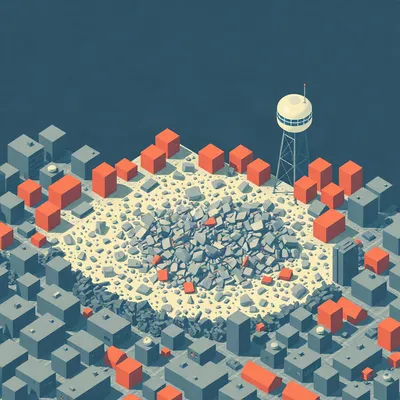
Daniel's been poking around in satellite imagery again. He describes the ArcGIS Wayback tool, which is exactly what it sounds like — a time machine for overhead imagery, free to anyone with a browser. You pick a patch of ground, scrub backward through dates, and watch the surface of the earth change. He's been comparing Gaza before and after the campaign that followed October seventh, and he says the scale of it is flabbergasting. Whole neighborhoods reduced to rubble. His question isn't about the displacement, the hunger, the disease. He wants to know what happens to the physical landscape itself when inhabited territory suddenly becomes a wasteland of jagged concrete and exposed infrastructure. The construction dust, the destroyed utilities, the parts of the social fabric that were never meant to be blown apart. What does the ground itself become?

The first thing that happens is the debris stops being buildings and starts being geology. You get a new kind of terrain. Not soil, not bedrock — pulverized concrete, rebar, gypsum, glass, asbestos fibers, and whatever was inside those buildings when they came down. The UN estimated in mid twenty twenty-four that Gaza had over forty million tons of rubble. Some later estimates pushed it toward fifty. To put that in scale, that's more than the entire city of Manhattan produces in a decade of normal construction and demolition.
Forty million tons. So the ground level itself rises.
It does. In some areas, the rubble is eight to ten meters deep. Streets that used to run between three-story buildings are now just... an uneven surface of crushed concrete with steel rods sticking out of it. And the rods are a hazard on their own. Rebar under tension, snapped and twisted, points upward. Anyone moving across that surface is walking on a lattice of impalement hazards. That's before you get to the unexploded ordnance mixed into the fill.
Unexploded ordnance. So the rubble field is also a minefield.
Not a formal one, which is somehow worse. A formal minefield gets mapped, fenced, marked. This is ordnance scattered through forty million tons of building material. Some of it failed to detonate on impact. Some of it was in weapons caches inside buildings that collapsed. The UN Mine Action Service has said that clearing it will take years, possibly more than a decade, and that's with full access and funding. Without it, the rubble just sits there, and every person who tries to salvage a door frame or a water tank is rolling the dice.
And people do salvage. Because the rubble is also the economy now.
Right. When there's no construction material coming in, the destroyed city becomes the quarry. People pull rebar out of broken concrete, straighten it, sell it. They chip off intact cinderblocks. They collect copper wire from dead electrical systems. It's dangerous work, but it's one of the few sources of income left. There are reports of people being killed by collapsing rubble while extracting metal. The rubble is simultaneously a threat and a resource.
That's the part that doesn't show up in the satellite imagery. The image shows gray where buildings used to be. It doesn't show that the gray is now a workplace.
And the gray has a chemistry problem. Concrete dust. When concrete is pulverized, it releases fine particulate matter — silica, calcium compounds, traces of heavy metals. The dust from a demolition of this scale doesn't just settle. It gets into the air, into the water table, into people's lungs. And it's alkaline. Concrete dust mixed with water creates a caustic slurry. When it rains — and Gaza does get rain in the winter — that slurry runs into whatever drainage still works, or doesn't work, and it changes the pH of the soil.
So the farmland around the rubble is getting poisoned by runoff.
Potentially. The dust also carries whatever was in the buildings. Older buildings in Gaza had asbestos in roofing and insulation. When those buildings come down, the asbestos doesn't disappear. It's in the dust. It's in the rubble. People breathing that air, day after day, for months, are inhaling fibers that cause mesothelioma twenty years from now. The public health consequences of this are going to outlast the political situation by decades.
Twenty years from now, someone who's five years old today, breathing that dust, gets a cancer diagnosis and nobody connects it to the rubble they grew up on.
That's the latency problem. Asbestos-related disease takes fifteen to forty years to present. By the time it shows up, the causal chain is invisible. No one's doing exposure tracking in a rubble field. And it's not just asbestos. Burned plastics, lead from old paint and pipes, mercury from electronics. All of it pulverized and suspended in the air.
What about the infrastructure underneath? The stuff that was buried before the bombs hit?
That's the part I find frightening. Gaza's water and sewage systems were already fragile before October seventh. The coastal aquifer was over-pumped and contaminated with seawater intrusion. Now you've got broken sewer lines leaking into the rubble, broken water mains, and no treatment happening. The sewage doesn't flow anywhere. It pools. It mixes with the concrete dust and the decomposing organic material. In the summer heat, that's a breeding ground for every waterborne pathogen you can name.
Cholera?
Cholera was confirmed in Gaza in late twenty twenty-four. First cases in decades. And the conditions for it to spread are perfect — contaminated water, no sanitation, crowded living conditions, and a population with compromised immune systems from months of malnutrition. The destroyed infrastructure isn't just an inconvenience. It's an epidemiological time bomb.
And the electricity grid.
The grid is gone. Not damaged — gone. The power plant, the substations, the transmission lines. When the grid dies, everything that depends on it dies too. Water pumps stop. Sewage pumps stop. Hospitals run on generators until the fuel runs out. Desalination plants shut down. Gaza was already importing most of its drinking water. Without power, the distribution system collapses, and people are left with whatever they can carry.
So the destruction of the built environment cascades into the destruction of the systems that made the built environment livable. It's not just that the buildings are gone. It's that the absence of buildings takes down the water, the sewage, the power, the communications.
And the roads. You can't drive a water truck down a street that's buried under eight meters of rubble. The first phase of any recovery is just clearing paths. Not rebuilding — clearing. Making it possible to move from one place to another. That's months of work with heavy equipment, and the equipment has to be brought in, and the fuel has to be brought in, and the operators have to be trained, and the unexploded ordnance has to be cleared before any of it can start.
What does the actual clearing process look like? Say you've got forty million tons of rubble and you want to make it go away. Where does it go?
That's one of the unspoken problems. You can't just dump it in the sea. Well, you can, and there have been proposals, but dumping concrete rubble mixed with hazardous materials into the Mediterranean creates a whole new set of problems. You can't use it as fill for new construction until it's been tested and sorted, because you don't want to build housing on top of asbestos and ordnance. So the realistic answer is that it gets moved to designated sites, sorted, crushed, tested, and then either recycled or landfilled. The UN has estimated that clearing forty million tons of rubble would take over a decade and cost hundreds of millions of dollars. And that's with full cooperation and access.
A decade of just moving broken concrete.
Before a single new building goes up. And during that decade, the population is living somewhere. Where? In the rubble? In tents on top of the rubble? In camps outside the rubble field? The displacement isn't a temporary condition. It's the medium-term reality of a destroyed urban landscape.
Daniel mentioned the social fabric. The things that weren't intended to be torn up. What does that actually mean at ground level?
Think about what a neighborhood contains beyond the buildings. The corner store. The mosque. The school. The clinic. The barber. The place where the old men play backgammon. The cemetery where your grandparents are buried. When the buildings go, those things go too. But the social relationships that lived in those places don't automatically transfer to a tent camp. They're anchored to geography. You lose the geography, you lose the pattern of daily life that made the society cohere.
The cemetery is an interesting one. Because that's not infrastructure. That's memory.
And in Gaza, some of the cemeteries have been damaged. Graves disturbed. That's a wound that doesn't heal with a new coat of paint. It's not just that people lost their homes. They lost the physical record of their family history. The places where they mourned. The places where they expected to be buried themselves.
There's also the issue of the dead who aren't in cemeteries. People buried under the rubble.
The number of people still unrecovered under collapsed buildings is unknown, but it's certainly in the thousands. Some of those bodies will never be recovered. The rubble becomes a mass grave. And that has implications for both the psychological recovery of the community and the practical question of what you do with the land afterward. Do you rebuild on a site where people are buried? Do you memorialize it? These are questions that every society that's suffered mass destruction has had to answer.
Hiroshima. Dresden. Aleppo.
Aleppo is the closest parallel in recent memory. A city of two million people, whole districts reduced to rubble, and the reconstruction is still incomplete years after the fighting stopped. The rubble in Aleppo was estimated at over thirty million tons. Similar problems with unexploded ordnance, with asbestos, with the sheer logistics of clearing the ground. And Aleppo had a functioning state behind it, eventually. Gaza doesn't have that.
What about the environmental angle beyond the dust? The coastal aquifer, the soil, the vegetation.
The vegetation is largely gone. Urban trees, orchards, agricultural land near the border. Some of it was destroyed by the fighting itself. Some of it was cut down for firewood because there's no cooking fuel. When you strip the vegetation, you get erosion. The topsoil blows away or washes away. The land becomes less able to absorb water, so flooding gets worse. And the coastal aquifer, which was already in bad shape, is now being polluted by sewage and chemical runoff from the rubble. The long-term environmental damage is going to be measured in generations.
The satellite imagery Daniel's looking at shows the scale. But it doesn't show the depth. It's a two-dimensional image of a three-dimensional disaster.
That's the limitation of remote sensing. You see the footprint of destruction, but you don't see the eight meters of rubble, the broken pipes underneath, the bodies, the ordnance, the dust in the air. The image is clean. The reality is not.
Do you think there's a value in the public having access to that imagery? Daniel's point is that anyone with an internet connection can look at this. That's a relatively new thing.
I think it matters enormously. For most of human history, the aftermath of a war was described by the victors. Now you have independent verification. Anyone can pull up the imagery and see for themselves what happened. That's a check on propaganda from all sides. But it's also a strange kind of intimacy. You're looking at the place where someone used to live. Where someone died. It's not abstract when you can see the individual buildings.
And the Wayback aspect means you can watch the destruction happen incrementally. The stages in between.
Which is its own kind of horror. Watching a street go from intact to damaged to gone, one image at a time. It's like a time-lapse of catastrophe. And I think that's part of what Daniel's reacting to. The flabbergasting scale of it. The human brain isn't built to process destruction at that magnitude. The imagery makes it real in a way that statistics don't.
Forty million tons is a number. A satellite image of a neighborhood that's now gray is a picture. The picture hits differently.
It does. And the picture doesn't show the dust. The dust is the part that lingers. Concrete dust in the lungs of children. Asbestos fibers in the air. The heavy metals leaching into the water table. The destruction isn't an event. It's an ongoing process. The buildings fell in months. The consequences will unfold over decades.
That's the thing that doesn't get covered. The news moves on. The rubble stays.
The rubble stays, and it keeps doing damage. It's not inert. It's chemically active, biologically active, physically dangerous. It's a continuing disaster in slow motion. And the people who live in and around it are the ones who absorb that damage, day after day, with no end in sight.
What would it actually take to make a place like that safe again? Just safe.
Safe is a long way off. The first step is clearing the ordnance. That's a precondition for everything else. Then you need to stabilize the rubble — prevent it from collapsing further, contain the dust, manage the runoff. Then you need to sort it, test it, and start moving it. That's years of work with specialized equipment and trained crews. And all of that assumes you have a functioning government, a budget, and access to the site. None of which currently exists.
So the realistic timeline is what? A generation?
Before the land is fully usable again? Probably. And that's if everything goes right from here. If the ordnance gets cleared, if the funding materializes, if the political situation stabilizes. That's a lot of ifs.
The term "wasteland" gets thrown around loosely. But this is what a wasteland actually is. A place full of hazards that used to be a city.
A wasteland that used to be a city is worse than empty desert. The desert doesn't have rebar sticking out of it. The desert doesn't have asbestos in the dust. The desert doesn't have unexploded bombs buried under the surface. A destroyed city is a landscape that's actively hostile to human life.
And yet people are living in it. That's the part that I keep coming back to. The rubble field isn't abandoned. It's inhabited.
Because they have nowhere else to go. The people who are living in the rubble are doing it because the alternatives are worse. A tent on a pile of broken concrete is still a place. It's still home, in some diminished sense. And they're not just surviving there. They're working there. Salvaging. Clearing. Rebuilding in whatever small ways they can. The human capacity to adapt to hostile environments is extraordinary.
It's also a reminder that the destruction isn't total. The social fabric Daniel mentioned — it's torn, but it's not gone. People are still forming communities in the ruins.
That's the thing that gives me some hope, honestly. The buildings are gone, but the people are still there, and they're still organizing themselves, still helping each other, still trying to make a life. The physical destruction is total in some areas. The social destruction isn't.
But the longer the rubble sits there, the more damage it does to that social fabric. The dust, the disease, the danger — they wear people down. The destruction isn't just a one-time event. It's a continuing assault.
That's the point I want to land. The bombing campaign ended. The destruction didn't. It's still happening. It's happening in the lungs of the children breathing concrete dust. It's happening in the water supply. It's happening every time someone steps on an unstable pile of rubble and it shifts under their feet. The war has a long tail, and the tail is made of concrete and asbestos and ordnance and sewage.
Daniel's satellite imagery is a snapshot. The reality is a process. And the process is still unfolding.
It is. And the question of what happens to the ground itself — that's not a metaphor. The ground is changed. Chemically, physically, biologically. The land will take decades to recover, if it ever fully does. And the people living on it will carry the effects for the rest of their lives.
There's a detail in the debris analysis that stuck with me. The carbon footprint.
The Oxford study. They estimated that the carbon emissions from the first months of the bombing campaign — just the munitions and the immediate aftermath — were in the range of sixty million tons of carbon dioxide equivalent. That's more than the annual emissions of a small country. And that's before you count the carbon cost of reconstruction, which will be enormous. The environmental damage of war is an understudied field, but the numbers are staggering.
Sixty million tons. So the war is a climate event as well as a humanitarian one.
And the reconstruction will be another one. Concrete production is one of the most carbon-intensive industries on earth. Rebuilding forty million tons of destroyed buildings will generate emissions on the same order as the destruction itself. War is a carbon bomb, and the aftermath is a carbon bomb, and nobody's accounting for any of it.
The satellite imagery shows the gray. The carbon accounting shows the invisible part. The atmosphere is being changed too.
Everything is connected. The dust in the air, the carbon in the atmosphere, the sewage in the aquifer, the ordnance in the rubble. It's one system, and it's all been disrupted at once. That's what makes this different from a natural disaster. An earthquake destroys buildings too. But it doesn't leave unexploded bombs in the rubble. It doesn't pulverize asbestos into the air. It doesn't destroy the water treatment plant while leaving the sewage pipes broken. War is a uniquely thorough kind of destruction.
And uniquely enduring.
The half-life of a war is measured in decades. The landmines from World War Two are still killing people in North Africa. The unexploded ordnance from the Vietnam War is still a hazard in Laos and Cambodia. The rubble from this campaign will still be dangerous in twenty fifty.
Daniel's prompt was about the effects we don't hear about. I think the answer is that the effects we don't hear about are the ones that last the longest. The displacement makes headlines. The dust doesn't. But the dust is still there long after the headlines move on.
The dust and the water and the soil and the ordnance. The slow disasters. The ones that don't photograph well.
How so?

A wasteland sounds like nothing. Empty. Dead. But what you're describing is full. Full of rebar and ordnance and asbestos and sewage and bodies. That's not a wasteland. That's a landfill with extra steps.
That's... not inaccurate.
I spent eleven years doing demolition and site clearance. Nobody works on this scale. But the principles are the same. You don't clear a site by waving at it. You clear it inch by inch, and every inch has a surprise in it. I found a live artillery shell in a basement in Cleveland once. Nineteen forty-four manufacture. Still armed. The building had been a warehouse for sixty years and nobody knew.
What did you do with it?
Called the bomb squad. They came out, looked at it, said it was probably still live, and blew it up in a controlled detonation in a parking lot. Took out three cars and a dumpster. The owner of the dumpster tried to file an insurance claim. Said it was vandalism.
The ordnance in Gaza is going to be a hundred times worse than a single artillery shell.
It's not just the ordnance. It's the concrete. You ever try to move a slab of concrete with rebar running through it? It doesn't come apart clean. You need a shear attachment, a pulverizer, a magnet for the steel. And the dust. The dust gets into everything. Your equipment, your lungs, your eyes. I wore a respirator every day for eleven years and I still cough.
The dust is the part that doesn't get talked about.
The dust is the part that kills you slow. Silicosis. Lung cancer. COPD. I know three guys from my crew who died of lung disease. None of them smoked. It was the dust. And that's from ordinary demolition. Not from a war zone where the dust is full of asbestos and lead and God knows what else.
The exposure levels in Gaza are going to be off the charts. There's no protective equipment. There's no monitoring. People are breathing that air every day.
And they're not going to stop. They can't. They live there. They work in the rubble. They're not going to put on a respirator to cook dinner. The exposure is total.
What would you do if you were in charge of clearing a site like that?
First thing is you don't let people work in it without protection. But that's not realistic here. So you do what you can. Wet down the dust. Keep people out of the worst areas. Clear the ordnance first, before anything else. And you accept that it's going to take years and people are going to get sick anyway. That's the honest answer.
The honest answer is grim.
The honest answer is always grim. That's why it's honest. I had a guy on my crew who used to say, the easy part is knocking it down. The hard part is making it not kill you afterward. He was right. He's dead now. Lung cancer.
The easy part is knocking it down. That's the whole episode in one line.
The knocking down is the part that makes the news. The not killing you afterward is the part that doesn't. But that's the part that matters.
And that's the part that's going to be measured in decades.
Longer than that. The asbestos I pulled out of buildings in the eighties is still in landfills, still dangerous, still waiting. This stuff doesn't go away. It just sits there.
So the wasteland is permanent.
Nothing's permanent. But this is close enough. The land will be different forever. The people will be different forever. The dust will be in their lungs forever. That's what a war leaves behind. The dust.
The dust and the water and the soil. The slow disasters. The ones that don't photograph well.
The ones that don't photograph at all. You can't take a picture of silicosis. You can't take a picture of a polluted aquifer. You can't take a picture of a kid breathing asbestos fibers. But that's what's happening. Every day. In the gray part of the satellite image.
Daniel's looking at the gray part. And asking what it means. I think the answer is that the gray part is still active. Still dangerous. Still killing.
The war didn't end when the bombing stopped. It just changed form. It became the rubble. The dust. The water. The ordnance. The disease. It became the landscape itself.
And the landscape doesn't sign a ceasefire.
The forward-looking question, I suppose, is whether the recovery, when it comes, will account for all of this. The ordnance, the asbestos, the aquifer, the dust. Or whether the pressure to rebuild quickly will mean cutting corners on the slow work of making the land safe.
That's the tension. Rebuilding fast means building on top of the problem. Rebuilding right means years of unglamorous work that nobody wants to fund. The political pressure will be for speed. The public health pressure will be for caution. And I don't know which one wins.
The satellite imagery will be there either way. Anyone with a browser will be able to watch what happens next. The Wayback machine doesn't stop at the destruction. It keeps recording.
That's the one thing that's changed about modern war. The record is permanent. The imagery is public. The accounting, eventually, will be too.
Thanks to Hilbert Flumingtop for producing. This has been My Weird Prompts. If you want to send us your own rabbit holes, email us at show at my weird prompts dot com. We'll be back soon.