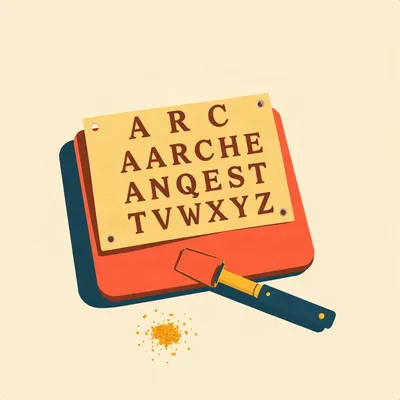
Daniel sent us this one — he's been doing a home inventory system, and it's sent him down a rabbit hole about marking tools. He noticed something odd. Walk into any well-stocked art supply store and you won't find enamel paint, which was the workhorse of hand-drawn signage for a century. The craft of sign painting, with its ruling pens and dedicated supply houses, has become a historical curiosity. So he's asking what that world looked like at its peak, whether any of those artisans still exist today, and whether their tools and materials have any practical use for functional industrial marking — the kind where it doesn't need to be beautiful, but it should look competent and last.

This is the kind of question where the material science is genuinely more interesting than the nostalgia. And I say that as someone who loves nostalgia.
The Venn diagram of "things Herman finds fascinating" and "paint chemistry" is basically a circle.
It's a very compelling circle. So let's frame the era we're talking about — roughly the 1880s through the 1990s. Before wide-format inkjet printers and vinyl cutters became cheap enough to dominate, every city of any size had dedicated sign shops. Not print shops that also did signs. Shops where someone stood at an easel or on scaffolding and painted lettering by hand, every single day. In 1920, there were something like fifteen thousand sign painting businesses in the United States alone. By the 1980s, there were still thousands. Today, the number of full-time traditional sign painters in the US is probably under three hundred.
Under three hundred. That's not a profession, that's a reenactment society.
That's the thing — it wasn't quaint. It was infrastructure. Every storefront, every delivery truck, every factory directory, every gold-leaf window on a bank. All of it was done by hand. The industry had its own trade journals, its own apprenticeship system, its own dedicated supply chain. Sign-paint supply stores weren't art stores — they were industrial suppliers that stocked enamel paint by the gallon, lettering quills made from squirrel hair, mahl sticks, gold leaf by the book, and a tool that most people today have never heard of — the ruling pen.
The ruling pen. Which we've touched on before, but it's worth understanding why it was the sign painter's go-to. Two spring-steel blades, a thumbscrew to adjust the gap, no internal reservoir. You dip it, you draw, you clean it with mineral spirits. It's basically the glockenspiel of precision marking — dead simple, impossible to improve, and completely sidelined by technology that's worse at the actual job.
Worse at the specific job, yes. And we'll get into why. But let's start with the paint itself, because the chemistry of enamel is what made the whole trade possible.
What made enamel different from everything else?
Enamel paint, as used in sign work, is an oil-modified alkyd resin system. What that means in practice is you've got a synthetic resin — the alkyd — that's been modified with a drying oil, usually linseed or soya. The pigment load is extremely high. We're talking forty to sixty percent solids by volume in a good lettering enamel. Compare that to a typical artist acrylic, which might be twenty to thirty percent solids. That high solids content is what gives enamel its hiding power — one coat coverage on dark surfaces — and its durability.
It's not just "oil-based paint." It's a specific formulation engineered for outdoor survival.
And this is one of the misconceptions worth addressing right up front. People hear "enamel" and think it's just any oil-based paint. But sign painter's enamel is formulated with self-leveling additives that let brush strokes flow out and disappear. It's got UV stabilizers — titanium dioxide for whites, carbon black for blacks, and various metal oxides for colors — that resist fading for decades. The curing process is two-stage: first the solvents evaporate, which takes a few hours, and then the alkyd resin oxidizes and cross-links over seven to fourteen days. At full cure, you've got a film that's flexible enough to expand and contract with the substrate, hard enough to resist abrasion, and chemically bonded to the surface.
A modern craft acrylic?
Water-based acrylic emulsion. Dries by water evaporation in minutes to hours. No cross-linking — the polymer particles just coalesce into a film. On a non-porous surface like metal or glass, that film is sitting on top, not bonded in. UV resistance is variable and generally lower. Put an acrylic-painted sign outdoors in direct sun and you'll see chalking and fading within a year. A properly applied enamel sign from 1923 is still legible on a brick wall in Chicago.
I've seen photos of those ghost signs — faded advertisements painted on the sides of buildings. They're a hundred years old and you can still read "Coca-Cola" or "Mail Pouch Tobacco." That's not just good design, that's materials engineering.
And those ghost signs survived because of a combination of factors. The enamel paint chemistry we just described, plus surface preparation that was rigorous. For wood signs, you'd start with an oil-based primer — historically lead-based, now alkyd — to seal the grain and create a bond coat. For metal, you'd either acid-etch or sandblast to create mechanical tooth for the paint to grip. For glass, the gold standard was reverse painting — you'd paint the design in reverse on the back of the glass, so the glass itself protects the paint from weather, and you view it from the front. That's why so many old storefront windows still have crisp gold lettering after eighty years.
Painting in reverse on glass. So you're doing the highlights first, then the mid-tones, then the background, and then you flip it around and hope you didn't forget anything.
It requires a completely different way of thinking about the image. And they did it routinely. This was not considered exotic — it was standard practice for any quality storefront job.
We've got the paint, we've got the surface prep. Let's talk about the ruling pen, because this is where the tool itself is almost perversely well-suited to the job.
The ruling pen is one of those tools that looks like it shouldn't work. Two pieces of spring steel, shaped into blades, held together by a thumbscrew. You turn the screw to adjust the gap between the blades — anywhere from about a tenth of a millimeter to two millimeters. You load it by dipping the tip into paint or ink, and capillary action holds the liquid between the blades. Then you draw. No internal feed mechanism, no cartridge, no nib with a slit. Just two blades and surface tension.
The advantage over a technical pen?
Technical pens — Rapidographs, Isographs, that family — have a hollow tube with a thin wire inside that regulates ink flow. They're precision instruments, but they're designed for thin drawing inks, not thick paints. Put enamel in a technical pen and it'll clog within minutes. The pigments are too large, the viscosity is too high, and once it dries inside that feed tube, the pen is essentially ruined. A ruling pen doesn't care. You can load it with enamel straight from the can, draw your line, and if it starts to dry, you wipe the blades with a rag dipped in mineral spirits and keep going. Cleaning takes thirty seconds.
It's the difference between a precision instrument that demands you use its approved fuel and a tool that'll run on whatever you've got.
The adjustability is the other thing. With a technical pen, if you want a different line width, you switch pens. With a ruling pen, you turn the thumbscrew. Need a hairline for fine detail? Tighten it down. Need a bold stroke for a headline? Open it up. Sign painters would often have two or three ruling pens loaded with different colors, adjusted to different widths, working simultaneously.
Why did this whole ecosystem vanish? If the tools and materials were so good, what happened?
The vinyl cutter happened. In the 1980s, computer-controlled vinyl cutting machines started becoming affordable for small sign shops. You'd design the lettering on a computer, the machine would cut it out of adhesive vinyl, and you'd weed out the excess and apply it to the substrate. It was faster, required less skill, and produced consistent results. Then wide-format inkjet printers got cheap in the 1990s, and you could print full-color signs directly. The economics just shifted. A hand-painted sign might take a skilled painter four hours and cost the equivalent of four hundred dollars in material and labor. A vinyl sign took thirty minutes and cost eighty dollars. Most customers chose the eighty dollar option.
The supply chain followed the demand. If the sign painters are retiring and nobody's replacing them, the stores that sold 1Shot enamel and squirrel-hair quills don't have enough customers.
The last dedicated sign-paint supply store in Manhattan, New York Central Art Supply, closed in 2016 after eighty years in business. These were institutions. They didn't just sell paint — they were hubs where sign painters would gather, trade techniques, and mentor apprentices. When the stores closed, the institutional knowledge started evaporating.
This is the bifurcation the prompt mentioned. Art stores now stock fine art supplies — acrylics, oils, watercolors — for people making paintings that hang on walls. Sign shops stock printers and vinyl. The middle ground, where you're making functional things that need to be durable and legible outdoors, just fell through the crack.
1Shot lettering enamel, which was introduced in the 1930s and became the industry standard, is still produced by Spraylat Corporation in Illinois. You can buy it today. But you won't find it at Blick or Michaels. You find it at auto-body supply stores, industrial paint distributors, and a handful of specialty online retailers. It's hidden in plain sight, but the retail channel that served sign painters specifically doesn't exist anymore.
A quart of 1Shot costs about forty dollars and covers roughly fifty square feet. For small runs, that's cheaper per sign than a digital print. But you have to know it exists and where to buy it.
That's the barrier. The knowledge of what to buy, how to use it, and where to get it — that used to be passed from master to apprentice. Now you have to piece it together from YouTube videos and old sign painting manuals on eBay.
Alright, but the prompt also asks whether any of these artisans still exist. Are there shops today doing hand-painted signs as an actual business?
A few dozen dedicated shops in the US. New Bohemia Signs in San Francisco, Colossal Media in Brooklyn — Colossal does hand-painted murals at enormous scale, the kind of building-side advertisements that used to be everywhere. There's a shop in Nashville called Handmade Sign Co., one in Austin called Stick 'Em Up. These aren't hobbyists — they're working businesses with waiting lists. They serve a specific market: heritage brands that want to maintain a consistent look, high-end retail where the perceived value of hand work justifies the cost, and film and TV production where period-accurate signage matters.
If you're Ralph Lauren and your flagship store needs signage that telegraphs "we care about craft," you're not getting a vinyl decal.
Ralph Lauren's flagship stores use hand-painted signage. Boutique coffee shops, craft breweries, barbershops — these are businesses where the sign is part of the brand identity, and a hand-painted sign communicates something a digital print can't. You pay five to ten times more — hand-painted signs typically run fifty to a hundred dollars per square foot, versus five to fifteen for digital vinyl — but you get something unique, durable, and aligned with the brand's values.
It's the same dynamic as mechanical watches. A quartz watch keeps better time and costs less, but people still buy mechanical watches because the craft itself is part of the value proposition.
And there's a practical dimension too. Hand-painted signs can go on surfaces that digital printers can't handle. Curved brick walls, irregular wood, textured metal. A vinyl decal on rough brick looks terrible and peels off within a year. A sign painter brushes enamel directly onto the brick, and the paint flows into the texture. It becomes part of the surface.
Which brings us to the part of the prompt I find most interesting — the functional marking question. He's not trying to make beautiful signs. He's labeling inventory bins. But he wants marks that last, on surfaces that are often oily, rough, or irregular. And he's been through the paint marker gauntlet and found them wanting.
This is where the old tools and materials are superior to the modern alternatives, and it's not even close. Let me give you a concrete comparison. You're marking a steel shelf in a workshop. You grab a Uni Paint marker — the PMA-eighty-five, which is one of the better oil-based paint markers on the market. The mark is legible. But the tip wears down on the rough steel, the paint doesn't bond chemically, and within a year or two outdoors, it's faded and flaking. Now you take a ruling pen loaded with 1Shot lettering enamel. You degrease the steel with acetone, draw your label, and let it cure. That mark will last five-plus years outdoors. The cost per mark is comparable — roughly two cents for the enamel versus three cents for the paint marker. But the enamel mark is bonded to the metal, not sitting on top.
Two cents versus three cents per mark, but one lasts five years and the other lasts one. That's not a close call, that's an order-of-magnitude difference in value.
The ruling pen never clogs. Paint markers clog constantly, especially if you're using them intermittently. The tip dries out, the valve sticks, you're shaking and pumping and pressing and hoping. A ruling pen? You dip it, you draw, you wipe it. It works the same whether you last used it yesterday or six months ago.
I'm picturing a small manufacturing shop. They've got hundreds of bins on steel shelving. They tried paint markers, the marks wore off, they tried label makers, the labels peeled. Then someone found an old ruling pen in a drawer, bought a quart of enamel from the auto-body supply store down the street, and suddenly their inventory system actually works.
That's not hypothetical. There's a small fabrication shop in Portland, Oregon, that does exactly this. They use ruling pens and enamel paint to label their parts bins because paint markers wore off in months. They buy their enamel from a local auto-body supply store — the only place in town that stocks it. They're not sign painters. They're not trying to make anything beautiful. They just need marks that stay put.
The learning curve? If I've never held a ruling pen in my life, how long before I can make a legible label?
About fifteen minutes. The basic technique is: adjust the gap to your desired line width, dip the pen so the paint loads between the blades — don't overload it — and draw with the pen held at a consistent angle, about forty-five degrees to the surface. The blades should both contact the surface evenly. If the line skips, you've got the angle wrong or you need more paint. If it blobs, you overloaded. You'll figure it out in a few test strokes on scrap material.
Fifteen minutes to basic competence. That's less time than I've spent trying to revive a clogged paint marker.
Once you've got the feel for it, you can do things no paint marker can do. Mix custom colors from a few base enamels for color-coded inventory systems. Adjust line width mid-stroke for emphasis. Write on curved or textured surfaces where a marker tip skips and stutters. The tool is more versatile because it's simpler.
Let's talk about where to actually get this stuff, because the prompt mentioned hitting a wall at art supply stores. If someone listening wants to try this, what do they do?
For enamel paint, skip the art store entirely. Go to an auto-body supply store or an industrial paint distributor. 1Shot is the gold standard for lettering enamel — you can order it online from specialty suppliers like Letterhead Sign Supply or Dick Blick's industrial division. Rust-Oleum Professional enamel is available at hardware stores and works adequately for functional marking, though the color range is limited and it doesn't self-level quite as well. For a ruling pen, eBay is your best bet — vintage ruling pens from the 1950s through 1970s are abundant and typically cost fifteen to thirty dollars. The old German-made ones from Haff and Richter are particularly good. If you want new, drafting supply stores still carry them — they're used by some cartographers and calligraphers.
Surface preparation — you mentioned degreasing with acetone.
For metal, clean with acetone or mineral spirits to remove oil and grease. If the surface is painted or coated, scuff it lightly with fine sandpaper to create mechanical tooth. For raw wood, use an alkyd primer first — the enamel will soak into bare wood unevenly without a primer coat. For plastic totes, clean and scuff, then test on an inconspicuous area because some plastics — polyethylene and polypropylene especially — are inherently low-surface-energy materials that nothing bonds to well without flame treatment or specialized primers.
The prompt mentioned that between understanding different paints, their properties, and surface preparation, there's quite a bit of meat to this discipline. It sounds like you're describing a body of knowledge that's not quite art and not quite industrial engineering — it's a craft that sits in between.
That's exactly what it is. And that's why it fell through the crack. The art world decided this wasn't art — it was commercial work. The commercial world decided it was too slow and expensive — digital printing was faster. So the knowledge became orphaned. Nobody teaches it in art school, and no trade school has a sign painting program anymore. It survives in a few apprenticeships, some online communities, and in the hands of the last generation of working sign painters who are mostly in their sixties and seventies now.
Which raises a question. Will this craft survive as a niche, or will it essentially disappear when the last of those practitioners retire?
I think it survives, but as something closer to a luxury craft than a trade. The same way custom furniture making survived IKEA. There will always be a market for hand-painted signs among businesses that can afford them and customers who value them. The question is whether the supply chain holds up. If 1Shot stops manufacturing lettering enamel because the volume drops too low, the whole ecosystem collapses. You can't make this stuff in your garage — it requires industrial chemistry.
That's the precarious thing about niche crafts. They don't just need practitioners, they need the material infrastructure underneath. If the last factory that makes squirrel-hair lettering quills shuts down, the sign painters adapt or disappear.
Squirrel-hair quills are actually still made — there's enough demand from fine art and restoration to sustain a few manufacturers. But you're right about the broader point. The enamel paint supply chain is the single point of failure. Right now it's stable, but it's one corporate decision away from vanishing.
Let's pull this back to the practical question. Someone listening has an inventory system to label. They've been frustrated by paint markers. They want to try the old methods. What's the shopping list and what's the process?
Shopping list: one ruling pen, fifteen to thirty dollars on eBay. One half-pint of 1Shot lettering enamel in your base color, about fifteen dollars — that'll last you years for labeling. A small can of mineral spirits for cleaning. Acetone or denatured alcohol for surface prep. Some lint-free rags. That's it. Total investment under fifty dollars. Process: clean the surface thoroughly. If it's bare metal, acetone wipe. If it's painted, scuff and clean. Load the ruling pen by dipping — the paint should fill about a third to half the gap between the blades. Test on scrap. Draw your label. Let it cure for twenty-four to forty-eight hours before heavy handling. If you need multiple colors for a color-coding system, buy a few primary colors of enamel and mix your own — the alkyd base means they blend predictably.
If you're labeling plastic totes?
The challenge with polyethylene and polypropylene is that nothing sticks well. Enamel will adhere better than water-based paint, but it's still not great. For those surfaces, you might be better off with an industrial adhesive label, or you can try flame-treating the surface — passing a propane torch quickly over the plastic to oxidize the surface layer and increase surface energy. That's getting into a level of fussiness that probably exceeds what most people want for home inventory. For metal shelving, wood bins, glass containers, and painted surfaces, enamel and a ruling pen will outperform any consumer paint marker.
The flame treatment detail is exactly the kind of thing that makes me think this whole domain is underappreciated. Most people don't know that polyethylene is inherently non-stick at a molecular level, and that you can change that with a propane torch. It sounds like alchemy, but it's just materials science.
And sign painters knew this stuff intuitively even if they didn't have the polymer chemistry vocabulary. They knew which surfaces needed primer, which needed etching, which paints would bond and which would peel. That knowledge was built up over decades of trial and error, and it's more sophisticated than most people realize.
To directly answer the prompt's question — do these old tools and materials have a role in functional industrial marking? The answer seems to be yes, and in some cases they're objectively better than the modern alternatives. Not because they're charming or authentic, but because the chemistry and mechanics are superior for the specific job.
The ruling pen loaded with enamel is the best tool for durable, precise marking on non-porous surfaces that I know of, short of industrial etching or stamping. It's not the fastest tool, and it's not the most convenient for one-off quick marks. But for a systematic labeling project where durability matters, it's hard to beat.
The broader point — which I think is really what this prompt is getting at — is that the craft of functional marking is a real discipline. It's not art, but it's also not just grabbing a Sharpie. There's a body of knowledge about materials, surface preparation, tool selection, and technique that used to be common knowledge in the sign trade and has now become obscure. Rediscovering it isn't nostalgia — it's practical problem-solving.
The Sharpie is the musical equivalent of beige wallpaper. It's fine for what it is, but as soon as you need something to last, you're in a different category of problem.
That different category is where the old sign painters lived. They weren't making art, mostly. They were making durable information. A sign that says "Hardware" over a store isn't a creative expression — it's wayfinding. But making it legible, durable, and competent-looking for thirty years outdoors required real skill and real materials science.
I want to circle back to something you said earlier about ghost signs. Those hundred-year-old advertisements on brick walls are the best argument for enamel paint that exists. They've survived a century of sun, rain, freeze-thaw cycles, and pollution. The brick around them has eroded more than the paint has. Modern acrylics would have been gone in five years. Vinyl would have peeled in two. The fact that we can still read them is a testament to the materials engineering that went into what looked like a simple can of paint.
The people who painted them were working on scaffolding, often in bad weather, with no room for error. You can't Ctrl-Z a brushstroke on a brick wall four stories up.
There's a famous sign painter's saying: "A good sign painter can letter faster than a bad one can erase." The point being that skill was about precision and speed together. These weren't artists laboring over a canvas for weeks — they were tradespeople who had to be fast to make a living, and the speed came from thousands of hours of practice.
Where does someone go to learn this today, assuming they want to go beyond functional labeling and actually develop the craft?
There are a few resources. The Letterheads, which started as a loose network of sign painters in the 1970s, still has an active online community and occasional in-person meetups. Mike Meyer, who runs a sign painting school in Mazeppa, Minnesota, teaches workshops and has excellent instructional videos. There are books — "Sign Painting" by E.Matthews from the 1940s is still in print and covers everything from brush selection to gold leaf application. And YouTube has a small but dedicated community of sign painters documenting their process.
Population four hundred and eighty-nine, give or take. And it's become a destination for people who want to learn a dying craft.
Mike Meyer has trained hundreds of sign painters from around the world. A lot of the current revival in hand-painted signage traces back to his workshops. He's one of the reasons the craft will probably survive.
Let's pull together the actionable takeaways, because this episode has covered a lot of ground and I want to make sure someone listening can actually use this information next week.
First, for durable outdoor or industrial marks, seek out enamel paint from auto-body or industrial supply stores. 1Shot lettering enamel is the gold standard. Rust-Oleum Professional is an adequate substitute. Avoid craft acrylics — they are not engineered for this job and will fail quickly.
Second, a ruling pen is a fifteen to thirty dollar investment that will outlast and outperform any paint marker for precise work on non-porous surfaces. It never clogs, it's infinitely adjustable, and it cleans in seconds. eBay is full of vintage ones that work perfectly.
Third, surface preparation is non-negotiable. Clean with acetone or mineral spirits. Prime porous surfaces like wood. Scuff glossy surfaces. Let enamel cure for at least twenty-four hours before handling, and ideally a full week for maximum hardness. Skipping prep is why most marking fails, regardless of the paint you use.
The meta-takeaway: the craft of functional marking is real, it's learnable, and the tools and materials are still available. They're just hiding in industrial supply catalogs instead of art stores. You don't need to be an artist. You need to understand what you're putting the mark on and what you're putting it on with.
The prompt mentioned that these marks don't need to be beautiful, but they should look nice. I'd add that when you use the right tools for the job, competence looks good. A clean enamel line drawn with a ruling pen has a crispness that a paint marker can't match. It's not artistry — it's the natural result of a tool that does its job well.
The aesthetic of "I used the correct materials and applied them properly." Which is its own kind of beauty.
Corn: The open question we're left with — will this craft survive? I think the answer is yes, but as something different than what it was. It won't be the default way signs are made. It'll be a premium option for businesses that value it, and a practical solution for people doing functional marking who've done their homework. The knowledge is out there. It's just not on the shelf at the craft store.
If you're doing an inventory system and want marks that last, you now know more than ninety-nine percent of the population about how to achieve that. The old sign painters would approve.
Now: Hilbert's daily fun fact.

In the early fifteen hundreds, European explorers in Tierra del Fuego encountered the Selk'nam people, who used a distinctive diamond-shaped body paint pattern called "k'ochi" — which is also the root of the word "kite" in geometry, because early surveyors saw the same quadrilateral shape in the Selk'nam designs and applied the name to the geometric figure.
...huh.
I'm going to need to fact-check that one.
I have questions about the etymology pipeline from Tierra del Fuego to European geometry.
This has been My Weird Prompts. Our producer is Hilbert Flumingtop. You can find every episode at myweirdprompts dot com. If you try the ruling pen and enamel approach for your own labeling project, we'd love to hear how it goes. We'll be back next week.