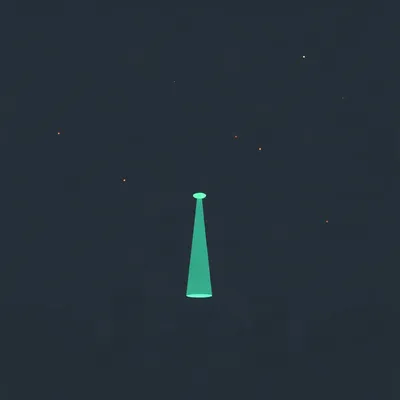
Daniel wrote in with a sky sighting over Jerusalem, and he's careful to say up front this is not a UFO story. He was looking out at the skyline, saw a green light zigzag across the sky, did the double take, and then it stopped and hovered. Pulsating green strobe. It stayed put, made slow movements, went back to hovering, and it never repeated that first jump. There was also a stationary amber strobe nearby, brighter, holding position. His best guess is a military drone, and his actual question is the interesting one: how does a person become an educated guesser of aerial objects? He knows the port and starboard basics, and he's already ruled out a private drone because of where he is, central Jerusalem, restricted airspace. He wondered about a helicopter but says that wouldn't explain the quick jump. He's got video if we want it, but he thinks the verbal description might be enough to get the detector work going.

He's right that the description is enough. The video would probably be worse. And the fact that he noticed the jump, then noticed that it didn't repeat, that's already the beginning of the method. Most people see a light and stop at "what is that." He saw a light, watched it, noted what changed and what didn't, and then started eliminating possibilities based on physics and where he was standing. That's the whole skill.
So what are we actually looking at when we look up? Because a sky full of lights at night is a mess of satellites, aircraft, drones, balloons, birds, and the occasional planet that someone swears is following them.
And the honest answer is that most of it is identifiable in the first ten seconds if you know what to check. The trick is that the cues are boring. Not dramatic. Light color, strobe pattern, movement, altitude, and operational context. Five things. Daniel hit four of them in his description without being coached.
Let's run his sighting through the five. Green light first. What does green mean in the air?
On a manned aircraft, green is the right wingtip light, starboard. Red is left, port. White is the tail. If you see a green light moving across the sky, you're looking at the right side of an aircraft moving roughly left to right, or the left side moving right to left, depending on whether you're seeing the nose or tail. But the key is that the wingtip lights are steady. They don't pulse. A pulsating green strobe is a different thing entirely.
Which is the first flag in Daniel's sighting. He said pulsating green strobe, not a steady green navigation light. So we're already outside standard manned aircraft configuration.
Correct. Anti-collision strobes on aircraft are white, and they flash at a specific rate. FAA standards put it at forty to one hundred flashes per minute. That's a range, but the point is it's regular, it's fast, and it's white. ICAO, the international body, has similar standards. A green strobe is not a standard anti-collision light on a commercial or private fixed-wing aircraft. It's not a helicopter nav light either. So the color alone tells you this is either a drone with its own lighting scheme, or something military with non-standard lights.
Or a drone with a green anti-collision strobe, which is increasingly common on the consumer and prosumer side. DJI and similar manufacturers put colored strobes on their units, and a lot of them pulse.
Right. And that's where Daniel's operational context does the work. Central Jerusalem is not a place where a private drone is legal. Israel has strict drone regulations, and the airspace around Jerusalem is heavily restricted. Government buildings, military installations, the Knesset, the Prime Minister's residence, all of that is a no-fly zone for civilian drones. A private person flying a drone in central Jerusalem at night is either doing it illegally or has an authorization that most people don't get.
So the private drone explanation fails on regulation before it fails on physics. Now the movement. This is the part I keep coming back to. He saw a green light zigzag across the sky, then stop and hover. Fixed-wing aircraft can't do that. Not at any speed. A Cessna can't stop mid-air and hold position.
Neither can a commercial jet, obviously. A helicopter can hover, and it can move laterally, but a quick jump followed by a stationary hover is not how helicopters move. A helicopter that changes position rapidly is either accelerating through the air, which means it's not hovering, or it's doing a maneuver that requires forward airspeed. The kind of jump Daniel described, a rapid short movement followed by an immediate stationary hover, is a multirotor drone signature. Quadcopters and hexacopters can do exactly that because they're controlling thrust on multiple axes simultaneously. They can dart, stop, and hold with no transition.
And the amber light. Steady amber, stationary, brighter than the green. What's that?
Amber is interesting because it's often a beacon or a strobe on larger aircraft, but those are usually on the fuselage or the tail. A stationary amber light near a hovering green light suggests either a second aircraft or a second light on the same platform. If it's a drone, some military and commercial drones have separate navigation beacons, one on each arm or on the body, and they can be different colors. The fact that the amber light stayed put while the green light moved suggests either two separate objects or a drone with a light on one part that's visible from Daniel's angle.
I'd lean toward two separate objects, or one object with the green light on a moving part. But the simpler explanation is that the amber light was a different aircraft entirely, maybe a helicopter hovering at a distance, and the green light was the drone. Jerusalem at night has military air activity. It's not unusual to see a helicopter holding position.
That's plausible. And it's the kind of thing the educated guesser method is designed to handle. You don't need certainty. You need a ranked list of possibilities and the ability to say which one is most likely given what you observed. Daniel's ranked list would probably be: military drone, authorized security drone, helicopter, private drone, something else. And the physics and the context push the first two to the top.
Let's talk about the method itself. Daniel asked how one becomes an educated guesser. What's the actual process?
I think of it like birdwatching. A birdwatcher doesn't see a bird and say "that's a bird." They see a bird and note the size, the shape, the color pattern, the flight style, the habitat, the time of year. Each of those is a field mark. The combination narrows the possibilities. Aerial object identification is the same. You're looking at field marks: light color, light position, strobe rate, movement pattern, altitude, sound, and context.
Sound is one Daniel didn't mention. He was at a distance, so he probably couldn't hear anything. But sound is a huge discriminator. A helicopter at close range is loud. A quadcopter has a distinctive buzz. A fixed-wing aircraft has an engine note. If you can hear it, you've already eliminated a lot.
And altitude is another one. Daniel said the light was at altitude. If it's high enough that a private drone wouldn't be visible or legal, that's a data point. But altitude is hard to judge at night. A light in the sky doesn't give you a reference point. You can use the skyline, buildings, known landmarks. Daniel had the Jerusalem skyline as a reference, which is helpful.
The strobe rate is the one most people don't know to check. Aircraft anti-collision strobes flash between forty and one hundred times per minute. That's a specific range. If you count the flashes, you can tell whether something is in the manned aircraft range or not. A drone's strobe is often slower, or it pulses rather than flashes. Pulsating is the word Daniel used, and it's a good one. A pulse is different from a flash. A flash is sharp, regular, like a camera. A pulse is a softer rise and fall.
And that's a real distinction. A drone's LED strobe often has a pulse pattern, a slow brightening and dimming. An aircraft strobe is a rapid on-off. If you watch for a few seconds, you can tell which you're seeing. Daniel said pulsating, and I think he was describing exactly that.
So the educated guesser's toolkit is: watch the light, note the color, count the flashes, observe the movement, listen, and know where you are. That last one is operational context, and it's the one people skip.
Operational context is the difference between a good guess and a lucky one. In Jerusalem, the context is specific. The Israeli military operates drones like the Hermes 450 and the Skylark. The Hermes 450 is a large surveillance drone, fixed-wing, with a long endurance. The Skylark is smaller, used for tactical surveillance. Both are common in Israeli airspace. A military drone over central Jerusalem at night is not an unusual event. It's the most likely explanation for what Daniel saw.
The Hermes 450 is a fixed-wing platform, though. It can't hover. The Skylark is also fixed-wing. So if Daniel's green light was hovering, it wasn't one of those. It would have to be a multirotor military drone, which the IDF does operate, or a security drone used by police or another agency.
That's a good correction. The IDF has multirotor drones for urban operations. They're used for surveillance, crowd monitoring, and security. A multirotor with a green strobe and an amber beacon, hovering over central Jerusalem, making short rapid movements, that's consistent with a security drone.
And the fact that it made one quick jump and then didn't repeat it is interesting. A drone operator might reposition the platform once, then hold it in place for observation. The jump was the repositioning. The hover was the mission.
That's a very plausible read. And it's the kind of inference the educated guesser makes. You're not just identifying the object, you're inferring the intent. A drone that jumps and then hovers is probably looking at something. A drone that wanders in a pattern is probably mapping or patrolling. A drone that moves in a straight line at speed is transiting.
Let's talk about what most coverage gets wrong. The misconception is that a green light means something exotic. A green light at night could be a drone, a helicopter with a green nav light, a bird with a reflection, or even a lens artifact. The color alone is almost meaningless. The pattern and the movement are what matter.
And the second misconception is that video footage is definitive. It's not. Most phone video of night sky objects is low resolution, noisy, and lacks scale. You can't tell size, distance, or speed. But the video can capture the light pattern and the movement trajectory, which is what Daniel said his video shows. That's the useful part. Not the pixels of the object, but the behavior of the light.
Daniel offered to post the video. He said it's not the greatest mystery footage, but it shows the position and the light. That's actually the best kind of footage for this purpose. You don't need to see the airframe. You need to see the light behavior.
And if he does post it, the thing to do is watch it at full speed, then slow it down, then count the flash rate. You can do that with a video player. Count the pulses over ten seconds, multiply by six, and you've got the flashes per minute. If it's between forty and one hundred, it's in the manned aircraft range. If it's slower, it's likely a drone.
That's a concrete, actionable tip. And it's the kind of thing that turns a casual observer into an educated guesser. You're not just watching the sky, you're measuring it.
There's also the psychology of it. Why do our brains jump to "unidentified" so fast? It's because a light in the sky is ambiguous, and ambiguity is uncomfortable. The brain wants a resolution. So it grabs the first dramatic explanation. And once it's grabbed it, confirmation bias kicks in. You start noticing everything that supports the dramatic explanation and ignoring everything that doesn't.
The fix is training. Birdwatchers train themselves to notice field marks before making an identification. Pilots train themselves to scan instruments and cross-check. An educated guesser in the sky is doing the same thing: slowing down the identification process, noting the cues, and then making a judgment.
And it's okay to be wrong. The point is the process, not the certainty. Daniel said his best guess is a military drone. He's probably right. But even if it was something else, the process he used to get there is sound. He noted the color, the pulse, the movement, the context, and he eliminated the impossible.
Let's zoom out to the bigger picture. Why does this matter beyond one man's sky sighting?
Because the sky is getting busier. Drones are proliferating. The FAA in the United States has registered over a million drones. Israel has a growing drone industry and a military that uses them extensively. As the sky fills up, the ability to read it becomes more valuable. Not just for curiosity, but for safety. If you see a drone near an airport, you should report it. If you see a drone over a restricted area, you should report it. Knowing what you're looking at is the first step.
And the reporting question is one Daniel didn't ask, but it's implied. If you see something and you want to share it, where do you go?
There are organizations that collect sighting reports. NUFORC, the National UFO Reporting Center, and MUFON, the Mutual UFO Network, are the big two in the United States. They accept reports from anywhere. But their analysis varies in rigor. Some of their investigators are excellent. Some are not. The reports are useful as data, but the conclusions are often speculative.
In Israel, the better move for a sighting in restricted airspace is to contact local authorities. If you see a drone over central Jerusalem at night, the police or the aviation authority would want to know. Not because it's a UFO, but because it might be an unauthorized drone flight.
And that's the practical side of the educated guesser. You're not just satisfying curiosity. You're contributing to airspace awareness. If enough people report accurately, the authorities get a picture of what's actually happening in the sky.
Let's talk about the future. As drones become more common, the light configurations will get more complex. Manufacturers are already experimenting with different lighting schemes. Some drones have programmable lights. Some have lights that change color based on status. The old rules, green for starboard, red for port, white for tail, will still apply to manned aircraft, but the drone world is a wild west of lighting.
That's a real challenge for the educated guesser. You can't just memorize a chart. You have to understand the principles: what lights are for, how they're positioned, how they behave. The principles will stay the same even as the specifics change.
And the skill is transferable. The educated guesser mindset, probabilistic reasoning, noting cues, eliminating impossibilities, accepting uncertainty, that's useful in any domain where you're trying to understand something from limited information.
It's the scientific method in miniature. Observe, hypothesize, test, revise. Daniel did it in real time, standing on a balcony in Jerusalem. That's the whole thing.
Now let's get into a specific part of the method that I think is underrated. The wind.
The wind.
If a light is drifting with the wind, it's probably a balloon or something unpowered. If it's holding position against the wind, it's powered. A drone has to work to hold position in wind. A balloon just goes where the air takes it. That's a discriminator you can use without any equipment.
It's not one I would have thought to mention. Wind direction at altitude can be different from wind at ground level, but if you can feel the wind on your face and the light is drifting in that direction, that's a strong signal.
Daniel said the amber light was stationary. If there was wind that night, and the amber light was holding position, that's powered. A balloon would have drifted.
Unless it was tethered. A tethered balloon would hold position. But a tethered balloon over central Jerusalem at night is a strange thing to see. It would also have a specific light configuration, usually a steady white light, not amber.
So the wind cue is another arrow in the quiver. And it's the kind of thing that only comes from experience. You have to be outside, watching, noticing how the air moves and how objects respond to it.
And that's the thing about becoming an educated guesser. It's not a course you take. It's a habit you build. You start noticing the sky the way you notice the street. You learn the patterns. You make mistakes and correct them. Over time, you get better.
I want to go back to something Daniel said. He said he's not alleging a UFO, and he's careful about that. There's a stigma around reporting lights in the sky. People don't want to sound like conspiracy theorists. But the reality is that most sightings have mundane explanations, and the ones that don't are usually military or classified activity, not aliens.
The stigma is real, and it's counterproductive. If people are afraid to report what they see, the data gets worse. The better framing is: you saw something you couldn't identify, you noted the details, you're trying to figure it out. That's not a conspiracy theory. That's observation.
And the military angle is important. Daniel's guess is a military drone. If that's true, he's not going to get a confirmation. Military drone operations are classified. The IDF doesn't publish a schedule of drone flights over Jerusalem. So an educated guesser has to accept that some sightings will never be confirmed.
That's the uncertainty part. You can narrow it down to military drone, but you can't know for sure. And that's okay. The process is the reward. Daniel's description was detailed enough to do real analysis. That's more than most people manage.
Let's talk about the video for a second. Daniel said he can post it. If he does, what should someone looking at it check?
First, the frame rate. Most phone video is thirty or sixty frames per second. A strobe that flashes faster than the frame rate will look like it's on continuously. That's a classic artifact. Second, the exposure. Night video is often overexposed, which makes lights look bigger and brighter than they are. Third, the movement. You can track the light's position frame by frame and see the trajectory. That's the useful part.
So the video is evidence, but it's evidence that needs interpretation.
And that's the misconception to bust. Video footage is not definitive proof of anything. It's a record of light patterns and movement. The interpretation is where the skill lives.
Daniel's verbal description might actually be more useful than the video, because he already did the interpretation. He noted the pulse, the jump, the hover, the amber light. That's the processed data. The video is the raw data.
Raw data is noisy. Processed data is information. Daniel turned his observation into information in real time. That's the educated guesser's instinct.
Let's say someone wants to start doing this. What's the first step?
Go outside at night and look up. Seriously. Spend ten minutes watching the sky. Try to identify everything you see. Satellites move in straight lines at a steady speed. Aircraft have flashing strobes and steady nav lights. Planets don't twinkle as much as stars. Drones hover and dart. After a few nights, you'll start to see the patterns.
Then start asking the questions. What color? How fast? What direction? Is it making sound? Is it holding position or drifting? The questions are the method.
There's also a community aspect. There are forums and groups where people discuss sightings. Some are full of conspiracy theorists, but some are serious. The serious ones are full of pilots, air traffic controllers, and aviation enthusiasts who can help you identify what you saw.
The birdwatching analogy again. Birdwatchers have field guides and communities. Sky watchers have the same, if you know where to look.
The field guide for the sky is mostly in your head. The rules of thumb: green is starboard, red is port, white is tail, strobes flash fast, drones pulse slow, fixed-wing can't hover, multirotors can dart. That's the core.
Let's apply all of this to Daniel's sighting one more time. Green pulsating strobe, rapid jump then hover, stationary amber light, central Jerusalem, night. What's the ranked list?
Top of the list: a military or security multirotor drone. The movement pattern is a perfect match. The context supports it. The lighting scheme is plausible. Second: an authorized civilian drone, maybe a contractor doing infrastructure inspection or security. Less likely given the location, but possible with permits. Third: a helicopter with unusual lighting, but the hover and jump pattern is wrong. Fourth: a private drone flying illegally. Possible but the operator would be taking a big risk in that airspace. Fifth: something unidentified.
And the amber light?
Probably a second drone, or a second light on the same platform, or a helicopter at a distance. The fact that it stayed stationary while the green light moved suggests it's either separate or on a different part of the same aircraft.
Daniel's guess of a military drone is well-supported. He did the work.
He did. And the fact that he's asking "how do I get better at this" instead of "what was it" shows he's already thinking like an educated guesser.
Before we wrap, I want to flag one thing about the reporting side. If Daniel or anyone else sees something like this in restricted airspace, the responsible move is to note the time, location, direction, and description, and pass it to the authorities. Not because it's a threat, but because unauthorized drone flights over sensitive areas are a real security concern.
The authorities in Israel take this seriously. There have been incidents of drones over sensitive sites, and the response is usually to investigate. A good sighting report with accurate details is valuable.
The skill has a civic dimension. You're not just satisfying curiosity. You're contributing to airspace safety.
That's a good note to end the main discussion on.

I've seen that green light before. Over the Negev. Nineties. I was working night security at a radar station down there, logging blips. Most of them were birds or weather balloons. You'd get a blip, you'd log it, you'd move on. One night I saw a green strobe out the window, just sitting there, then it jumped and hovered. I nearly filed it as a UFO. Turns out it was a Skylark test. Nobody told us. I spent half a shift convinced I'd seen something I shouldn't have.
The wind detail is the thing I keep coming back to. It's so simple, and it's not in any of the standard guides.
It's a discriminator that only comes from being outside and paying attention. A balloon drifts. A drone holds. If you know which way the wind is blowing, you can tell them apart without any other information.
Check the wind. If the light is drifting with the wind, it's probably a balloon or something unpowered. If it's holding position, it's working against the air. Drones have to fight the wind. Balloons don't. That's the whole trick.
It works at any altitude. If you can feel the wind on the ground, and the light is moving in that direction, that's a strong signal.
The other thing is, even the experts get it wrong without context. I was sitting in a radar station, trained to identify aircraft, and I nearly filed a drone test as a UFO because nobody told me there was a test. The equipment doesn't tell you everything. You need to know what's supposed to be up there.
That's the operational context point. Daniel had it. He knew he was in restricted airspace, so he knew a private drone was unlikely. That one piece of context did more work than any of the visual cues.
The military doesn't publish a schedule. So you're always guessing a little. You can narrow it down, but you can't confirm. That's just how it is.
The process is the reward, then.
I'd say so. I never got confirmation on half the blips I logged. You learn to live with the uncertainty. You note what you saw, you make your best guess, and you let it go.
The uncertainty tolerance is the hard part. People want a definitive answer. The educated guesser learns to be comfortable with a ranked list and a best guess.
It's like being a security guard. You see something, you assess it, you decide if it's a threat, and you act. Most of the time it's nothing. But you have to go through the process every time. You can't just shrug and walk away.
The process gets better with practice. The more you watch, the more you notice.
The green strobe on the Skylark, that's a specific thing. It pulses. Slower. If you've seen it once, you'll recognize it again.
That's the field guide in your head. You build it over time. Daniel's already started.
He should keep watching. The sky over Jerusalem is busier than people think.
The misconception to close on. People think a green light in the sky is exotic. It's not. Green is a standard navigation color. The exotic part is the pulse pattern and the movement. A steady green light on a moving aircraft is normal. A pulsating green light that hovers and darts is a drone. The color alone tells you almost nothing.
The video misconception. Footage is not proof. It's raw data. The interpretation is the skill. Daniel's verbal description was more useful than the video would be, because he'd already done the interpretation.
The open question. As the sky gets busier, as drones proliferate and light configurations get stranger, how do we keep our sky-reading skills sharp? I think the answer is that the principles stay the same. Color, pattern, movement, altitude, context. The specifics will change, but the method won't.
The broader point. The educated guesser is a model for navigating uncertainty in any domain. Observe, hypothesize, test, revise. Accept that you might not get a definitive answer. That's a useful skill in a world full of ambiguous information.
Daniel's sighting may never be confirmed. But the process of guessing was its own reward. He looked up, he noticed, he reasoned, and he learned. That's more than most people do.
Thanks to our producer Hilbert Flumingtop for keeping the show running.
This has been My Weird Prompts, the human-AI collaboration podcast.
If you've got a sighting or a question, email us at show at my weird prompts dot com.
We'll be back soon.