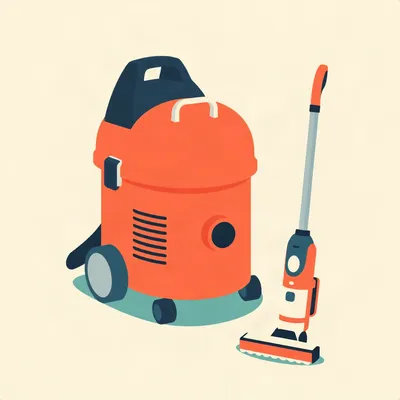
Daniel sent us this one — he's been on a bit of a kick lately trying to find industrial-grade versions of everyday household products, and this time it's vacuum cleaners. He's asking about the kind of commercial units you see in airports and hotel hallways, what sets them apart from the machine under your sink, what they actually cost, how long they last, and crucially, where a regular person can actually buy one. There's a whole parallel universe of vacuum engineering most of us never encounter, and the price overlap with high-end consumer models is genuinely surprising.

It really is. Most people's mental model of a vacuum purchase is you go to the big-box electronics store, you spend somewhere between a hundred and fifty and eight hundred dollars, and you expect to do that again in about four years. That's just the rhythm of the thing. But there's this completely separate market running alongside it where the machines are designed to run eight hours a day, every day, in an airport or a factory, and the entry-level units start around three to four hundred dollars. That's the same price as a mid-range Dyson stick vac, but you're getting something engineered to entirely different standards.
Which is the kind of math Daniel loves. The man can't walk past a consumer product without wondering if there's a commercial version that'll outlast him.
With vacuums, that instinct actually pays off. I want to be clear about what we mean by "industrial vacuum cleaner" here, because the term gets thrown around loosely. We're talking about a distinct class of machine. Typically a dry vacuum with a large tank — either metal or thick polyethylene — a powerful bypass motor, and a filtration system rated for continuous duty. These are the canister-style units you see cleaning crews pushing through hotel corridors, the ones with the big round bodies and the hose coming out the top. Not a shop vac from Home Depot, not a stick vac with "pro" in the name. A genuine industrial unit.
The defining difference from what most of us have at home isn't just that it's bigger. It's that the engineering philosophy is completely different. A consumer vacuum is built for maybe thirty to sixty minutes of use per week. An industrial unit is rated for eight-plus hours of daily operation, often with a two or three year continuous-duty warranty.
The motor is the core of this difference. Consumer vacuums almost universally use what's called a through-flow motor. The air that carries the dirt actually passes directly over the motor windings to cool them. That means every bit of dust, every particle of fine grit, every accidental damp clump — it all gets pulled across the motor. Over time, that abrasive stream wears down the windings and the bearings. It's also why picking up something slightly damp can kill a consumer vacuum. The moisture hits the motor and shorts it out.
Which is a design choice that, when you say it out loud, sounds completely insane.
It does, but it's cheap to manufacture and it lets them make the unit smaller and lighter. Now, an industrial vacuum uses a bypass motor. The cooling airflow is completely separate from the dirt path. A dedicated fan pulls clean air over the motor to cool it, while the dirty air goes through the impeller and straight into the bag or tank. The motor never sees the dirt. That single design decision means the motor lasts three to five times longer, and it won't die if you vacuum up something that's a little damp.
The motor has its own little clean-air bubble. That's the kind of thing that sounds obvious once you hear it, but most people have no idea their vacuum is force-feeding dirt through its own engine.
Then there's the filtration architecture. Industrial units use multi-stage filtration, and the bag is the first stage, not the last. You've got a large primary bag — twenty to thirty liters of capacity — made of thick paper or fabric. After that, a secondary foam filter catches anything that made it through. Then, optionally, a HEPA H thirteen or H fourteen final filter.
Compare that to a cyclonic bagless vacuum, where the whole pitch is "no bags." But what actually happens is the cyclonic separator does a decent job with larger particles, and then everything else ends up on a washable filter that you're supposed to rinse every few weeks. Which nobody does.
And the filter clogs, suction drops, and you're essentially vacuuming with a blocked airway. The industrial approach is basically the opposite — use a bag that's so big and so effective that the rest of the system barely has to work. Those industrial bags cost about fifty cents to a dollar each. Consumer bags, if you can even find them anymore, run two to four dollars and hold maybe one or two liters. An industrial bag holds twenty to thirty liters. You change it every few months instead of every few weeks.
There's a system that makes even that seem primitive. Nilfisk has something called the Longopac system. It's a continuous sleeve of bag material on a roll inside the canister. When it's full, you tie off the section, cut it, pull fresh material down from the roll, and keep going. No individual bags to buy, no wrestling with cardboard collars. Just a clean cut every couple of months.
It's one of those things where you see it and think, why doesn't every vacuum work this way? The answer is probably that it would cannibalize bag sales. But for a commercial cleaning crew that's filling multiple bags a day, it's a genuine productivity innovation.
The motor stays clean, the filters stay clean, and that leads to the other thing that's different — suction consistency. How do they actually measure this?
Industrial motors are rated in air watts, which is a measure of suction power that accounts for both airflow and pressure. A typical twelve hundred watt industrial motor delivers somewhere between three hundred and four hundred air watts sustained. Now, a high-end consumer cyclonic vacuum might peak higher than that — Dyson loves to publish peak numbers. But here's the thing. As the bin fills and the filters start to clog, cyclonic suction drops off sharply. You might start with four hundred air watts and be down to two hundred by the time the bin is half full. An industrial vacuum with a bypass motor and a big bag will maintain over ninety percent of its initial suction right up until the bag is completely full.
The consumer machine has a better spec on paper, for the first thirty seconds of a clean, and then the industrial unit just hums along at the same level for months.
And that's the difference between peak performance and sustained performance. It's the same distinction you see in a lot of engineering domains. A sports car might have a higher top speed than a tractor, but the tractor pulls the same load all day without overheating.
Alright, so the engineering is clearly different. But where does that leave you, the listener, who just wants to clean your house? Let's talk about actually buying one of these things, because this is where Daniel's question gets really practical. What do these cost, and where do you find them?
The price overlap with consumer models is what makes this whole conversation worth having. Let me give you some specific examples. Numatic — that's the British company that makes the Henry vacuum, the one with the smiling red face — their consumer Henry is already kind of a crossover product. It's a commercial-grade machine sold to consumers. It costs about two to three hundred dollars, has a ten-year tank warranty, and uses a bypass motor. It's the gateway drug to the industrial world.
The Henry is the one you see in basically every British school and office building. It's not pretending to be sleek. It's a bucket with a face and a hose, and it'll outlive your grandchildren.
Henry's big brother is where it gets interesting. The Numatic George is a wet and dry industrial unit built on the same chassis. It adds a bypass motor rated for continuous duty and a pump system for wet pickup. It costs about a hundred dollars more than the consumer Henry. You're getting genuine industrial engineering for around four hundred dollars.
What about the German side of this world? Kärcher is the name most people recognize.
Kärcher is fascinating because they sell to both markets. Most people know them for pressure washers and the yellow consumer-grade wet-dry vacs you see at hardware stores. But Kärcher Professional is a completely separate division. The T fifteen one is their entry-level industrial dry vacuum. It costs around five hundred dollars. It has a bypass motor, multi-stage filtration, a thick polyethylene tank, and a three-year commercial warranty. Compare that to the Kärcher WD six, which is their consumer wet-dry vac at around two hundred and fifty dollars. The WD six has a one-year home warranty and a through-flow motor. Same brand, completely different engineering philosophy, and the price difference is about two hundred and fifty dollars.
That warranty difference alone tells you everything. A company that puts a three-year commercial warranty on a machine is saying they expect it to run for thousands of hours in a hotel or a factory. Put that same machine in someone's house, where it runs for maybe an hour a week, and it'll last a decade and a half.
That's exactly the math. A well-maintained industrial vacuum in a home environment should last ten to fifteen years. In commercial use, where it's running eight hours a day, five to seven years is typical before you need to replace the motor brushes or do any major service. Consumer vacuums average three to five years, and that's with light home use. The motors aren't designed to be serviced. When they die, you throw the whole thing away.
Let's do the total cost of ownership, because this is the part that makes the case. A six hundred dollar industrial vacuum with a twelve-year life works out to fifty dollars a year. A three hundred dollar consumer vacuum replaced every three years works out to a hundred dollars a year, and you're sending a whole plastic machine to the landfill every time.
That's before bags and filters. Let's do the full comparison. Kärcher T fifteen one at five hundred dollars, plus twelve years of industrial bags at about ten dollars a year — that's a hundred and twenty dollars — brings you to six hundred and twenty dollars total over twelve years. A Dyson V fifteen Detect at seven hundred and fifty dollars, replaced every four years over that same twelve-year period, is two thousand two hundred and fifty dollars just for the machines. Add filters and you're easily past three thousand dollars. The industrial unit is literally a fifth of the cost over a decade.
The Dyson numbers assume the replacement units cost the same, which they won't, because inflation exists. Meanwhile the industrial unit just keeps running.
There's a real-world example I came across. A hotel chain using Nilfisk VP three hundreds across their properties reported an average seven-year service life, with the only maintenance being motor brush replacements at year four. Motor brushes are a fifteen dollar part and take about ten minutes to swap. That's it. Seven years of daily commercial use, and the fix is a fifteen dollar part.
Which brings up another point. These things are designed to be repaired. The motors are accessible, the parts are available, and the service manuals actually exist. Consumer vacuums are increasingly glued together with proprietary fasteners and no available spare parts.
Right to repair in a nutshell. But even with all these advantages, there are real tradeoffs, and we should be honest about them. Industrial vacuums are heavier. We're talking fifteen to thirty pounds for a canister unit versus eight to twelve pounds for a consumer stick vac. They're louder — sixty-five to seventy-five decibels versus sixty to sixty-five. They're less maneuverable. They don't have pet hair modes or self-cleaning brush rolls or laser dust detection or any of the feature-list items that consumer brands compete on.
The laser dust detection thing is funny to me. It's a little green light that shows you dirt on the floor. The industrial solution is a vacuum that actually picks up the dirt so you don't need a laser to confirm it's still there.
That's the philosophical divide. Consumer vacuums compete on features because they can't compete on longevity — planned obsolescence is built into the business model. Industrial vacuums compete on durability and serviceability because their customers — hotels, airports, factories — will fire them if the machines keep breaking. The incentives are completely different.
What are you actually giving up if you go industrial for your home? Weight, noise, and the lack of a motorized brush roll for carpets, mostly. You'd want a separate carpet head, or you'd pair the canister with a powered floor nozzle if you have wall-to-wall carpet.
Most industrial canisters are designed for hard floors and low-pile commercial carpet. If you've got deep-pile carpet throughout your house, an industrial canister with a turbo brush attachment will work, but it's not going to have the powered brush roll agitation that a consumer upright provides. That's a genuine tradeoff. For homes that are mostly hard floors with some area rugs, it's a non-issue.
Alright, let's talk brands and where to actually buy these things, because walking into Best Buy won't work.
The key manufacturers, and these are the names Daniel should be looking for. Kärcher, out of Germany, has a massive range from four hundred dollar portable units all the way up to fifteen thousand dollar central vacuum systems. Their T series is the entry point — T fifteen one, T twelve one, going up from there. Nilfisk, out of Denmark, is known for the Advance line and that Longopac bag system we mentioned. Their VP series is the core commercial range, and they offer three-year warranties on the motors. Numatic, from the UK, is the Henry and NEW brand, but their commercial line — the NSSD and NVQ series — is a completely different beast from the consumer Henry. And then there's Pullman Ermator out of Sweden, which specializes in HEPA-rated vacuums for construction and asbestos abatement. That's probably overkill for a home, but it tells you the ceiling of what's available.
Where do you actually buy one? Because these companies don't stock the shelves at Target.
You go through industrial suppliers and cleaning supply wholesalers. Kärcher has a dealer network for their Professional division — you can find local distributors through their website. Nilfisk sells direct through their e-shop and through authorized distributors. Numatic has a similar dealer network. In Israel, where Daniel is, he'd want to look for industrial equipment suppliers or cleaning supply wholesalers. These places typically sell to businesses, but most of them will happily sell to an individual walking in off the street. Online, you can use Amazon Business, or specialty sites that cater to the commercial cleaning industry. The key is to look at the brand's Professional or Commercial website, not their consumer homepage. The product lines are completely separate.
The buying experience is different too. You're not comparing feature checklists and reading Wirecutter reviews. You're looking at spec sheets that list air watts, tank capacity, filtration ratings, and warranty terms. It's closer to buying a tool than an appliance.
Which is exactly what a vacuum cleaner is. It's a tool. The consumer market has convinced us it's a lifestyle product, with colorways and docking stations and companion apps. An industrial vacuum is a motor, a tank, a hose, and a filter. That's it. Nobody's trying to make it exciting. They're trying to make it indestructible.
There's something almost refreshing about that. No app, no firmware updates, no "smart" features that stop working when the company discontinues the server. Just a switch and a motor.
The switch is probably rated for a million cycles. That's the thing about industrial design — every component is chosen for duty cycle, not for cost optimization. The power switch on a Kärcher T series is the same switch they use in their factory-floor equipment. It's not going to fail because you turned it on and off too many times.
Let's get concrete. If someone listening to this is in the market for a vacuum, what should they actually do?
First, skip the consumer aisle entirely. Don't even walk down it. Look at the Kärcher T series, the Nilfisk VP series, or the Numatic commercial line. Expect to pay between four hundred and eight hundred dollars for a unit that will outlast three consumer machines. Second, check for local industrial cleaning supply distributors. These places exist in every major city and most of them sell to the public. You can often demo units in the showroom, which is something you can't do with a Dyson at Best Buy.
What are the non-negotiables in terms of features?
Prioritize three things. A bypass motor — that's the single biggest determinant of longevity. A metal or thick polyethylene tank — not thin ABS plastic that'll crack if you knock it against a doorframe. And a bag system rather than cyclonic. I know bagless has been marketed as the future for twenty years, but in industrial settings, bagged systems are preferred for consistent suction, hygiene, and lower filter maintenance. The Longopac continuous bag system from Nilfisk is a game-changer for convenience. If you can find a unit with that, get it.
The mindset shift is probably the hardest part. We've been trained to think of a vacuum as something you replace every few years, like a phone. The idea of buying one vacuum and using it for fifteen years feels almost transgressive.
It does, and that's entirely by design. The consumer appliance industry has spent decades normalizing planned obsolescence. They want you on a replacement cycle. But the math doesn't lie. A six hundred dollar industrial vacuum over twelve years costs you fifty dollars a year. A three hundred dollar consumer vacuum replaced every three years costs you a hundred dollars a year, and you're generating four times the plastic waste. The environmental argument alone is compelling, even before you get to the better cleaning performance.
The waste stream from consumer vacuums is particularly nasty. You've got mixed materials, lithium batteries in the stick vacs, electronics, all glued together in a way that makes recycling nearly impossible. An industrial canister is mostly metal and thick polyethylene, both of which are actually recyclable at end of life.
There's an open question here that I keep coming back to. Will the consumer market ever shift toward repairability and longevity, or will planned obsolescence continue to dominate? The right-to-repair movement is gaining real traction — the EU has been particularly aggressive on this — but appliance manufacturers are fighting it hard. They argue that sealed units are more efficient and safer, which is true in some edge cases, but mostly it's about protecting the replacement cycle.
The EU's e-waste regulations are getting tighter though. We're seeing minimum repairability requirements and mandatory spare parts availability for certain appliance categories. Consumer vacuums might eventually be forced to meet durability standards that industrial vacs already exceed. At which point the line between the two categories starts to blur.
Which would be a good thing for everyone except the manufacturers who've built their business model on disposability. In the meantime, the industrial pipeline is sitting right there, available to anyone who knows to look for it. You just have to be willing to buy a vacuum that looks like it belongs in a janitor's closet.
Which, honestly, is a feature. Nobody's going to steal your Numatic George. It's the anti-theft vacuum. Burglars will walk right past it.
It's not exactly photogenic. Although I will say, the Henry has a certain charm. The face helps.
Take the face off and it's just a red bucket with a hose. But put a smile on it and suddenly it's beloved by an entire nation.
Britain's most trusted appliance. There's probably a lesson there about branding that we don't have time to unpack.
Before we wrap, let me crystallize the takeaways here, because this episode is unusually actionable. If your vacuum dies, don't replace it with the same thing. Go find an industrial dealer. Look for a bypass motor, a thick tank, and a bag system. Expect to spend four to eight hundred dollars. That machine will clean better, last longer, and cost you far less per year than anything in the consumer aisle. The upfront price is higher, but the math over a decade is not even close.
The specific models to start your search with: Kärcher T fifteen one at around five hundred dollars, Nilfisk VP three hundred at around six to seven hundred, or the Numatic George at around four hundred. Any of those will run circles around a consumer vacuum in terms of longevity, and they'll maintain consistent suction in a way that bagless cyclonic machines simply cannot.
Next time your vacuum dies, don't replace it. Go see what five hundred dollars buys you in a different world.
And now: Hilbert's daily fun fact.

In the eighteen sixties, a prospector crossing the Simpson Desert in Australia reportedly carried a didgeridoo modified with a beeswax mouthpiece containing powdered ochre, believing the pigment's iron oxide content would ward off evil spirits when heated by breath during play.
I have so many questions about the beeswax.
This has been My Weird Prompts. Our producer is Hilbert Flumingtop. If you enjoyed this episode, tell someone who's about to buy a Dyson that there's a better way. Find us at my weird prompts dot com.
We'll be back next week.