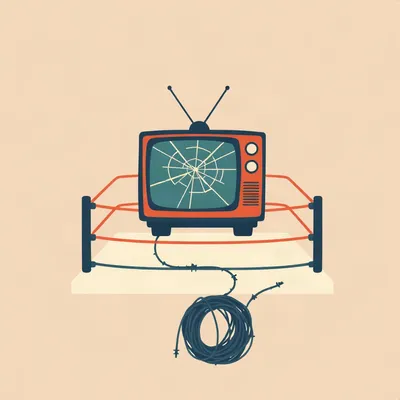
A show where ten comedians sit in a room for six hours and the first one who laughs gets eliminated. A wrestling match where the ring is wired with explosives and the only way to win is to not be standing on it when it goes off. A game show where a hundred and forty people try to storm a castle and almost none of them make it. All three from the same country, all three taken completely seriously.
Daniel wrote in with a whole thing about this. He and I were talking earlier about the most absurd reality shows ever made, and a couple of Japanese entries came up. We've also covered Takeshi's Castle before. But he pointed out that other Japanese formats have crossed over too, including the disturbing world of deathmatch wrestling. His question is what unites the Japanese variants across all these categories. His theory is that it might be an expression of the Japanese commitment to excellence in whatever field they attempt. Some of it's disturbing, some of it's hilarious, some of it's just plain weird. But for someone just discovering this stuff, what series are readily available, subtitled into English, and will have viewers questioning what they're watching? He wants us to focus on newer shows from the past few years, though he's fine with exceptions for anything truly spectacularly odd that's older.

The thing about Daniel's framing is that he's already named the mechanism without quite landing on it. It's not just commitment to excellence. It's commitment to premise. A Japanese producer will take a format and follow it to the end of its logic, no matter where that end is.
So what exactly unites a show where comedians can't laugh and a wrestling match where the ring explodes?
Total sincerity. That's the whole thing. Western shows wink at the audience constantly. There's always a host raising an eyebrow, a confessional where someone says can you believe we're doing this. Japanese formats don't do that. The producers never step outside the frame to say isn't this silly. They commit so completely that the absurdity stops being absurd and becomes something else entirely.
It becomes a sport.
It becomes a sport, or a ritual, or an endurance test. And that's what makes it transcendent instead of just weird. Weird for weirdness sake is what happens when you don't commit. Japanese weird TV is ruthlessly structured. Every absurd premise has rules, and the rules are enforced without mercy.
I remember watching Takeshi's Castle as a kid and thinking the obstacle course was the joke. It took me years to realize the joke was that everyone involved treated it like an Olympic event.
Right. And the Craig Charles dub we got in the UK added a layer of ironic commentary that the original never had. The original is funnier in a different way, because nobody's telling you to laugh. You're just watching a hundred and forty people attempt to cross a wobbly bridge while a man in a costume shoots them with a water cannon.
Daniel's question has a practical angle too, though. He wants actual recommendations. What should someone watch tonight?
We'll get there. But I want to start with the purest expression of this principle, because once you understand how it works, every other recommendation makes sense.
Documental.
Documental. Created by Matsumoto Hitoshi, half of the comedy duo Downtown. He's one of the most respected comedians in Japan, which matters because it means the show has real credibility within the industry. Ten professional comedians are locked in a room. They have six hours. The goal is to make each other laugh. If you laugh, you're eliminated. Last one standing wins ten million yen.
Which is about sixty-seven thousand dollars.
About that, yes. And here's the part that makes it work. These are professionals. They know every comedy technique in the book. They've spent their entire careers learning how to make people laugh, and now they're sitting in a room with nine other people who are doing everything in their power not to laugh. The tension is extraordinary.
It's the opposite of a comedy show.
It's a comedy show where the audience is the enemy. Normally a comedian performs and the audience's job is to laugh. Here the audience's job is to resist. And the performers know exactly which buttons to push because they know each other. They've worked together for years. They know each other's insecurities, their weak spots, the things that make them crack.
So it becomes psychological warfare.
It becomes psychological warfare almost immediately. Season one has this infamous moment where one contestant does a routine involving, and I'll be delicate here, a bodily fluid. And another contestant just breaks. He can't hold it. And the look on his face when he realizes he's out, after hours of holding on, is devastating.
The stakes are real because the money is real and the professional pride is real.
And the format escalates as seasons go on. By the later seasons, contestants are crying. They get physically aggressive. There's a moment in one season where a contestant is so desperate to make someone laugh that he destroys the room. The laughter threshold becomes this meditation on what comedy actually is when the audience refuses to participate.
What did you call it earlier? The purest expression of the thesis.
Total commitment to an absurd premise. Ten people locked in a room, forbidden from laughing, for hours. That's the entire show. No eliminations by vote, no audience participation, no confessionals. Just the room and the rules.
And Amazon adapted it for the West.
Last One Laughing. The franchise has run in the UK, Australia, Canada, multiple other countries. The New York Times covered it when it expanded. And every single adaptation softens the format. Shorter durations, less cruelty, more editing. The Western versions add redemption arcs. They want you to feel good about the winner. The Japanese original doesn't care how you feel about the winner. It cares that the winner didn't laugh for six hours.
The redemption arc thing is interesting. Western TV needs the audience to feel okay about what they just watched.
Japanese TV doesn't ask for that. The format is the format. If the format requires a man to sit naked in a room for fifteen months, then that's what happens.
That's Denpa Shōnen. Nasubi.
Nineteen ninety-eight. A comedian named Tomoaki Hamatsu, stage name Nasubi, was left naked in an apartment with no food, no clothes, no contact with the outside world. His only way to survive was to win prizes from magazine sweepstakes. He had to fill out contest entries, and whatever he won, he lived on. The segment ran for fifteen months. It was broadcast weekly to millions of people.
And he didn't know it was being broadcast.
He did not. He thought he was filming a segment that might air later. He had no idea he was the most famous person in Japan. The producers kept him in that room while the show became a national phenomenon. When he finally got out, he had no idea what had happened.
That's the ancestor of this whole tradition. The DNA is there.
And it's the disturbing edge Daniel mentioned. This isn't all fun and games. Some of it is grim. But the same commitment that makes Documental transcendent made Nasubi exist. The producers followed the premise to its conclusion.
So let's talk about the physical counterpart. Deathmatch wrestling.
Frontier Martial-Arts Wrestling, FMW, pioneered this in the early nineties. Atsushi Onita was the driving force. Barbed wire ropes, exploding rings, light tubes. Big Japan Pro Wrestling, BJW, continues the tradition today. And here's where the cultural difference really shows. Western deathmatch wrestling, the CZW stuff, treats violence as spectacle. It's nihilism. It's shock for shock's sake. Japanese deathmatch treats it as sport.
What's the actual difference in the ring?
The respect rituals. After a Japanese deathmatch, the competitors bow to each other. They acknowledge what they just went through together. The framing is athletic. These are two men testing themselves against each other and against the environment. The violence is real, but the meaning is different. It's not about degradation. It's about endurance and courage.
The same shokunin spirit applied to light tubes and razor wire.
The craftsman's commitment. Once you've decided to do a deathmatch, you do it properly. You don't half-do it. You don't wink at the camera and say isn't this crazy. You commit to the match as if it were the most important athletic contest of your life.
There was a Big Japan exploding ring deathmatch in two thousand five that people still talk about.
The moment the format became art, some people say. The ring was wired with explosives. The match built to this crescendo where both men were in the ring when it went off. And the aftermath, the respect shown between the two competitors, is what elevated it. It wasn't just violence. It was a shared ordeal.
So if Documental is the purest example of the comedy version, deathmatch wrestling is the physical version. And Takeshi's Castle is the game show version.
Takeshi's Castle ran from nineteen eighty-six to nineteen ninety. Up to a hundred and forty contestants storming a castle defended by Takeshi Kitano and his forces. The obstacles were designed to be nearly impossible. The humor came from watching people try anyway, with full commitment.
What is a game when winning is impossible?
That's the question Takeshi's Castle asked. And the answer is that it becomes something else. A test of character. A spectacle of human determination. A comedy about the gap between effort and outcome.
So let's test Daniel's thesis. Is this shokunin spirit or something darker?
I think it's both. The commitment is real. Japanese producers don't half-do anything, including absurdity. But there's also something about the Japanese entertainment industry specifically. The variety show tradition, the owarai comedy scene, the dohyo of professional wrestling. These are all spaces where extreme dedication is expected as a baseline.
The disturbing edge is part of the package. Nasubi wasn't an accident. The producers knew what they were doing.
And the audience knew too. Fifteen million people watched Nasubi every week. The show was a hit. That's the part that makes Western observers uncomfortable. It's not that the producers were evil. It's that the entire society looked at this and said, yes, this is entertainment.
I think Western TV pulls its punches because it's afraid of that discomfort. It wants to be edgy but not actually cross the line.
And the line keeps moving. Western reality TV has gotten crueler over the years, but it always keeps a safety net. There's always a host telling you it's okay to laugh. There's always a redemption arc. Japanese formats don't have the safety net.
So what should Daniel actually watch?
Documental is the first answer. It's on Amazon Prime with English subtitles. All seasons. Start with season one and watch the format establish itself. The escalation across seasons is part of the experience.
And if he wants the gateway version first?
Last One Laughing. The Western franchise is a softer entry point. You get the mechanics of the format without the full intensity. Then you go back to the original and realize what you were missing.
What about the wrestling side?
Big Japan Pro Wrestling has a streaming service with English commentary on the deathmatch archives. That's the easiest way in. The older FMW stuff is harder to find legally, but clips are all over YouTube. If you want to see the exploding ring match, it's out there.
And the newer stuff Daniel asked about?
Documental is still running. Season ten dropped in twenty twenty-three, and the format keeps escalating. There's a moment in that season where a contestant breaks so badly he quit comedy afterward. That's the level we're talking about.
He quit comedy.
He quit comedy. The show broke him. And the show kept going.
There's also The Chair. Korean origin format that Japan adopted and intensified.
Right. The Chair is a psychological endurance format. Contestants sit in a chair and have to endure various provocations without reacting. The Japanese version pushed it further than the Korean original. It's newer, it's subtitled, and it's exactly the kind of thing Daniel's asking about.
The YouTube ecosystem is worth mentioning too. Fan-subtitled clips of Japanese variety shows are everywhere now. The barrier to entry has collapsed.
And that's the twenty twenty-four to twenty twenty-six wave. Streaming has made the originals accessible in a way they never were before. You don't need to import DVDs or hunt for bootlegs. You can watch Documental on Prime, BJW on their streaming service, and a thousand fan-subbed clips on YouTube.
What does this mean for how we understand Japanese TV?
I think it means Japanese TV is doing something Western TV refuses to do. It's taking the premise of entertainment seriously. Not the production values, not the marketing, but the premise itself. What would actually happen if you locked ten comedians in a room and told them not to laugh? What would actually happen if you wired a wrestling ring with explosives? Western TV asks those questions and then immediately backs away from the answer. Japanese TV stays in the room.
The weirdness is a byproduct of commitment, not the goal.
That's the misconception to bust. People think Japanese game shows are weird for weirdness sake. They're not. They're weird because someone asked a question and then refused to flinch from the answer.
And the Western adaptations that soften everything prove the point. Last One Laughing is fine. It's a decent show. But it's not Documental. It's Documental with the nerve removed.
The nerve is the whole thing. Without it, you just have a comedy panel show with a gimmick.
So Daniel's recommendation list, in order. Documental on Prime. Last One Laughing as the gateway. Big Japan Pro Wrestling's streaming service for the deathmatch side. The Chair for the newer psychological format. And YouTube for the fan-subbed variety clips.
And if he wants the truly spectacular oddity that doesn't fit the recency criterion, Takeshi's Castle is the foundational text. The Amazon Prime revival is fine, but the original episodes are the real thing.
The revival is interesting actually. Amazon brought it back and it didn't quite capture the magic.
Because the original was a product of its moment. Nineteen eighty-six. The bubble economy. A hundred and forty people storming a castle because that's what the format demanded. The revival is self-aware in a way the original never was.
Self-awareness is the enemy of this stuff.
It really is. The moment a format becomes self-aware, it stops being transcendent and starts being a parody of itself. The Japanese originals, the good ones, never reach that point. They stay sincere all the way through.
You know what I keep thinking about? The contestant who quit comedy after Documental season ten. What did the show do to him?
From what I've read, it wasn't any single moment. It was the cumulative effect. Hours in that room, the pressure of the format, the realization that his peers were willing to go to places he couldn't follow. He walked away from the industry.
And the show just kept going. Next season, new contestants, same room.
That's the format. The format doesn't care about the contestants. The format is the format.
That's the thing Western TV can't replicate. It cares too much about the contestants. It wants you to like them, root for them, feel good when they win. Japanese TV doesn't care if you like anyone. It cares that the format was executed properly.
And that's why the post-match respect rituals in Japanese deathmatch wrestling matter so much. They're not for the audience. They're for the competitors. They're an acknowledgment that both men committed to the format and survived it.
Western deathmatch doesn't have that. It's just violence.
Western deathmatch is nihilistic. It's about degradation. The Japanese version is about transcendence through ordeal. Same violence, completely different meaning.
Daniel's going to watch the exploding ring match and have questions.
He should watch it. It's remarkable. The build, the explosion, the aftermath. It's not just a wrestling match. It's a piece of performance art.
Performance art is probably the right frame for all of this. Documental is performance art about comedy. Takeshi's Castle is performance art about failure. Deathmatch wrestling is performance art about survival.
And Nasubi is performance art about isolation. The darkest version of the form.
The fact that it was broadcast weekly to millions of people and the man at the center of it had no idea. That's the part that stays with me.
He thought he was alone. He was the most watched person in Japan.
There's a documentary about him now. He's talked about the aftermath, the difficulty adjusting.
The segment ended in nineteen ninety-nine. He went from total isolation to total fame in a single day. The psychological whiplash must have been extraordinary.
And yet the format continued. Other shows picked up the DNA and ran with it.
Because the format works. That's the uncomfortable truth. These shows are compelling. You can't look away. The commitment pulls you in even when you're horrified.
So what is it really about? Is this a cultural outlier or a glimpse of what TV could be everywhere?
I think it's both. Japan has a specific entertainment culture that enables this. The variety show tradition, the owarai comedy scene, the professional wrestling ecosystem. These are all spaces where extreme dedication is the baseline. But the underlying principle, follow the premise to its conclusion, could be applied anywhere. Western TV just chooses not to.
Because Western TV is afraid of the answer.
Because Western TV is afraid of the answer. It asks the question and then flinches.
We should talk about what makes a good contestant in these formats. Because it's not just the producers who commit. The contestants do too.
The contestants are the format. A Documental contestant who doesn't commit ruins the show. A deathmatch wrestler who doesn't commit gets hurt. The commitment has to be total on both sides of the camera.
The excellence is in the performance of absurdity.
It's the contestants.
Say that again.
The commitment to excellence. It's the contestants, not the producers. I worked on a pilot in two thousand three. American adaptation of a Japanese game show called Tore. Obstacle course format. Never made it past pilot. The network executives kept asking where's the prize money. They couldn't understand that the Japanese version didn't need prize money. The appeal was the pure humiliation. But the real problem was the contestants. Our American contestants kept asking what do I win. The Japanese contestants on the original show treated the obstacles like Olympic athletes. They didn't care about the prize. They cared about not failing.
So the format was the same but the people were different.
We had one guy. Retired firefighter. Took the whole thing so seriously. There was a giant foam hammer challenge. You had to cross a beam while this hammer swung at you. He fell off. And he cried. Grown man, retired firefighter, crying because he failed a foam hammer challenge. And the network cut that. They said it was too much. Too real. They wanted people laughing at the obstacles, not feeling for the contestants.
That's the difference in one anecdote. The Japanese version would have kept that moment. It would have built the entire episode around it.
I still have the pilot tape. In a box somewhere. That firefighter's moment is more compelling than anything I've seen in any adaptation since. Because his sincerity was real. He wasn't performing. He believed the foam hammer mattered.
The excellence is in the performance of absurdity. You said it better than we did.
The producers just set up the room. The contestants fill it. You can have the best format in the world and if your contestants are winking at the camera, you've got nothing.
Which is why Documental works. Those comedians aren't winking. They're trying to make each other laugh and trying not to laugh. The stakes are real to them.
And that's why the Western adaptations fail. Not because the format is wrong. Because the contestants don't believe in it. They're too aware of the camera. Too aware of their brand. A Japanese comedian walks into that room and he's a comedian. That's all he is. An American comedian walks in and he's thinking about his podcast, his tour dates, his social media.
The firefighter crying over a foam hammer. That's the whole thesis.
He was the only one who got it. The only one on that set who understood what we were trying to make. The network fired the director after the pilot. I don't know what happened to the firefighter.
He probably went back to fighting fires.
Probably. Better use of his sincerity.
You know, that story changes how I think about the recommendation list. It's not just about finding the right shows. It's about watching them with the right eyes.
Watching them without irony. That's the key. If you watch Documental with an ironic distance, you'll miss what makes it great. You have to let yourself believe in the premise as much as the contestants do.
Daniel's good at that. He's the kind of person who can watch a foam hammer challenge and understand why it matters.
He's also the kind of person who'll watch the exploding ring match and immediately want to know the engineering details.
That's true. He'll have questions about the explosive yield.
The safety protocols. And whether the wrestlers sign waivers.
The answer to that last one is yes, by the way. Deathmatch wrestlers sign extensive waivers.
They train for years. The exploding ring match isn't something you just walk into. There's real craft involved in making it look chaotic while actually being controlled.
The chaos is choreographed.
The chaos is choreographed. That's the thing about Japanese deathmatch. It looks like anarchy but it's built on discipline. The same discipline that makes a comedian sit in a room for six hours without laughing.
The open question Daniel's prompt leaves us with. As streaming makes these formats more accessible, does the Western appetite for softened adaptations kill the originals, or does it eventually lead audiences to demand the real thing?
I think the softened adaptations are a gateway. Last One Laughing introduces people to the format. Some percentage of those people will seek out Documental. Some percentage of those will seek out the wrestling. The adaptations don't kill the originals. They advertise them.
That's optimistic.
It's realistic. The internet has made cultural gatekeeping impossible. Anyone who wants the real thing can find it in five minutes. The adaptations are just the first hit.
The first hit is free, and then you're watching a man cry over a foam hammer.
You understand why it matters.
This has been My Weird Prompts. Thanks to Hilbert Flumingtop for producing, and for the story about the firefighter.
Check the show notes for the full list of recommended viewing. Documental on Prime, Last One Laughing as the gateway, Big Japan's streaming service, The Chair, and the YouTube rabbit hole.
Email us at show at my weird prompts dot com. Tell us what Japanese format broke your brain.
We'll be back soon.