A city that never stops digging, and the people trying to live in it. Daniel's been quoted in the Jerusalem Post grumbling about the construction, which he says he didn't expect but was flattered by. Then he found another piece, this one about elderly residents who can't get around because there's no signage, no alternative paths, just holes in the ground where the sidewalk used to be. His point was sharper than that, though. He's in his thirties, no mobility issues, but he's got a young baby, and the lack of accessibility is a pain in the backside for him too. Failed accessibility doesn't just hit the elderly. It hits everyone the municipality isn't thinking about.
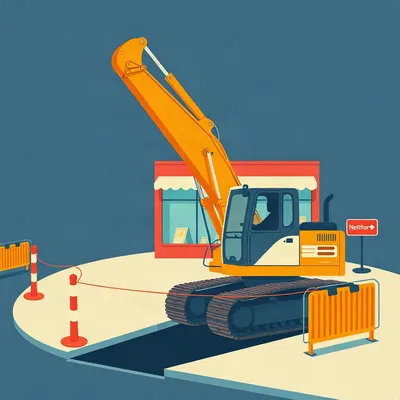
Then he logs onto Facebook and sees a friend venting. Her business is tanking because there are JCBs parked directly in front of her shop entrance. Customers physically cannot reach her door. The street's a pile of rubble. And she's still paying full arnona, the highest municipal tax rates in Israel, while the city offers no information, no consultation, no recourse. Daniel took a long walk recently and noticed all his favorite restaurants are gone, replaced by construction sites or generic high-rises. He wakes up every morning to jackhammering with no noise abatement and no end date in sight. His core question is, what are we paying for? And do any cities actually do this better?
So we're going to look at what the social contract of municipal taxation actually promises, and whether any city on earth has figured out how to rebuild without declaring war on its own residents.

The scale here is staggering. Jerusalem is in the middle of the J Net light rail expansion, which is a multi-line build-out, plus a wave of high-rise residential construction that's remaking entire neighborhoods. The city is simultaneously a construction site and a functioning municipality, and it's failing at the second job.
The second job being the one it actually collects taxes for.
Right. And the Jerusalem Post piece Daniel shared about elderly residents unable to navigate, that's the thing that sharpens it. Because this isn't just noise and dust. It's who bears the cost of progress. Daniel's grievance is precise. The municipality extracts the highest arnona rates in the country while providing no information, no alternative routes, no noise abatement, no recourse. You pay premium rates and you get a hole in the ground where your street used to be.
So what's actually going wrong here, beyond the obvious chaos?
The first failure is that the disruption is invisibly exclusionary. The article Daniel found was about elderly residents, and that's the obvious case. But the deeper point is that failed accessibility is a universal design failure. It doesn't just affect the elderly. It affects parents with strollers, delivery drivers, people with temporary injuries, tourists who don't know the detours. When you design for the most vulnerable user, everyone benefits. When you design for no one, everyone suffers. Jerusalem's approach is to dig a trench, put up a flimsy barrier, and assume people will figure it out.
A flimsy barrier that probably falls into the trench within a week.
And this is what drives Daniel's frustration. He's in his thirties, no mobility issues, but he's got Ezra in a stroller. Every missing curb cut, every blocked sidewalk, every unmarked detour is a problem for him too. The municipality treats accessibility as a niche concern for the elderly and disabled, when actually it's the connective tissue of the whole city.
The thing that gets me is the signage. Or rather, the absence of it. You'd think that if you're going to tear up a sidewalk, the absolute minimum is a sign saying where to walk instead. That's not expensive. That's not complicated. It's a piece of plastic with an arrow on it. And the fact that the city can't even manage that tells you everything about how much they're thinking about the people on foot.
It's a signal. The absence of signage says, we didn't plan for you. We planned for the construction equipment. And then there's the small business angle, which Daniel's friend crystallized. JCBs parked directly in front of her shop entrance. Customers can't reach her. She's paying full arnona while the city has effectively shut her business down without notice, consultation, or compensation.
That's the part that really lands. This isn't collateral damage. It's a policy choice. The city decided to do this work, decided where to stage the equipment, decided not to inform her, decided not to offer any mitigation. Every step of that is a decision. And she's the one paying for all of them.
And the democratic principle here is real. Taxation is not just extraction. It's a bargain. Citizens pay for services, yes, but also for information, for predictability, for being treated as stakeholders. When the city takes away your street, your customers, and your peace of mind without telling you when it ends, the bargain is broken. Daniel's phrase, you begin feeling like you've been scammed, that's exactly the erosion of civic trust.
Scammed is the right word. Because a scam is when you pay for something and the person takes your money and gives you nothing. That's the feeling. You're paying the highest rates in the country and the city is actively making your life worse, and there's no mechanism to complain, no timeline, no one to call.
And this matters beyond Jerusalem. This is the universal tension of urban renewal. Every growing city faces it. The question is whether the default is contempt for current residents in service of a future vision, or whether there's a better way. Jerusalem's default is pretty clearly the first one.
I think there's something else going on too. The city sees residents as obstacles to be managed, not constituents to be served. The construction is the priority. The people are the inconvenience. And that's backwards. The whole point of infrastructure is to serve the people who live there. But somewhere along the way, the project became the point.
The project became the point, and the residents became the thing standing in the way of the project. That's the inversion. And it's why the failures are so specific. No published end dates for construction phases. No noise abatement enforcement. No consultation. These aren't oversights. They're what happens when you don't think the residents matter.
Let's talk about the noise for a second. Daniel wakes up every morning to jackhammering. No noise abatement policy. No clarity on when it ends. In most functioning cities, there are noise ordinances. Construction can start at a certain hour, has to stop at a certain hour, and there are limits on what you can do when. Jerusalem seems to have decided that the construction itself is the ordinance.
And the lack of an end date is almost worse than the noise. People can tolerate disruption if they know it's temporary. It's the open-endedness that breaks you. Six months of jackhammering with no end in sight is psychologically different from six months with a published completion date. The city withholds that information, and the withholding itself is a form of contempt.
So if the city won't stop digging, what should it owe the people it's digging around?
That's the question Daniel's friend raised, and it's the right one. She floated the idea of a discount or waiver on municipal taxes while the disruption is ongoing. Daniel agrees there should be some quid pro quo at minimum. And here's the thing, this isn't hypothetical. There are real precedents. Multiple cities have formal mechanisms for exactly this.
I'm all ears.
Philadelphia. The city offers a construction impact tax credit for businesses that lose revenue due to city-initiated construction projects. It's a formalized mechanism. You document your losses, you claim relief. It's not automatic, but it exists as a recognized right. The city acknowledges that when it disrupts your business, it owes you something.
A recognized right. That's the phrase. In Jerusalem, there's no right to be recognized at all.
Montreal has gone further. The city implemented a construction mitigation framework that includes financial compensation for businesses affected by major infrastructure work. The principle is explicit. The private sector shouldn't bear the full cost of public projects. If the city needs to tear up your street to build a transit line, the city compensates you for the damage to your livelihood.
And the city has to budget for that. Which means the city has an incentive to minimize disruption. If compensation is a line item, suddenly the project managers care about how long the JCB sits in front of the shop.
That's the deeper insight. These aren't charity measures. They're accountability mechanisms. When a city has to pay for disruption, it becomes very motivated to minimize disruption. Tax relief isn't just fairness. It's a discipline device that forces better project management.
So the compensation is doing two jobs at once. It's fair to the business owner, and it's a stick for the city. The longer you dig, the more you pay.
Nelson, New Zealand is another good example. When city-centre roadworks dragged on, the council offered rates deferral to affected businesses. Rates are their equivalent of municipal tax. The council explicitly acknowledged that prolonged disruption warranted financial accommodation. They didn't have to be sued into it. They looked at what was happening and said, we should help.
Rates deferral. So not even a waiver, just a deferral. Pay later, when the street is back and the customers can reach you. That's a remarkably sane idea.
And Cork in Ireland and San Antonio in Texas have similar programs or have experimented with them. Cork had a scheme for businesses affected by street works, and San Antonio has looked at impact relief for construction-adjacent businesses. This is established practice. It's not fringe policy.
So the misconception here is that tax relief for construction disruption is radical or unprecedented. It's neither. It's a normal thing that functioning cities do.
And the contrast with Jerusalem sharpens. No such mechanism exists. The city's approach is extractive. Take the taxes, impose the disruption, offer no recourse. The absence of a relief mechanism isn't an oversight. It reflects a municipal culture that doesn't see residents as stakeholders with rights.
And that's the thing about the arnona system. The city has the highest rates in Israel, and it still can't manage basic communication. It's not a resource problem. It's a priorities problem.
The consultative alternative is the other piece. Cities like Copenhagen and Freiburg have institutionalized resident consultation before and during infrastructure projects. Not as a checkbox, but as a genuine feedback loop. Residents get real information about what's happening, when, and how long it will take. And their feedback actually shapes the project.
Copenhagen's approach to cycling infrastructure is famous for this. They test designs, they talk to residents, they iterate. It's not that they don't disrupt anything. It's that the disruption is negotiated rather than imposed.
Right. The lesson isn't just about tax rebates. It's about treating disruption as a negotiated process rather than a unilateral imposition. The city says, here's what we need to do, here's how long it will take, here's how we'll mitigate it, and here's your recourse if we fail. That's the social contract in action.
And in Jerusalem, the contract is, we're digging, deal with it.
Which brings us back to the accessibility point. When you design for no one, everyone suffers. The elderly woman who can't cross the street. The parent with a stroller. The delivery driver. The tourist. The business owner. They're all the same person to the municipality, which is to say, they're all invisible.
The thing I keep thinking about is the end date. Or the lack of one. Daniel said the city provides no clarity as to when construction nuisances might end. That's such a basic thing. Every construction project has a timeline. The city knows exactly when the work is scheduled to finish. They just don't tell anyone.
And that's information asymmetry. The city has the information, the resident doesn't. And the city uses that asymmetry as a shield. If residents don't know when it ends, they can't hold the city to a deadline.
Which is a form of power. The city hoards the information and uses it to avoid accountability.
That's exactly what we should talk about next. Because there's a lived dimension to this that's worth hearing.

The leaflet.
What?
The consultation leaflet. Through the door. That's what you got in Manchester when they tore up the street for the tram line extension. A leaflet saying there'd be a public meeting. Tuesday, two in the afternoon. At the community centre. Which is fine if you don't work, or you're retired, or you don't have a shop to run.
You were in Manchester?
Ran a small print shop on a street that got torn up for fourteen months. Tram line extension. The leaflet came through the door. I read it. I thought, well, they're consulting. Then I looked at the meeting time. Tuesday afternoon. I had a shop to run. I couldn't close for two hours to go and listen to a man with a clipboard tell me about the disruption I could already see out my front window.
The consultation was decorative.
It was a box they ticked. The real information, the stuff that mattered, that came later. They told me six weeks. The whole thing took fourteen months. Six weeks turned into fourteen months, and every time I asked, they said, nearly done. The contractor had no incentive to finish because they were paid per day. Every extra day was money in their pocket. The city knew the real timeline. I didn't. That's the asymmetry.
Paid per day. So the incentive structure was backwards. The longer they dragged it out, the more they made.
The landlord got the tax break. Not me. The city's relief went to the property owner. I was the tenant. I was the one losing customers because the street was a trench and the delivery vans couldn't stop. I was the one who went under. The landlord got the cheque and I got the bankruptcy forms.
The compensation mechanism existed, but it didn't reach the person who was actually hurt.
The property owner wasn't standing in the shop watching the takings drop to nothing. He was somewhere else, collecting rent from someone else. But the relief went to him because he owned the building. The system was designed by people who think the building matters more than the business inside it.
That's a sharp observation. The compensation schemes we were talking about, Philadelphia, Montreal, Nelson, they're all designed to reach the business owner. But if the mechanism routes through the property owner, it can miss the person who's actually losing the revenue.
That's a failure mode that probably applies in Jerusalem too. Even if the city adopted a relief program, who would actually receive it? The business owner who rents the storefront, or the landlord who owns the building?
The landlord. Same as Manchester. The city knows the landlord. The landlord pays the arnona, or passes it through. The tenant is just a name on a lease. When the relief comes, it goes to the person with the title deed, not the person with the till.
That's the thing about municipal compensation. It's only as good as the mechanism that delivers it. If the relief goes to the property owner while the tenant business folds, the policy has failed at the exact point where it was supposed to help.
The real fix isn't just tax relief. It's penalty clauses. Published deadlines with financial teeth. If the contractor goes over, they pay. If the city goes over, the residents get something back automatically. Not a leaflet and a Tuesday afternoon meeting. A real mechanism.
The discipline device needs to be built into the contract itself. Not just compensation for the residents, but penalties for the people doing the digging.
The contractor in Manchester had no reason to finish. Paid per day. Fourteen months of daily payments. Why would he hurry? If there'd been a penalty clause, say a hundred pounds a day after the deadline, the street would have been done in eight months.
The city would have had to publish the deadline. That's the thing. Penalty clauses only work if the deadline is public. If no one knows when it's supposed to end, no one can enforce the penalty.
That's the information asymmetry again. The city had the real schedule. I had a leaflet.
The fix has three parts. Publish the deadline, attach financial penalties for missing it, and route the compensation to the person who's actually losing the money.
The tenant. The one standing in the empty shop.
That's the piece that gets missed in a lot of these discussions. The compensation exists, but it doesn't reach the person who needs it. The policy looks good on paper, and then the landlord cashes the cheque and the business still folds.
In Jerusalem, there's no cheque at all. There's no leaflet with a meeting time. There's just the JCB and the jackhammer and the arnona bill.
The arnona bill always arrives. That's the one thing the city is reliable about.
The one piece of information they always manage to deliver.
Every month. On time.
The open question is, if the municipality won't voluntarily adopt consultative practices, what forces change? Elections? Legal challenges? Organized resident pushback?
The voter turnout in the last municipal elections was thirty-eight percent, the lowest in twenty years. That's a signal. Residents have checked out. They don't believe the city can be changed through the ballot box, so they stay home. And that creates a feedback loop. Low turnout means the city doesn't feel pressure to respond.
Which means the change has to come from somewhere else. Maybe legal challenges. Maybe organized resident groups. Maybe businesses banding together to demand compensation as a bloc.
The broader context matters here. As more cities undergo climate-adaptive infrastructure renewal, this tension between construction and livability is going to intensify. The cities that figure out the social contract of disruption will have a competitive advantage in retaining residents and businesses. The ones that don't will hollow out.
Jerusalem's already seeing that. The restaurants Daniel loved are gone. The small businesses are folding. The city is building for a future population while driving out the current one.
That's the deeper question Daniel's asking. What are we paying for? But beneath that, there's the question of whether cities can learn to see current residents as the point of infrastructure, not obstacles to it.
The cutting-room floor detail I keep coming back to is the Nelson rates deferral. It wasn't a waiver. It was a deferral. Pay later, when the street is back and the customers can reach you. That's such a simple, humane idea. It says, we know this is hard, we'll give you breathing room, and when the work is done, you'll have the revenue to pay. It treats the business owner as a partner in the project, not a casualty of it.
That's the thing Jerusalem doesn't do. It doesn't see the business owner as a partner. It sees her as a taxpayer who happens to be in the way.
The question hangs there. If the city won't change on its own, what makes it change? And can civic trust be rebuilt once it's been broken this badly? I don't think there's an easy answer. But Daniel's instinct is right. The bargain has to mean something. Otherwise, what are we paying for?
Thanks to Hilbert Flumingtop for producing.
This has been My Weird Prompts. Email us at show at my weird prompts dot com.
We'll be back soon.