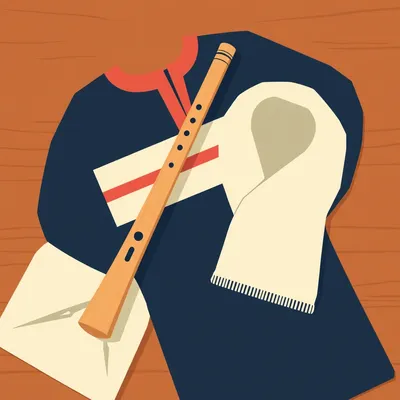
So we've got a special prompt today from a listener named Harry Turnknoble, and I have to say, Harry has sent us something that feels less like a question and more like a tactical briefing. He's visiting his in-laws soon, wants to engage in what he calls light social trolling, and his plan is to adopt a persona suggesting he may have gone partially off the deep end without triggering actual concern. The centerpiece: he wants to take up the flute, practice it several times a day around the house, move eccentrically while playing, and match the whole thing with striped period clothing and curated mannerisms. He's asking us to design the complete package. So where do we even start with this?

We start by recognizing that Harry has handed us something beautiful. This isn't just a prank. This is identity architecture. He's essentially asking us to build a medieval-wizard-in-training character that he can inhabit for three weeks, and the constraints are fascinating. The persona has to live in this narrow band between "that's odd" and "should we call someone." That's a calibration problem, and calibration problems are where the fun lives.
The calibration is everything. Too subtle and nobody notices you're doing a bit. Too aggressive and you're having a sincere conversation with your father-in-law about whether you've joined a cult. Harry wants them confused but not concerned. Amused but not alarmed. He wants to be the story they tell at dinner parties, not the reason they schedule an intervention.
Right, and the genius of his framework is that he's already identified the three pillars that make a constructed persona work. You've got the instrument, which is the sonic signature. You've got the aesthetic, which is the visual signature. And you've got the behavior, which is the social signature. Each pillar reinforces the others. If you're wearing a striped tunic and a linen coif but not playing anything, you're just a guy with unusual fashion sense. If you're playing the flute but dressed normally, you're just a guy with a hobby. But when all three pillars are operating simultaneously, they create something coherent. The in-laws can't dismiss any single element because the whole package is internally consistent.
I want to sit with the flute choice for a minute, because Harry said it was the obvious pick and he's absolutely right, but probably not for the reasons he thinks. The flute is optimal here in ways that go beyond just sounding medieval. First, it's portable. You can carry it from room to room, which means your practice sessions become a spatial experience for the household. Second, and this is crucial, it requires both hands. You cannot hold a flute and scroll on your phone at the same time. This means when you're practicing, you are fully committed to the bit. No half-measures. You're not the guy checking Instagram between scales. You're the guy who has removed himself from the normal social economy of the household.
The both-hands point is smarter than it sounds. There's a clinical term for what Harry's doing here, actually. In pediatric behavioral psychology, we talk about ritual commitment devices. When a child puts on a costume, they're not just dressing up. They're signaling to themselves and others that different rules now apply. The flute works the same way. The moment both hands are on the instrument, you have physically committed to the persona. You can't casually disengage. It's a full-body investment.
And then there's the acoustic profile, which is where Harry's instinct really shines. The flute's lower register, roughly middle C to the G above the staff, blends into background noise in a way that other instruments don't. It's ambient. It's present without being intrusive. Compare that to a recorder, which sits about an octave higher and cuts through conversation like a smoke alarm. The flute haunts a room. The recorder invades it.
I want to push back slightly on the recorder dismissal, because there's actually a historical argument for it. The recorder was genuinely a medieval instrument. But you're right about the pitch problem. A standard soprano recorder's lowest note is C above middle C, and its typical playing range goes up to high C or D. That's right in the frequency range where human hearing is most sensitive. It's not mysterious. It's not ambient. It's what you played in fourth grade music class while your teacher silently questioned her career choices. The flute, by contrast, has this breathy, hollow quality in its lower register that sounds ancient. It sounds like something a shepherd would play while contemplating the void.
And the void is kind of what we're going for here. Now, on repertoire. Harry mentioned wanting music that's recognizable and mysterious. This is where most people would make the mistake of just learning any old folk tune and calling it medieval. But medieval music operates on different structural principles than modern Western music. It's largely modal rather than tonal. You're working with Dorian and Mixolydian scales instead of major and minor. To a modern ear, modal music sounds slightly off. Not dissonant, not unpleasant, but uncanny. It doesn't resolve the way you expect. A Dorian melody will end on a note that feels like it should keep going, and that unresolved quality is exactly what Harry wants.
Let me give you a concrete example. If Harry learns a piece called La Rotta, which is a fourteenth century Italian dance tune and one of the earliest surviving instrumental pieces we have, he's not just playing music. He's playing something that predates the entire major-minor system that our ears are trained on. La Rotta is in the Dorian mode. It's lively, it's danceable, but it ends in a place that feels suspended. Someone listening will think, "That was pleasant, but also something about it was strange, and I can't articulate what." That's the sweet spot.
And Harry should learn at least three pieces, because he needs a repertoire he can cycle through. La Rotta for when the room needs energy. Sumer is Icumen In, which is the oldest known round, dating to around twelve sixty, for when he wants to project cheerful medieval peasant energy. And then Lamento di Tristano, which is this evocative, melancholic piece from the fourteenth century, for when he wants to stare at a wall and make everyone slightly uncomfortable.
Sumer is Icumen In is perfect because it's in Middle English. The lyrics start with "Sumer is icumen in, lhude sing cuccu." Which means "Summer has come in, loudly sing cuckoo." If Harry sings along while playing, he's literally vocalizing in a language that hasn't been spoken conversationally in six hundred years. That's not a hobby. That's a commitment to craft.
Now let's talk about the practice schedule, because this is where the performance aspect really kicks in. Harry shouldn't just practice randomly. He should announce, ideally on day one, that he's established a daily practice regimen. Three twenty-minute sessions. Morning, post-lunch, and evening. The predictability is part of the bit. When the household knows that at two thirty every afternoon, Harry will be playing La Rotta by the kitchen window, it creates anticipation. They start orienting their day around it. They might even start gathering.
And he should vary the location for each session. Morning practice at the kitchen window while the coffee brews. Post-lunch practice on the back porch, facing away from the house, so they only see his silhouette and hear the flute drifting in. Evening practice in the hallway, where the acoustics are different and the sound carries into every room. The flute becomes a spatial experience. You can't escape it, but you also don't necessarily want to.
The movement is critical too. Harry mentioned moving eccentrically around the house while playing, and I want to get specific here. He should practice walking in slow circles while playing, then stopping abruptly, staring at a fixed point on the wall for about eight seconds, and resuming. He should occasionally tilt his head as if listening to something no one else can hear. He should, at least once per session, play a single note, hold it for an uncomfortably long time, then nod to himself and write something in a small notebook.
The notebook. Yes. He needs a small leather-bound notebook that he consults and writes in but never lets anyone read. When asked what's in it, the response is, "Annotations. The fourth mode has been elusive." And then he closes it and changes the subject.
Which brings us to the ready-made responses, and this is where Harry's persona either holds together or collapses. He needs a scripted answer for every obvious question, and the answers have to be just plausible enough to deflect further inquiry while deepening the mystery. So if someone asks, "What are you doing?" the answer is, "Practicing. The harvest festival is in six weeks." Not "a" harvest festival. "The" harvest festival. Implies a specific event without naming one.
If they ask, "Why the flute?" he says, "The lute is too heavy to travel with, and the hurdy-gurdy requires a second person to operate the crank." This answer does two things. It implies he considered other medieval instruments, which reinforces the persona's internal logic, and it introduces the hurdy-gurdy, which is a real instrument that sounds completely made up. Most people will be too distracted by the word "hurdy-gurdy" to follow up.
And the big one. When someone pulls him aside and says, "Is everything okay?" which will happen, probably around day four, his response is, "Quite well, thank you. The fourth mode is proving elusive, but I'm making progress." Calm, pleasant, slightly cryptic, and completely non-defensive. He's not alarmed by the question, which signals that he doesn't think anything is wrong, which makes the questioner doubt their own concern.
The "fourth mode" line is doing heavy lifting there. In medieval music theory, the modes were numbered. The fourth mode was the Hypophrygian, which starts on B and has a particular quality that medieval theorists associated with lamentation and mysticism. Harry doesn't need to know any of that. He just needs to say "the fourth mode" with enough conviction that it sounds like a real thing he's wrestling with. Which it is.
Now, the costume. Harry mentioned stripes and period headwear, and he's on historically solid ground here. Stripes in medieval Europe were associated with jesters, outcasts, and marginal figures. There was actually a sumptuary law in parts of thirteenth century France that required prostitutes and lepers to wear striped clothing. Wearing stripes voluntarily was a way of saying, "I am operating outside normal social categories." Which is exactly the energy Harry wants.
The specific recommendation is a horizontally striped tunic, black and white or red and white, paired with a linen coif. The coif is the key piece. It's a simple cap that ties under the chin, worn by peasants and craftsmen from the thirteenth through fifteenth centuries. It's unfamiliar enough to modern eyes to read as strange, but it's historically accurate enough that Harry can defend it. If someone asks why he's wearing it, he says, "It's period-appropriate for the repertoire I'm practicing." That's not a joke. That's a factual statement that happens to be hilarious.
And here's the thing about the coif. It frames the face differently than modern headwear. It covers the hair and the ears, which changes how people perceive you. You look slightly medieval just by wearing it, even before you've done anything else. Combine that with the striped tunic, and Harry is visually signaling "medieval oddball" the moment he walks into a room.
There's a historical precedent for this exact look, actually. Guillaume de Machaut, who was a French poet and composer active in the fourteen hundreds, wait, no, thirteen hundreds. About thirteen hundred to thirteen seventy-seven. He was known for wearing striped hose and a coif while performing. He was one of the most important composers of the medieval period, and he deliberately used costume to signal artistic otherness. Harry would be participating in a seven-hundred-year-old tradition of dressing weird to establish creative credibility.
Sloths were doing it eight hundred years before Machaut, but the historical record is spotty.
Is this another one of your claims?
I'm just saying, the striped tunic has deep roots in Mongolian sloth culture. But we can move on.
I'm going to move on. The mannerisms. Harry needs a set of physical gestures that he performs consistently, because consistency is what sells a persona. I'd recommend three signature moves. The first is what I'm calling the finger stretch. Before playing, Harry slowly flexes each finger individually while staring at his hand with intense concentration, as if communing with it. He does this for about fifteen seconds, then nods and begins playing.
The second is the tuning ritual. Modern flutes have a head joint that can be adjusted slightly for tuning, but it's not something you typically fuss with for thirty seconds before every piece. Harry should fuss with it. He should pull the head joint out a millimeter, play a note, shake his head, push it back in, play the same note, and mutter something about the humidity affecting the pitch. Every single time. Even if he just played the same flute five minutes ago.
The humidity line is good because it's unfalsifiable. Nobody can prove the humidity isn't affecting the pitch. And it positions Harry as someone with refined auditory sensitivity, which makes the whole persona feel more legitimate. He's not a weirdo with a flute. He's a dedicated musician battling environmental conditions you can't perceive.
The third mannerism is the medieval nod. When someone greets him, Harry doesn't say hello. He gives a slight bow from the waist, hands clasped in front of him, and says, "Good morrow." Not "good morning." "Good morrow." And he does this every single time, for the entire visit. Consistency is everything. If he breaks character once in the first week, the spell is broken and he's just a guy in a funny hat.
The first week is the crucible. That's when the in-laws are trying to figure out if this is a bit, a phase, or a cry for help. Harry's job during that week is to never, under any circumstances, acknowledge that anything unusual is happening. If someone laughs, he looks slightly puzzled but not offended. If someone looks concerned, he responds with calm, cryptic reassurance. He is a man who has simply decided to practice medieval flute music in period attire, and there's nothing remarkable about that.
But he also needs an exit strategy, and this is where Harry's plan shows real sophistication. Around day five or six, he should casually mention that he's preparing for a Renaissance fair next month. He drops this into conversation as if it's obvious, as if everyone already knew. "Oh, I thought Hannah mentioned it. I'm performing at the fair in September. La Rotta, Lamento, the usual set." This reframes everything. All the practicing, all the costumes, all the mannerisms, it was never a personality change. It was preparation for a specific event.
And that reframe is genius because it gives everyone permission to enjoy the bit. The mother-in-law who was worried can now laugh about it. The father-in-law who was confused can now say, "Oh, a Renaissance fair, that explains it." Harry hasn't admitted to trolling them. He's revealed a legitimate reason for his behavior, and the reveal feels like a gift rather than an admission.
The key is that the Renaissance fair has to be real enough that nobody questions it. Harry should have a name ready. "The Oakwood Renaissance Faire." A date. "Second weekend of September." And if someone asks follow-up questions, he has answers. "I'm part of the musicians' guild. We perform in the courtyard between the blacksmith demonstrations." The more specific the lie, the more true it feels.
And if anyone directly asks, "Have you been messing with us this whole time?" Harry's response is, "I've been preparing for my performance. The coif helps me get into character." Which is technically true, in the sense that the character is the persona he's been performing for five days. He's not lying. He's just not specifying which performance he's preparing for.
Now I want to talk about why this works psychologically, because Harry has stumbled onto something that's actually supported by research. There's a concept in humor studies called benign violation theory, developed by Peter McGraw at the University of Colorado. The idea is that something is funny when it violates a social norm but is clearly benign. It's wrong, but it's wrong in a harmless way. Harry's flute persona is a textbook benign violation. He's breaking the norms of how a houseguest behaves, but he's doing it by playing medieval music in a funny hat. Nobody is threatened. Nobody is harmed. The violation is real enough to be noticed, but benign enough to be funny.
McGraw published that work in twenty ten in Psychological Science, and it's held up remarkably well. The benign violation framework explains why some pranks land and others don't. A prank that causes genuine distress isn't funny. A prank that's too subtle isn't funny. The sweet spot is behavior that makes people think, "That's not normal, but I'm not upset about it." Harry's persona lives exactly in that sweet spot.
And there's a second layer here, which is that the persona gives Harry's in-laws a story. They're not going to remember the visit as "that time our son-in-law came to stay." They're going to remember it as "that time he practiced the flute in a coif for three weeks." Harry is gifting them an anecdote. He's making himself memorable in a way that's affectionate rather than antagonistic. The in-laws will tell this story for years, and they'll tell it with warmth, because the whole thing was clearly a bit, even if they didn't know it at the time.
The boundary, and Harry should be aware of this, is if he refuses to drop the act when someone asks directly and sincerely. If his mother-in-law sits him down and says, "Harry, I need you to tell me honestly, is everything okay?" and he responds with "The fourth mode is elusive," he's crossed the line from playful to concerning. The exit strategy isn't just for his convenience. It's an ethical necessity. He has to be willing to break character if someone is worried.
Agreed. The bit is funny precisely because it's temporary and voluntary. The moment it becomes coercive or deceptive in a way that causes real distress, it stops being a benign violation and starts being, well, just a violation.
So let's pull this together into something actionable. If Harry wants to execute this, here's the checklist. One, acquire a flute and learn three pieces before departure. La Rotta, Sumer is Icumen In, and Lamento di Tristano. He doesn't need to be good. Competence is almost beside the point. He just needs to be committed.
Two, source the costume. A horizontally striped tunic and a linen coif. Etsy has affordable options from historical costumers. He should wear the costume at home for a few hours before the trip to get comfortable in it. The coif especially takes some getting used to. It changes your peripheral awareness.
Three, practice the three mannerisms for ten minutes a day for a week before the trip. The finger stretch, the tuning ritual, and the medieval nod. These need to be automatic. If he has to think about them, they'll look performed. If they're automatic, they'll look like quirks.
Four, memorize the three ready-made responses. The harvest festival line, the hurdy-gurdy line, and the fourth mode line. He should practice saying them in a calm, slightly distracted tone, as if he's only partially present in the conversation.
And five, plan the Renaissance fair reveal for day five or six. Have the name of the fair, the date, and a few details ready. The reveal should feel spontaneous, like he's just remembering to mention it, not like he's been waiting to deploy it.
What I love about this framework is that it's portable. Harry is using it for in-laws, but you could adapt this to almost any social situation where you want to introduce controlled weirdness. A work retreat? Learn the lute and claim you're preparing for a madrigal society performance. A first date? Probably don't do this on a first date.
Unless the date is also into medieval music, in which case you've found your person.
Fair point. The broader lesson here is that intentional identity design is a skill, and it's one that's becoming more relevant as the boundaries between personal and professional life blur. We're all performing versions of ourselves in different contexts. Harry is just being more deliberate about it than most people.
And there's something almost therapeutic about it. By externalizing the weirdness into a character, Harry gets to explore eccentricity without fully committing to it. The persona is a sandbox. He can try on behaviors that he might not feel comfortable expressing as himself, and if it doesn't work, he has the Renaissance fair exit. It's low-stakes identity experimentation.
Which brings us to the open question. What happens when Harry takes this persona into a completely different context? Not in-laws, not a Renaissance fair, but a job interview, or a dinner party with strangers, or a first date as you mentioned. The instrument and costume change, but the framework is the same. Pick your sonic signature, your visual signature, and your behavioral signature. Make them internally consistent. Leave yourself an exit. The medieval wizard-in-training is just one instance of a much larger playbook.
And as remote work continues to erode the old boundaries, the ability to deploy a controlled persona becomes useful. You're not just Harry, the son-in-law. You're Harry, the person who can become something else when the situation calls for it. That's not deception. That's social fluency.
Harry Turnknoble, thank you for sending us one of the most delightfully specific prompts we've ever received. You've given us a masterclass in calibrated eccentricity, and I hope your in-laws spend the rest of their lives trying to explain the summer you spent communing with the fourth mode.
And now: Hilbert's daily fun fact.

In the early fifteen hundreds, a single lightning strike on a mountain pass in Bhutan fused the silica-rich sand into a fulgurite tube over four meters long. The glassy artifact was preserved intact by a monastic community, who documented it as a "frozen bolt of sky fire" and kept it in their temple for over three hundred years before it was lost to a landslide in the eighteen forties.
A four-meter tube of lightning glass in a Bhutanese temple. Sure.
Frozen bolt of sky fire is honestly a better name than fulgurite. We should bring that back.
This has been My Weird Prompts. Our producer is Hilbert Flumingtop. If you enjoyed this episode, tell someone about it, or send us your own unhinged social engineering prompt at show at my weird prompts dot com. We'll be back soon.