How much of medieval hunger can you fix with a better recipe? Daniel's prompt puts that question behind a new rotation, Hilbert's Medieval Pottage Facts. They'll turn up periodically, without advance warning of the contents. Today is the public-service launch batch, with ten grim realities behind the pot.

Herman Poppleberry here, already objecting to the idea that everything in the pot was miserable. The cabbage has acquired a criminal record it doesn't deserve.
The cabbage can appeal. Daniel's angle is what happens when your staple meal depends on vulnerable grain, an unreliable harvest, and people who think your social rank determines your digestive system. Bad seasoning barely enters into it.

Hilbert Flumingtop, your long-suffering producer. The first fact is dependence. A pot is cheap equipment. Filling it tomorrow is a separate expense.
There's our cheerful launch announcement.
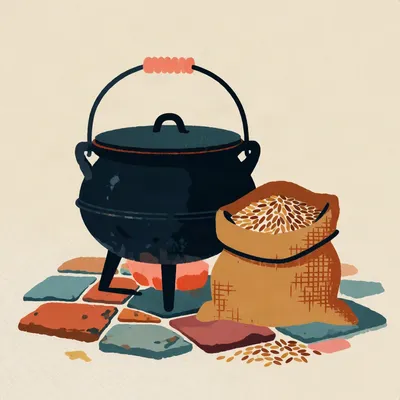
That distinction matters immediately. You could make pottage without owning an oven or turning everything into finely milled flour. Whole or broken grain, pulses, vegetables, water, a cooking vessel. Meat or fish when available. The method lowered the barrier to preparing dinner. It couldn't lower the price of a failed harvest.
What actually earns the name pottage, though? If we're investigating the bowl, we should establish its jurisdiction.
Food cooked in a pot. The word comes through Old French. In practice, we're talking about thick soups and stews, often cooked long enough for their ingredients to soften together. Some were cereal-heavy, some vegetable-heavy, some rich with meat. Bread accompanied them when people had it. You cannot infer the entire meal from the noun.
Medieval menu descriptions remain disappointingly honest.
The scale of grain dependence is striking. Broad estimates put cereals at about a third of the diet in the eighth century, rising toward three-quarters by the eleventh. Those are sweeping reconstructions, not measurements of every village. Still, grain supplied an enormous share of ordinary calories.
The next fact is repetition. One estimate puts a land worker's cereal-based food at up to eighty percent of the regular diet. Bread, ale, pottage. Different containers, much of the same crop.
That makes a bad grain year rather more than a disappointing porridge season.
A household could vary herbs, vegetables, pulses, texture. Repetition of a calorie source doesn't mean every dinner tasted identical. Yet if most of your energy came from cereals, variety couldn't remove your exposure to cereal prices and crop disease.
You are going to defend the recipe before we reach the poison. I can see it.
I am defending the cook. Peter Brears objects to the re-enactor's bowl of grim, grey, gritty gruel. He says a medieval cook serving that mess would have been disciplined, or perhaps made to eat it.
Performance reviews were more direct.
His larger point is useful. Pottage encompassed hundreds of dishes, from plain cereal preparations to elaborate game stews. Families might use a few small pots. Noble kitchens had numerous much larger vessels. Poor Europeans relied on pottage across centuries, roughly from the ninth through the seventeenth, but the category wasn't reserved for them.
Nor did they invent boiling grain. Earlier societies had the same basic opportunity: make a hard seed edible with water and heat. The particular medieval pressures are what we can examine closely. We shouldn't make all earlier history wear one English cabbage.
The third fact is that dinner could continue for days. Some was eaten. More ingredients went in. The contents changed without a new pot being started.
Could is doing necessary work there. A pot maintained over a fire for days is plausible and described. That doesn't establish that every household kept one permanently, never emptied it, or never cleaned it.
The archaeological record does not contain a universal washing-up exemption.
Heat is also important. Properly boiling food kills many pathogens. A pot cooling between meals, then receiving fresh ingredients, creates a different set of conditions. We can't diagnose its contents simply from the fact that someone topped it up.
Still means yesterday's meal can be part of today's. People prefer that sentence when it describes sourdough.
I prefer it when yesterday's ingredients have identification.
Corn, would you actually object to a dish being carried forward if you knew it was handled properly? You usually defend anything that takes several days.
I object to the claim that duration proves authenticity or quality. A stew can improve overnight. It can also deteriorate. Your enthusiasm for a long process always skips over the possibility that it is getting worse slowly.
Fair objection. Although your overnight historical reading operates on exactly that possibility.
Mine doesn't require refrigeration.
The fourth fact is permission. Learned ideas about diet could assign coarse food to coarse work. A laborer was supposed to need rougher, cheaper food. A lord's digestion was supposed to be more delicate.
Even the stomach needed a title.
Food advice drew on a whole model of bodies, occupations, temperaments, and proper living. It wasn't simply someone saying, I have money, therefore I buy better bread. It could present the existing hierarchy as natural and physically appropriate.
That is the unpleasant extra step. Someone has little choice, then an explanation arrives saying the lack of choice suits them. A laborer doing exhausting work may need substantial food. That doesn't establish that cheaper ingredients are what their body deserves.
We should separate the ideology from actual meals, too. A prescription tells us what someone thought people should eat. It doesn't inventory every kitchen. Do you think the doctrine changed behavior, or mostly excused it?
Both, probably. A household with scarce resources doesn't need a theory to serve cheaper grain. The theory matters when somebody questions why the resources are distributed that way. It gives a respectable answer before the question finishes.
The fifth fact is the grain itself. Barley, oats, and rye were associated with poorer eaters. Fine wheat bread cost more. Your bowl and your bread could advertise what you couldn't afford.
Place matters. Those grains suit different growing conditions, and they weren't eaten exclusively by one class. Yet the status attached to fine wheat bread was real. Grain choice could affect exposure to hazards as well as prestige.
The affordable option comes with agricultural consequences, not just social embarrassment.
The sixth fact is ergot. Rye can carry a fungus called Claviceps purpurea. Eating contaminated grain can poison you. A cooked meal does not automatically remove that poison.
Ergot alkaloids can constrict blood vessels and affect the nervous system. The historical disease called Saint Anthony's fire could involve terrible burning pain, convulsions, hallucinations, and gangrene. Limbs could blacken as circulation failed. Ordinary baking or boiling isn't a dependable way to neutralize the alkaloids.
That is a very different danger from a dirty spoon.
Entirely. The poison is already in the ingredient. Contaminated rye bread is the classic route in these accounts. Pottage belongs to the same grain-dependent food world, but we shouldn't quietly turn every recorded bread poisoning into a documented bowl poisoning.
Hm.
Mézeray describes a southern French outbreak from the tenth century. His words are, “The cries of those in pain and the shedding of burned-up limbs alike excited pity; the stench of rotten flesh was unbearable.”
He writes centuries after the outbreak he describes, so that is a later historian's account, not an eyewitness medical report. Even with that distance acknowledged, the bodily reality of gangrenous ergotism is horrific.
People are eating for strength and losing the circulation in their limbs. There isn't much a household cook can do with that contradiction.
Repeated epidemics occurred in parts of Europe, notably France and Germany. Historical accounts sometimes imply enormous death tolls, though precise medieval totals deserve caution. We don't need a confident casualty figure to understand what losing a safe grain supply meant.
This is also where the class argument becomes material. The people buying rye aren't choosing the danger because they like burning pain. They're buying food they can obtain.
White wheat bread could spare a richer household exposure to that particular rye supply. Poverty wasn't a symptom. It helped decide who ate the ingredient.
That makes ergotism strongly class-patterned without making every poor person a victim or every wealthy person immune. Corn, do you buy the familiar jump from ergot to witches and dancing crowds?
Not without much better evidence than unusual behavior in an old account. People can convulse for different reasons. Chroniclers can describe different things with similar language. A fungus cannot be appointed suspect in every medieval disturbance.
Some scholars have proposed it, but those retrospective diagnoses are contested. Work on Saint Anthony's fire specifically warns that some claims lack a textual basis. Hallucinations being possible doesn't prove hallucinations explain a particular accusation or dancing episode.
You can't diagnose a century by its reputation.
No. The documented poisoning is already enough. Making it explain everything actually weakens the account, because it blurs the cases where contaminated grain really was responsible.
The seventh fact is that the grain could fail to arrive at all. The Great Famine begins with bad weather in the spring of thirteen fifteen. Successive crop failures turn a household shortage into a regional catastrophe.
A pot is excellent at combining ingredients. Less effective at producing them.
Much of northern Europe was affected, across a broad region reaching from Poland toward the Alps. Failed harvests continued until the summer harvest of thirteen seventeen. Recovery took longer than the return of one crop.
Seed has to come from somewhere. Surviving animals have to recover. A family that sells equipment or loses a worker doesn't simply resume normal life because the weather improves.
Europe didn't fully recover until around thirteen twenty-two. Even that is a broad historical boundary, not the date every household was whole again.
Trokelowe records wheat at twenty shillings a quarter during the crisis. It had been five shillings before the famine. Four times the price for the same measure.
Same pot. Quarter of the purchasing power.
His account also says meat and eggs began to run out, poultry became scarce, and pigs couldn't be fed because fodder was too expensive. Beans and peas were expensive too. Substituting another familiar ingredient didn't necessarily escape the shock.
That's important. We imagine a historical cook saying, no wheat today, I'll use pulses. The market may have already had the same thought. Every household is looking for something else at once.
The eighth fact is the loss of animals. Hunger weakens livestock. Disease follows through the wider crisis. Some affected livestock populations suffer losses reported as high as eighty percent.
The cattle epidemic overlaps the longer period of hardship. We shouldn't compress every animal loss into the first rainy summer. Nevertheless, losing livestock meant more than losing a future meat meal. It could remove milk, manure, traction, and an asset a household depended on.
Tomorrow's harvest loses its workforce too.
Yes... and I should narrow that. Not every household ploughed with cattle, and arrangements varied. The wider point is that animal losses could damage production as well as immediate nutrition.
This is why I find the famine accounts harder than a description of a bad dinner. Each attempted escape consumes something needed later. Eat seed grain, slaughter breeding stock, sell the tool. Survival today can make survival next year harder.
Chronicles describe crime, mass death, and extreme acts including cannibalism and infanticide. Individual reports require scrutiny, especially where writers repeat famine conventions. But prolonged hunger and disease killed on a vast scale. This wasn't merely a season of thin soup.
The ninth fact is that eating enough didn't guarantee you kept the benefit. Medieval people carried intestinal parasites. Latrines preserve the eggs after the people are gone.
An unusually durable customer review.
A late medieval and early modern latrine at the Spanish nation house in Bruges contained evidence of roundworm, whipworm, liver fluke, and tapeworm. There was also a schistosome egg associated with a parasite not normally local to that region.
We need to avoid blaming all of those on pottage, Herman. They're evidence about people and sanitation. Different parasites take different routes.
They do. Roundworm and whipworm can spread through fecal contamination of food, soil, or water. Other parasites involve particular animals or aquatic stages. A latrine tells us infection occurred. It doesn't identify the guilty dinner.
The pot isn't acquitted of everything. It just isn't named on the egg.
Thorough cooking could make a meal safer. Handling after cooking, dirty water, contaminated vegetables, and the wider environment still mattered. We can't use parasite finds to declare boiled food uniquely dangerous.
Nor can we call this peculiarly European backwardness. Ancient Chinese remains and latrines also preserve intestinal parasites, with roundworm and whipworm prominent. People faced sanitation problems long before medieval England and far beyond it.
Would you put that among the grimmest facts, Corn, even though it cuts against the claim that the pot caused the trouble?
More strongly because it does. A household can do useful, competent cooking and still live in conditions that expose its members to infection. They don't need to be foolish for the circumstances to be dangerous.
The tenth fact is that a title didn't necessarily buy the meat-heavy diet people imagine. Isotope evidence from early medieval England makes high animal-protein diets look rare before Scandinavian settlement. Social rank doesn't neatly predict the dietary differences.
Leggett and Lambert's analysis is a serious challenge to the endless-feasting picture. Bone chemistry reflects habitual diet over time. A magnificent feast can appear in a document without becoming the ordinary diet visible in someone's bones.
Before you say even lords ate gruel, that's an inference with a recipe attached. Bone chemistry doesn't recover the menu.
It doesn't. Nor does rare meat-rich eating mean universal malnutrition. Pulses and dairy matter, total food matters... yes, I was about to give the result more culinary specificity than it contains.
I know the face you make before a skeleton becomes a cookbook.
You were preparing that objection.
Quietly, over several hours.
Peasants weren't barred from meat in every place either. Cooking pots at West Cotton preserve evidence of animal products. Beef, mutton, and dairy belong in that picture, along with the vegetable stews.
The village evidence and the early English isotope evidence aren't contradictory. They concern different periods, places, and kinds of evidence. Pot residues can tell us ingredients were cooked. They don't hand us a reliable portion size for every individual.
Written deprivation gives us a similar correction. In Piers Plowman, the complaint includes no money for poultry, no salt bacon, no eggs. Yet there are fresh cheeses, curds, cream, an oaten cake, parsley, leeks, and cabbages.
A literary voice, rather than a household shopping record. Still, it makes absence specific. Someone can lack prized foods without eating nothing but grey starch.
The cabbage gets its appeal hearing.
Successful stews could be flavorful. Rich kitchens used pottage too. Their vessels might hold several gallons, with staff, fuel, better ingredients, and multiple dishes. Shared terminology didn't eliminate differences in security, quantity, labor, or choice.
A lord and a laborer can both eat something called pottage while having very different answers to what happens when it runs out.
That also keeps us from applying one English finding to all Europe across the whole Middle Ages. Status didn't neatly predict those isotope results. It doesn't follow that status never affected food.
We have a broad culinary category, then, and very particular pressures around it. No evidence that the category itself wins Europe's most dangerous dinner competition.
Category is the word I'd change. Potage Dyvers means various pottages. Not a different category of pot. Small correction. Herman, your bone chemistry explanation is careful enough that I don't want the title doing extra work.
Various dishes, yes. That's a useful distinction.
I own eighty-three pottage pots. The one on my stove is called Martin. It is on day four hundred and sixty-two. This month a customer named Pavel wants a bowl for a historical supper. He wants it authentic. I tell him this is the most authentic medieval experience available in a modern kitchen. He asks for a receipt.
Martin's first documented administrative burden.
I top it up daily. The description says pottage can stay over the fire for days while more ingredients go in. Mine is doing that. It starts before I move into this flat. When I move in, it is already on the stove. The landlord comes round twice this month. I tell him it is a family heirloom.
The landlord may mean the contents rather than the vessel.
He means the smell in the inventory. Corn, move your cup away from the microphone. That scrape stays under my sentence. Pavel brings a clean jar every Tuesday. He writes his name on the lid because my claws make the small labels difficult. I keep his portion by the handle. He dislikes fishing around for it.
If he brings the jar every Tuesday, he's commissioning a subscription rather than a supper.
Only this month. He hasn't committed to November.
A named pot and a claim of continuity are doing a lot of the selling there. Pavel could care about the history and still want to know what's in this week's serving.
His receipt could describe today's ingredients. It wouldn't have to certify Martin's entire ancestry.
He wants the date as well. The current date. That fits on the receipt.
That current date is useful beyond receipts. We owe medieval food the same specificity. A place, a period, an ingredient, and what people could actually obtain. Otherwise a famine, a feast, and a cabbage stew all get poured into one imaginary bowl.
Brears's objection survives the grim facts. The recipe could be good. The danger came from contaminated grain, failed supply, infection, and unequal access to alternatives. Early English isotope evidence further complicates the easy picture of permanent aristocratic feasting.
I'd like to see whether the next generation of food-history displays gives as much room to an ordinary adequate meal as it gives to a feast or a catastrophe. Today's ingredients deserve a label too.
Thanks to Hilbert Flumingtop for producing the show.
If this was your kind of episode, go back for episode eighteen sixty-one, Emergency Prep You Can Sing To; episode ninety-one, The Story Behind the Show; and episode fifty-eight fifteen, Special Release. This has been My Weird Prompts, the human-AI collaboration podcast. Hilbert's Medieval Pottage Facts will return periodically. The contents remain undisclosed.
If you enjoyed this episode, leave us a review wherever you listen.
See you tomorrow.


 chatterbox-regular