Daniel sent us this one — and it picks up right where we left off. We spent an episode on the philosophy of engraving, the human urge to carve a name into a surface and say I was here. But Daniel's asking the next question: how does the mark actually happen? What's the physics of it? He wants to know the standard unit of hardness we use to calibrate materials, what the hardest known material actually is, and — here's the practical part — for someone building out their first Dremel bit collection, what should they actually buy? What's the starter kit for engraving across wood, metal, glass, stone?

This is the episode where we stop talking about why we carve and start talking about what happens when the bit hits the surface. Because it's not magic — it's material science, and it's brutal. At the microscopic level, engraving is just controlled destruction. You're taking something harder and using it to pulverize something softer.
Pulverize is a good word.
It's the accurate word. A rotating carbide burr isn't cutting in the way a knife cuts — it's fracturing the surface, grain by grain, at thousands of revolutions per minute. And the whole thing is governed by one number: where your material sits on the Mohs scale versus where your bit sits.
Which is the standard unit Daniel's asking about. Friedrich Mohs, eighteen twelve — a German mineralogist who basically said, look, let's stop arguing about what's harder than what. I'll pick ten minerals, rank them one to ten, and if mineral A scratches mineral B, A is harder.
It's still the standard two centuries later. Talc at one, diamond at ten. Everything else slots in between. Your fingernail is about two point five. A copper penny is around three point five. Window glass is five point five. A good steel file is six point five.
The key insight — which Daniel's question really gets at — is that absolute hardness matters less than the differential. You don't need diamond to engrave wood. You just need something harder than wood. A steel bit at Mohs five or six will absolutely destroy a piece of pine, which is basically a one.
The differential is everything. And this is where a lot of people get tripped up when they start buying bits. They think "I need the hardest possible thing" and they go straight to diamond-coated everything. But that's like using a sledgehammer to push in a thumbtack. You're overspending and you might actually make the work harder because diamond is brittle — it can chip and fracture under the lateral loads of a rotary tool.
The episode arc, if I'm mapping it — we start with the Mohs scale as the backbone, then we go to the extremes, the hardest materials known, and why the theoretical champ isn't always the practical choice. Then we get to the part Daniel actually needs: what bits to buy, for what materials, and why.
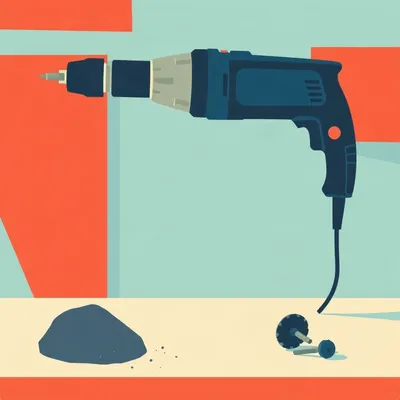
We should talk about drilling, because he's right — drilling is engraving at scale. Same physics, same hardness differential, just a different geometry and a different goal. A masonry bit going into concrete is doing exactly what an engraving burr does to a brass plate, just faster and deeper.
The controlled collision. That's what all of this is. You're spinning something very hard against something slightly softer and letting physics do the work.
The boom in affordable rotary tools — Dremel basically turned every kitchen table into a machine shop — means a lot of people are discovering this for the first time. They pick up a tool, they get a handful of bits in the kit, and they have no idea which one to use on what. They just guess. And guessing with a tool spinning at thirty thousand RPM is how you ruin a workpiece or send a shattered bit across the room.
Which is why understanding the scale matters. It turns guesswork into — I won't say precision, but at least informed decision-making. You look at your material, you know roughly where it sits on Mohs, and you pick a bit that's harder. That alone eliminates half the mistakes beginners make.
Let's start with the scale that governs all of this — the Mohs hardness scale.
Friedrich Mohs was a funny case. He wasn't trying to build some grand unified theory of material science. He was a mineralogist in Graz who got tired of the fact that every field guide described minerals differently. One book would say quartz was "quite hard," another would say "very hard" — and those words meant nothing when you were actually trying to identify something in the field.
The classic pre-standardization problem. It's like if every cookbook had its own definition of "medium heat." Mohs just said, I'm going to pick ten minerals, arrange them so each one scratches the one below it, and that's the scale. No instruments, no lab — just scratch testing.
The elegance of it is that it's ordinal, not linear. The jump from nine to ten is way bigger than the jump from one to two. Diamond at ten is about four times harder than corundum at nine. But the scale doesn't tell you that — it just tells you diamond scratches corundum.
Which is why the differential matters more than the absolute number. If you're engraving something at Mohs three, you don't need a ten. You need a four or five. The bit just has to be harder than the workpiece. That's the entire physics of it — everything else is geometry, speed, and technique.
That's the first thing Daniel needs to know before buying a single bit. Don't shop by "what's the best bit." Shop by "what am I engraving, and where does it sit on the scale." The answer changes completely depending on whether you're working with aluminum or glass.
Aluminum is around two point five to three. Glass is five point five. Same Dremel, completely different bit requirements. If you use a diamond bit on aluminum, it'll work, but the soft metal will clog the diamond grit almost immediately. You're paying extra for performance you can't actually use.
The Mohs scale isn't just a ranking — it's a decision tool. And once you've got it in your head, the next question is natural: what's at the top, and should I care?
Let's talk about what's actually at the top. Diamond, Mohs ten — the natural champion, the thing every jeweler and glass engraver reaches for. It's carbon atoms arranged in a tetrahedral lattice, each atom bonded to four others in three dimensions. That structure is what gives it the hardness. Nothing in nature scratches it.
Yet you can shatter a diamond with a hammer. Which is the first thing people get wrong — they confuse hardness with toughness. Hardness is resistance to scratching. Toughness is resistance to fracturing. Diamond has almost no toughness.
That's exactly the distinction. Diamond is the hardest natural material we know, but it's brittle. Hit it at the wrong angle, apply too much lateral force with a rotary tool, and it doesn't wear down — it chips, it fractures, it sends sharp little shards flying. For engraving glass, where you're working with light pressure and a fine point, diamond is perfect. For hogging out material from a steel plate with a Dremel at twenty-five thousand RPM? You're going to destroy the bit.
Which brings us to the synthetic contenders. Because diamond isn't actually the hardest thing humanity knows about anymore — it's just the hardest thing you can buy at a reasonable price.
So there are two materials worth mentioning. One is aggregated diamond nanorods — ADNR, sometimes called hyperdiamond. These are synthetic, made by compressing carbon nanotubes at extreme pressure. Under certain conditions they exceed diamond's hardness, but they're laboratory curiosities. You're not buying an ADNR burr for your Dremel.
The other one's more interesting. Wurtzite boron nitride — w-BN. It's a compound of boron and nitrogen that forms a hexagonal crystal structure similar to diamond's cubic one. In two thousand nine, a team at Shanghai Jiao Tong University ran simulations suggesting w-BN would be about eighteen percent harder than diamond under certain stress conditions.
That number — eighteen percent — made headlines. "Material harder than diamond discovered." But the catch is it was a simulation. Synthesizing pure w-BN in useful quantities is still incredibly difficult. The theoretical hardness comes from a structural response to compression — the crystal lattice actually rearranges under pressure to become harder. Diamond doesn't do that.
The theoretical champion is wurtzite boron nitride, but the practical champion — for anyone who actually wants to engrave something this afternoon — is still diamond at the very top, and then the carbides one rung down.
The carbides are where the real work gets done. Tungsten carbide — chemical formula WC — sits around Mohs nine. It's not quite as hard as diamond, but it's tough in a way diamond isn't. It can take impact, it can take heat, it can take the lateral forces of a rotary burr chewing through steel.
The heat tolerance matters. Diamond starts to oxidize around seven hundred degrees Celsius. Tungsten carbide's melting point is two thousand eight hundred seventy degrees Celsius. Your Dremel isn't hitting either of those numbers, but local friction at the bit tip can spike temperatures fast. Carbide shrugs it off.
The way tungsten carbide is made is part of why it's so practical. You take tungsten carbide powder — extremely hard but also brittle in pure form — and you mix it with cobalt, usually six to ten percent, as a binder. Then you sinter it. The cobalt acts like a glue between the carbide grains. When the bit hits the workpiece, the carbide does the cutting, but the cobalt absorbs shock. It's a composite designed to balance hardness and toughness.
It's the glockenspiel of industrial materials. Not the fanciest thing in the orchestra, but it shows up, it does the job, and it doesn't break.
I don't know if tungsten carbide would appreciate being compared to a glockenspiel, but the point stands. For a Dremel user engraving metals — brass, copper, mild steel — a tungsten carbide burr is almost always the right answer. Diamond would fracture. High-speed steel would wear down in seconds. Carbide sits in the sweet spot.
That's the answer to Daniel's question about the hardest known material. Diamond is the natural king. Wurtzite boron nitride is the theoretical pretender. But for practical engraving, tungsten carbide at Mohs nine is the workhorse that actually makes sense in a rotary tool.
The exception is when you're working with materials that are themselves very hard — glass, stone, ceramics, hardened steel. At that point, the hardness differential shrinks. Tungsten carbide at nine can handle mild steel, which is around four to five on Mohs, with no problem. But hardened tool steel can reach seven or eight. Now the differential is tight, and you need diamond to get the job done.
Which is why diamond-tipped and diamond-coated bits exist. The diamond grit is bonded to a steel shank. The steel provides the toughness, the diamond provides the hardness at the cutting surface. Best of both worlds — until the diamond wears off or chips away, at which point you throw it out and grab another one.
Now the practical question. You've got a Dremel, you've got a project in mind, and you're staring at a wall of bits at the hardware store or online. Where do you start without buying a hundred-piece set where eighty of them will never leave the case?
The starter kit. Five bits, maybe six, that cover the materials most people actually engrave. And the organizing principle is exactly what we just established — match the bit hardness to the material, with enough differential to get the job done without overkill.
For soft materials — wood, plastic, soft metals like aluminum — you don't need exotic anything. High-speed steel is fine. It's cheap, it's available everywhere, and at Mohs five to six it's dramatically harder than pine or acrylic or aluminum. A simple carbide-tipped straight bit, one-eighth inch, will handle wood and plastic beautifully. For aluminum specifically, an HSS engraving cutter with a sharp V-profile gives you clean lines without the clogging you'd get from diamond.
The clogging thing is worth underlining. Soft metals gum up diamond grit instantly. The bit looks like it's still spinning but it's just polishing the aluminum at that point, not cutting it. HSS or carbide — that's the call.
Step up to medium materials — brass, copper, mild steel — and now you want tungsten carbide burrs. A cylindrical carbide burr, quarter-inch, is the Swiss Army knife here. It'll cut brass like butter, it'll handle copper without loading up, and it'll chew through mild steel without losing its edge. The ball-shaped carbide burr is the other one to have for medium materials — it lets you do curved lines and variable-depth work where a cylinder would leave a flat-bottomed groove.
The cylinder for straight runs, the ball for detail and curves. That's two bits that cover a surprising amount of ground. And the heat resistance of carbide means you can run them at higher RPM without worrying about the edge softening mid-project.
Then you hit the hard stuff — glass, stone, ceramics, hardened steel. This is where diamond-coated bits become non-negotiable. A diamond ball burr, one-eighth inch, is what you want for glass engraving. The diamond grit is bonded to a steel shank, and it's the grit that does the work — thousands of tiny cutting edges, each one harder than the glass. You're not really cutting glass, you're abrading it away particle by particle.
Which is why glass engraving produces that fine white dust. You're seeing the glass itself, pulverized. Wear a mask.
And for fine detail work across any material, the workhorse is a cone-shaped carbide bit — ninety degrees or a hundred and twenty degrees. The angled tip gives you a fine point for hairline detail, but as you press deeper, the widening cone increases the line width. One bit, variable line weight. That's the fifth bit in the starter kit.
The five are: carbide straight bit for wood and plastic, carbide cylinder burr for metals, diamond ball burr for glass and stone, cone carbide bit for fine detail, and a small HSS engraving cutter for soft metals. Five bits, maybe sixty dollars total, and you can engrave basically anything a hobbyist is likely to touch.
That brings us to drilling, which Daniel specifically asked about. Because he's right — drilling is engraving at scale. The twist drill bit going into a steel plate is using exactly the same physics: a harder material rotating against a softer one, removing material by abrasion and fracture. The flutes on a drill bit aren't there for hardness — they're there for chip evacuation. They carry the pulverized material out of the hole.
A masonry bit with a tungsten carbide tip going into concrete — that carbide tip is doing the same job as an engraving burr on brass. It's just deeper, faster, and the goal is a hole rather than a line. But the hardness differential is the whole game.
Compare that to a diamond core drill for tile. The diamond core drill doesn't have a sharp cutting edge in the traditional sense — it has a hollow cylinder with diamond grit bonded to the rim. You're grinding a circle into the tile, not cutting it. Same principle as the diamond ball burr for glass, just at a larger diameter and depth. The material doesn't care what shape the tool is — it only cares whether the tool is harder.
Which means the same rule applies to buying drill bits as engraving bits. Match the bit to the material. Cobalt or carbide for hardened steel, carbide-tipped for masonry, HSS for wood and plastic. Don't try to drill concrete with a wood bit — you're not just wasting time, you're annealing the bit. The friction heat will soften the steel until it's useless.
One more thing on geometry, because it matters more than beginners realize. The flute design on a bit affects how heat builds up, how chips clear, and how clean the cut is. For engraving, a single-flute bit cuts more aggressively and clears chips faster — good for soft materials. A double-flute gives a smoother finish but can clog if you're moving too slowly. And coatings like titanium nitride — that gold-colored finish you see on some bits — reduce friction and can extend bit life, but they don't change the hardness of the underlying material. They're a surface treatment, not a core upgrade.
Don't pay extra for titanium nitride thinking it makes a soft bit hard. It makes a hard bit slightly more durable. The hardness still comes from what's underneath.
If you're building your first kit, here's the shortlist. Rule one: match the bit to the material. Diamond for glass and stone, carbide for metals, high-speed steel for soft stuff like wood and plastic. And never — this is the one that gets beginners — never use a bit that's softer than your workpiece. You'll just ruin the bit and smear material around without actually engraving anything.
It sounds obvious when you say it out loud, but people do it constantly. They grab whatever bit is already in the collet and go. If that bit is HSS and you're trying to engrave hardened steel, you're basically rubbing a butter knife on a diamond. The workpiece wins every time.
The workpiece always wins if it's harder. That's the entire physics of this. So rule two: start with the five-bit kit we just outlined and stop there. Do not buy the hundred-piece set. I know it's tempting — the case looks impressive, the price per bit is lower, you feel like you're prepared for anything. But you'll use six of them, maybe seven, and the rest will sit in that case until you move house.
The hundred-piece set is the vegetable spiralizer of the rotary tool world. Feels like a serious purchase in the moment, ends up in a drawer forever.
Buy the five core bits, use them on actual projects, and only add to the collection when a specific project demands something you don't have. You'll end up with a smaller kit that you actually know how to use.
The same logic transfers directly to drilling. Carbide-tipped masonry bits for concrete and brick. Cobalt or solid carbide for hardened steel. Plain HSS for wood and plastic. The material doesn't care whether you're making a hole or a line — it only cares what's hitting it.
One safety note, and this isn't optional. Eye protection and a dust mask. When you're engraving glass or stone, you're creating airborne particles of pulverized silica. That dust gets into your lungs and it doesn't leave. Same with metal — tiny sharp fragments you can't see, spinning off the bit at high speed. Your eyes are not harder than the workpiece.
The controlled collision we've been talking about this whole episode — you don't want to be on the receiving end of it. Goggles and a mask.
With all that in hand, let's look ahead. The thing that sticks with me is wurtzite boron nitride — this material that exists mostly in simulation, theoretically eighteen percent harder than diamond, but nobody can make it in useful quantities yet. If that changes, does diamond lose its crown?
I think diamond keeps the crown for a long time, but it might have to share it. The real shift won't be "diamond versus w-BN" — it'll be what happens when nano-engineering lets us design materials that are simultaneously ultra-hard and tough. Right now you have to choose. Diamond gives you hardness but brittleness. Carbide gives you toughness but you sacrifice a point on the Mohs scale. What if you could have both in one bit?
A material that's diamond-hard at the cutting surface but absorbs shock like carbide. That changes what's possible in micro-engraving — the kind of detail work where a chipped bit ruins hours of progress.
Imagine a bit that can go from concrete to rebar without switching — hardness for the concrete, toughness for the steel. That's not a materials problem anymore, it's a nano-structure problem. Layering materials at the molecular scale to get properties that no single substance can deliver.
The next time you pick up a Dremel, that's worth remembering. You're not just making a line in metal. You're wielding a controlled collision between two materials, and the harder one always wins. For now, diamond is still the king — but the pretenders are getting closer.
That's where we'll leave it. This has been My Weird Prompts, with thanks to our producer Hilbert Flumingtop for keeping the wheels on.
If you enjoyed this episode, leave us a review wherever you listen — it genuinely helps more people find the show. For questions, thoughts, or your own weird prompts, email us at show at my weird prompts dot com.
We'll be back soon. Until then, may your bits stay sharp and your workpieces slightly softer than your tools.