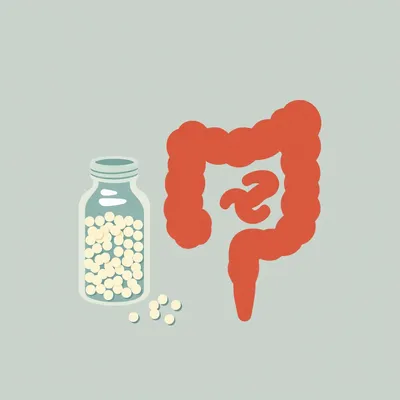
Daniel sent us this one — he had his gallbladder out seven years ago, and he's been dealing with the aftermath ever since. The core question is pretty specific. Without a gallbladder, you don't have that bile reservoir sitting there ready to dump into a meal. So when you eat something substantial, especially something fatty, there's just not enough bile on hand to handle it. You get bloating, urgency, the whole unpleasant parade. His workaround has been eating smaller meals, which helps, but he wants to know if there's something he can take on special occasions to supplement the bile pool. Ox bile comes up. He's asking whether it actually works and if there's a specific dosing pattern that makes sense.

This is one of those questions where the standard post-surgery advice completely fails people. You get told you'll be fine, go home, eat normally, and then six months later you're wondering why a hamburger ruins your evening.
The "you'll be fine" school of surgical aftercare.
And for a lot of people it's not fine. The physiology here is actually pretty straightforward once you look at it. A healthy gallbladder stores and concentrates bile between meals. When food hits the duodenum, the gallbladder contracts and dumps that concentrated bile in — about thirty to fifty milliliters at once, sometimes more for a large fatty meal. Without the gallbladder, the liver is still making bile, around six hundred to twelve hundred milliliters a day, but it's just dripping continuously into the small intestine. There's no reserve to call on.
You're trying to fight a house fire with a garden hose.
That's exactly the image. And the consequence is fat malabsorption. Undigested fats travel further down the intestine, draw in water through osmosis, and gut bacteria ferment them. That's where the bloating, the urgency, the discomfort come from. It's not mysterious — it's just physics.
Which brings us to the ox bile question. What actually is it?
Ox bile is literally what it sounds like — bile extracted from bovine gallbladders, processed, dried, and put into capsules. It's been used in traditional medicine for centuries, and it's the main ingredient in most bile acid replacement supplements. The active components are bile acids themselves — primarily cholic acid and deoxycholic acid. These are chemically identical to human bile acids. Your body doesn't distinguish between them.
It's not some herbal approximation. It's the actual substance.
It's the actual substance. Which is important because a lot of supplements for digestion are enzymes or herbs that work indirectly. Ox bile is the thing your gallbladder would have supplied. You're just supplying it from outside.
Does the body know what to do with it? I mean, timing matters. The gallbladder had a beautiful choreographed release system — hormones signaling, sphincters relaxing. You swallow a capsule and it's just...
That's the critical question and it's where the dosing pattern becomes everything. If you take ox bile on an empty stomach or well before a meal, it's largely going to pass through without doing much useful work. The bile needs to be present in the small intestine at the same time as the food, specifically the fatty components. Otherwise you're just supplementing your toilet.
Like hiring a translator who shows up after the meeting ends.
The consensus from clinical practice — and I should say this isn't FDA-regulated in the way a prescription drug would be, so the evidence base is more from clinical experience and smaller studies — is that you take ox bile with the meal or immediately after the first few bites. Some practitioners recommend splitting the dose. Half at the start of the meal, half midway through.
That makes intuitive sense. You're trying to mimic the sustained release you'd get from a functioning gallbladder.
And that's where the dosing itself gets interesting. Most ox bile supplements come in doses of one hundred twenty-five to five hundred milligrams per capsule. The typical starting recommendation is around one hundred twenty-five to two hundred fifty milligrams with a meal containing moderate fat. For a larger or fattier meal — Daniel's hamburger scenario — you might go up to five hundred milligrams, sometimes a thousand.
That's a wide range. How does someone figure out where they land?
Trial and error, unfortunately. The clinical guidance is to start low and titrate up. Too little and you'll still get the bloating and urgency because fats aren't being broken down. Too much and you can get the opposite problem — bile acid diarrhea, which is its own special category of unpleasant. The bile acids that aren't used for fat digestion end up in the colon, where they irritate the lining and draw in water. So you're looking for the Goldilocks zone.
The bitter irony of solving one digestive disaster by walking straight into another.
It really is. And this is why I always tell people that post-cholecystectomy supplementation isn't a set-it-and-forget-it situation. The dose that works for a salad with grilled chicken is not the dose that works for a ribeye with fries. You're calibrating to the fat load of the meal.
Which sounds exhausting, but I suppose it beats the alternative.
It beats the alternative significantly. And anecdotally, a lot of people find that once they've done the calibration for a few different meal types, it becomes second nature. They know their hamburger dose, their pizza dose, their holiday dinner dose.
Are we talking about something you'd use daily or just for those special occasions?
That depends on the individual. Some people without gallbladders do fine on a day-to-day basis and only need ox bile when they're eating outside their normal pattern. Others have ongoing fat malabsorption with every meal and benefit from regular supplementation. There's actually a study from 2018 out of the Polish Journal of Surgery that looked at this — they found that about forty percent of post-cholecystectomy patients had some degree of bile acid malabsorption even years after surgery, and many of them were never told it was a possibility.
Forty percent is not a small number.
It's not small at all. And that study tracked patients up to ten years post-surgery. So this isn't a transition problem that resolves. For a substantial minority, it's the new normal.
Let me ask you about the fat composition question. Daniel mentioned higher-fat foods specifically. Is it just total fat, or does the type of fat matter for how much bile you need?
Type of fat matters a lot, actually. Long-chain triglycerides require bile acids for emulsification and absorption. That's your saturated fats, your omega-threes and omega-sixes. Medium-chain triglycerides, which you find in coconut oil and palm kernel oil, can be absorbed directly through the intestinal wall without bile acid emulsification. They go straight into the portal vein rather than through the lymphatic system.
Coconut oil is basically a gallbladder-free cheat code.
To some extent, yes. There's a reason MCT oil is popular in the post-cholecystectomy community. It provides a fat source that doesn't demand bile. That said, most of the delicious fats in life are long-chain. Butter, meat fat, cheese. MCT oil is not making your hamburger taste better.
The "delicious fats in life" — that's going on a t-shirt.
I stand by it. But the practical takeaway is that if you know you're eating a meal heavy in long-chain fats, that's when bile supplementation becomes most relevant. If you're cooking with coconut oil and eating lean proteins, your bile demand is much lower.
What about other supplements? Ox bile is the headliner, but are there supporting actors worth knowing about?
Lipase is the obvious one. Lipase is the pancreatic enzyme that actually breaks down triglycerides into monoglycerides and free fatty acids. Bile emulsifies the fat — breaks it into smaller droplets — so lipase has more surface area to work on. They're a team. Some post-gallbladder supplement protocols combine ox bile with lipase, and there's decent logic to that. The bile does the emulsification, the lipase does the cleavage.
You're basically outsourcing two steps of the digestive assembly line.
And some people find that combination more effective than bile alone, especially if they've had other digestive issues. The prompt mentioned gastritis and bloating that predated the surgery. That's relevant because gastritis can reduce stomach acid production, and stomach acid is what triggers the release of cholecystokinin, which would normally stimulate what remains of the biliary system. So you've got a cascade where multiple steps are compromised.
The digestive system as a Rube Goldberg machine where someone removed a part and expects the whole thing to still work.
That's not even an exaggeration. The gallbladder is part of a coordinated system. Take it out and the system doesn't just route around the damage — it functions differently, and the downstream effects cascade.
What about timing with other medications or supplements? If someone's taking something else with meals, does ox bile interfere?
Ox bile can affect the absorption of fat-soluble vitamins — A, D, E, and K — which is actually a good thing if you're deficient in them, because you need bile to absorb them properly. Post-gallbladder patients sometimes run low on those vitamins for exactly that reason. But it also means ox bile could theoretically increase absorption of fat-soluble medications, which could be relevant for certain drugs. Nothing catastrophic, but something to be aware of. If you're on something like warfarin, which is fat-soluble, you'd want to be consistent with whether you're using bile supplements or not.
Pick a lane and stay in it.
Don't use ox bile only on weekends and surprise your medication absorption on Monday.
Let's talk about what's actually available. If someone goes looking for ox bile, what are they going to find?
It's widely available over the counter. The most common brands are Nutricology, Seeking Health, and Jarrow Formulas. Most come in doses of one hundred twenty-five to five hundred milligrams. Some are pure ox bile, some are combined with digestive enzymes. The price is generally reasonable — maybe fifteen to thirty dollars for a month's supply depending on the brand and dose. It's not a prescription item, which is both a blessing and a problem. The blessing is accessibility. The problem is that people are left to figure out dosing on their own with no medical guidance.
The classic supplement dilemma. Available enough to try, unguided enough to mess up.
This is where I get on my soapbox a little. Post-surgical follow-up for gallbladder removal is, in my view, inadequate across most healthcare systems. You get a fifteen-minute post-op appointment, someone checks your incisions, and you're discharged from surgical care. Nobody sits you down and says, here's how your digestion has changed, here are the signals to watch for, here are the tools available to you. Patients end up on Reddit threads and Facebook groups figuring out ox bile dosing from strangers.
Which is probably how Daniel ended up asking us.
And I'm glad he did, because the information gap is real.
Let's get concrete. Special occasion, hamburger and fries, higher fat than normal. What does the dosing pattern actually look like?
Here's the practical protocol that most functional medicine practitioners land on. With a meal like that, you'd take one capsule of ox bile — usually two hundred fifty to five hundred milligrams — within the first few bites of food. If the meal is particularly large or rich, you'd take a second capsule about halfway through. If you're also using lipase, that goes in at the same time. The key is that the bile needs to be in the small intestine when the food arrives. Taking it thirty minutes before the meal means it's already moved through. Taking it thirty minutes after means the food got there first and the fats are already causing trouble.
It's less like taking a daily vitamin and more like seasoning your food. In real time.
That's actually the perfect framing. You're seasoning the meal with bile. And just like seasoning, the amount depends on what you're eating and how much.
Are there downsides to doing this occasionally? If someone uses ox bile once a week for a nice dinner out, is the body going to downregulate its own bile production?
The evidence suggests no, and here's why. Bile production in the liver is regulated primarily by the enterohepatic circulation — bile acids are recycled, and the rate of new synthesis is driven by how much is lost in the stool. Supplemental bile acids don't suppress hepatic synthesis the way, say, supplemental thyroid hormone suppresses thyroid function. It's a different regulatory loop. So occasional use shouldn't create dependence.
That's reassuring. What about people who try this and it doesn't work? What else should be on the radar?
One is that not all post-cholecystectomy bloating is from fat malabsorption. Some of it is from altered motility. The gallbladder and the sphincter of Oddi are part of a coordinated motility pattern, and removing the gallbladder can disrupt that coordination. Food moves through at different rates. Gas accumulates differently. Ox bile won't fix a motility problem.
You might be treating the wrong thing.
You might be. Another possibility is that the bloating is coming from small intestinal bacterial overgrowth — SIBO — which is more common after gallbladder removal because the continuous drip of bile changes the antimicrobial environment of the small intestine. Bile acids are normally bacteriostatic. Alter the flow and you alter the microbial balance.
That's a whole different diagnostic rabbit hole.
And the third thing is that some people simply don't tolerate ox bile well. They might get nausea, they might get cramping. In those cases, the alternatives are things like TUDCA — tauroursodeoxycholic acid — which is a specific bile acid with a better tolerability profile for some people. It's more expensive and harder to find, but it's an option.
That sounds like a character from a space opera.
It does, but it's actually a naturally occurring bile acid that's been studied fairly extensively for liver conditions. It's gentler on the stomach and some people find it works when standard ox bile doesn't.
Let me circle back to something you mentioned earlier. The enterohepatic circulation. Walk me through that, because it seems relevant to why the gallbladder matters in the first place.
Bile acids are precious. The body doesn't want to waste them. After bile is released into the small intestine and does its work emulsifying fats, about ninety-five percent of those bile acids are reabsorbed in the terminal ileum — the last section of the small intestine. They travel back to the liver through the portal vein, the liver extracts them, and re-secretes them into bile. Each bile acid molecule makes this loop multiple times a day. The gallbladder is the reservoir that sits on the side of this loop, storing the bile between meals so it can be released in a bolus when needed.
When the gallbladder is removed, the loop still works, but the reservoir is gone. The bile just trickles.
The liver is still making bile, the ileum is still reabsorbing it, but there's no storage tank. It's like having a water system with no water tower. The pumps are running, but when demand spikes, there's no reserve pressure.
Which is why a big meal overwhelms the system. You need a surge of bile, and there's no surge capacity.
That's the whole story. And that's why supplementing with ox bile at mealtime makes physiological sense. You're providing the surge capacity from outside.
Does the body eventually adapt? I've heard people say that over time, the bile duct dilates and starts acting as a pseudo-gallbladder.
This is a widely repeated claim that has some basis in fact but is often overstated. Yes, the common bile duct can dilate after cholecystectomy. Studies show an average increase of about one to two millimeters in diameter. And yes, in some patients, the dilated duct can store a small amount of bile — maybe five to ten milliliters, compared to the gallbladder's thirty to fifty. But it's not a true functional replacement. The duct doesn't have the muscular wall of the gallbladder. It doesn't contract on demand. The storage capacity is minimal.
It's less "your body grows a new gallbladder" and more "your bile duct gets slightly stretchier.
That's the realistic version. Some people do notice improvement over time, and the duct dilation may contribute to that. But it's not a full adaptation, and the forty percent of patients still experiencing malabsorption years later suggests that for many people, it never fully resolves.
What about diet composition? Beyond just reducing portion sizes, are there ways to structure a meal so it's less demanding on the bile system?
Soluble fiber helps. It binds to bile acids and slows gastric emptying, which gives the continuous bile drip more time to work on the food. Foods like oats, barley, apples, carrots — these can make a noticeable difference when included in a fatty meal. There's also some evidence that bitter greens — arugula, dandelion greens, radicchio — stimulate bile flow from the liver. They're not a replacement for the gallbladder's storage function, but they can increase the volume of bile being produced during the meal.
A hamburger with a side salad isn't just virtue signaling. It's actually mechanically helpful.
It's mechanically helpful. The bitters stimulate bile production, the fiber slows things down and gives digestion more time. It's not going to solve the problem entirely, but it shifts the odds in your favor.
The bitter greens thing — that feels like something I should have known as a leaf medicine practitioner.
Corn, your leaf medicine practice is based on a sloth tradition that you have consistently refused to document or verify.
The verification is in the centuries of ancestral wisdom.
You were born in Mongolia. Sloths are not from Mongolia.
That's the official story.
That's the only story. There is no alternative narrative.
There are many narratives, Herman. The leaves speak differently to those who listen.
I'm going to move us back to actual medicine before we lose the audience entirely. Another thing worth mentioning is that some people find benefit from artichoke leaf extract. There's a small body of evidence suggesting it stimulates bile production and protects the liver. It's not a replacement for ox bile, but it can be complementary.
The toolkit is ox bile for direct replacement, lipase for enzymatic support, fiber and bitter greens for mechanical assistance, and maybe artichoke extract if you want to get fancy.
That's a fair summary. And the order of operations matters. If someone's just starting to experiment, I'd recommend trying ox bile alone first. One variable at a time. If that helps but not completely, add lipase. If there's still an issue, look at meal composition and fiber intake. You want to know what's actually doing the work.
The scientific method applied to your own digestive tract.
It's not glamorous, but it's effective.
What about the urgency symptom specifically? Daniel mentioned urgency alongside bloating. What's the mechanism there?
That's the gastrocolic reflex getting triggered aggressively. When undigested fats hit the colon, they're an irritant. The colon's response to irritation is to speed up motility — it wants to get the irritant out. So you get rapid transit, reduced water absorption, and the urgent need to find a bathroom. Bile acids themselves are also potent stimulants of colonic motility. If you've got unabsorbed bile acids and undigested fats arriving together, you've got a double hit.
The ox bile, by helping you digest the fats properly, should reduce both the fat irritation and the bile acid irritation, because the bile acids get used up doing their job.
That's the theory, and it matches what people report. Properly emulsified and digested fats don't reach the colon. The bile acids get reabsorbed in the ileum. The system works as designed, just with the bile arriving from a capsule instead of a gallbladder.
It's elegant, in a way. You're restoring the normal sequence of events. The bile and the fat meet each other at the right time and place, and everyone goes home happy.
Everyone except the toilet.
The toilet has had a rough run.
And I think that's something people don't talk about enough. The social and psychological impact of unpredictable digestion. You go out to dinner with friends and you're doing mental math about what you can order, how much you can eat, where the nearest bathroom is. It's exhausting.
It shrinks your world.
And the promise of something like ox bile isn't just about physical comfort. It's about being able to accept a dinner invitation without running a risk assessment first.
For Daniel's scenario — he wants to occasionally go to a restaurant and eat like a normal person — the ox bile approach makes sense. He's not looking for a daily crutch. He's looking for a special occasion solution.
And the dosing pattern for that is straightforward. Start with a low-to-moderate dose with the first few bites. Two hundred fifty milligrams is a reasonable starting point. If the meal is large or particularly rich, take a second dose midway through. Adjust upward or downward based on results. The goal is no bloating, no urgency, and formed stools the next day. That's your endpoint.
The glamorous metric of digestive success.
You laugh, but it's one of the most reliable indicators of fat absorption. Steatorrhea — fatty, floating, foul-smelling stools — is the classic sign that fats aren't being digested. If ox bile eliminates that, you know it's working.
If it doesn't eliminate it?
Then you look at other factors. Is the dose high enough? Is there a concurrent issue like SIBO or pancreatic insufficiency? Is the problem not actually fat malabsorption but something else? This is where working with a gastroenterologist or a functional medicine practitioner becomes valuable. The self-experimentation can take you far, but it has limits.
Limits being a good word for when you're six months into tweaking your supplement stack and still miserable.
There's a point where professional help is the right call.
Let's talk about the broader context for a moment. Gallbladder removal is one of the most common surgeries performed. Hundreds of thousands of these procedures happen every year in the United States alone. And yet the follow-up care seems, from what you're describing, almost nonexistent.
It's a real gap. The surgery itself is routine — laparoscopic cholecystectomy takes about an hour, you go home the same day or the next morning. The surgical outcome is excellent. But the functional outcome is highly variable, and we don't do a good job of tracking or managing that variability. Part of the problem is that surgeons do surgery. Their job is to remove the gallbladder safely, and they do that well. The digestive aftermath falls into a gap between surgery and gastroenterology, and patients often aren't referred unless they complain loudly.
The burden is on the patient to advocate for themselves.
Which is true of a lot of chronic conditions, but it's especially stark here because the surgery is presented as definitive. "You have gallstones, we'll take out the gallbladder, problem solved." Nobody mentions that for forty percent of patients, a new set of problems begins.
Those problems are less dramatic than a gallbladder attack, so they get dismissed.
Bloating and urgency don't send you to the emergency room. They just make your life worse in a low-grade, persistent way. And patients learn to live with it because they think it's normal or because nobody told them there were options.
I want to go back to something you said earlier about ox bile not being FDA-regulated as a drug. What does that mean for quality control?
It means the usual supplement caveats apply. You're trusting the manufacturer to deliver what's on the label. Third-party testing is valuable. Look for brands that use independent labs to verify purity and potency. Nutricology and Seeking Health both do this. The other thing is that ox bile sourcing matters. It comes from animals, so you want suppliers that test for contaminants and use BSE-free sources. Bovine spongiform encephalopathy. That's not a major concern with bile extracts specifically, but it's part of the broader quality picture.
You're not just buying a supplement. You're buying a supply chain.
And that's true of any animal-derived supplement. The manufacturing standards matter.
What about vegetarian or vegan alternatives? Is there a synthetic bile acid option?
There are prescription bile acid medications — ursodeoxycholic acid, which is UDCA or Ursodiol, and the TUDCA I mentioned earlier, which is the taurine-conjugated form. These are synthesized and don't come from animals. But they're prescription drugs, not over-the-counter supplements, and they're primarily approved for liver conditions, not for post-cholecystectomy digestion. Getting them prescribed for this purpose would require a gastroenterologist who's willing to go off-label.
Practically speaking, for someone without a prescription, ox bile is the accessible option.
It's the accessible option, and for most people it works well enough that the prescription alternatives aren't necessary.
Let me ask you something from a different angle. Daniel mentioned he's been dealing with this for seven years. Is there a point where the body just settles into its new normal and further adaptation stops happening?
Most of the adaptation that's going to happen happens within the first year. The bile duct dilation I mentioned, changes in the enterohepatic circulation, adjustments in the gut microbiome — those processes play out over months, not years. By year seven, what you're experiencing is likely the steady state. If bloating after fatty meals is still a problem at that point, it's not going to spontaneously resolve. Intervention is the right call.
There's no point waiting longer to see if things improve.
At seven years, no. The window for spontaneous adaptation closed a long time ago.
That's actually useful to hear, I think. It takes the pressure off. You're not failing at recovery. This is just the hand you were dealt, and now you're looking for the right way to play it.
That's exactly the right framing. Post-surgical digestive changes are not a personal failure. They're a physiological reality. The question isn't "why am I still not better" — it's "what tools can I use to work with the system I now have.
One of those tools is a capsule of bovine bile taken at the right moment.
Which is a sentence that would horrify our ancestors and delight a very specific kind of biochemist.
The Venn diagram of horrified ancestors and delighted biochemists is this podcast's target demographic.
I think you just described our entire listener base.
To pull this together for the practical question — ox bile, two hundred fifty to five hundred milligrams, with the first few bites of a fatty meal, possibly a second dose midway through if it's a large meal. Start low, titrate up, watch for the Goldilocks zone between malabsorption and bile acid diarrhea. Combine with lipase if needed. Add fiber and bitter greens to the meal for mechanical support. And if none of that works, consider SIBO or motility issues as alternative explanations.
That's the protocol. And I'd add — keep a simple food and symptom journal for the first few weeks of experimenting. Nothing elaborate, just what you ate, what supplement dose you took, and how you felt afterward. Patterns emerge quickly when you write them down.
The least exciting diary in human history, and possibly the most useful.
Useful is underrated.
One more thing. Is there any risk with long-term ox bile use? If someone ends up using it regularly rather than just for special occasions?
The main theoretical concern would be suppression of the body's own bile acid synthesis, but as I mentioned, the enterohepatic regulatory loop doesn't work that way. Bile acid synthesis is primarily regulated by the farnesoid X receptor, which responds to bile acid levels in the liver, not in the intestine. Supplemental bile acids that are taken orally and used for digestion get reabsorbed and join the normal pool. They don't send a suppression signal. There's no evidence that long-term ox bile use causes the liver to stop making its own bile.
It's not like taking testosterone and shutting down your own production.
Different regulatory system entirely. That said, very high doses over a long period could theoretically increase the risk of bile acid diarrhea or colonic irritation. But at therapeutic doses for meal supplementation, the safety profile looks good.
I feel like we should address the elephant in the room, which is that the supplement industry is full of products that don't work for things that aren't real problems. Ox bile, in this specific context, is neither of those things. It's a physiologically logical intervention for a well-understood anatomical change.
That's what makes this different from a lot of digestive supplements. The mechanism is clear. The gallbladder stored bile. It's gone. Ox bile provides bile. The chain of reasoning is short and each link is solid. This isn't "support your body's natural detoxification pathways" — it's "here is the substance your body used to have and now doesn't.
The supplement industry's rare moment of intellectual honesty.
The supplement industry will still sell you ox bile for seventeen different things it probably doesn't help with. But for this specific use case, the logic holds up.
Which is all we can ask for, really.
In this world, yes.
If Daniel's listening — and I assume he is, since he sent the prompt — the answer is yes, ox bile is worth trying, the dosing pattern matters more than the dose itself, and you're not crazy for thinking a hamburger shouldn't ruin your evening.
You're not crazy, and you're not alone. That's probably the most important thing to communicate here. A lot of people are dealing with this, and most of them are dealing with it silently.
The silent fellowship of the gallbladder-free.
They should make a pin.
A tiny gallbladder with a line through it.
I'd wear it.
And now: Hilbert's daily fun fact.
Hilbert: In the 1880s, British explorers surveying Lake Tanganyika observed that the lake's surface was so perfectly flat and reflective under certain conditions that they could measure the curvature of the Earth by sighting across it — and their measurements differed from the modern satellite-derived figure by less than one-half of one percent.
That's genuinely impressive.
It really is. Nineteenth-century optics and a very still lake.
Here's the forward-looking thought I'd leave people with. We're getting better at understanding the downstream consequences of surgeries we've been performing for decades, but the knowledge isn't reaching patients in a systematic way. If you've had your gallbladder out and nobody told you about bile supplementation, that's not a you problem. That's a system problem. And the fix, for now, is sharing information directly. Which is what this whole show is about.
That's the note. Thanks to our producer Hilbert Flumingtop. This has been My Weird Prompts. Find us at myweirdprompts.com, and if you've got a prompt of your own, send it in. We'll be here.
We'll be here.